
Affiliate Agreement Template [Free Fillable & Printable PDF]
Affiliate Agreement problems in England usually surface when a business starts questioning where a lead came from, whether a commission payment is actually due, or whether an affiliate’s marketing activity crossed a line it was never supposed to cross. An Affiliate Agreement is commonly used by online retailers, software companies, influencers, publishers, and marketing partners to define referral rules, commission triggers, payment schedules, and promotional restrictions, particularly where advertising and personal data obligations under the UK GDPR and the Privacy and Electronic Communications Regulations (PECR) may come into play.
A recurring issue seen in County Court disputes is the use of vague tracking and attribution clauses that fail to explain who earns commission when multiple referral sources are involved, leaving businesses and affiliates arguing over sales records months later. The difficulty is rarely the referral itself; it is proving entitlement once the money is on the table and the agreement lacks precise wording. The template and drafting guidance that follow focus on the provisions most likely to determine whether an affiliate commission claim stands up when challenged.
Table of Contents
ToggleAffiliate Agreement Template (PDF, Word & Printable Formats)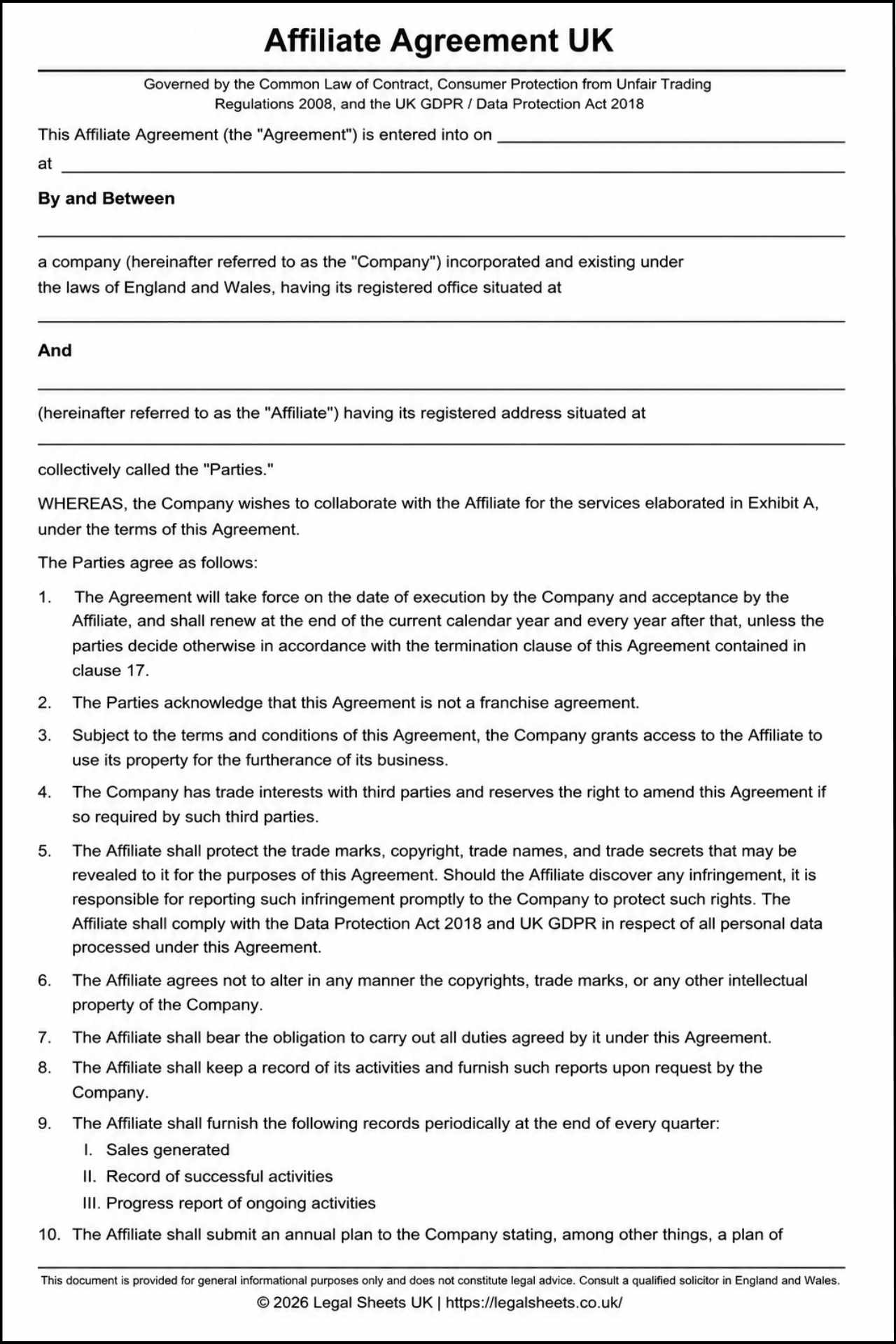
Defining the Commercial Relationship Correctly
Why Affiliates Must Remain Referrers Rather Than Sales Agents
One of the most significant drafting issues involves maintaining the affiliate’s role as a referrer.
Keeping the affiliate in a promotional role:
- Preserves the intended commercial structure.
- Limits exposure to statutory agency claims.
- Reduces post-termination compensation risks.
Many businesses mistakenly assume that calling someone an affiliate determines their legal status or independent contractor status.
Activities That May Transform an Affiliate Into a Commercial Agent
The risk increases where affiliates are permitted to:
- Negotiate prices with customers.
- Accept orders on behalf of the merchant.
- Commit the merchant to transactions.
Under the Commercial Agents (Council Directive) Regulations 1993, affiliates who effectively negotiate sales may acquire statutory protections that cannot easily be excluded by contract.
Protecting Against Commercial Agency Risk
Many merchants include clauses that:
- Prohibit price negotiations.
- Restrict authority to referrals only.
- Prevent affiliates from accepting orders.
- Clarify that no agency relationship exists.
These provisions become particularly valuable when a terminated affiliate later claims compensation rights.
Structuring Commission and Attribution Terms
Choosing the Right Commission Model
Different programmes use different payment structures.
Common models include:
- Pay-per-sale.
- Pay-per-lead.
- Pay-per-click.
- Hybrid commission arrangements.
The chosen model should define precisely when commission becomes payable and what constitutes a qualifying referral.
Tracking Windows and Attribution Rules
Many affiliate disputes involve attribution rather than payment rates.
Important issues include:
- Cookie duration periods.
- First-click attribution.
- Last-click attribution.
- Multi-channel attribution models.
If attribution rules are unclear, affiliates may argue they generated a sale while merchants rely on alternative tracking records showing a different source.
Preventing Commission Disputes
Commission provisions should address:
- Qualifying transactions.
- Cancelled orders.
- Refunds and chargebacks.
- Tracking errors.
- Missing referral data.
The most effective agreements anticipate failures before they occur rather than attempting to resolve them after commission claims arise.
When Commission Deductions May Become Unenforceable
Merchants sometimes attempt to deter breaches by withholding all unpaid commission.
Problems arise where clauses:
- Forfeit all historic commissions.
- Impose disproportionate deductions.
- Apply severe financial consequences to minor breaches.
Under English common law principles relating to penalty clauses, courts may refuse to enforce disproportionate financial punishments. This can result in withheld commissions becoming payable despite the affiliate’s breach.
Advertising Compliance Clauses That Cannot Be Ignored
Mandatory Affiliate Disclosure Requirements
Affiliate marketing is advertising.
The agreement should require affiliates to clearly identify promotional content before users interact with affiliate links.
Typical disclosure practices include:
- “Ad” labels.
- “Affiliate Link” disclosures.
- Clear social media advertising identifiers.
Under consumer protection requirements and the CAP Code, commercial intent must be apparent before a consumer clicks a promotional link.
Hidden Advertising Risks for Merchants
Businesses often assume liability rests solely with the affiliate.
In practice, merchants frequently face scrutiny where affiliates publish undisclosed promotional content.
Relevant requirements can be found within the Digital Markets, Competition and Consumers Act 2024 framework and consumer protection rules. Public enforcement action can create significant reputational damage even where direct financial penalties are not imposed.
Social Media Promotion Rules
Social media campaigns require particular attention.
Agreements commonly require:
- Clear advertising labels.
- Consistent disclosure practices.
- Compliance with platform requirements.
- Transparent promotional content.
Many ASA investigations originate from influencer marketing campaigns where disclosures were difficult for consumers to identify during consultancy campaigns.
Cookie Tracking and Privacy Compliance
When Affiliate Tracking Triggers PECR Obligations
Affiliate marketing frequently relies on:
- Tracking cookies.
- Pixels.
- Behavioural monitoring tools.
- Device recognition technologies.
These technologies often fall within the scope of PECR where they are used for tracking and attribution purposes.
Consent Requirements Before Tracking Begins
The agreement should clearly allocate responsibility for obtaining consent.
Allocating Responsibility for Tracking Compliance
Effective agreements usually identify:
- Merchant obligations.
- Affiliate obligations.
- Shared compliance responsibilities.
- Reporting requirements.
Without clear allocation, both parties may blame each other when a privacy complaint arises.
Data Sharing and Lead Generation Clauses
When Personal Data Flows Between Parties
Data protection issues commonly arise where affiliates collect:
- Lead forms.
- Customer enquiries.
- Registration information.
- Referral submissions.
Once personal data is transferred between parties, compliance responsibilities become more complex.
Determining Data Protection Responsibilities
The agreement should address:
- Lawful processing grounds.
- Data-sharing arrangements.
- Record-keeping obligations.
- Processing responsibilities.
Managing Data Protection Risk
Practical provisions often cover:
- Security measures.
- Breach notification procedures.
- Retention periods.
- Deletion obligations.
Data protection disputes can become expensive because they frequently involve both contractual liability and regulatory investigation.
Brand Protection and Marketing Restrictions
Trademark Usage Controls
Affiliate programmes frequently permit limited use of:
- Logos.
- Trade marks.
- Marketing materials.
- Brand assets.
The agreement should specify exactly what use is authorised and what use is prohibited.
PPC Brand Bidding Restrictions
One recurring dispute involves affiliates purchasing advertisements using the merchant’s own branded keywords.
Restrictions often cover:
- Trade mark bidding.
- Keyword targeting.
- Search advertising practices.
- Competitor interception tactics.
Without explicit prohibitions, withholding commission for such conduct can become difficult.
Content and Promotional Standards
Content controls commonly require:
- Accurate statements.
- Lawful advertising.
- Prohibited claims restrictions.
- Consumer protection compliance.
These standards reduce the risk of affiliates generating traffic through misleading promotions.
Preventing Spam and Unlawful Marketing
Restrictions on Email Marketing Activities
The agreement should prohibit unlawful marketing practices.
Typical provisions address:
- Consent requirements.
- Unsolicited communications.
- Approved marketing methods.
- Prohibited traffic sources.
Many enforcement actions originate from aggressive lead-generation campaigns rather than traditional affiliate websites.
SMS and Automated Messaging Risks
Affiliates using automated marketing channels can expose merchants to regulatory attention.
Issues frequently involve:
- Automated texts.
- Bulk messaging systems.
- Consent failures.
- Opt-in deficiencies.
PECR compliance should be addressed expressly within the contract.
Consequences of Non-Compliant Marketing
Potential consequences include:
- Regulatory investigations.
- Financial penalties.
- Programme suspension.
- Immediate termination rights.
Merchants are often treated as the instigators of unlawful marketing conducted by affiliates promoting their products.
Managing Programme Changes and Operational Updates
Updating Commission Structures
Businesses often need flexibility to amend: Commission rates for distribution partners.
- Bonus structures.
- Payment thresholds.
The agreement should explain notice periods, implementation procedures, and acceptance mechanisms.
Modifying Tracking Systems
Tracking systems regularly change due to: Software migrations by service providers.
- Attribution updates.
- Platform upgrades.
Many commission disputes arise because affiliates were not adequately informed about these changes.
Why Change-Control Clauses Matter
Well-drafted change procedures:
- Reduce attribution disputes.
- Create evidential certainty.
- Improve operational consistency.
Where disputes reach court, documented notification processes often become critical evidence.
Suspension, Removal and Termination Rights
Circumstances Justifying Immediate Suspension
Immediate suspension rights commonly apply where there is: Fraudulent activity or trademark misuse.
- Spam complaints.
- Brand misuse.
- Regulatory breaches.
Waiting until full termination can expose merchants to continuing compliance risks.
Grounds for Termination
Common termination triggers include:
- Material breach.
- Reputational concerns.
- Compliance failures.
- Closure of the affiliate programme.
The agreement should clearly identify which breaches justify immediate termination.
Obligations Following Termination
Post-termination provisions often require: Removal of affiliate links after written resignation.
- Cessation of promotions.
- Return of brand materials.
- Final commission reconciliation.
Many disputes arise because affiliates continue using promotional materials after termination.
Notices, Electronic Acceptance and Record Keeping
Valid Methods of Contract Formation
Affiliate programmes rarely rely on physical signatures.
Common acceptance methods include: Click-wrap agreements for remote workers.
- Electronic acceptance.
- Online onboarding systems.
Under common law principles, electronic acceptance can create a legally binding contract where acceptance mechanisms are properly implemented.
Service of Notices
Many programmes permit service through:
- Email.
- Affiliate dashboards.
- Portal notifications.
- Registered account details.
English courts generally recognise such methods where they are clearly authorised by the agreement.
Records That Should Be Retained
Useful records include:
- Acceptance logs.
- Tracking reports.
- Commission statements.
- Compliance records.
- Disclosure evidence.
These records frequently determine the outcome of commission and compliance disputes.
UK Legal Facts and Compliance Framework
Legal Requirements Table
| Topic / Issue | England Legal Rule | Governing Law |
|---|---|---|
| Execution Formalities | Electronic acceptance and click-wrap agreements are generally binding | Common Law |
| Advertising Disclosures | Commercial intent must be clearly disclosed | DMCCA 2024 / CPRs 2008 / ASA CAP Code |
| Tracking Cookies | Prior consent required for non-essential tracking | PECR 2003 |
| Spam Marketing | Opt-in consent generally required | PECR 2003 |
| Data Processing | Lawful basis required for data sharing | UK GDPR / Data Protection Act 2018 |
| Commercial Agency Risk | Negotiation authority may trigger statutory rights | Commercial Agents Regulations 1993 |
Practical Legal Impact
These requirements influence how affiliate programmes operate day-to-day rather than simply how contracts are drafted.
Non-compliant disclosures may attract attention from the ASA. Unlawful cookie deployment can result in ICO scrutiny. Poor commission provisions can trigger County Court disputes, while allowing affiliates to negotiate sales may unexpectedly create statutory commercial agency rights. Data-sharing failures can create contractual and regulatory exposure simultaneously.
Common Drafting Mistakes That Lead to Disputes
Vague Attribution Rules
Common consequences include:
- Unclear commission entitlement.
- Tracking conflicts.
- Lost referral claims.
Weak Compliance Clauses
Common failures include:
- Hidden advertising breaches.
- Cookie consent deficiencies.
- Data-sharing uncertainty.
Inadequate Brand Controls
Frequent problems involve:
- Trade mark misuse.
- PPC bidding disputes.
- Reputational damage.
Poor Termination Provisions
Recurring disputes concern:
- Outstanding commissions.
- Continued promotion after termination.
- Enforcement difficulties following programme closure.
Frequently Asked Questions
Can an affiliate continue earning commission after the agreement has ended?
It depends on the wording of the attribution and post-termination provisions. Well-drafted agreements specify whether commission remains payable for transactions generated before termination but completed afterwards.
What happens if an affiliate fails to disclose that a link is an advertisement?
Both the affiliate and the merchant may face regulatory scrutiny. Hidden advertising can lead to enforcement action, reputational damage, and public findings by regulators or the ASA.
Can a merchant withhold all unpaid commissions for a minor breach?
Not necessarily. Under English common law principles relating to penalties, disproportionate forfeiture provisions may be unenforceable. A court may require earned commissions to be paid despite the breach.
Who is responsible for obtaining consent for affiliate tracking cookies?
Responsibility depends on the programme structure. The agreement should clearly allocate PECR compliance obligations between the merchant and affiliate to reduce uncertainty if complaints arise.
Why should an affiliate agreement prohibit price negotiations with customers?
Allowing negotiation authority may transform the arrangement into a commercial agency relationship under the Commercial Agents Regulations 1993, potentially creating statutory rights that are difficult to exclude by contract.
Author
-

Ankur is the founder and editorial reviewer at LegalSheets. He researches, writes, and reviews legal content, ensuring every template and guide is clear, accurate, and based on current UK laws and official government guidance. His focus is on making legal documents easier for individuals and businesses to understand and use.
