
Sales Agreement Template UK – Free Word and PDF Format
A Sales Agreement is often sought when a transaction has moved beyond informal discussions and the parties need a written record of exactly what is being bought and sold. In England, disputes regularly reach the County Court because key points such as delivery obligations, ownership of the goods, or payment deadlines were never properly recorded, leaving the court to piece together the arrangement from invoices and correspondence.
The Sale of Goods Act 1979 continues to influence many commercial sales, while consumer transactions may also engage the Consumer Rights Act 2015, making accurate wording particularly important. Problems commonly emerge when goods arrive damaged, payment is withheld, or one side claims the agreed specification was different from what was supplied. The template and accompanying guidance that follow are designed to help record the transaction clearly and reflect the practical realities of buying and selling goods in England.
Table of Contents
ToggleSales Agreement Template (PDF, Word & Printable Formats)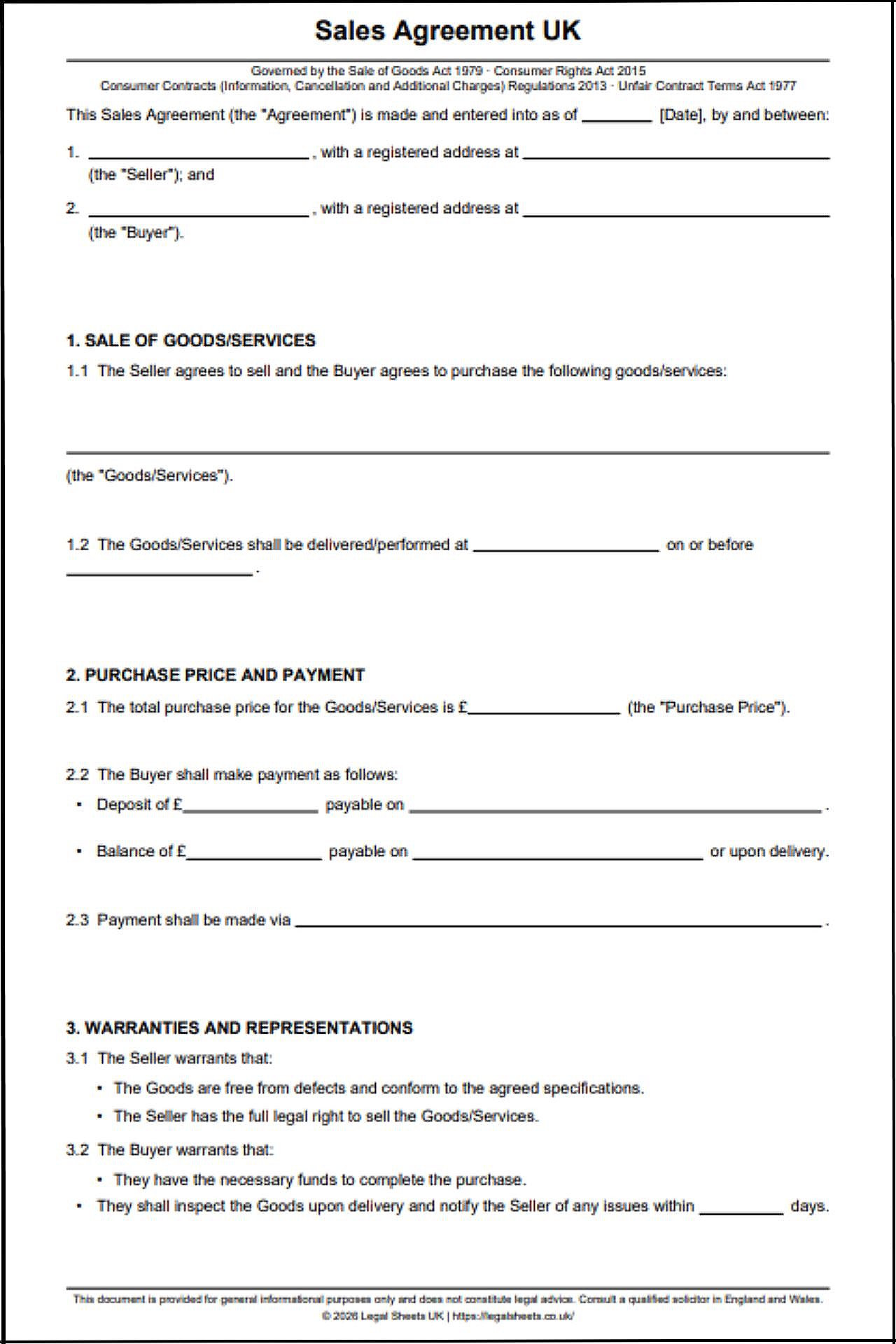
Situations Where a Standard Template May Not Be Enough
International Sales
Cross-border transactions often require additional contractual protections and jurisdiction clauses.
Complex Supply Chains
Multiple suppliers and delivery stages can create risks that standard templates may not address adequately.
Retention of Title Structures
Advanced ownership protection clauses frequently require bespoke drafting.
High-Value Commercial Transactions
Large transactions often justify negotiated liability and risk-allocation provisions during business acquisitions.
Before Using a Sales Agreement: The Commercial Risks Most Businesses Miss
Many disputes arise because parties focus on price and overlook the terms that control payment, delivery, ownership, and liability. A sales agreement becomes particularly valuable when goods are supplied on credit, delivered in stages, or manufactured to specific requirements.
Why Purchase Orders and Invoices Often Fail to Protect Either Party
Missing Contractual Terms
Purchase orders and invoices usually record basic transaction details but rarely address warranties, liability limits, ownership rights, or dispute procedures.
Unclear Delivery Obligations
Disputes often occur when the parties have different expectations regarding delivery dates, collection arrangements, or responsibility for transport costs.
Pricing Disputes
Additional charges, taxes, and delivery fees can create disagreements if the pricing structure is not clearly documented.
Warranty Disagreements
Buyers and sellers frequently have different expectations regarding defect reporting, replacements, and product performance standards.
The Cost of Leaving Key Terms Unwritten
Payment Disputes
Unclear payment deadlines can lead to delayed payments and costly debt recovery proceedings.
Delivery Disputes
Without detailed delivery terms, disputes may arise regarding late deliveries, damaged goods, or failed collections.
Product Quality Claims
Poorly defined specifications often result in disagreements over whether the goods meet the agreed standard.
Unclear Ownership Rights
Ownership issues become particularly serious when a buyer experiences financial difficulties before payment is completed.
When a Bill of Sale, Sales Contract, and Purchase Agreement Serve Different Purposes
Evidencing a Completed Transfer
A bill of sale is commonly used to record that ownership has already transferred.
Creating Future Obligations
A sales contract is generally used where delivery, payment, or other obligations will be performed later.
Recording Staged Transactions
Some transactions involve phased deliveries or milestone payments that require additional contractual detail.
Managing Ongoing Performance Obligations
Long-term supply arrangements may include continuing obligations relating to warranties, replacements, or support services.
Choosing the Correct Agreement Structure
One-Off Product Sale
Suitable for single transactions where the goods, price, and delivery arrangements can be clearly identified.
Recurring Supply Arrangement
Useful for ongoing commercial relationships involving repeat orders and long-term supply commitments.
Custom-Manufactured Goods
Custom products often require detailed specifications because disputes commonly arise regarding design requirements, acceptance standards, and consultant specifications.
Bulk Commercial Purchases
Large-volume orders typically benefit from inspection procedures, acceptance periods, and staged delivery provisions.
Consumer Sales Completed Online or by Telephone
Distance sales and subscription models demand rigorous pre-contract disclosures. Following the full implementation of the Digital Markets, Competition and Consumers Act 2024 (DMCCA), failing to supply mandatory cancellation notices or ‘easy exit’ mechanisms not only extends the consumer’s cancellation window by up to 12 months and 14 days, but now exposes businesses to direct, heavy financial penalties from the Competition and Markets Authority (CMA)
The Clauses That Usually Decide Whether a Sales Agreement Holds Up in Court
When a dispute reaches court, the outcome often depends on a handful of key clauses rather than the agreement as a whole. These provisions should be drafted carefully from the outset.
Product Description and Specification Clauses
Clear Product Descriptions
Goods should be described accurately and consistently. Under the Sale of Goods Act 1979 and Consumer Rights Act 2015, disputes frequently arise when products do not match their description.
Pricing, VAT, and Payment Terms
Purchase Price
The agreement should clearly state the agreed purchase price and whether VAT applies.
Payment Deadlines
Unclear payment dates are a common cause of debt recovery claims. Payment triggers should be easy to identify.
Additional Charges
Delivery costs, storage fees, and other charges should be disclosed in advance to avoid disputes.
Delivery and Collection Obligations
Delivery Responsibilities
The agreement should identify who is responsible for arranging transport and bearing delivery costs.
Proof of Delivery
Businesses frequently lose payment disputes because they cannot properly prove delivery occurred. Signed delivery records are often valuable evidence.
Passing of Risk vs Passing of Ownership
Risk Transfer
The agreement should state when responsibility for loss or damage transfers from seller to buyer.
Ownership Transfer
Ownership may pass at a different time from risk, particularly where goods are supplied on credit terms.
Inspection and Acceptance Procedures
Inspection Periods
Commercial buyers often require time to inspect goods after delivery.
Defect Reporting
The contract should explain how and when defects must be reported.
Warranty and Defect Reporting Provisions
Warranty Coverage
The agreement should specify what defects are covered and for how long.
Claims Procedure
Clear reporting procedures can reduce disagreements regarding responsibility for defective goods.
Returns, Replacements, and Refund Mechanisms
Return Procedures
The contract should explain how goods are returned and who bears transport costs.
Replacement and Refund Rights
Clear remedy provisions can prevent disputes from escalating unnecessarily.
Retention of Title Clauses: Protecting Goods After Delivery
Retention of title provisions are commonly used where goods are supplied before payment is received.
When Ownership Should Remain With the Seller
Credit Sales
Sellers often retain ownership until full payment has been made.
Insolvency Protection
Retention provisions can provide additional protection if the buyer encounters financial difficulties.
Common Retention of Title Drafting Failures
Missing Recovery Rights
A clause that does not address recovery of goods may provide limited practical protection.
Mixed or Processed Goods
Problems often arise when goods are incorporated into other products or mixed with other inventory.
Insolvency Risks and Recovery Problems
Buyer Insolvency
A seller may struggle to recover goods if ownership provisions are poorly drafted.
Unsecured Creditor Risk
Where retention provisions fail, the seller may rank alongside unsecured creditors.
Why Simple Retention Clauses Often Fail in Practice
Inadequate Drafting
Many clauses appear effective but fail when tested after insolvency.
Operational Reality
Recovery rights, identification of goods, and access provisions often determine whether the clause works in practice.
B2B Transactions: Managing Commercial Liability Without Creating Unenforceable Terms
Commercial parties often attempt to reduce risk through contractual wording. However, liability clauses that appear strong on paper may fail if they do not comply with legal requirements.
Sale of Goods Act Protections
Description of Goods
In B2B transactions, goods must correspond with their description. Disputes often arise where marketing materials and contractual descriptions do not match.
Quality and Fitness for Purpose
The Sale of Goods Act 1979 implies terms relating to satisfactory quality and fitness for purpose unless lawfully excluded.
Limitation of Liability Clauses
Financial Liability Caps
Businesses commonly seek to cap their financial exposure. The cap should be realistic and proportionate to the transaction.
Excluded Losses
Contracts often attempt to exclude certain categories of loss, particularly in commercial transactions.
UCTA Reasonableness Test
Unreasonable Restrictions
Under Section 6(1A) of the Unfair Contract Terms Act 1977 (UCTA), standard B2B terms attempting to exclude liability for statutory implied terms—such as satisfactory quality or matching a description—are entirely void unless the seller can prove the clause satisfies the statutory ‘reasonableness’ test. Judges rigorously assess this based on the parties’ relative bargaining power and whether the buyer had alternative commercial options
Commercial Consequences
If a limitation clause fails, the seller may face significantly greater liability than originally anticipated.
Clauses That Courts Commonly Strike Out
Blanket Exclusions
Attempts to exclude all responsibility for defective goods often face enforcement difficulties.
Artificially Low Liability Caps
Courts may reject liability caps that bear little relationship to the value or risk of the transaction.
Consumer Sales: Rights That Cannot Be Contracted Away
Consumer transactions operate under stricter statutory protections than commercial sales.
Consumer Rights Act Protections
Satisfactory Quality
Goods supplied to consumers must be of satisfactory quality.
Fitness for Purpose
Products must be capable of performing the purpose for which they were purchased.
Matching the Description
Goods must correspond with the description provided to the consumer. These rights cannot generally be excluded.
Repair, Replacement, and Refund Rights
Repair Options
Many disputes can be resolved through repair where appropriate.
Replacement Goods
Replacement products may be required when defects cannot be remedied effectively.
Refund Rights
Refund obligations may arise where statutory remedies apply.
Why “Sold as Seen” and “No Refunds” Clauses Can Be Void
Invalid Consumer Terms
Terms attempting to remove statutory consumer rights may be legally ineffective.
Compliance Risks
Using phrases such as “no refunds” or “sold as seen” can expose businesses to disputes, regulatory scrutiny, and reputational damage.
Distance Selling and Online Sales Requirements
Online and telephone sales create additional compliance obligations that do not usually apply to standard in-person commercial transactions.
Distance Selling and Online Sales Requirements
Cancellation Rights and Cooling-Off Periods
Standard Cooling-Off Period
Consumers possess a statutory 14-day cooling-off period for qualifying distance sales. Crucially, the Digital Markets, Competition and Consumers Act 2024 (DMCCA) expanded this framework for subscription models, legally mandating a supplementary 14-day ‘renewal cooling-off period’ following a free trial or long-term renewal, alongside a frictionless, single-step cancellation mechanism. Bespoke or fully customised goods remain exempt from these cancellation rights
Consequences of Failing to Provide Cancellation Information
Extended Cancellation Rights
Failure to inform consumers about their cancellation rights can extend the cancellation period by up to 12 months and 14 days. This is a common compliance mistake for online sellers.
Model Cancellation Form Requirements
Required Consumer Documentation
Where the Regulations apply, sellers should provide the prescribed model cancellation form alongside the required pre-contract information.
Company Signatures and Authority Issues
Even a well-drafted sales agreement can create problems if the person signing lacks authority to bind the business.
Who Can Sign on Behalf of a Business
Authorised Representatives
The agreement should be signed by an individual with actual or ostensible authority to act for the company.
Actual vs Ostensible Authority
Authority Disputes
Businesses occasionally attempt to deny responsibility by claiming the signatory lacked authority under a power of attorney. This can lead to expensive litigation over contract formation.
Executing Agreements Through Limited Companies
Corporate Execution Requirements
Under Section 44 of the Companies Act 2006, a corporate entity validly executes an agreement either by affixing the signatures of two authorised officers (typically two directors, or a director and a company secretary) or by a single director signing in the physical presence of an attesting witness. Relying on an unwitnessed signature from a single director can render the contract completely unenforceable against the company.
Common Corporate Execution Mistakes
Incorrect Company Details
Contracts should contain the correct company name, registered number, and registered office address. Failure to provide required corporate disclosures may lead to penalties.
The Battle of the Forms Problem
Many commercial disputes arise because buyers and sellers exchange different contractual terms during the ordering process.
When Buyers and Sellers Use Different Terms
Competing Standard Conditions
A buyer may rely on purchase order terms while the seller relies on separate sales terms. Both parties often assume their own conditions apply.
Purchase Orders vs Seller Terms
Contract Formation Risks
Where terms conflict, determining which document governs the transaction can become a central issue in litigation.
Understanding the Last Shot Rule
Final Terms Before Performance
Under the common law “last shot” principle, the party whose terms were last presented before performance may succeed in enforcing those terms.
Preventing Conflicting Contract Terms
Consistent Documentation
Businesses should ensure quotations, order acknowledgements, invoices, and sales agreements work together and do not contain conflicting conditions.
Delivery Evidence and Proof Problems
Why Businesses Lose Payment Claims
Insufficient Delivery Evidence
Many sellers lose debt claims because they cannot adequately prove that goods were delivered to an authorised recipient.
Delivery Notes and Courier Records
Evidential Weaknesses
Unsigned delivery notes and generic courier records may not provide sufficient evidence during a disputed claim.
Acceptable Evidence of Receipt
Stronger Evidence
Businesses commonly rely on:
- Signed delivery notes
- Named recipients
- Electronic delivery confirmations
- Time-stamped acceptance records
Protecting Against Non-Delivery Allegations
Record Keeping
Maintaining detailed delivery records can significantly strengthen a seller’s position if a dispute reaches the County Court.
UK Legal Facts You Should Know
| Topic / Issue | England Legal Rule | Governing Law |
|---|---|---|
| Execution Formalities | Standard sales contracts require no prescribed format (can be formed orally, written, or by conduct). If executed formally as a Deed, strict witnessing requirements apply. | Common Law & Law of Property (Miscellaneous Provisions) Act 1989 |
| B2B Implied Terms | Unless lawfully modified, goods must correspond with their description, be of satisfactory quality, and be reasonably fit for purpose. | Sale of Goods Act 1979 |
| B2C Implied Terms | Strict, non-excludable consumer rights dictating that goods must be of satisfactory quality, fit for purpose, and match the seller’s description. | Consumer Rights Act 2015 (ss. 9–11, 31) |
| Cooling-Off Rights & Subscriptions | 14-day cancellation right for distance/online sales; strict mandatory “renewal cooling-off” periods, reminder notices, and single-communication “easy exit” rules for auto-renewing subscriptions. | Digital Markets, Competition and Consumers Act 2024 & Consumer Contracts Regulations 2013 |
| Limitation of Liability | Liability for death or personal injury resulting from negligence can never be legally excluded. Blanket exclusions for B2B defective goods are subject to a strict “reasonableness” test. | Unfair Contract Terms Act 1977 (ss. 2(1), 6(1A)) & Consumer Rights Act 2015 (s. 65) |
| Corporate Execution Capacity | Agreements must be executed by individuals with actual or ostensible authority, or formally executed by two authorised officers or a single director with a witness. | Companies Act 2006 |
Filing, Registration, and Notice Requirements
When No Government Filing Is Required
Private Agreement Status
A standard sales agreement does not normally require filing with Companies House, HM Land Registry, or any government authority.
Situations That May Trigger Companies House Registration
Security Interest Arrangements
Certain complex retention of title structures or floating charge arrangements may require registration.
Contractual Notice Clauses
Notice Procedures
The agreement should specify how notices are served, including addresses and permitted communication methods.
Litigation Service Rules Under the Civil Procedure Rules
Court Proceedings
If litigation begins, service of court documents must comply with the Civil Procedure Rules rather than the contract’s internal notice provisions.
Common Drafting Mistakes That Create Expensive Disputes
Unclear Product Descriptions
Specification Problems
Vague descriptions frequently create disputes regarding whether the supplied goods meet contractual requirements.
Missing Delivery Terms
Operational Uncertainty
Failure to define delivery responsibilities often leads to disagreements about delays and transportation costs.
Weak Limitation Clauses
Enforceability Risks
Clauses that fail the UCTA reasonableness test may be struck out completely.
Ambiguous Payment Deadlines
Collection Difficulties
Unclear payment triggers can delay debt recovery and increase legal costs.
Poorly Drafted Retention of Title Provisions
Insolvency Exposure
Weak ownership provisions often fail when the buyer becomes insolvent.
Missing Consumer Compliance Language
Regulatory Risks
Consumer contracts that omit mandatory disclosures can create refund obligations and enforcement issues.
If the Agreement Is Breached
Available Remedies for Sellers
Seller Options
- Recovery of unpaid invoices
- Damages for breach
- Enforcement of ownership rights
- Contract termination where permitted following written notice.
Available Remedies for Buyers
Buyer Options
- Claims for defective goods
- Non-delivery claims
- Misdescription claims
- Contractual damages
County Court Claims
Common Forum
Most sales agreement disputes are resolved through the County Court.
High Court Proceedings
Complex Commercial Cases
Higher-value and more complex disputes may proceed in the High Court.
Small Claims Track Considerations
Consumer Disputes
Many consumer claims under £10,000 are handled through the Small Claims Track, where legal costs are generally not recoverable.
Alternative Dispute Resolution Options
Early Resolution
Businesses are encouraged to signpost consumers to appropriate ADR providers before commencing litigation.
Frequently Asked Questions
Can a sales agreement be legally binding if it was agreed by email rather than signed?
Yes. A sales agreement can generally be formed orally, in writing, or through the conduct of the parties unless specific execution requirements apply. Emails, accepted quotations, and completed transactions may all help establish that a binding contract exists.
What happens if a limitation of liability clause fails the UCTA reasonableness test?
If the clause fails the statutory reasonableness test, a court may strike it out entirely. The party relying on the clause could then face broader liability exposure than originally anticipated.
Can a seller rely on a retention of title clause after the buyer becomes insolvent?
Possibly. The effectiveness of the clause depends on its drafting and whether the goods remain identifiable. Retention of title provisions frequently fail where goods have been mixed with other inventory or incorporated into new products.
Does a consumer still have cancellation rights if the seller forgot to provide cancellation information?
Absolutely. Under the current regulatory regime, omitting mandated cancellation forms or ‘easy exit’ instructions automatically extends the consumer’s cancellation period by up to 12 months and 14 days. Furthermore, under the direct enforcement powers granted by the DMCCA 2024, non-compliant businesses face the risk of substantial financial penalties, which can reach up to 10% of their global turnover
Which terms apply when the buyer’s purchase order conflicts with the seller’s sales agreement?
The outcome depends on how the contract was formed. Under the common law “last shot” rule, the final terms accepted through performance may govern the transaction.
Author
-

Ankur is the founder and editorial reviewer at LegalSheets. He researches, writes, and reviews legal content, ensuring every template and guide is clear, accurate, and based on current UK laws and official government guidance. His focus is on making legal documents easier for individuals and businesses to understand and use.
