
Power Of Attorney UK – Free PDF & Editable Template
A Power Of Attorney is often searched for when a family suddenly realises that authority to deal with finances, property, or care arrangements cannot simply be assumed, even where everyone agrees on what should happen. One of the most common problems in England arises when an LPA is completed but the signing sequence, witnessing requirements, or registration process under the Mental Capacity Act 2005 has not been followed correctly.
In practice, that mistake may not come to light until a bank, care provider, or public body asks for evidence of authority and the Office of the Public Guardian refuses to accept a defective application. The resulting delay can be particularly frustrating when urgent decisions need to be made on behalf of someone whose capacity has deteriorated. The template and guidance that follow are designed to assist with preparing the document correctly and understanding the formal steps required before it can be relied upon in England.
Power Of Attorney Template (PDF, Word & Printable Formats)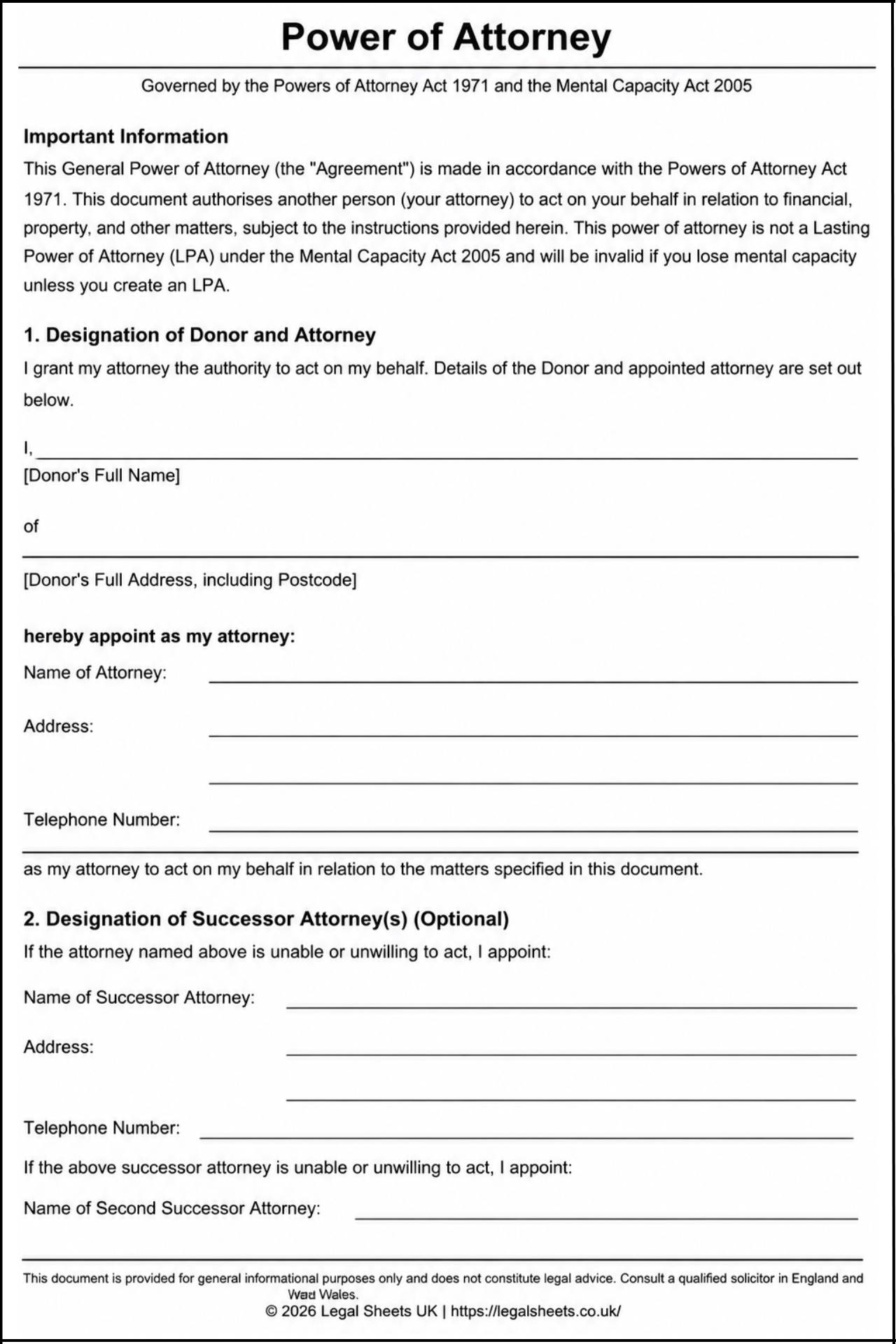
When a Power Of Attorney Is the Wrong Document for the Problem
Temporary absence versus future incapacity
Many people assume one document covers every situation, but that is rarely true. Someone leaving England for several months may simply need another person to deal with banking or property matters while they are away. A General Power of Attorney is often suitable because it operates while the donor continues to have mental capacity.
Where there is concern that capacity could later be lost through dementia or another progressive illness, an Ordinary Power of Attorney is not enough. It automatically ends when the donor loses mental capacity, leaving the attorney without authority to continue acting.
Managing affairs while travelling abroad
Travelling overseas does not prevent someone from managing their affairs, but practical difficulties often arise when documents require signatures or financial decisions must be made quickly. A properly executed Power Of Attorney can allow an attorney to deal with routine administration without delaying transactions.
Authorising property transactions during absence
Property sales, purchases, or remortgages frequently require documents to be signed within strict deadlines. Granting authority through a Power Of Attorney enables an attorney to complete those transactions while the donor is unavailable, reducing the risk of contractual delays.
Delegating banking and financial administration
Banks commonly receive Power Of Attorney documents for everyday financial management including loan administration. Institutions often request original documents or properly certified copies before accepting an attorney’s authority, so execution should be completed carefully.
Situations where an Ordinary Power of Attorney is sufficient
An Ordinary or General Power of Attorney is commonly suitable where:
- The donor retains full mental capacity.
- Authority is needed for a temporary period.
- Property or financial matters require another person to act.
- Business owners need temporary representation through business consultants.
- Overseas travel makes personal attendance difficult.
Unlike an LPA, an Ordinary Power of Attorney does not require registration before use.
When capacity concerns change the legal position
The legal position changes immediately if the donor loses mental capacity. Under the verified legal framework, an Ordinary Power of Attorney automatically ceases to have effect. Continuing to use it after capacity has been lost may expose the attorney to serious legal consequences because they no longer possess valid authority.
Progressive illness and future decision-making
Families often prepare documents after receiving a diagnosis involving declining capacity. Waiting too long can create significant difficulties because the donor must have mental capacity when signing the document. If that opportunity is missed, a different legal process may become necessary.
Dementia-related planning
One of the most common misunderstandings involves dementia planning. A General Power of Attorney cannot continue once capacity is lost. Individuals expecting future incapacity should consider arrangements designed for that situation before symptoms progress.
Long-term care arrangements
Moving into long-term care often involves decisions about finances, property, and personal welfare. Different legal documents deal with different types of authority, making early planning considerably easier than attempting to resolve issues after capacity has already been lost.
Why a General Power of Attorney stops working after loss of capacity
Many families discover this limitation only when a bank refuses to recognise an existing document. Once mental capacity has been lost, an Ordinary Power of Attorney no longer authorises financial decisions. Banks may freeze access until appropriate legal authority exists, disrupting payment of care fees, household expenses, and property management.
Documents commonly confused with a Power Of Attorney
Lasting Power of Attorney (LPA)
A Lasting Power of Attorney is governed by the Mental Capacity Act 2005 and is intended for situations where authority may need to continue after the donor loses capacity. It has no legal effect until it has been registered with the Office of the Public Guardian.
General Power of Attorney (OPA)
A General Power of Attorney is governed by the Powers of Attorney Act 1971. It is commonly used for temporary financial or property matters and remains effective only while the donor retains mental capacity.
Deputyship Orders from the Court of Protection
Where capacity has already been lost and no valid LPA exists, family members cannot simply create a new Power of Attorney. Instead, authority may need to be obtained through the Court of Protection by applying for a Deputyship Order.
Authority letters to banks
A simple authority letter may allow limited communication with a bank but does not create the legal authority provided by a properly executed Power Of Attorney. Financial institutions usually distinguish between informal authority and legally recognised attorney powers.
Executor authority after death
Power Of Attorney authority ends immediately upon the donor’s death. Responsibility for administering the estate then passes to the executor or personal representative, not the former attorney.
Why authority under a POA ends on death
A common misconception is that attorneys can continue managing accounts after the donor dies. They cannot. Any authority granted under a Power Of Attorney comes to an end on death, and further decisions must be made by those legally responsible for administering the estate.
Power Of Attorney Template (PDF, Word & Printable Formats)
What the template is designed to do
This POA form is designed to authorise another person to make specified decisions on the donor’s behalf within the limits set out in the document. The authority may be broad or limited depending on the drafting.
Delegate authority to an attorney
The template allows the donor to appoint a trusted individual to act within clearly defined powers. Selecting someone reliable is often more important than granting wide authority, as attorneys owe a fiduciary duty to act in the donor’s best interests.
Property and financial decision-making
Many Power Of Attorney documents focus on financial administration, including banking, investments, tax matters, and property transactions. The scope should always match the donor’s intended purpose.
Temporary and ongoing authority arrangements
Some appointments are intended for a short period, while others are created as part of long-term planning. Choosing the correct legal document at the outset avoids disruption if circumstances later change.
Personal and business use cases
A legal power of attorney may be appropriate for:
- Individuals travelling overseas.
- Property owners completing transactions during absence before property sales.
- Business owners requiring temporary representation under service contracts.
- Family members assisting with financial administration.
- Elderly individuals planning future financial management.
Available formats
The template is available in:
- PDF version
- Word version
- Printable version
- Editable version
Suitable users
The document may be suitable for:
- Individuals travelling abroad.
- Elderly people planning ahead.
- Family members assisting relatives.
- Property owners.
- Business owners needing temporary authority.
Situations where the template may not be sufficient
A standard template may not be appropriate where:
- Future loss of mental capacity is anticipated.
- Health and welfare decisions are required.
- Complex asset structures exist.
- Different attorneys require different powers.
- Court of Protection proceedings are already necessary.
Before signing the document
Before executing the document, the donor should:
- Confirm they have mental capacity.
- Choose an appropriate attorney.
- Decide the scope of authority.
- Determine whether the authority should be temporary or ongoing.
- Check the witnessing requirements.
For an Ordinary Power of Attorney, execution as a deed is essential. Failure to satisfy the required execution formalities can result in banks, property professionals, and other organisations refusing to recognise the attorney’s authority, even if both parties intended the arrangement to be valid.