
Motorcycle Bill Of Sale UK (PDF, Word & Fillable Template)
Buying or selling a used motorcycle often feels straightforward until paperwork is questioned months later, and that’s exactly when a Motorcycle Bill Of Sale becomes valuable. While ownership between private individuals is generally governed by the Sale of Goods Act 1979, the document does not replace the DVLA process for changing the registered keeper, a point that’s misunderstood surprisingly often.
A seller may believe handing over the keys and signing a receipt finishes the job, only to discover speeding notices or parking penalties still arrive because the V5C was never updated. If you’re selling a commuter bike, a classic motorcycle or a larger touring machine, the template below records the essential details of the transaction, explains the clauses that matter in practice, and highlights the legal issues that frequently surface when ownership or payment is later disputed.
Affiliate Disclosure: We may earn a commission from purchases made through affiliate links on this page, at no extra cost to you.
Motorcycle Bill Of Sale Template (PDF, Word)
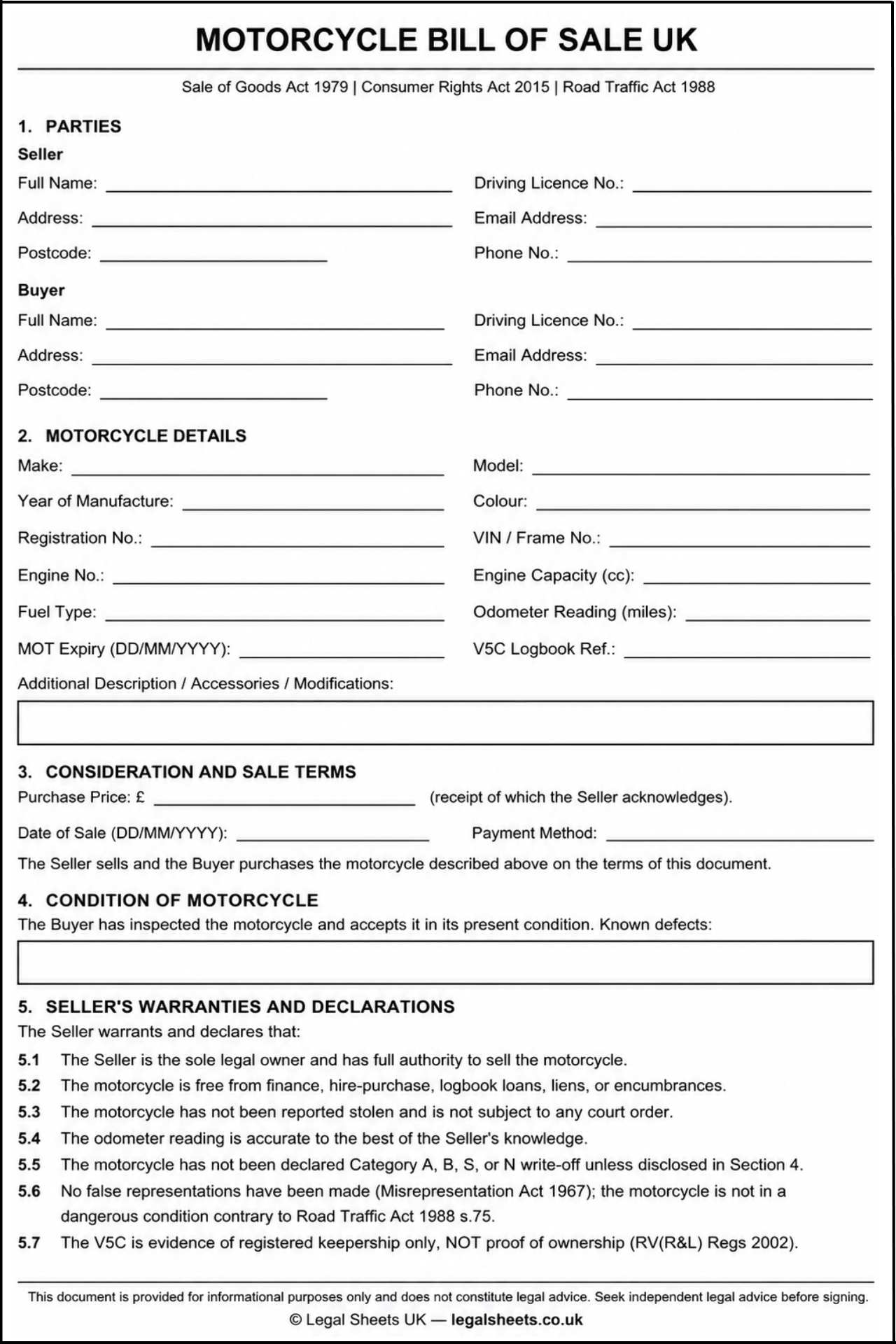
Customised Do-it-yourself Bill of Sale
Situations Where a Motorcycle Bill Of Sale Becomes Essential
Private Motorcycle Sales
Private motorcycle sales often take place between individuals who have never dealt with one another before. Once payment has been made and the motorcycle changes hands, memories can differ about what was agreed. A written Motorcycle Bill Of Sale creates a reliable record that both parties can refer to if questions arise later about payment, condition, included accessories, or the date ownership transferred.
Private sales also operate differently from dealer sales. Buyers frequently assume they receive the same legal protections as they would from a motorcycle dealership, which is not always correct. Recording the terms clearly at the point of sale reduces misunderstandings.
Dealer-to-Consumer Transactions
Motorcycle dealerships use bills of sale as part of their sales paperwork to record the transaction alongside invoices and registration documents through sales agents.
Unlike private sellers, businesses cannot remove statutory consumer protections by inserting clauses such as “Sold As Seen” or “No Refunds” into the agreement. Any wording attempting to exclude the consumer’s statutory rights regarding satisfactory quality or fitness for purpose is legally ineffective in a retail consumer sale.
Family Transfers
Many motorcycles are transferred between parents, children, siblings, or other relatives. Although no money may change hands, ownership still changes.
Recording the transfer helps establish when responsibility for the motorcycle passed to the new owner and reduces confusion if ownership is questioned in the future.
Gifts Without Payment
A Motorcycle Bill Of Sale can also record motorcycles given as gifts.
Instead of recording a purchase price, the document can confirm that ownership was transferred without financial consideration while still identifying the motorcycle and both parties involved.
Classic or Collector Motorcycle Sales
Older motorcycles often have significant historical or collector value. Buyers usually pay close attention to originality, restoration history, mileage records, and included documentation.
Recording these details accurately protects both parties if questions later arise about what was represented during negotiations before purchase.
Evidence of Ownership Transfer
A Motorcycle Bill Of Sale acts as evidence that ownership was intended to pass from one party to another.
Although the DVLA records the registered keeper separately, the bill of sale can still become valuable evidence if ownership is later disputed or supporting documentation is required during legal proceedings.
Information That Should Always Be Included
Buyer and Seller Details
Record each party’s full legal name, residential address, telephone number, and email address where available.
One of the most common practical problems in private motorcycle sales is incomplete contact information. If litigation later becomes necessary, inaccurate addresses can make serving County Court documents extremely difficult.
Motorcycle Description
Describe the motorcycle accurately.
Include:
- Manufacturer
- Model
- Model year
- Colour
- Engine size
- Fuel type
- Body style where appropriate
Small errors may create unnecessary disputes if multiple motorcycles are owned by the seller.
VIN, Registration Number and Engine Number
These identifiers distinguish one motorcycle from another.
Before signing, both parties should physically compare the VIN and engine number against the motorcycle itself rather than relying solely on paperwork.
Recording incorrect identification numbers may cause future ownership disputes or difficulties proving which motorcycle was sold.
Odometer Reading
The mileage shown on the motorcycle at the time of sale should be recorded exactly as displayed.
If mileage is estimated, unreadable, or believed to be inaccurate, that fact should be stated rather than allowing assumptions to develop later.
Mileage disputes commonly arise where buyers later discover evidence suggesting the motorcycle’s history differs from what was represented during the sale.
Purchase Price
State the agreed purchase price clearly.
Avoid leaving blank spaces or using approximate figures. If a deposit has already been paid, the balance should also be identified.
Clear payment records reduce disputes regarding unpaid balances or alleged overpayments.
Payment Method
Specify how payment was made.
Examples include:
- Bank transfer
- Cash
- Banker’s draft
Recording the payment method creates additional evidence that the transaction occurred.
Date and Time of Sale
The exact date and, where possible, the time ownership changed should be recorded.
This can become particularly relevant where parking penalties, speeding offences, insurance issues, or vehicle tax responsibilities arise shortly after the transaction.
Keys, Documents and Accessories Included
Many disputes involve items that both parties assumed were included.
Record whether the buyer received:
- Spare keys
- Service records
- MOT certificates
- Owner’s manuals
- Luggage systems
- Security devices
- Additional accessories
Listing these items prevents later disagreement over missing equipment.
Signatures
Although no specific statutory execution formalities require a Motorcycle Bill Of Sale to be signed to transfer ownership, signed documents carry considerably greater evidential value if the transaction is later disputed.
Both parties should retain identical signed copies.
Clauses That Help Prevent Future Disputes
Ownership and Right to Sell
The seller should confirm they have the legal right to sell the motorcycle.
If the seller lacks legal title because finance remains outstanding or ownership belongs to someone else, significant legal problems may follow after the sale.
Sale Price Confirmation
A clause confirming the final agreed purchase price removes uncertainty if either party later alleges that further payments remained outstanding.
Where deposits were paid separately, recording those payments creates a complete financial history within one document.
Motorcycle Condition Statement
Many disagreements arise because buyers believe verbal statements formed part of the agreement.
If the seller wishes to describe the motorcycle’s condition, those descriptions should be accurate and capable of being supported. False statements about accident history, servicing, or previous damage may later become evidence in a misrepresentation claim.
“Sold As Seen” Clause for Private Sales
Private sellers often include wording stating that the motorcycle is sold as seen, tried, and approved without guarantee.
Although commonly used, this wording does not protect a seller who deliberately makes false statements about the motorcycle’s condition or history.
For dealer sales, wording attempting to remove statutory consumer rights is ineffective and should not be relied upon.
Outstanding Finance Declaration
A declaration confirming whether outstanding finance exists allows both parties to address ownership concerns before completion.
Failure to disclose finance can expose both buyer and seller to significant problems if a finance company later asserts its rights over the motorcycle.
Included Parts and Accessories
List every additional item transferring with the motorcycle.
This may include:
- Helmets (if included)
- Top boxes
- Side panniers
- GPS units
- Aftermarket exhausts
- Tool kits
- Spare parts
Detailed schedules remove uncertainty over what formed part of the agreed sale.
No Additional Promises Clause
A simple clause confirming that no additional promises were made outside the written agreement reduces arguments over informal conversations that allegedly changed the terms of the sale.
It encourages both parties to record any important representations before signing.
Before Signing the Motorcycle Bill Of Sale
Check the Motorcycle Identity
Inspect the registration number, VIN, engine number, and other identifying information directly on the motorcycle.
Never rely exclusively on documents provided by the seller.
Verify the Seller’s Identity
Confirm the seller’s identity using reliable identification and ensure the details recorded on the bill of sale match those provided.
Buyers who fail to verify identity sometimes struggle to trace sellers if disputes later arise.
Confirm Outstanding Finance
Before payment is made, establish whether any hire purchase, conditional sale agreement, or other finance remains attached to the motorcycle.
Finance issues are considerably easier to resolve before ownership changes than after delivery has taken place.
Review Service History
Inspect available servicing records carefully.
Rather than assuming a motorcycle has been maintained simply because service books are present, buyers should check whether servicing appears complete and consistent with the recorded mileage.
Inspect MOT Status
Where applicable, compare the MOT history with the motorcycle’s current condition and mileage.
Unexpected differences may justify asking further questions before proceeding.
Match Registration Documents
Finally, compare the motorcycle itself with the accompanying registration documents to ensure the recorded details are consistent.
Completing these checks before signing the Motorcycle Bill Of Sale reduces the likelihood of ownership disputes, identification errors, and disagreements once the motorcycle has already changed hands.
After the Sale Is Completed
Updating the DVLA
Signing a Motorcycle Bill Of Sale does not automatically update the official vehicle records. Although ownership has passed between the parties, the seller must separately notify the Driver and Vehicle Licensing Agency (DVLA) that the registered keeper has changed.
This notification can usually be completed online through the DVLA service or by completing the relevant section of the V5C registration certificate and sending it to the DVLA. Until that happens, the previous keeper may continue receiving correspondence relating to the motorcycle.
V5C Responsibilities
Many buyers mistakenly believe the V5C logbook proves legal ownership. In reality, the V5C records the registered keeper, while the Motorcycle Bill Of Sale records the transaction itself.
Under the Road Vehicles (Registration and Licensing) Regulations 2002, the seller bears a strict statutory duty to notify the DVLA of the change of registered keeper immediately. Until this legal requirement is formally fulfilled, the seller remains statutorily liable for the motorcycle’s vehicle excise duty (road tax), speeding fines, ULEZ charges, and parking penalties.
Insurance Changes
Once ownership transfers, both parties should review their insurance arrangements without delay.
The seller should notify their insurer that the motorcycle has been sold, while the buyer should ensure suitable insurance is in place before using the motorcycle on public roads.
Vehicle Tax Responsibilities
Vehicle tax responsibilities should also be considered immediately after the sale.
Keeping accurate records of the transfer date helps resolve questions if liability for tax or enforcement notices is later disputed.
Keeping Copies of the Agreement
Both parties should retain signed copies together with supporting documents such as payment confirmations, service records, MOT certificates, photographs taken before handover, and correspondence discussing the sale.
These records often become the strongest evidence if disagreements later reach the County Court.
Common Mistakes That Cause Problems Later
Incomplete Seller Details
A surprisingly common problem is recording only a first name or mobile telephone number.
If the buyer later discovers undisclosed defects or ownership problems, tracing the seller becomes significantly more difficult. County Court proceedings may stall because documents cannot be properly served.
Incorrect Motorcycle Identification Numbers
Errors in the registration number, VIN or engine number may appear minor when completing the document, yet they can create uncertainty over which motorcycle was actually sold.
Always compare the physical motorcycle with the paperwork before signing.
Missing Purchase Price
Leaving the purchase price blank or recording an estimated figure creates unnecessary uncertainty.
If payment is disputed later, neither party has a reliable written record confirming the agreed consideration.
False Statements About Condition
A seller should never describe the motorcycle as accident-free, fully serviced or HPI clear unless those statements are accurate.
Under the Misrepresentation Act 1967, false statements of fact that induce the purchase may allow the buyer to seek rescission of the agreement or claim damages.
Failing to Declare Outstanding Finance
Outstanding finance is one of the most expensive mistakes made during private motorcycle sales.
Where finance remains attached to the motorcycle, ownership disputes may arise after completion. Depending upon the circumstances, the finance company may still have enforceable rights against the motorcycle.
Relying Only on Verbal Agreements
Conversations made during negotiations are easily remembered differently.
Recording every significant promise within the Motorcycle Bill Of Sale reduces disagreement about what was actually agreed before payment changed hands.
Private Sales vs Dealer Sales
Different Legal Responsibilities
Private sellers and motorcycle dealerships operate under different legal rules.
Private sales are primarily governed by the Sale of Goods Act 1979, while dealership sales to consumers fall under the Consumer Rights Act 2015.
This distinction affects both parties’ legal rights if problems arise after completion.
Consumer Protection Differences
Dealership sales provide statutory protections relating to satisfactory quality, fitness for purpose and compliance with the description given to the buyer.
Those statutory standards do not automatically apply in the same way to private consumer-to-consumer sales.
When “Sold As Seen” Applies
Private sellers often include “Sold As Seen” wording to reinforce that buyers have inspected and accepted the motorcycle before purchase.
However, this wording cannot excuse deliberate or negligent misrepresentations made about the motorcycle’s history or condition.
Clauses Dealers Cannot Legally Use
Businesses cannot remove statutory consumer protections simply by inserting wording such as:
- Sold As Seen
- No Refunds
- Trade Sale Only
- Spares or Repairs (unless genuinely sold as scrap)
Under Section 31 of the Consumer Rights Act 2015, any attempt by a dealership to use these clauses to bypass their statutory duty to provide a motorcycle of satisfactory quality is strictly legally void. Such wording directly breaches consumer law and exposes the business to severe regulatory enforcement by Trading Standards.
Outstanding Finance and Ownership Risks
Hire Purchase Agreements
Motorcycles purchased through hire purchase arrangements require particular care before resale.
The seller should ensure the finance has been properly dealt with before transferring ownership.
Conditional Sale Agreements
Conditional sale agreements may also affect legal ownership until contractual obligations have been satisfied.
Buyers should investigate ownership carefully before completing the purchase.
Good Faith Purchaser Protection
The Hire-Purchase Act 1964 contains protection for certain private purchasers who acquire a financed motorcycle in good faith and without notice of the outstanding agreement.
Nevertheless, discovering finance after purchase frequently results in avoidable disputes and additional expense.
When a Finance Company Can Repossess the Motorcycle
Selling a motorcycle subject to outstanding finance without addressing that finance first can expose everyone involved to legal complications.
Under Section 12 of the Sale of Goods Act 1979, selling a financed motorcycle usually breaches the implied condition of title, permitting the finance company to lawfully repossess the bike. However, a vital exception exists under Part III of the Hire-Purchase Act 1964: if a private individual unknowingly purchases the motorcycle in good faith without notice of the finance, they legally acquire ‘good title,’ permanently defeating the finance company’s right to repossess it.
Misrepresentation Claims After a Motorcycle Sale
False Mileage
Mileage frequently influences a motorcycle’s market value.
If an odometer reading or mileage history is knowingly misrepresented, the written statement may later become important evidence in legal proceedings.
Hidden Accident Damage
Concealing previous crash damage while positively stating the motorcycle has never been involved in an accident may amount to actionable misrepresentation.
Accurate disclosure is always preferable to making assumptions or unsupported claims.
Service History Misstatements
Describing a motorcycle as having a full service history when documentation cannot support that statement creates unnecessary legal risk.
Any representation written into the Motorcycle Bill Of Sale should be capable of verification.
Remedies Available to Buyers
Where actionable misrepresentation is established under the Misrepresentation Act 1967, the buyer holds a civil right to formally rescind the contract—forcing the seller to accept the motorcycle’s return and issue a full refund—or to claim financial damages covering the cost of necessary repairs.
UK Legal Facts
Legal Requirements Table
| Topic / Issue | Precise English Legal Rule | Governing Statute / Administrative Regulation |
| Private Sales (C2C) | Operates under the caveat emptor (buyer beware) principle, provided the seller makes no false statements of fact. | Sale of Goods Act 1979 |
| Dealer Sales (B2C) | Dealerships are strictly prohibited from using contractual clauses (“Sold as Seen”) to exclude statutory rights of satisfactory quality or fitness. | Consumer Rights Act 2015 (Section 31) |
| Financed Motorcycle Title | A private buyer purchasing a financed motorcycle in good faith without notice legally acquires good title, barring repossession. | Hire-Purchase Act 1964 (Part III) |
| Logbook Loans (Security) | A security Bill of Sale must strictly match the prescribed schedule wording and be registered at the High Court within 7 days, otherwise it is entirely void. | Bills of Sale Act (1878) Amendment Act 1882 |
| Misrepresentation | A false statement of fact written on the Bill of Sale that induces the purchase grants the buyer the right to rescind the contract or claim damages. | Misrepresentation Act 1967 |
| DVLA Keepership Update | The seller has a strict administrative duty to notify the DVLA of the change of registered keeper immediately upon executing the sale. | Road Vehicles (Registration and Licensing) Regulations 2002 |
Practical Legal Impact
These legal rules influence far more than the wording of the Motorcycle Bill Of Sale. They determine who bears responsibility if ownership is disputed, what consumer rights exist after the sale, and whether certain contractual clauses are legally effective.
Most disputes involving private motorcycle sales are resolved in the County Court. Smaller claims are generally allocated to the Small Claims Track, while higher-value disputes may proceed under the Fast Track. Courts commonly examine the written agreement, payment evidence, correspondence, photographs, and any representations made before the transaction.
When a Motorcycle Bill Of Sale Cannot Be Used
Motorcycle Loan Security
A standard Motorcycle Bill Of Sale should never be used to secure repayment of a loan while the original owner continues possessing and riding the motorcycle.
Logbook Loans
Transactions involving logbook loans require an entirely different statutory process.
Under Section 9 of the Bills of Sale Act (1878) Amendment Act 1882, utilizing an ordinary contract to secure a loan against a motorcycle while retaining physical possession renders the security absolutely and incurably void in law. The lender must use the exact prescribed statutory schedule and register the deed at the High Court within 7 clear days.
Transactions Requiring Different Legal Documents
Some sales require additional agreements because of finance arrangements, commercial transactions or specialist ownership structures.
Using the correct documentation from the outset avoids later challenges over ownership and enforceability.
Motorcycle Bill Of Sale vs Similar Documents
Bill Of Sale vs Vehicle Receipt
A receipt mainly confirms payment.
A Motorcycle Bill Of Sale records payment while also identifying the motorcycle, the parties involved and the transfer of ownership.
Bill Of Sale vs Purchase Agreement
A purchase agreement usually contains broader contractual obligations before completion.
A Motorcycle Bill Of Sale primarily records that the completed sale has taken place.
Bill Of Sale vs V5C Logbook
The V5C identifies the registered keeper.
The Motorcycle Bill Of Sale records the contractual transfer between buyer and seller. Neither document replaces the other.
Bill Of Sale vs Invoice
Invoices generally record amounts due from commercial sellers.
A Motorcycle Bill Of Sale provides broader evidence of the completed ownership transfer.
Keeping the Document as Evidence
How Long to Keep Copies
Both buyer and seller should retain their signed copies together with supporting documents for future reference.
Old paperwork often becomes valuable long after the sale if ownership, payment or representations are questioned.
Digital vs Paper Records
Maintaining both digital scans and original signed copies provides additional protection against accidental loss or damage.
Payment confirmations, photographs and correspondence should be stored alongside the agreement.
Using the Bill Of Sale in County Court
If litigation becomes necessary, the Motorcycle Bill Of Sale forms part of the documentary evidence presented to the court.
Accurate completion, complete identification details and genuine signatures all strengthen the document’s evidential value.