
Agency Agreement Template UK (Free Fillable PDF)
Agency Agreement problems rarely appear when the relationship starts; they usually surface when commission payments are disputed or one side wants to terminate the arrangement. In England, Agency Agreements frequently operate alongside the Commercial Agents (Council Directive) Regulations 1993. Following the Retained EU Law (Revocation and Reform) Act 2023 and the government’s 2025 regulatory review, these rules are now entrenched as ‘assimilated law,’ meaning businesses are still routinely caught out when their contract wording unlawfully conflicts with strictly protected statutory agency rights
A common dispute arises after a successful sales relationship ends and the principal discovers that compensation obligations can survive termination despite what the agreement appears to say. County Court and High Court claims regularly turn on poorly drafted commission clauses, unclear territory provisions, or termination terms copied from generic templates. The template and guidance that follow focus on the clauses that matter most before an agency relationship begins generating business.
Agency Agreement Template (PDF, Word & Printable Formats)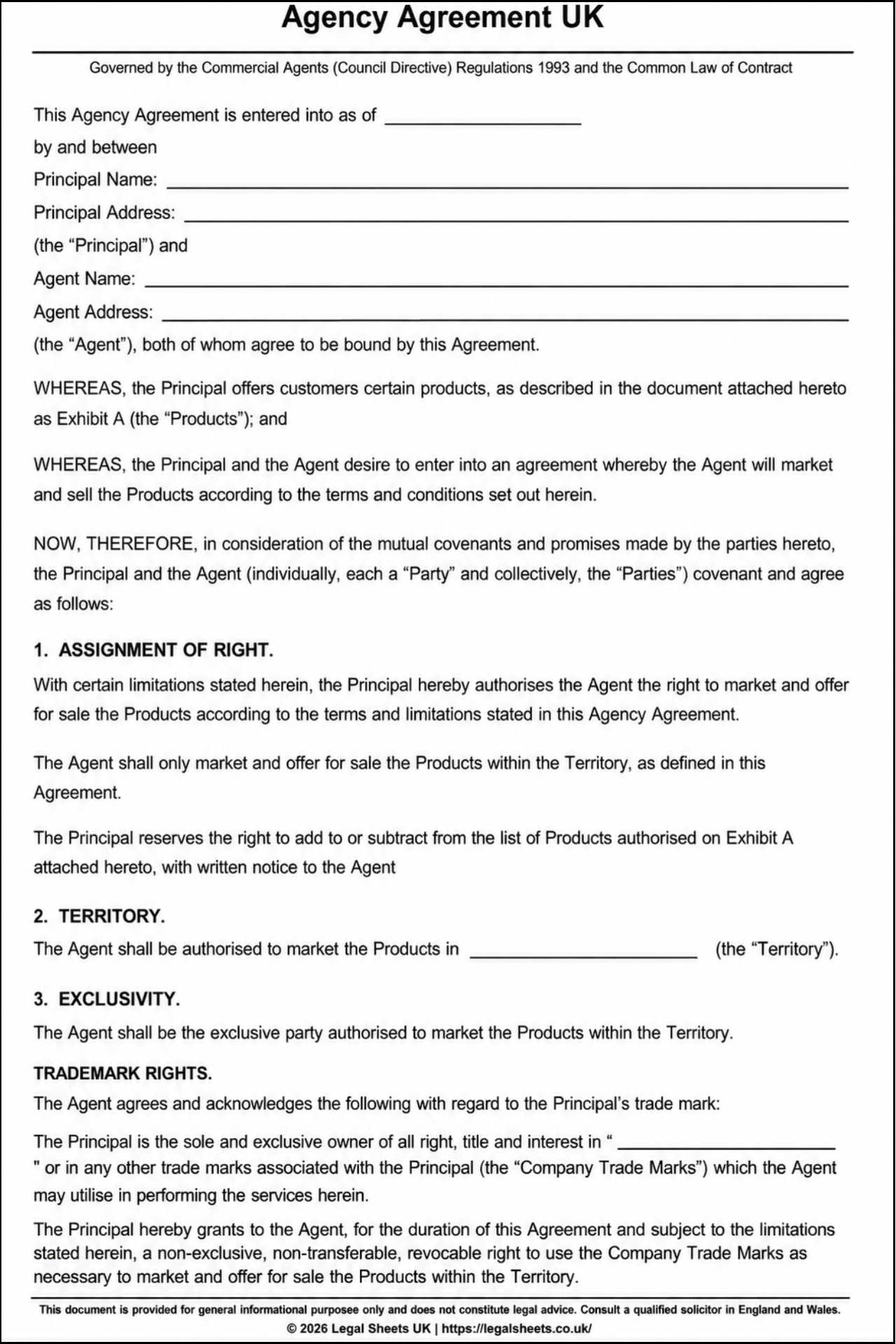
Why Businesses Use an Agency Agreement Instead of a Distribution Agreement
One of the most common commercial mistakes is assuming that an agency arrangement and a distribution arrangement achieve the same result. They may both involve selling products into a market, but the legal and commercial consequences are very different.
Agent Sells on Behalf of the Principal
In a sales agency agreement, the principal remains the contracting party with the customer. The agent’s role is normally to generate business opportunities, negotiate terms, or introduce customers in exchange for commission. The customer relationship ultimately belongs to the principal, and ownership of the goods generally remains with the principal until the sale takes place.
This structure is attractive to businesses entering new markets because it allows expansion without recruiting employees or establishing a physical presence. However, it also means disputes often focus on commission entitlement, customer ownership, and post-termination payments rather than product resale issues.
Distributor Buys and Resells
A distributor usually purchases goods and resells them independently. The distributor assumes commercial risk, determines its own resale strategy, and generates profit through the difference between purchase and resale prices.
The distinction becomes particularly important when a relationship ends. A distributor generally does not benefit from the same statutory protections that may apply to a commercial agent handling goods. Businesses that use the wrong agreement sometimes discover this difference only after a dispute arises.
Why Getting the Structure Wrong Creates Risk
The problem is not usually obvious when the relationship begins. It tends to emerge when one party attempts to terminate the arrangement or when commission claims arise after termination.
Where the reality of the relationship looks more like an agency arrangement than a distribution arrangement, statutory rights may apply regardless of how the contract is labelled. Principals are often surprised to discover that notice obligations and post-termination payment claims can arise despite believing they had complete freedom to end the relationship.
The Clauses That Usually Cause Problems During the Relationship
Most agency disputes are not caused by the commission percentage itself. They arise because the agreement failed to deal properly with authority, customer ownership, or the circumstances in which commission becomes payable.
Defining the Agent’s Authority
Authority disputes can become expensive because they often involve third parties. If an agent promises something to a customer that the principal never intended to offer, the disagreement may extend beyond the agency relationship and affect the underlying commercial transaction.
Authority to Negotiate
Many principals want agents to discuss pricing, delivery arrangements, and commercial opportunities without giving them unrestricted authority to commit the business.
Problems arise when the agreement does not clearly identify where negotiation authority ends. Customers may assume the agent has authority to make binding commitments, while the principal takes the opposite view. Once a dispute reaches court, the focus often shifts to the wording of the agreement and the conduct of the parties rather than what either side believed internally.
Authority to Conclude Contracts
Some agents are authorised to negotiate but not sign contracts. Others are given authority to conclude transactions on behalf of the principal.
This distinction should be addressed clearly. Businesses frequently assume that everyone understands the limits of the agent’s role, only to discover later that the customer relied upon statements or commitments the principal never intended to authorise.
Commission Clauses: Where Agency Relationships Commonly Break Down
Few disputes arise when commission is being paid regularly and the relationship remains positive. Problems usually appear after a major customer is secured, a sale completes shortly after termination, or the parties disagree about when commission becomes earned.
When Commission Is Earned
One of the most common drafting mistakes is assuming that identifying the commission percentage is enough.
In practice, the agreement should explain whether commission becomes payable when an order is placed, when the customer pays, when goods are delivered, or when the contract is completed. Each approach creates different commercial consequences. If the agreement remains silent, disputes often arise precisely when the sums involved become significant.
Pipeline Commission Disputes
Pipeline commission disputes are among the most common agency disagreements. An agent may spend months developing a customer relationship only for the transaction to complete after the agency relationship has ended through affiliate referrals.
The principal may argue that the agreement has terminated and no commission remains due. The agent may argue that the sale resulted directly from work completed before termination. According to the verified legal framework, these disputes frequently depend upon contractual drafting and evidence demonstrating the agent’s contribution to the eventual sale.
Exclusivity Provisions
Exclusivity can create significant value for an agent, but it can also create significant restrictions for a principal.
Exclusive Agency Rights
Where exclusivity is granted, the agreement should clearly identify the territory, customer group, or market sector affected.
Many disputes occur because exclusivity is described in broad commercial language without explaining whether the principal may continue servicing existing customers or appoint additional representatives in the same territory.
Non-Exclusive Arrangements
Non-exclusive arrangements offer greater flexibility, but they create their own challenges.
If multiple agents operate in the same market, disagreements frequently arise regarding which agent introduced a customer first and who is entitled to commission. Without accurate records and clear contractual wording, these disputes can become difficult to resolve long after the original introduction took place.
Termination: Where Most Agency Disputes Begin
Most agency relationships do not end because of a single dramatic event. More commonly, sales decline, business priorities change, or the parties gradually move in different directions. The legal issues usually begin when one side assumes it can simply end the arrangement immediately.
For commercial agents involved in the sale or purchase of goods, mandatory notice provisions may apply under the Commercial Agents (Council Directive) Regulations 1993. The statutory minimum is one month during the first year, two months during the second year, and three months from the third year onwards. Contract clauses attempting to provide less notice than these minimum periods are ineffective and may expose the principal to liability for damages. In practice, many businesses only discover this issue after serving a termination notice that does not comply with the statutory requirements.