
Employment Contract Template UK [Free PDF & Word]
An Employment Contract often becomes the centre of attention only after something has gone wrong — a disagreement over notice pay, working hours, bonus entitlement, or whether a restrictive covenant can actually be enforced. In England, employers must provide employees with a written statement of particulars under section 1 of the Employment Rights Act 1996, and since the 2020 reforms many businesses have discovered that outdated contract templates no longer reflect current statutory requirements.
Employment Tribunal claims regularly expose contracts that looked adequate when signed but failed to deal properly with probation periods, variable pay, hybrid working arrangements, or post-termination restrictions. The issue is rarely that no contract existed; it is that key provisions were drafted too vaguely to support the employer’s position once a dispute arose. The template, sample clauses, and completion guidance that follow focus on the areas most frequently scrutinised when an Employment Contract is tested in practice.
Table of Contents
ToggleEmployment Contract Template (PDF, Word & Printable Formats)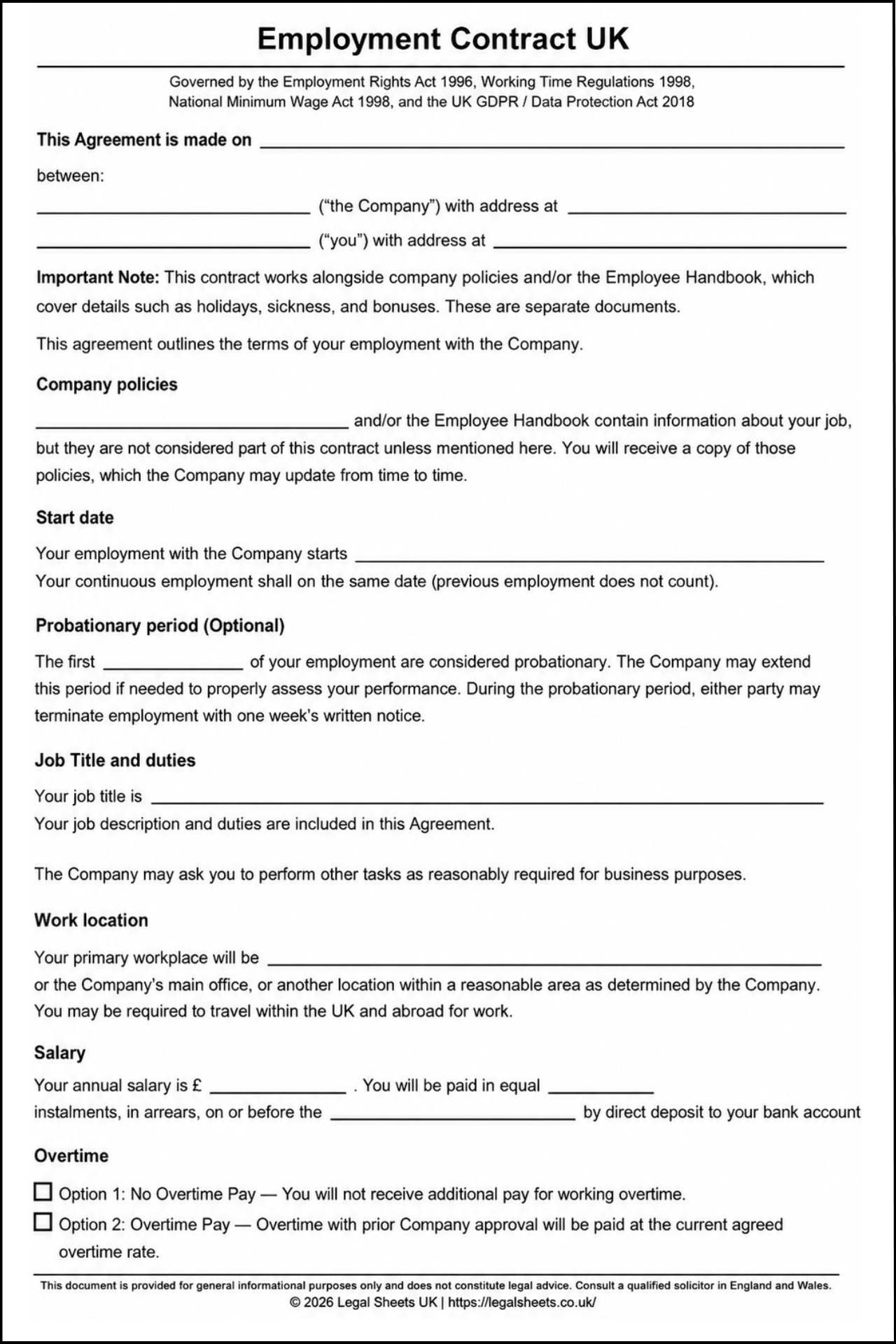
Situations Where an Employment Contract Prevents HR and Tribunal Problems
Preventing Disputes Over Pay and Working Hours
Contractual Pay Terms
Many wage disputes begin with differing assumptions rather than deliberate misconduct. Clear pay provisions reduce uncertainty regarding salary, payment intervals, and authorised deductions.
Overtime Expectations
Where overtime arrangements are not expressly documented, disagreements often emerge over whether additional hours are voluntary or compulsory.
Working Pattern Clarity
A work contract should accurately reflect actual working patterns. Outdated contractual hours frequently become problematic during grievance procedures or tribunal claims.
Avoiding Unauthorised Wage Deduction Claims
Written Authorisation Requirements
Under Section 13 of the Employment Rights Act 1996, deductions generally require prior written contractual authority.
Training Cost Repayment Provisions
Training repayment clauses require careful drafting for internship programmes. Courts may reject provisions that operate as penalties rather than reflecting a genuine financial loss.
Payroll Deduction Controls
Employers frequently encounter disputes where payroll deductions were implemented operationally but never authorised contractually.
Managing Changes to Duties, Location, and Working Practices
Flexibility Clauses
Employers commonly seek flexibility to alter duties or reporting structures. However, broadly drafted powers can create constructive dismissal risks.
Mobility Provisions
Location clauses should reflect realistic business needs rather than providing unrestricted relocation powers.
Variation Procedures
Contractual changes imposed without agreement frequently generate tribunal disputes, particularly where pay or responsibilities are affected.
Clauses That Carry the Greatest Legal and Financial Risk
Job Role and Duties Clauses
Scope of Responsibilities
Role descriptions should allow operational flexibility while accurately reflecting the position being performed.
Reporting Lines
Management structures often change. Contracts should accommodate reasonable organisational adjustments.
Operational Flexibility Limits
Employers regularly overestimate how much unilateral change a contract permits. Poor drafting can transform a business reorganisation into a constructive dismissal claim.
Pay, Benefits, and Bonus Terms
Contractual Versus Discretionary Benefits
One of the most common drafting errors is failing to distinguish guaranteed benefits from discretionary arrangements.
Bonus Wording Risks
Bonus clauses often generate disputes where contractual language suggests entitlement despite management intending discretion.
Pension Obligations
Employers must ensure pension arrangements align with workplace pension obligations and operational enrolment processes.
Sick Pay and Absence Provisions
Statutory Sick Pay Requirements
Following the 2026 reforms, Statutory Sick Pay is payable from the first day of absence.
Enhanced Employer Schemes
Where enhanced sickness benefits exist, the contractual wording should clearly distinguish them from statutory entitlements.
Reporting Obligations
Employees should understand how sickness absence must be reported, documented, and formally recorded.
Restrictive Covenants After Employment Ends
Non-Compete Provisions
English courts apply the Doctrine of Restraint of Trade. Restrictions extending beyond what is necessary may be struck out entirely.
Non-Solicitation Restrictions
Customer protection provisions should be targeted and proportionate.
Confidential Information Protection
Confidentiality obligations frequently provide more reliable protection than overly aggressive non-compete restrictions.
Training Cost Recovery Clauses
Sliding-Scale Repayment Structures
Repayment obligations commonly become enforceable when they reduce progressively over time.
Penalty Clause Risks
Clauses demanding full repayment years after training was completed may be treated as penalties.
Enforceability Concerns
Employers often discover enforcement problems only after an employee leaves and challenges the deduction.
Day-One Employment Rights That Must Be Reflected in the Contract
Section 1 Written Particulars Requirements
Mandatory Employee Information
Employees must receive prescribed written information regarding their employment terms on or before their first day.
Mandatory Employer Information
The employer must provide details covering pay, hours, notice, holidays, sickness arrangements, and other statutory particulars.
Timing Requirements
Delays frequently become relevant evidence during tribunal proceedings.
Mandatory Information Often Missed by Employers
Continuous Employment Date
Incorrect service dates can affect future rights and entitlements.
Mandatory Training Details
Training requirements should be disclosed where applicable.
Probationary Terms
Many employers operate probation periods without clearly documenting them.
Notice Provisions
Unclear notice arrangements frequently create disputes when employment ends.
Consequences of Incomplete Written Particulars
Employment Tribunal Awards
Where another successful employment claim exists, tribunals may award additional compensation for failures relating to written particulars.
Evidence Problems During Disputes
Missing contractual information often weakens an employer’s evidential position.
Compliance Failures
Documentation deficiencies frequently emerge during grievance investigations and tribunal disclosure exercises.
Employment Contracts and the 2026 Employment Law Reforms
Changes Affecting Statutory Sick Pay
First-Day Entitlement Rules
Under the Employment Rights Act 2025 (effective April 2026), the previous three-day waiting period and the Lower Earnings Limit have both been abolished. Statutory Sick Pay (SSP) is now payable from the first full day of sickness absence to all eligible employees, calculated at 80% of their average weekly earnings or the statutory flat rate, whichever is lower.
Removal of Previous Waiting Periods
Employers relying on outdated templates may inadvertently apply obsolete rules.
Guaranteed Hours Obligations
Variable-Hours Workers
Workers regularly working predictable patterns may require contractual review under zero-hours arrangements.
Regular-Hours Assessments
Employers should monitor actual working arrangements rather than relying solely on historic documentation.
Contract Review Requirements
Periodic contract reviews reduce compliance risks where working practices evolve.
Restrictions on Fire-and-Rehire Practices
Automatically Unfair Dismissal Risks
The 2026 reforms significantly restrict dismissing employees solely to impose less favourable contractual terms.
Business Survival Exception
Limited exceptions exist where severe financial difficulties threaten business continuity.
Contract Variation Alternatives
Consultation and negotiated agreement remain safer approaches than unilateral change.
Employee Handbook Integration: A Common Drafting Mistake
What Should Remain Contractual
Pay
Hours
Notice Periods
Core Employment Terms
These provisions usually belong within the contract itself because they define fundamental employment obligations.
What Should Usually Remain Non-Contractual
Disciplinary Procedures
Grievance Procedures
Absence Management Policies
Bonus Schemes
Employers often prefer these policies to remain non-contractual so they can be amended without renegotiating employment contracts.
Risks of Incorporating the Entire Handbook
Breach of Contract Claims
Employers occasionally discover that internal guidance has unintentionally become contractually binding during disciplinary processes.
Reduced Management Flexibility
Contractual incorporation limits the ability to revise policies efficiently.
Tribunal Complications
Policy breaches may evolve into contractual disputes if drafting is unclear.
Signing, Issuing, and Storing the Employment Contract
Electronic Signatures and Contract Validity
E-Signature Acceptance
Electronic signatures are generally valid under common law principles.
Record Keeping
Employers should retain evidence demonstrating acceptance and execution.
Audit Trails
Digital audit records can become valuable evidence during disputes.
Providing Contracts Before Employment Begins
HR Workflow Considerations
Issuing contracts early allows time for clarification and correction.
Onboarding Requirements
Employers should ensure contractual terms are acknowledged before employment commences following offer acceptance.
Evidence of Acceptance
Retention of signed copies remains a common operational safeguard.
Retention and Record Management
Personnel Records
Employment contracts should remain accessible throughout employment and beyond where necessary.
Data Protection Considerations
Personnel documentation must be handled consistently with data protection obligations.
Access Controls
Access to employment records should be restricted to authorised personnel.
Employee Data and Privacy Obligations
Why the Privacy Notice Should Remain Separate
Employers frequently merge privacy notices into employment contracts without considering the consequences. When privacy wording becomes contractual, updating data processing practices may require contractual variation rather than a simple privacy notice update.
Avoiding Contractual Status
Separate documentation provides greater operational flexibility.
Updating Privacy Practices
Data processing activities often evolve over time.
GDPR Compliance
Relevant privacy disclosures should be provided separately from the employee agreement.
Information Employers Must Disclose
Data Collection Purposes
Lawful Processing Bases
Retention Periods
Employees should receive transparent information regarding how their personal data is processed and retained for references.
Risks of Non-Compliance
ICO Enforcement Action
Employee Complaints
Data Governance Failures
Poor privacy practices can create both regulatory and employment-related difficulties.
Employment Contract Disputes and Where They Are Resolved
Matters Typically Heard by the Employment Tribunal
Unfair Dismissal
Discrimination
Unlawful Deductions
Wage Disputes
These statutory employment rights are generally determined by the Employment Tribunal.
Claims Commonly Pursued in the Civil Courts
Restrictive Covenant Breaches
Confidential Information Misuse
High-Value Contractual Disputes
Employers seeking injunctions to enforce restrictive covenants frequently pursue claims through the County Court or High Court.
The Role of the Fair Work Agency
Underpayment Enforcement
Statutory Pay Investigations
Employer Penalties
Established in April 2026, the Fair Work Agency has enforcement powers relating to key workplace rights and may pursue breaches involving statutory pay obligations.
UK Legal Facts About Employment Contracts
| Topic / Issue | England Legal Rule | Governing Law |
|---|---|---|
| Right to Written Terms | Written particulars required on or before Day 1 | Employment Rights Act 1996 |
| Statutory Notice Periods | Minimum notice protections apply | Employment Rights Act 1996 |
| Statutory Sick Pay | Payable from first day of absence | Employment Rights Act 2025 |
| Guaranteed Hours | Regular hours may require updated contracts | Employment Rights Act 2025 |
| Unlawful Deductions | Written authorisation required | Employment Rights Act 1996 |
| E-Signatures | Valid under common law principles | Common Law |
| Data Protection | Employee privacy obligations apply | UK GDPR / Data Protection Act 2018 |
Employment disputes rarely arise because legislation is unknown. More commonly, problems develop because contracts do not reflect actual working practices. Tribunals frequently examine whether the written terms match the reality of the workplace, particularly in disputes involving pay, hours, notice, or contractual variation.
Practical Legal Impact
- Missing mandatory particulars can increase tribunal exposure.
- Poorly drafted flexibility clauses may contribute to constructive dismissal claims.
- Excessive restrictive covenants may be unenforceable.
- Unauthorised wage deductions can lead to repayment claims.
- Failure to follow grievance or disciplinary procedures may increase tribunal awards.
Common Employment Contract Errors Employers Discover Too Late
Contracts That Do Not Reflect Actual Working Practices
Outdated Hours
Changed Responsibilities
Informal Workplace Arrangements
Employment relationships often evolve while documentation remains unchanged. This creates evidential difficulties when disputes arise.
Unclear Notice and Resignation Procedures
Service Disputes
Ambiguous Notice Provisions
Resignation Evidence Issues
Many disagreements focus not on whether notice was given, but when it was received and whether contractual service requirements were followed.
Overly Aggressive Restrictive Covenants
Junior Employee Restrictions
Excessive Durations
Geographic Overreach
Restrictions that appear commercially attractive on paper may prove unenforceable when tested before the courts.
FAQ
Can an employee challenge a restrictive covenant that lasts 12 months?
Yes. English courts may strike down restrictive covenants that extend beyond what is reasonably necessary to protect legitimate business interests.
What happens if an employer fails to provide written particulars on the employee’s first day?
If the employee succeeds in another qualifying employment claim, the Employment Tribunal may award additional compensation relating to the failure to provide required written particulars.
Can an employer deduct training costs from wages when the employee leaves?
Only where the deduction is clearly authorised in writing and the repayment provision is drafted in an enforceable manner.
Is an electronic signature valid on an employment contract?
Yes. Employment contracts can generally be executed electronically and remain legally enforceable under common law principles.
Can an employer change pay, duties, or work location without agreement?
Not usually. Poorly drafted variation provisions can create breach of contract risks and may contribute to constructive dismissal claims.
Author
-

Ankur is the founder and editorial reviewer at LegalSheets. He researches, writes, and reviews legal content, ensuring every template and guide is clear, accurate, and based on current UK laws and official government guidance. His focus is on making legal documents easier for individuals and businesses to understand and use.
