
Internship Agreement Template (UK) – Free PDF, Word & Printable Format
An Internship Agreement is often downloaded when an organisation is about to welcome a student, graduate, or work-experience participant and wants to document the placement properly from the outset. The difficulty usually appears later, when an arrangement that began as observation and training gradually turns into regular operational work without anyone updating the paperwork.
In Employment Tribunal disputes in England, decision-makers systematically apply the reality-of-contract principle. They evaluate the day-to-day operational facts of the placement rather than relying on the contractual label, particularly where mandatory hours, direct supervision, and commercial output point toward worker status under English law That practical reality makes it sensible to define learning objectives, supervision arrangements, placement duration, and expectations with care from the beginning, alongside any obligations that may arise under the Employment Rights Act 1996. The template and drafting guidance that follow are designed for organisations that want a placement structured around learning rather than discovering after the event that the arrangement looked very different in practice.
Internship Agreement Template (PDF, Word & Printable Formats)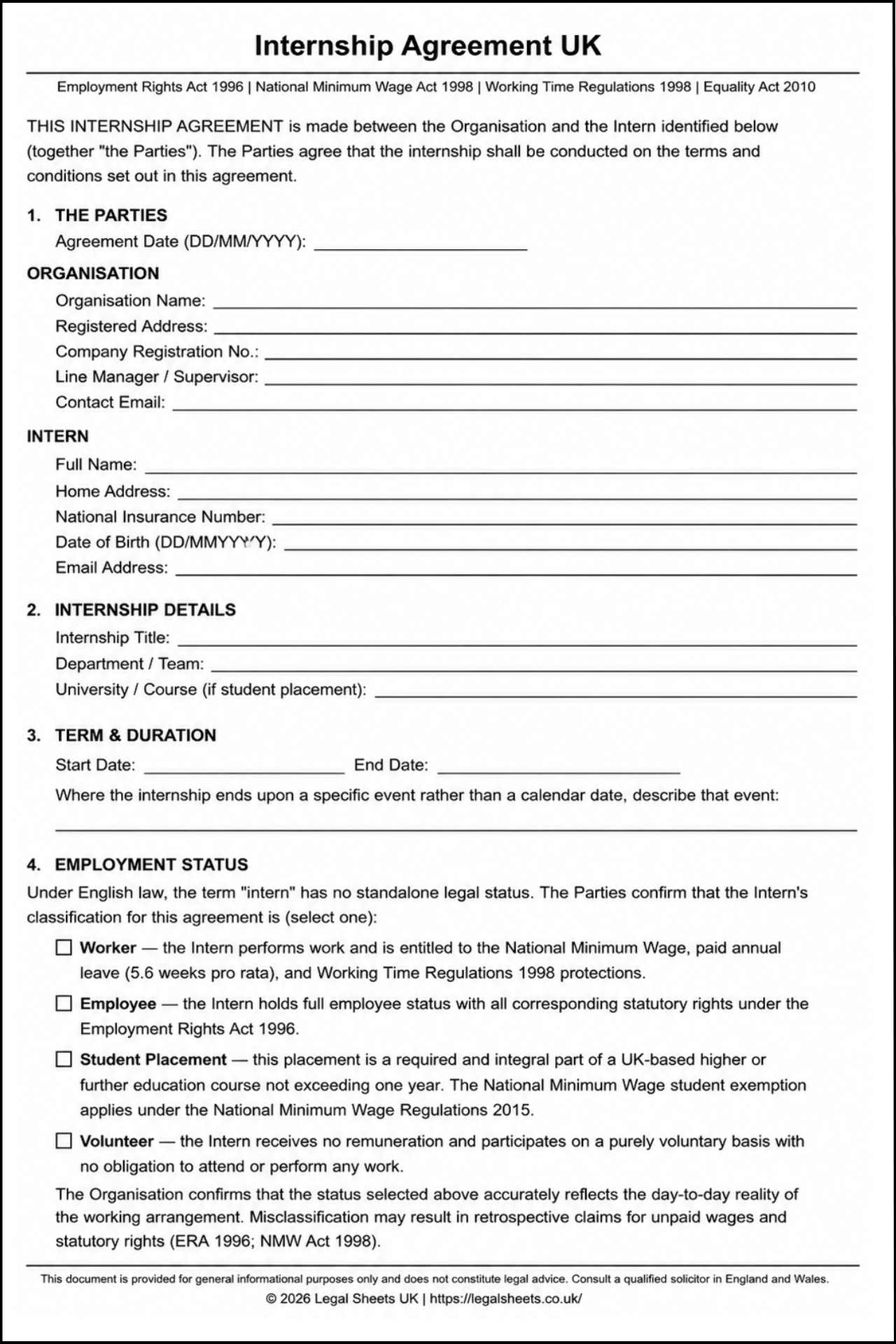
Get PDF | WORD
Situations Where an Internship Agreement May Be the Wrong Document
Using the wrong document creates more risk than using no document at all.
An internship agreement may be unsuitable where the arrangement is actually:
- Permanent employment recruitment
- Apprenticeship arrangements
- Casual worker engagements
- Volunteer-only roles
- Fixed-term employment positions
- Self-employed contractor arrangements for independent contractors
Where the individual is expected to perform ongoing operational work under management control, an employment contract or fixed-term employment agreement may be more appropriate.
When Legal Advice May Be Needed
- Additional legal review is often sensible where the placement involves: Paid internship programmes with commission structures
- International interns
- Graduate recruitment pathways
- Regulated industries
- Intellectual property-heavy projects
- Interns undertaking revenue-generating work
The greater the commercial contribution expected from the intern, the greater the likelihood that worker-status questions may arise later.
The First Question Employers Get Wrong: Is the Intern Actually a Worker?
Many employers focus on the title “intern” and overlook the reality of how the placement operates.
Employment Tribunals generally examine the substance of the arrangement rather than the label attached to it.
When an Internship Stops Being Work Experience
Problems often begin when the internship gradually evolves.
Indicators include:
- Productive work rather than observation
- Mandatory attendance requirements
- Performance targets
- Revenue-generating activities
- Operational responsibilities
A placement originally designed as learning experience can drift into a working arrangement if the intern becomes integrated into normal business operations.
Employment Tribunal Risks of Misclassification
Worker-status disputes frequently arise after the internship has ended.
Potential claims may include:
- Worker status disputes
- National Minimum Wage claims
- Holiday pay claims
- Unlawful deduction claims
- Retrospective employment rights
In practice, tribunals often examine what the individual actually did each day rather than what the agreement originally stated.
Warning Signs That the Arrangement Has Drifted Beyond an Internship
Common warning signs include:
- Fixed schedules resembling employee rotas
- Ongoing business-critical tasks
- Line-management responsibilities
- Client-facing obligations
- Long-term role substitution
When interns become essential to operational delivery, the original educational purpose becomes increasingly difficult to defend.
Building an Internship Around Learning Rather Than Labour
The strongest internship programmes place education at the centre of the placement.
Defining Educational Objectives
Learning objectives should be specific rather than aspirational.
Examples include:
- Skills development goals
- Department exposure
- Project participation
- Mentoring arrangements
Vague objectives frequently create evidential problems if the educational value of the internship is later questioned.
Supervisor Responsibilities
A named supervisor demonstrates that learning is being actively managed.
Responsibilities commonly include:
- Training obligations
- Progress reviews
- Feedback procedures
- Workplace support
Many organisations underestimate how useful supervision records become if a dispute later develops.
Recording Learning Outcomes
Documenting progress creates a practical audit trail.
Useful records include:
- Placement objectives
- Evaluation forms
- Completion certificates
- University reporting requirements
These records often become more persuasive than the agreement itself when demonstrating the educational nature of the placement.
Clauses That Cause Most Internship Disputes
Duration and End Date Provisions
Unclear duration clauses create avoidable uncertainty.
The agreement should define:
- Fixed placement periods
- Extension options
- Early completion scenarios
Allowing extensions without formal review can create confusion regarding the original purpose of the placement.
Working Hours and Attendance Expectations
Attendance expectations should reflect the educational nature of the internship.
Common provisions include:
- Scheduled attendance
- Flexible attendance arrangements
- Remote participation
Rigid attendance requirements combined with productive work duties can strengthen arguments that the individual was functioning as a worker.
Expenses and Reimbursement Clauses
Expense disputes are common where expectations are not documented.
The agreement should address:
- Travel costs
- Accommodation expenses
- Meal allowances
- Claim procedures
Clear reimbursement procedures reduce disagreement at the end of the placement.
Confidentiality Obligations
Interns often gain access to commercially sensitive information surprisingly quickly.
Confidentiality clauses should address:
- Business information access
- Customer information
- Internal systems
- Post-placement restrictions
A missing confidentiality clause can become particularly problematic in technology, finance, healthcare, and professional services environments.
Intellectual Property Ownership
This clause becomes critical whenever interns contribute creative or technical work.
The agreement should clarify ownership of:
- Work product
- Creative content
- Software development
- Research outputs
Businesses frequently discover ownership issues only after valuable work has already been produced.
Paid, Unpaid and Hybrid Internship Models
Situations Where Payment Is Commonly Expected
Payment expectations generally increase where interns are contributing commercially valuable work.
Examples include:
- Operational work contributions
- Ongoing project involvement
- Commercial activities
The more productive the contribution, the more difficult it becomes to characterise the arrangement as pure work experience.
National Minimum Wage Exposure
Under English law, ‘intern’ is not a distinct statutory status. If an individual performs productive, commercially valuable work and is subject to contractual obligations of attendance, they legally qualify as a ‘worker’ under the National Minimum Wage Act 1998, regardless of the contract title
Practical risk indicators include:
- Regular attendance requirements
- Structured operational duties
- Business-critical work
- Measurable performance expectations
Tribunal claims often focus on actual working practices rather than labels used within documents, as explained in UK Government guidance on internships and work experience.
Reimbursement Versus Remuneration
Employers should distinguish carefully between:
- Genuine expenses
- Stipends
- Allowances
- Payroll-related payments
Paying flat-rate daily stipends or non-receipted allowances constitutes remuneration under English common law. To protect an unpaid work-shadowing arrangement from accidentally triggering full National Minimum Wage liabilities, the agreement must strictly limit payments to the reimbursement of actual, receipted, out-of-pocket expenses.
Internship Agreements Used Alongside University Placements
Additional Stakeholders Involved
University placements introduce additional participants.
These may include:
- Universities
- Colleges
- Placement coordinators
- Training providers
Each stakeholder may require separate reporting or documentation obligations.
Documents Commonly Required
Additional paperwork often includes:
- Placement agreements
- Risk assessments
- Insurance confirmations
- Learning plans
The internship agreement rarely operates in isolation.
Handling Academic Placement Requirements
Academic institutions commonly request:
- Attendance reporting
- Assessment support
- Performance feedback
- Completion verification
Failure to provide required reports can create difficulties for both the student and host organisation.
Remote and Hybrid Internship Arrangements
Equipment and Access Provisions
Remote internships create practical risks that office-based placements do not for remote workers.
The agreement may address:
- Company devices
- Software access
- Security requirements
Many data security issues arise because remote-access arrangements were never properly documented through service providers.
Monitoring and Supervision Challenges
Supervision remains essential regardless of location.
Common considerations include:
- Remote supervision
- Communication expectations
- Reporting structures
A lack of active supervision can undermine arguments that the placement was educational.
Confidentiality Risks Outside the Workplace
Remote work environments increase confidentiality exposure.
Typical concerns include:
- Home working arrangements
- Shared devices
- Data access restrictions
Businesses handling sensitive information frequently impose stricter access controls for remote interns.
Common Drafting Mistakes That Create Employment Claims
Calling Someone an Intern While Treating Them Like Staff
Titles rarely determine legal status. Daily working practices carry significantly more weight.
Failing to Define Learning Objectives
Without documented educational goals, it becomes harder to demonstrate that the placement was designed around learning rather than labour.
Omitting Confidentiality Provisions
Sensitive information can leave the business with little contractual protection once the internship ends.
Ignoring Intellectual Property Ownership
Ownership disputes often emerge after valuable work has been completed rather than during the placement itself.
Allowing Placements to Continue Indefinitely
Open-ended internships create uncertainty regarding purpose, expectations, and status.
Failing to Address Expenses Properly
Unclear reimbursement arrangements commonly generate avoidable disputes at the conclusion of the internship.
What Happens When an Internship Ends Early?
Employer-Led Termination
The agreement should explain when the organisation may terminate the placement before the expected end date.
Intern Withdrawal
Interns may leave because of academic commitments, employment opportunities, or personal circumstances following resignation notice.
A simple withdrawal procedure reduces disruption.
Misconduct Issues During Placement
Even educational placements may encounter misconduct concerns involving confidentiality breaches, inappropriate conduct, or misuse of company systems.
University Placement Complications
Where a university placement is involved, early termination may trigger reporting obligations to the institution.
Documentation to Retain After Termination
Organisations commonly retain:
- Signed agreements
- Supervisor notes
- Learning assessments
- Expense records
- Completion documentation
These records can become valuable evidence if disputes arise later.
UK Legal Facts
Legal Requirements Table
| Topic / Issue | Precise English Legal Rule | Governing Law |
| National Minimum Wage | Interns must be paid the statutory minimum wage if they perform productive work and have defined hours, unless a specific statutory exemption applies. | National Minimum Wage Act 1998 |
| Student Placement Exemption | Interns are legally exempt from the minimum wage if the placement is a mandatory requirement of a UK higher or further education course and does not exceed 12 months. | National Minimum Wage Act 1998 (Section 44) |
| Work Shadowing | Unpaid arrangements are only lawful if the individual is purely observing, has no fixed attendance obligations, and performs no commercially valuable tasks. | Common Law |
| Right to Written Terms | If an intern’s duties classify them as a worker or employee, they hold a Day-1 right to receive a Section 1 Statement of Written Particulars. | Employment Rights Act 1996 (Section 1) |
| Holiday Pay Accrual | Paid interns legally qualify as workers and accrue statutory holiday pay at the standard rate of 12.07% of actual hours worked from Day 1. | Working Time Regulations 1998 |
| Reimbursement vs Reward | Paying flat-rate daily stipends or non-receipted meal/travel allowances legally counts as remuneration, instantly triggering. full worker status and NMW liabilities. |
Practical Legal Impact
Why Internship Status Must Be Evaluated Carefully
Worker-status disputes can create substantial liabilities. Wage claims, holiday pay claims, and tribunal proceedings often focus on the reality of the working relationship rather than the wording of the internship agreement.
Why Placement Duration Matters
Repeated extensions can raise questions about whether the arrangement remains educational or has become a long-term labour resource. Where fixed-term employment structures emerge, additional statutory protections may become relevant.
Why Written Particulars Remain Important
Under Section 1 of the Employment Rights Act 1996, written particulars should be provided on or before Day 1. Missing documentation often attracts significant attention during tribunal proceedings because it weakens the employer’s evidential position.
Why Early-Termination Clauses Matter
Poorly drafted termination provisions can create financial exposure, operational disruption, and disputes regarding the intended duration of the placement.
Documents Commonly Used Alongside an Internship Agreement
Internship Offer Letter
An internship offer letter is commonly issued before the internship agreement and confirms the proposed placement.
Confidentiality Agreement
Some organisations use standalone confidentiality agreements where interns will access commercially sensitive information.
Data Protection Notice
Where interns handle personal data, separate privacy and data-processing information is often provided.
Health and Safety Documentation
Health and safety records are particularly important for placements involving physical workplaces or specialist equipment.
University Placement Agreement
Educational institutions frequently require separate placement agreements alongside the internship documentation.
FAQ
Can an unpaid intern bring a National Minimum Wage claim after the internship has ended?
Yes. A claim can arise after the placement has finished if the individual argues that the reality of the arrangement amounted to worker status rather than genuine work experience. Employment Tribunals typically examine the actual duties performed, attendance requirements, supervision arrangements, and the extent to which the intern contributed to the organisation’s operations.
What happens if an internship continues beyond its intended end date?
An internship that continues beyond its planned duration should be reviewed carefully. Repeated extensions can weaken the argument that the arrangement is primarily educational and may increase the risk of worker-status disputes. Employers should document any extension, reassess learning objectives, and confirm whether a different contractual arrangement has become more appropriate.
Can an intern own the intellectual property they create during the placement?
That depends largely on the wording of the internship agreement. Where intellectual property ownership is not expressly addressed, disputes may arise after the internship has ended, particularly where the intern has contributed creative work, software development, research outputs, or commercially valuable content. Clear ownership provisions reduce uncertainty.
Is an internship agreement sufficient if the intern performs the same work as paid staff?
No. An internship agreement cannot override the practical reality of the arrangement. If an intern is performing the same productive work as employees, working fixed schedules, and contributing directly to business operations, a Tribunal may conclude that worker rights apply regardless of the document’s title.