
Job Offer Letter UK [PDF & Free Fillable Template]
Recruitment often moves quickly, and a Job Offer Letter is frequently issued before every background check or reference has been completed. That becomes a problem when the offer is unconditional, because under the common law principles of contract formation an accepted offer may leave the employer committed even if the employee has not yet started work.
Employers also need to think ahead to the written employment particulars required by Section 1 of the Employment Rights Act 1996 if the offer letter is intended to act as the primary employment document. Solicitors regularly see disputes arising after an accepted offer is withdrawn following a failed reference or immigration check, with breach of contract claims proceeding through the civil courts or discrimination allegations reaching the Employment Tribunal. The template and guidance that follow are designed to help employers prepare a clear offer, include appropriate conditions where required, and complete the document with confidence before recruitment moves to the employment contract stage.
Job Offer Letter Template (PDF, Word & Printable Formats)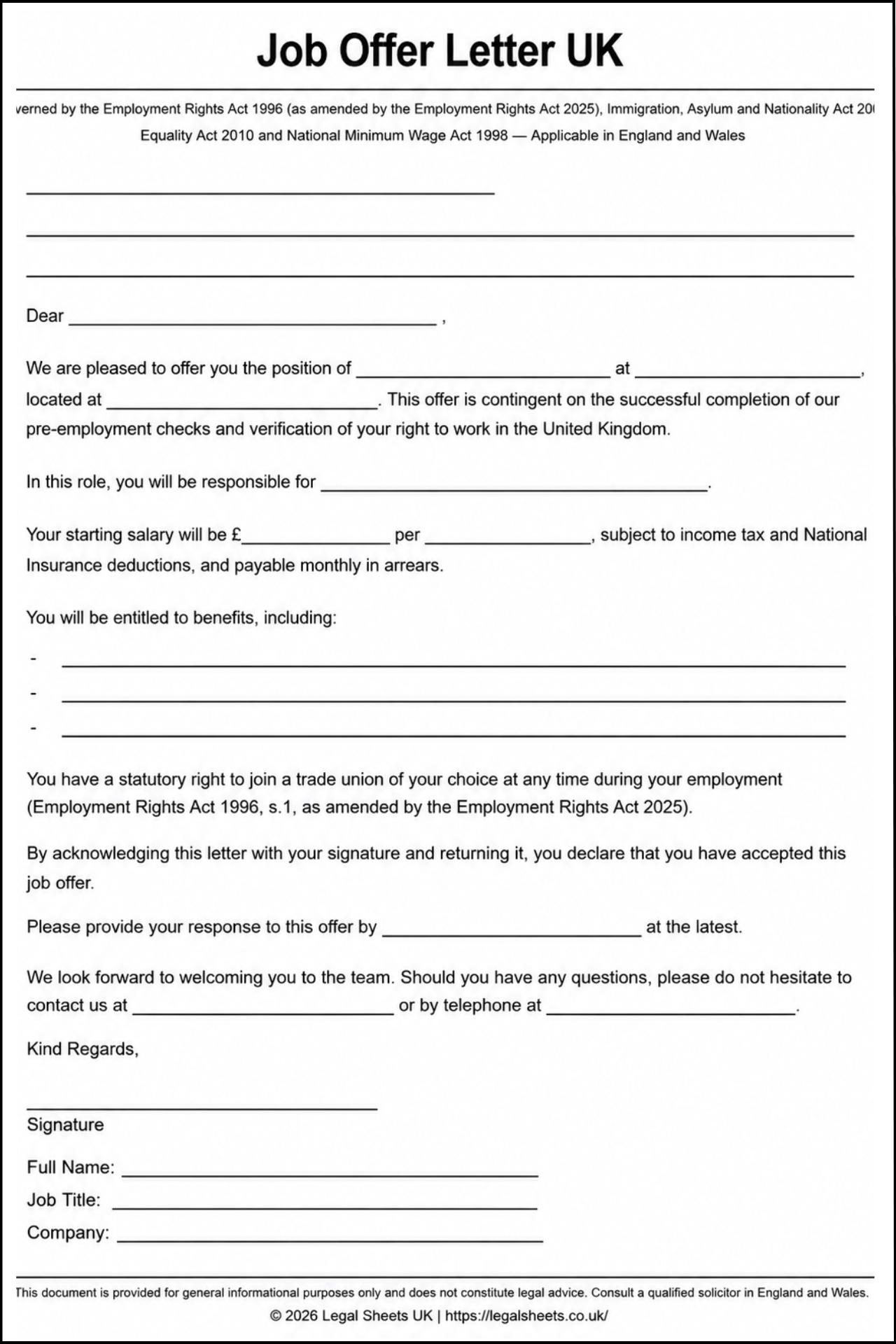
Building the Offer Correctly Before It Becomes Legally Binding
One of the most common recruitment mistakes is assuming an employment contract begins only when the employee starts work. Under common law, that assumption is often incorrect.
Once an unconditional offer is accepted, a legally binding employment contract may already exist. If the employer later withdraws the offer without lawful justification, they may become liable for breach of contract, including payment of the contractual notice period, even where no work has been performed.
When an Offer Creates an Employment Contract
Contract formation depends upon the traditional common law principles of offer, acceptance, consideration and intention to create legal relations.
An unconditional offer accepted without qualification generally creates the employment contract immediately.
For that reason, employers should avoid sending unconditional offers while references, immigration checks or other essential recruitment requirements remain incomplete.
Conditional vs Unconditional Offers
A carefully drafted conditional offer protects both the recruitment process and the employer’s commercial interests.
Typical conditions may include:
- Satisfactory references
- Successful Right to Work verification
- Qualification checks
- Background screening
- Other business-specific recruitment requirements
Without these conditions, withdrawing the offer because a reference proves unsatisfactory or eligibility checks fail may amount to breach of contract.
How Acceptance Can Occur
Acceptance is not limited to signing the document.
Under common law, employers may receive valid acceptance through:
- Signed copy
- Email acceptance
- HR portal acceptance
- Verbal acceptance
- Conduct clearly indicating acceptance
Many recruitment disputes arise because employers incorrectly assume a signature is always necessary before contractual obligations arise.
Why Timing Matters
Recruitment follows a sequence that employers should understand:
- Offer issued
- Candidate accepts
- Employment contract is formed
- Employer obligations begin
Once this point is reached, withdrawing the offer becomes considerably more difficult. Employers frequently discover this only after attempting to cancel an accepted offer because internal approvals changed or business circumstances altered.
Such disputes are commonly pursued as breach of contract claims through the civil courts where the individual never actually commenced employment, while discrimination-related withdrawals may instead proceed before the Employment Tribunal.
Drafting Clauses That Reduce Recruitment Disputes
A well-drafted job offer letter does more than confirm a successful application. It records the terms that persuaded the candidate to accept the role while reducing the likelihood of later disagreements. Many recruitment disputes arise because important details were assumed rather than written down. If the offer letter and employment contract later contain conflicting provisions, unnecessary contractual arguments can follow.
Job Title and Role
The job title should accurately reflect the position being offered and be consistent with any later employment contract. Where duties may evolve, the wording should allow reasonable flexibility without creating uncertainty about the employee’s primary responsibilities.
Avoid using informal descriptions during recruitment that differ from the official position. Candidates frequently rely on the wording of the offer when deciding whether to resign from their existing employment.
Salary and Payment Frequency
The offer should clearly state:
- Basic salary
- Payment frequency (weekly or monthly)
- Any guaranteed allowances
- Whether bonuses are contractual or discretionary
Employers should avoid describing discretionary bonuses as guaranteed payments. If the offer promises a fixed signing bonus or incentive that later disappears from the employment contract, disputes may arise over breach of contract or misrepresentation.
Working Hours
The expected working pattern should be recorded clearly, including:
- Normal weekly hours
- Shift arrangements where applicable
- Flexible working expectations if agreed
Leaving working hours vague often creates disagreements once employment begins, particularly where overtime expectations were discussed verbally during interviews.
Location of Work
The offer should identify the employee’s normal place of work.
Where the employer expects flexibility between different offices or sites, that should be made clear from the outset rather than introduced after acceptance.
Hybrid or Remote Working Arrangements
Hybrid and remote working arrangements should never be left to informal emails or verbal conversations.
The offer should specify:
- Whether home working is permanent or temporary
- Office attendance expectations
- Any review arrangements
One of the most common recruitment disputes occurs when the offer promises remote working but the employment contract later requires office attendance.
Benefits
Benefits should be described accurately and consistently.
Examples include:
- Pension eligibility
- Private medical insurance
- Company car
- Life assurance
- Employee assistance programmes
Avoid listing benefits that remain subject to separate eligibility criteria unless those conditions are clearly explained.
Probation Period
Where employment is subject to probation, the offer should identify:
- Length of probation
- Any review process
- Whether confirmation of employment depends on satisfactory performance
Candidates should understand that successful completion of probation is separate from accepting the initial offer.
Holiday Entitlement
The offer should state the employee’s annual leave entitlement together with any information about public holidays if applicable.
If more detailed holiday provisions will appear in the employment contract, the wording should remain consistent.
Notice Period
Notice provisions should never be omitted.
Where an accepted unconditional offer is later withdrawn, the contractual notice period may become central to any breach of contract claim. Recording notice clearly reduces uncertainty if recruitment does not proceed as planned.
Confidentiality Expectations
Even before employment begins, employers often share commercially sensitive information during onboarding.
The offer may therefore remind candidates that confidential business information received before commencement should remain private.
Proposed Start Date
The anticipated start date should be clearly recorded.
Where commencement depends upon outstanding recruitment checks, the wording should indicate that the proposed date may change if those conditions remain incomplete.
Reporting Manager
Identifying the reporting manager helps establish the organisational structure and reduces uncertainty during onboarding, particularly within larger organisations.
Conditions That Should Never Be Left Out
Conditional wording is one of the most valuable protections available during recruitment. Once an unconditional offer has been accepted, withdrawing it becomes significantly more difficult.
Right to Work Verification
Employers must verify the candidate’s legal Right to Work in the UK before employment begins. The official Right to Work guidance explains the approved verification process for employers.
Offers should therefore remain conditional upon successful completion of those checks. Failing to include this condition may leave the employer contractually bound before immigration compliance has been completed.
Reference Checks
Where references remain outstanding, the offer should expressly state that employment depends upon satisfactory references.
Without this wording, an employer who later discovers an unsuitable reference may face contractual liability if the offer has already been accepted.
Qualification Verification
Professional qualifications should be verified where they are necessary for the role.
The offer should explain that employment remains conditional upon confirmation of any required academic or professional credentials.
Professional Membership Requirements
Certain occupations require ongoing membership of professional bodies.
If membership is essential, the offer should clearly identify that requirement before acceptance.
Background Screening
Where lawful background screening forms part of recruitment, the offer should explain that employment remains subject to satisfactory completion of those checks.
Employers should avoid assuming candidates understand that background investigations are automatic.
Business-Specific Conditions
Some employers require additional conditions such as:
- Internal approval
- Client security clearance
- Regulatory authorisation
- Business licensing requirements
Expressly recording these conditions reduces uncertainty if recruitment cannot proceed.
Expiry Date for Accepting the Offer
An acceptance deadline prevents offers remaining open indefinitely.
Including a clear expiry date also assists workforce planning where several candidates remain under consideration.
Preventing Costly Mistakes Before the Candidate Starts
Recruitment problems often arise long before the employee’s first working day. Most are entirely preventable through careful drafting.
Issuing an Unconditional Offer Too Early
One of the most expensive mistakes is sending an enthusiastic offer before references or compliance checks have been completed.
If the candidate accepts immediately, an employment contract may already exist. Later withdrawal may expose the employer to breach of contract claims and liability for contractual notice pay.
Promising Benefits That Differ From the Employment Contract
Every benefit mentioned in the offer should match the employment contract.
Differences involving bonuses, remote working, additional leave or allowances frequently become sources of dispute because candidates accepted the role relying on those earlier promises.
Failing to State Important Conditions
Conditions cannot usually be introduced after acceptance.
Outstanding recruitment requirements should therefore appear clearly within the original offer rather than being added later during onboarding.
Using Ambiguous Bonus Wording
Expressions such as “expected bonus” or “likely annual incentive” often create confusion.
If bonuses are discretionary, the wording should make that position unmistakably clear.
Omitting Notice Terms
Notice provisions become particularly significant where employment never begins.
Without clearly recorded notice arrangements, disagreements may arise over the employer’s financial obligations if an accepted offer is withdrawn.
Inconsistent Remote Working Promises
Remote working should never depend solely upon interview discussions.
Every promise relating to location, hybrid working or office attendance should appear consistently throughout both the offer letter and the employment contract to minimise future disputes.
Aligning the Offer Letter With the Employment Contract
The offer letter and employment contract should work together rather than compete with one another. Candidates often make major decisions, such as resigning from an existing role or relocating, based on the offer they receive. If the later contract changes important terms without explanation, trust can quickly break down and legal disputes may follow.
Information That Must Match
The core employment terms should remain consistent throughout both documents.
This normally includes:
- Job title
- Salary
- Working hours
- Place of work
- Start date
- Holiday entitlement
- Notice period
- Agreed benefits
Even small inconsistencies can create confusion. For example, an offer stating permanent home working followed by a contract requiring full-time office attendance is likely to generate immediate disagreement.
Avoiding the “Battle of the Forms”
A common recruitment problem occurs when the offer letter promises one arrangement while the employment contract introduces different terms.
In practice, employers should review both documents before they are issued to ensure they tell the same story. Correcting discrepancies before acceptance is far simpler than defending a contractual dispute after employment has begun.
Entire Agreement Considerations
Many employment contracts contain an “Entire Agreement” clause stating that the written contract replaces previous negotiations and discussions.
Although such clauses are widely used, employers should not assume they automatically erase every promise made during recruitment. Where a candidate accepted the role because of specific representations in the offer letter, inconsistent drafting can still lead to costly disputes and damaged employee relations.
When the Employment Contract Should Replace the Offer Letter
The offer letter is intended to confirm the proposed appointment and principal employment terms.
Once the employment contract has been signed and takes effect, it usually becomes the primary document governing the employment relationship. Employers should retain both documents on file as part of the employee’s recruitment record.
Right to Work Checks Before Employment Begins
Right to Work verification is one of the most significant compliance obligations during recruitment. Employers should complete these checks before the employee starts work rather than treating them as an administrative task for the first day.
Employer Responsibilities
Before employment begins, employers must verify that the successful candidate has the legal Right to Work in the UK.
Offers should remain conditional upon successful completion of these checks where verification has not yet taken place. Allowing employment to commence without completing the required process exposes the business to substantial compliance risks.
Acceptable Verification Methods
Verification may be completed using approved methods, including:
- Inspection of original documents where appropriate
- Home Office share code verification
- Other lawful verification processes available at the time of recruitment
Employers should follow the applicable verification procedure rather than relying on copies supplied without proper checking.
Record Retention Requirements
The offer letter itself does not require registration with any government authority. However, employers should retain evidence of completed Right to Work checks.
Operational records normally include:
- Copies of verified documents where applicable
- Home Office verification records
- Recruitment correspondence
- Accepted offer letter
These records should be retained for the duration of employment and for two years after employment ends.
Consequences of Non-Compliance
Failure to complete Right to Work checks before employment begins has devastating financial consequences. Under the strict civil penalty regime active in 2026, employers who allow an individual to start work without conducting a compliant statutory check face severe fines of up to £45,000 per illegal worker for a first breach, scaling to £60,000 for repeat offences. In aggravated cases, company directors face personal criminal prosecution and the immediate revocation of their sponsor licences
For many HR teams, completing immigration compliance before confirming the start date is one of the simplest ways to avoid expensive enforcement action.
Equality Considerations During the Offer Process
Recruitment decisions must remain free from unlawful discrimination throughout the offer process. Legal obligations do not begin only after employment starts. Applicants are protected at the recruitment stage, meaning employers should exercise particular care when deciding whether to withdraw or amend an offer.
Withdrawing an Offer Without Discrimination Risks
An employer may occasionally need to withdraw a conditional offer because a stated condition has not been satisfied, such as an unsuccessful reference or failed Right to Work verification.
However, withdrawing an offer because of a protected characteristic creates a very different legal issue. Decisions should always be based on legitimate recruitment requirements rather than personal characteristics protected by law.
Pregnancy and Maternity
If a candidate discloses a pregnancy after receiving an offer, that disclosure should not influence the recruitment decision.
Under Section 39 of the Equality Act 2010, job applicants are explicitly protected from discriminatory recruitment practices. Withdrawing an offer because a candidate discloses a pregnancy or an anticipated maternity leave triggers an automatic direct discrimination claim. Because these protections apply without any qualifying period of service, the candidate can immediately sue in the Employment Tribunal for uncapped financial damages.
Disability and Reasonable Adjustments
A candidate’s request for reasonable adjustments should not be treated as a reason to reconsider an accepted offer.
Employers should instead consider what adjustments may be appropriate for the role rather than viewing the request as an obstacle to recruitment.
Protected Characteristics
Recruitment decisions should never be influenced by a protected characteristic covered by the Equality Act 2010.
Examples include decisions based upon:
- Pregnancy
- Disability
- Other protected characteristics recognised by the legislation
Maintaining clear recruitment records helps demonstrate that any withdrawal was based on legitimate business reasons rather than unlawful discrimination.
Pre-Employment Health Questions
Under Section 60 of the Equality Act 2010, it is strictly unlawful to ask candidates general health or sickness-absence questions before making a formal job offer, unless checking for reasonable interview adjustments or intrinsic functions of the role. Making an offer conditional upon a broad, pre-offer medical questionnaire directly breaches the Act, exposing the employer to Equality and Human Rights Commission (EHRC) enforcement and immediate Employment Tribunal claims Health enquiries should therefore be carefully considered as part of a compliant recruitment process rather than included automatically in every application.
If an Accepted Offer Needs to Be Withdrawn
Withdrawing an accepted job offer is rarely straightforward. Once an unconditional offer has been accepted, an employment contract may already exist under common law, even if the employee has not started work. Before withdrawing the offer, employers should carefully review the wording of the offer letter, identify any outstanding conditions, and consider whether there is an alternative to cancellation.
Legitimate Reasons
An employer may have valid grounds to withdraw a conditional offer where a stated condition has not been satisfied.
Examples include:
- Unsatisfactory references
- Failed Right to Work verification
- Qualification checks that cannot be verified
- Background screening that reveals disqualifying information
- Business-specific conditions that remain unmet
The reason for withdrawal should relate directly to a condition that was clearly stated in the original offer.
Breach of Contract Risks
Problems usually arise when an employer withdraws an unconditional offer after it has already been accepted.
In these circumstances, English common law dictates that a binding employment contract has already been formed. If the employer withdraws the unconditional offer without lawful justification, they commit a repudiatory breach of contract (Wrongful Dismissal). Crucially, because the individual never actually started work, the Employment Tribunal has no jurisdiction over the breach; the candidate must sue the employer directly in the civil courts (the County Court or High Court) to recover their unpaid contractual notice period
Notice Pay Liability
If an accepted unconditional offer is withdrawn, the employer may become liable to pay the contractual notice period contained in the offer letter or employment contract.
Many employers incorrectly assume that no payment is due because the employee never started work. In practice, contractual obligations may already have arisen once the offer was accepted.
Alternatives Before Withdrawal
Before cancelling an accepted offer, employers should consider whether another solution is available.
Possible alternatives include:
- Delaying the proposed start date
- Extending the conditional recruitment period
- Requesting further supporting information
- Resolving outstanding compliance issues before employment begins
These options may reduce the likelihood of contractual disputes while preserving the recruitment process.
Practical HR Steps
Where withdrawal cannot be avoided, HR teams should:
- Review the original offer wording.
- Confirm whether the offer was conditional or unconditional.
- Record the reasons for withdrawal.
- Retain all recruitment correspondence.
- Communicate the decision promptly and professionally.
Clear documentation often becomes valuable evidence if the decision is later challenged.
Common Recruitment Scenarios and How the Offer Letter Should Change
Recruitment requirements vary between organisations. Tailoring the offer letter to the specific appointment reduces ambiguity and reflects the practical realities of the role.
Permanent Employees
Permanent appointments should clearly identify ongoing employment terms, salary, notice provisions and any probationary period.
Fixed-Term Employees
The offer should specify the fixed-term duration or the event that will bring the employment to an end.
Part-Time Employees
Working hours, days of work and salary arrangements should be recorded accurately to avoid misunderstandings.
Remote Employees
The offer should explain whether remote working is permanent, fully home-based or subject to future review.
Hybrid Workers
Where employees divide their time between home and the workplace, office attendance expectations should be clearly described.
Graduate Recruitment
Graduate offers often remain conditional upon successful completion of qualifications and satisfactory onboarding checks.
Senior Appointments
Senior recruitment frequently requires additional documentation covering restrictive covenants, incentive arrangements and executive benefits beyond the scope of a standard offer letter.
Signing, Sending and Accepting the Offer
Modern recruitment rarely depends on paper documents alone. Employers commonly issue offers electronically, and common law recognises several methods of acceptance.
Electronic Signatures
Electronic signatures are legally valid and provide an efficient way to complete recruitment, particularly where candidates are located remotely.
Email Acceptance
A candidate may accept the offer by replying to the employer’s email where the response clearly communicates unconditional acceptance.
Signed PDF
Many employers continue to request a signed PDF for record-keeping purposes, particularly where HR systems are document based.
HR Portal Acceptance
Recruitment platforms often allow candidates to accept offers electronically through a secure HR portal. This method provides a clear audit trail showing when acceptance occurred.
Record Keeping
Employers should retain:
- Accepted offer letters
- Signed copies where applicable
- Email correspondence
- Electronic acceptance records
- Recruitment communications
Maintaining accurate records assists with future HR administration and provides evidence if questions later arise about the recruitment process.
Storing Recruitment Records
Recruitment documentation should be stored securely and retained in accordance with business record-keeping practices and applicable data protection obligations.
Accepted Offer Letters
A signed or electronically accepted offer letter should form part of the employee’s personnel file.
Right to Work Documents
Evidence of completed Right to Work checks should be retained for the duration of employment and for two years after employment ends.
Recruitment Correspondence
Emails, interview records and recruitment communications may assist in resolving later disputes about what was offered or accepted.
Data Protection Considerations
Recruitment records often contain personal information. Employers should ensure that documents are stored securely and accessed only by authorised personnel.
UK Legal Facts
| Topic / Issue | Precise English Legal Rule | Governing Statute / Regulation |
| Contract Formation | An unconditional offer, once accepted (verbally, electronically, or in writing), immediately forms a legally binding employment contract. | ACAS – Employment Contracts |
| Right to Work (RTW) | Employers must successfully verify the candidate’s legal right to work before employment begins, or face Home Office fines of up to £60,000 per illegal worker. | Immigration, Asylum and Nationality Act 2006 |
| Pre-Offer Health Questions | It is strictly unlawful to ask candidates general health or absence questions prior to making a formal job offer, barring narrow “intrinsic function” exemptions. | Equality Act 2010, Section 60 |
| Discriminatory Withdrawal | Withdrawing an offer because the candidate discloses a protected characteristic (e.g., pregnancy, disability) triggers uncapped discrimination claims. | Equality Act 2010, Section 39 |
| Right to Written Terms | If the offer letter acts as the primary employment contract, it must contain a complete “Section 1 Statement of Written Particulars” on or before Day 1. | Employment Rights Act 1996 (Section 1) |
| Wrongful Dismissal (Notice Pay) | Withdrawing an accepted, unconditional offer constitutes a breach of contract. The employer must pay the contractual notice period via civil court claims. | Common Law |
These rules have practical consequences throughout the recruitment process. Employers who issue unconditional offers before completing recruitment checks may unintentionally create contractual obligations. Likewise, inconsistent recruitment documents or unlawful withdrawal decisions can lead to civil court proceedings or Employment Tribunal claims depending on the nature of the dispute.
Practical Legal Impact
The wording used in a job offer letter has consequences beyond recruitment administration. Conditional language allows employers to complete essential checks before becoming contractually bound, while accepted unconditional offers may immediately create enforceable obligations.
Where the offer letter acts as the primary employment document, employers should ensure that the required written particulars are provided by the employee’s first day. Failing to complete mandatory Right to Work checks may expose the employer to significant civil penalties and, in serious cases, criminal consequences. Consistency between the offer letter and the employment contract also reduces the risk of later contractual disputes.
Where Job Offer Letter Disputes Are Usually Resolved
Depending on the nature of the disagreement, disputes may be resolved through:
- County Court claims
- High Court claims
- Employment Tribunal claims
Jurisdiction depends on the legal basis of the claim. Pure breach of contract disputes arising before employment begins are generally pursued through the civil courts, while discrimination claims relating to the recruitment process fall within the jurisdiction of the Employment Tribunal.
Practical Drafting Tips for HR Teams
- Use conditional wording until all recruitment checks have been completed.
- Keep the offer letter consistent with the employment contract.
- Include a clear deadline for accepting the offer.
- Avoid making verbal promises that do not appear in the written documents.
- Review recruitment templates regularly to reflect current employment practices.
Frequently Asked Questions
Can an employer withdraw a Job Offer Letter after it has been accepted?
Yes, but the legal consequences depend on whether the offer was conditional or unconditional. An accepted unconditional offer may already have created a binding employment contract, and withdrawal could amount to breach of contract.
Does accepting a Job Offer Letter automatically create a legally binding employment contract?
It can. Under common law, an unconditional offer accepted by the candidate may immediately form a binding employment contract, even before employment starts.
Should a Job Offer Letter include all Section 1 employment particulars?
If the offer letter is intended to operate as the primary employment document, it should contain the written particulars required under Section 1 of the Employment Rights Act 1996 by the employee’s first day of work.
What happens if the offer letter and employment contract contain different terms?
Conflicting documents can create contractual disputes. Employers should ensure that the principal terms remain consistent throughout the recruitment process to avoid disagreement over the agreed conditions of employment.
Can an employer make a job offer subject to references and Right to Work checks?
Yes. Making the offer expressly conditional upon satisfactory references, Right to Work verification and other legitimate recruitment checks is common practice and may reduce the risk of contractual liability if those conditions are not satisfied.
Author
-

Eva Gray is a content writer and editorial reviewer at LegalSheets, where she writes and fact-checks articles on UK law, contracts, and everyday legal matters. She holds both a First-class BA and an MPhil from the University of Cambridge, and has gained hands-on legal experience through internships at Stephenson Harwood, Linklaters, and O'Keefe's Solicitors. A member of the Cambridge Law Society, Eva combines academic rigour with practical legal insight to produce clear, accurate, and trustworthy content that helps readers navigate complex legal topics with confidence.
