
Reference Letter UK [PDF & Fillable Template]
A poorly drafted Reference Letter can cause problems long after it has been sent, particularly where comments about performance, conduct, or attendance cannot be supported by the employer’s records. In England, there is generally no prescribed statutory format for employment references, but organisations remain subject to obligations under the Data Protection Act 2018 and UK GDPR when processing personal information and expressing factual opinions.
A recurring issue arises when a job offer is withdrawn after a reference is provided, leading to complaints that the information was inaccurate, incomplete, or unfairly presented. Where wider employment disputes already exist, the contents of a reference can later be scrutinised in Employment Tribunal proceedings or challenged through the Information Commissioner’s Office. The template and accompanying wording below are designed for employers and managers who need a clear, professional Reference Letter that reflects common practice in England.
Table of Contents
ToggleReference Letter Template (PDF, Word & Printable Formats)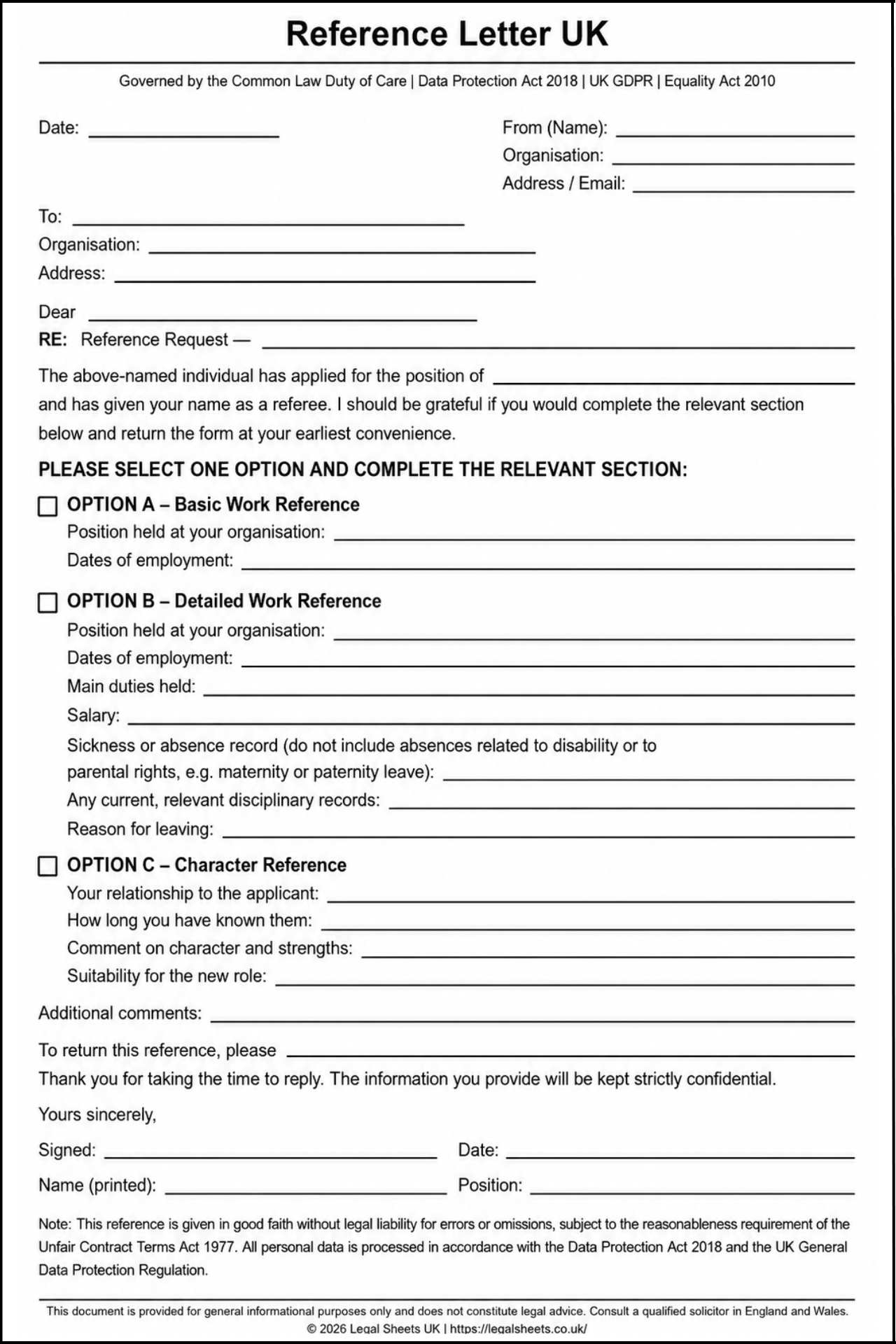
The Most Common Reference Letter Mistakes and Their Consequences
Inaccurate Negative References
A single incorrect statement can create significant financial consequences.
Withdrawn Job Offers
Many disputes begin when a prospective employer withdraws an offer after receiving adverse information.
Negligence Allegations
Where the information is inaccurate, negligence claims may follow.
Defamation Risks
False allegations can generate substantial litigation costs even before liability is determined.
Overly Positive References That Conceal Misconduct
References can create risk at the opposite extreme.
Liability to Future Employers
Providing a ‘glowing’ reference that deliberately conceals known, serious misconduct—such as financial irregularity or safeguarding breaches—exposes the former employer to direct civil liability. Under English common law, the new employer can sue the reference provider for the tort of Negligent Misstatement or Deceit to recover any financial damages suffered as a result of relying on the dangerously misleading document.
Financial Loss Claims
Where losses arise because misleading information was relied upon, the civil courts may become involved.
Misrepresentation Concerns
The danger usually arises where the reference creates an impression that is inconsistent with known facts.
Disclosing Sickness or Disability-Related Information
This remains one of the most sensitive areas of reference drafting.
Special Category Data Concerns
Health information constitutes special category data under UK GDPR and the Data Protection Act 2018.
Equality Act Implications
Disability-related disclosures can influence recruitment decisions and create discrimination risks.
Recruitment Discrimination Risks
A withdrawn offer following disclosure of health information may become the focus of legal scrutiny.
References Issued Inconsistently Across Employees
Consistency is often overlooked until a dispute emerges.
Victimisation Allegations
An employer operating a standard reference policy should apply it consistently.
Discrimination Complaints
Selective treatment can generate allegations of discriminatory conduct.
Employment Tribunal Exposure
Pursuant to Section 108 of the Equality Act 2010, employers cannot lawfully refuse or manipulate references as retaliation for discrimination complaints or grievances.
Settlement Agreements and Agreed Reference Wording
Why Agreed References Are Frequently Negotiated
References often become a central point during employment exits.
Departure Arrangements
Employees frequently seek certainty regarding future references before agreeing departure terms.
Redundancy Settlements
Reference wording is commonly negotiated as part of redundancy settlements.
Workplace Disputes
Where employment relationships have deteriorated, agreed wording can remove uncertainty regarding future disclosure during workplace mediation.
Risks of Departing from Agreed Wording
Breach of Settlement Terms
When agreed reference wording is explicitly annexed to a statutory Settlement Agreement under Section 203 of the Employment Rights Act 1996, the employer is strictly and legally bound to provide that exact text. Any deviation from, or oral contradiction of, this wording constitutes an actionable breach of contract.
Civil Court Claims
Deviation from agreed wording may result in breach of contract proceedings.
Damages for Contractual Breach
Financial loss arising from non-compliance may result in a claim for damages following contractual breaches.
Maintaining Consistency Across Future Reference Requests
HR Record Management
Approved wording should be retained within personnel records.
Approved Wording Procedures
Many employers restrict reference authority to HR personnel to prevent inconsistent responses following employee resignations.
Regulatory References and FCA Requirements
When a Standard Employee Reference Is Not Sufficient
Financial services employers operate within a different framework.
Senior Managers Regime
Senior Management Function appointments require regulatory references.
Certification Functions
Certification roles are also subject to mandatory reference requirements.
Financial Services Recruitment
Recruitment cannot proceed in the normal way where mandatory references have not been obtained.
Mandatory Disclosures Under FCA Rules
The FCA Handbook (specifically SYSC 22 Annex 1R) prescribes the mandatory template and sweeping disclosure requirements for regulatory references. Furthermore, following the April 2026 SM&CR regulatory updates (SYSC 22.5.17G), financial firms are now strictly expected to generate and issue these comprehensive references within an accelerated timeframe of just four weeks.
Conduct Rule Breaches
Relevant disciplinary findings involving Conduct Rule breaches must be disclosed.
Fitness and Propriety Findings
Findings affecting fitness and propriety assessments may require disclosure.
Six-Year Disclosure Requirements
Under the FCA Handbook (SYSC 22), regulated references carry a strict mandatory disclosure period for any Conduct Rule breaches or disciplinary actions occurring within the previous six years. Crucially, under English regulatory law, if the individual committed ‘serious misconduct,’ this six-year limitation is completely disapplied, and the firm must disclose the misconduct indefinitely
Consequences of Incomplete Regulatory References
Recruitment Restrictions
The recruiting firm may be unable to appoint the individual.
FCA Scrutiny
Incomplete disclosures attract regulatory attention.
Regulatory Enforcement Action
Failure to disclose relevant misconduct may result in enforcement action and regulatory penalties.
Confidentiality, Data Protection and Employee Access Requests
How Confidential Reference Exemptions Operate
Confidential references occupy a unique position under data protection law.
Reference Provider Protections
A confidential employment reference may be exempt from disclosure obligations.
Reference Recipient Protections
Under Schedule 2, Part 4, Paragraph 24 of the Data Protection Act 2018, the legal exemption for confidential employment references operates symmetrically. This means that neither the former employer drafting the reference nor the prospective employer receiving it is legally obligated to disclose the document to the employee if a Subject Access Request (SAR) is submitted
Subject Access Request Misconceptions
When References May Remain Exempt
Employees frequently assume that a Subject Access Request automatically grants access to a reference.
That assumption is often incorrect.
Common HR Misunderstandings
One recurring operational failure occurs when a receiving employer accidentally discloses a confidential reference during a Subject Access Request response.
This can create disputes between both organisations and may lead to allegations concerning confidentiality breaches.
Email Handling and Internal Distribution Controls
HR-to-HR Transmission Practices
Direct HR-to-HR transmission remains common because it supports confidentiality expectations for remote teams.
Record Retention Considerations
Copies are often retained to demonstrate precisely what information was supplied.
Avoiding Unnecessary Disclosure
Restricting circulation reduces the likelihood of accidental disclosure.
UK Legal Facts Relevant to Reference Letters
Legal Requirements Table
| Topic / Issue | Precise English Legal Rule | Governing Statute / Administrative Regulation |
| Obligation to Provide | Employers hold no general legal duty to provide a reference unless it is contractually agreed (e.g., via a Settlement Agreement) or mandated by industry regulators. | Common Law |
| Duty of Care (Accuracy) | If a reference is provided, the author owes a strict duty of care to ensure the information is true, accurate, fair, and does not give a misleading impression. | Common Law (Spring v Guardian Assurance / Hedley Byrne v Heller) |
| Financial Services Referencing | Regulated firms must proactively request and supply mandatory SM&CR regulatory references (using the SYSC 22 Annex 1R template) within an expected 4-week window. | Financial Services and Markets Act 2000 & FCA Handbook (SYSC 22) |
| Serious Misconduct Lookback | Disciplinary actions generally require a 6-year lookback period in regulated references, but ‘serious misconduct’ must be disclosed indefinitely with no time limit. | FCA Handbook (SYSC 22) |
| Post-Employment Victimisation | An employer is strictly prohibited from refusing to provide a reference, or providing a negative one, as retaliation for a former employee raising a discrimination complaint. | Equality Act 2010 (Section 108) |
| Confidential Reference Exemption | Confidential employment references are legally exempt from Subject Access Requests (SARs); neither the sender nor the receiver is obliged to disclose the text to the data subject. | Data Protection Act 2018 (Schedule 2, Part 4, Para 24) |
Practical Legal Impact
The legal significance of a reference often becomes apparent only after a recruitment decision has gone wrong.
An inaccurate negative reference may lead to lost earnings claims in the County Court or High Court. A retaliatory refusal to provide a reference may result in Employment Tribunal proceedings.
Financial services employers face additional obligations under the Financial Services and Markets Act 2000 and FCA Handbook requirements. Meanwhile, post-employment victimisation claims may arise under the Equality Act 2010.
The interaction between reference drafting and data protection law is particularly significant where sickness records, disability-related absences, or confidential communications are involved.
Before Sending a Reference Letter
Internal Checks Worth Completing
Most reference disputes could have been avoided through a short verification process.
Personnel File Review
Confirm employment records before drafting.
Performance Evidence Review
Verify any performance statements against documented evidence.
Disciplinary Record Verification
Ensure disciplinary disclosures are accurate and current.
Approval Procedures
Apply internal authorisation procedures consistently.
Questions HR Should Ask Before Release
Is Every Statement Supportable?
Unsupported assertions create unnecessary risk.
Could Any Wording Create a Misleading Impression?
Omissions can be as problematic as inaccuracies.
Does the Reference Reveal Special Category Data?
Health information requires particular caution.
Is the Reference Consistent With Company Policy?
Consistency remains one of the strongest safeguards against future disputes.
Related Employment Documents Often Used Alongside a Reference Letter
Settlement Agreement
Often contains agreed reference wording.
Grievance Letter
May become relevant where an employee challenges reference treatment.
Employment Contract
May contain contractual provisions regarding references.
Disciplinary Outcome Letter
Often provides evidence supporting conduct-related disclosures.
Redundancy Letter
Frequently reviewed when preparing agreed departure references.
Frequently Asked Questions
Can a former employer in England refuse to provide a Reference Letter altogether?
Generally yes. There is no general legal obligation to provide a reference unless a contractual commitment exists or the employer operates within a regulated sector requiring disclosure.
What happens if a job offer is withdrawn because of an inaccurate employee reference letter?
The former employee may pursue a claim for losses arising from the inaccurate reference. Depending on the facts, proceedings may involve negligence or defamation issues before the civil courts.
Can sickness absence or disability-related information be included in a professional reference letter?
Care is required. Health information engages obligations under the Data Protection Act 2018 and may create discrimination risks if recruitment decisions are influenced by disability-related information.
Does an employee have the right to see a confidential reference through a Subject Access Request?
Not necessarily. Confidential employment references may fall within the exemption contained in Schedule 2 Part 4 of the Data Protection Act 2018 and therefore may not need to be disclosed.
Author
-

Ankur is the founder and editorial reviewer at LegalSheets. He researches, writes, and reviews legal content, ensuring every template and guide is clear, accurate, and based on current UK laws and official government guidance. His focus is on making legal documents easier for individuals and businesses to understand and use.
