
Remote Work Agreement UK Template (Word & PDF)
A Remote Work Agreement is often searched for when an informal homeworking arrangement has gone on long enough that nobody is entirely certain whether it can still be changed. Many employers discover the importance of a Remote Work Agreement only when an employee challenges a return-to-office instruction and argues that remote working has become part of their contractual terms, a dispute that regularly finds its way to the Employment Tribunal.
Where homeworking permanently changes the employee’s place of work, the Employment Rights Act 1996 requires the change to be documented properly, yet this step is frequently overlooked during busy periods of operational change. The difficulty rarely comes from allowing remote work in the first place; it usually arises later when expectations about attendance, working hours, expenses, or supervision were never recorded clearly. The template and drafting guidance that follows are designed for those situations where remote working needs to move from informal practice to a properly documented employment arrangement.
Table of Contents
ToggleRemote Work Agreement Template (PDF, Word & Printable Formats)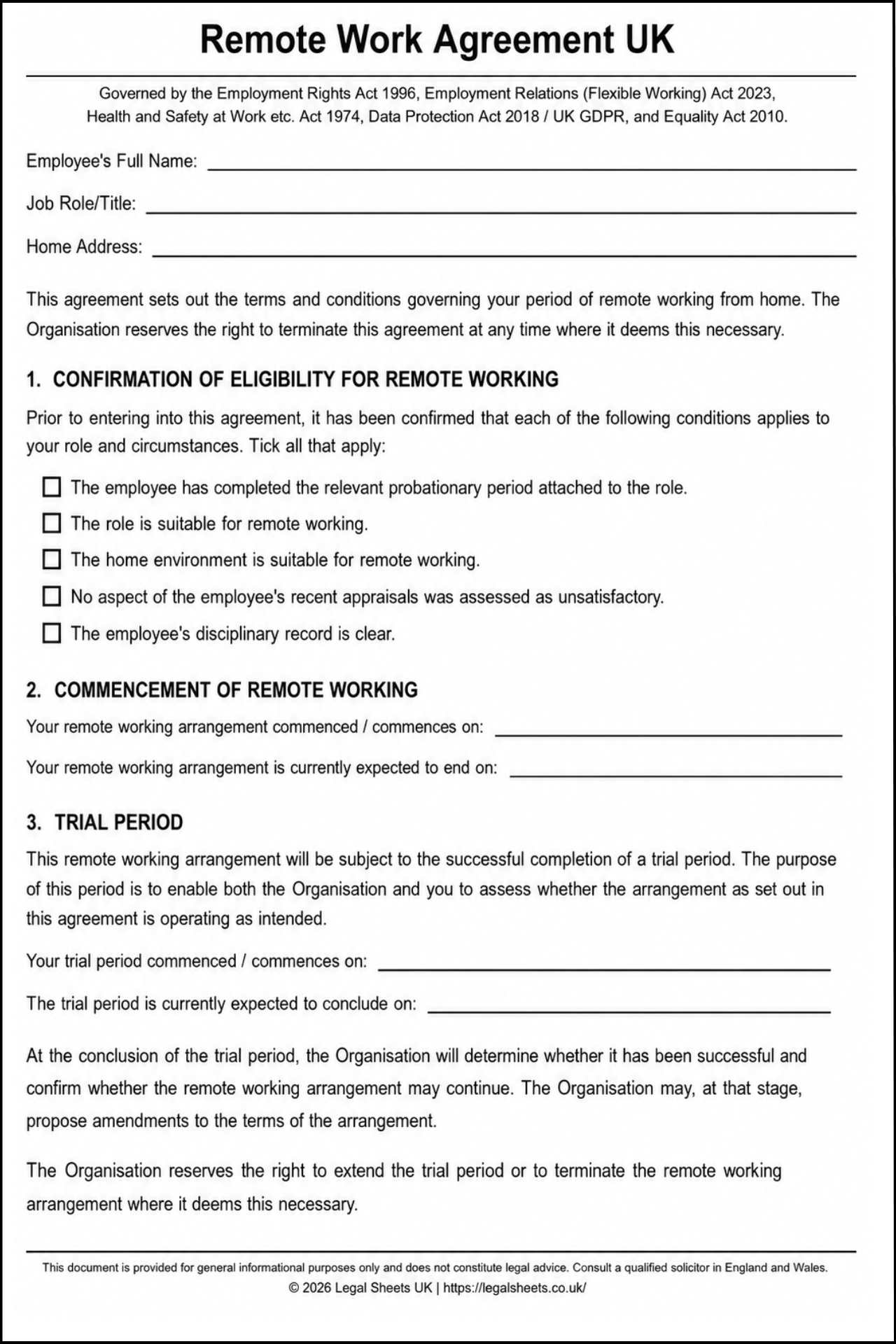
Before Remote Working Becomes Contractual: The HR Decisions That Matter
Is the Arrangement Temporary, Hybrid, or Permanent?
Many workplace disputes begin because nobody clearly identified whether the arrangement was temporary, hybrid, or permanent.
A temporary arrangement usually allows greater flexibility for future changes. A hybrid arrangement combines homeworking and office attendance. A permanent arrangement may alter the employee’s contractual place of work.
Employment Tribunals frequently examine the practical reality of how the arrangement operated rather than relying solely on labels used by employers. A remote arrangement described as temporary may eventually acquire contractual significance if it continues indefinitely without review.
Should the Employer Retain a Right to Require Office Attendance?
Businesses often discover difficulties when they attempt to require employees to return to the office after years of homeworking following organisational changes.
If the employer wishes to retain flexibility, the agreement should address:
- Circumstances requiring office attendance.
- Business continuity requirements.
- Review periods.
- Trial arrangements.
- Revocation rights.
The verified legal facts identify forced return-to-office disputes as one of the most common operational failures. Where a permanent contractual variation exists, unilateral withdrawal can expose employers to breach of contract and constructive dismissal claims.
When a Flexible Working Request Triggers the Need for an Agreement
Employees possess a Day 1 statutory right to request flexible or remote working. According to the verified legal facts, employers must consult and may only refuse such requests on permitted business grounds.
Where a request results in a long-term change to working arrangements, documenting the outcome through a Remote Work Agreement creates certainty regarding workplace expectations and operational responsibilities.
The Clauses That Most Often Cause Remote Working Disputes
Place of Work and Contract Variation
The workplace clause frequently becomes the most heavily scrutinised provision in any Remote Work Agreement.
Questions commonly arise regarding:
- The employee’s primary workplace.
- Whether the home address is designated as a workplace.
- Required office attendance.
- Flexibility regarding workplace location.
Pursuant to Section 4 of the Employment Rights Act 1996, where remote working permanently alters the contractual place of work, the employer must provide a written statement detailing the change within one month. Failure to do so can create additional liability if related Employment Tribunal claims arise.
Working Hours, Availability and Right to Disconnect
Remote working often blurs the distinction between working time and personal time.
The agreement should clearly address:
- Core working hours.
- Availability requirements.
- Break expectations.
- Overtime arrangements.
- Out-of-hours communications.
One recurring problem involves managers sending late-night emails that gradually create an expectation of continuous availability. The verified legal facts identify this as a significant risk area because failures relating to rest periods and disconnect expectations can generate Employment Tribunal claims.
Equipment, Broadband and Homeworking Costs
Expense disputes rarely arise on the first day of remote working. They typically emerge months later when equipment requires replacement or employees seek reimbursement for ongoing costs.
The agreement should address:
- Employer-owned equipment.
- Employee-owned equipment.
- Repairs and maintenance.
- Broadband usage.
- Utility expenses.
A common source of disagreement occurs where employers mandate remote working but never clarify responsibility for associated costs.
Performance Management Without Excessive Monitoring
Remote supervision requires balance.
Employers need visibility regarding productivity, while employees retain legitimate privacy expectations within their homes.
Problems commonly develop when organisations introduce monitoring software without clearly explaining its purpose or scope. Excessive monitoring can trigger employee grievances, regulatory concerns, and allegations that trust and confidence have been undermined.
Confidential Information in a Domestic Environment
Many confidentiality breaches occur through entirely ordinary household activities.
Examples include:
- Family members viewing screens.
- Documents left on kitchen tables.
- Printed records stored insecurely.
- Conversations conducted in shared living spaces.
The agreement should address practical confidentiality risks alongside technical cybersecurity controls for external consultants.
Home Office Safety: Obligations That Cannot Be Delegated
The Employer’s Duty of Care Beyond the Office
A common misunderstanding is that employers cease to have health and safety responsibilities once employees work from home.
The verified legal facts state that employers continue to owe a duty of care because the home workspace effectively becomes an extension of the workplace.
Homeworking Risk Assessments
Employers are required to assess homeworking risks.
Employers are required to assess homeworking risks under guidance from the Health and Safety Executive (HSE).volves:
- Display Screen Equipment assessments.
- Homeworking questionnaires.
- Follow-up reviews.
- Corrective measures where risks are identified.
Regulators are typically interested in whether risks were properly identified and addressed rather than the format used for the assessment itself.
Common Injury and Liability Scenarios
The most frequent issues involve:
- Back injuries.
- Poor workstation ergonomics.
- Repetitive strain injuries.
- Inadequate seating arrangements.
Where no meaningful assessment process exists, employers may face personal injury claims and Health and Safety Executive scrutiny.
Protecting Personal Data Outside the Workplace
Security Controls the Agreement Should Require
Remote workers routinely process personal and commercially sensitive information outside controlled office environments.
Common controls include:
- Password protection.
- Device encryption.
- Secure network requirements.
- Access restrictions.
According to the verified legal facts, employers must implement appropriate technical and organisational measures to secure remote processing activities.
Preventing Data Breaches at Home
Many breaches arise from simple mistakes rather than sophisticated cyberattacks.
Examples include:
- Shared household access.
- Visitors using work devices.
- Unsecured Wi-Fi networks.
- Lost laptops.
- Misplaced documents.
The agreement should address these risks in practical terms.
Remote Monitoring and Privacy Risks
The verified legal facts identify excessive monitoring as a major compliance concern.
Installing invasive monitoring software without appropriate assessment and disclosure can result in:
- Data protection complaints.
- ICO investigations.
- Employee grievances.
- Constructive dismissal allegations.
These issues frequently develop because organisations focus exclusively on productivity without considering privacy implications.
Avoiding the Most Expensive Remote Working Mistakes
Treating a Permanent Arrangement as a Reversible Policy
One of the most common Employment Tribunal disputes concerns whether remote working was contractual or merely discretionary.
Where the arrangement has become contractual, employers cannot simply withdraw it because business preferences have changed. Tribunals frequently examine workplace practice and conduct when resolving these disputes.
Allowing Invisible Overtime to Develop
Invisible overtime rarely appears in written policies.
Instead, it develops gradually through workplace culture and management expectations.
The verified legal facts identify failures relating to working hours and disconnect rights as significant sources of liability. Employees who feel pressured to remain constantly available may pursue claims relating to working time and constructive dismissal.
Leaving Expense Policies Undefined
Expense-related disagreements commonly involve:
- Broadband costs.
- Heating expenses.
- Equipment purchases.
- Maintenance costs.
A short clause dealing with reimbursement expectations can prevent disputes that otherwise escalate into formal grievances.
Failing to Address Home Confidentiality Risks
Data breaches occurring within domestic environments frequently attract greater scrutiny than employers anticipate.
Consequences may include:
- ICO investigations.
- Internal disciplinary action.
- Client complaints.
- Potential litigation following disclosure of confidential information.
UK Legal Requirements Affecting a Remote Work Agreement
Legal Requirements Table
| Topic / Issue | England Legal Rule | Governing Law |
|---|---|---|
| Place of Work Variation | Written statement required when workplace changes permanently | Employment Rights Act 1996 (Section 4) |
| Flexible Working Requests | Day 1 right to request remote or flexible working | Employment Rights Act 1996 (Section 80F) / ERA 2025 |
| Homeworking Health & Safety | Employer must assess remote workspace risks | Health and Safety at Work etc. Act 1974 / Health and Safety (Display Screen Equipment) Regulations 1992 |
| Working Hours & Disconnect | Rest periods and disconnect protections apply | Working Time Regulations 1998 / ERA 2025 |
| Data Protection | Appropriate safeguards required for remote processing | UK GDPR / Data Protection Act 2018 |
| Execution Formalities | Electronic signatures are generally valid | Common Law |
Practical Legal Impact
These legal requirements directly influence how a Remote Work Agreement should be drafted and implemented.
Workplace variation provisions affect contractual rights. Health and safety obligations require documented assessment processes. Data protection obligations influence confidentiality and device-security provisions. Working-time requirements affect availability expectations and management practices.
Employment Tribunal claims frequently arise where employers implement remote-working arrangements without addressing these issues at the outset. High-value confidentiality disputes may proceed through the High Court or County Court.
Signing, Implementing and Storing the Agreement
Obtaining Employee Agreement
Because a Remote Work Agreement often varies the employment contract, obtaining written agreement remains the safest approach.
The verified legal facts indicate that imposing changes unilaterally through email without employee consent creates legal risk.
Electronic Signatures and Digital HR Systems
Electronic signatures are generally valid for executing a Remote Work Agreement.
Many employers use HR platforms or digital signing systems to create a clear audit trail and maintain accessible records.
Documents That Should Sit Alongside the Agreement
The agreement is usually supported by:
- Employment contracts.
- Remote working policies.
- Health and safety assessments.
- IT security procedures.
- Data protection policies.
Together, these documents create operational consistency across the workforce.
How Remote Work Agreement Disputes Typically Reach a Tribunal
Contractual Variation Disputes
Common disputes involve:
- Refusal to return to the office.
- Withdrawal of homeworking rights.
- Alleged breaches of contractual commitments.
The central issue is often whether the arrangement became contractual or remained discretionary.
Working Time and Disconnect Complaints
Claims frequently arise where employees experience:
- Excessive working hours.
- Constant availability expectations.
- Inadequate rest periods.
These disputes often focus on management conduct rather than contractual wording alone.
Data Protection Incidents
Remote-working data breaches can lead to:
- Internal investigations.
- Regulatory scrutiny.
- Disciplinary proceedings.
- Confidentiality disputes.
High-Value Court Proceedings
Serious disputes may involve:
- Misuse of confidential information.
- Restrictive covenant breaches.
- Applications for injunctive relief.
According to the verified legal facts, these matters may proceed through the High Court or County Court rather than the Employment Tribunal.
Frequently Asked Questions
Can an employer require an employee to return to the office after signing a permanent Remote Work Agreement?
Not necessarily. If the agreement created a permanent contractual variation and contains no review or revocation mechanism, forcing a return to office may expose the employer to breach of contract and constructive dismissal claims.
What happens if a Remote Work Agreement changes the employee’s workplace but no Section 4 written statement is issued?
The verified legal facts state that an Employment Tribunal may award between two and four weeks’ statutorily capped pay where the employee succeeds in another substantive claim and the required statement was not provided.
Can an employer monitor a remote worker’s computer activity throughout the day?
Monitoring is not automatically prohibited, but excessive monitoring practices identified in the verified legal facts can create privacy, employment, and data protection risks where appropriate assessments and disclosures are absent.
Is a homeworking risk assessment still required if the employee chooses to work remotely?
Yes. Employers retain responsibility for assessing remote-working risks because the home workspace forms part of the working environment.
Who is usually responsible for broadband, heating and equipment costs when remote working is mandatory?
The answer depends on the agreement. Many disputes arise because expense arrangements were never documented. Where remote working is employer-mandated, reimbursement expectations should be addressed expressly within the Remote Work Agreement.
Author
-

Ankur is the founder and editorial reviewer at LegalSheets. He researches, writes, and reviews legal content, ensuring every template and guide is clear, accurate, and based on current UK laws and official government guidance. His focus is on making legal documents easier for individuals and businesses to understand and use.
