
Boat Bill Of Sale UK Fillable Template (PDF & Word)
A Boat Bill Of Sale usually becomes important after the deal has already been agreed, when the buyer asks for proof of ownership or the seller needs clear evidence that responsibility for the vessel has passed. In England, private boat sales commonly fall under the Sale of Goods Act 1979, while dealer sales are also subject to the Consumer Rights Act 2015, and a written record can make all the difference if ownership or the condition of the boat is later questioned.
One of the most common problems is relying on a simple receipt that omits details such as the Hull Identification Number (HIN), engine serial number, included equipment or outstanding marine finance, leaving the parties arguing in the County Court over what was actually sold. Whether you’re selling a narrowboat, yacht, motorboat or small pleasure craft, the template below records the transaction clearly and includes the practical wording needed to document the sale properly.
Affiliate Disclosure: We may earn a commission from purchases made through affiliate links on this page, at no extra cost to you.
Boat Bill Of Sale Template
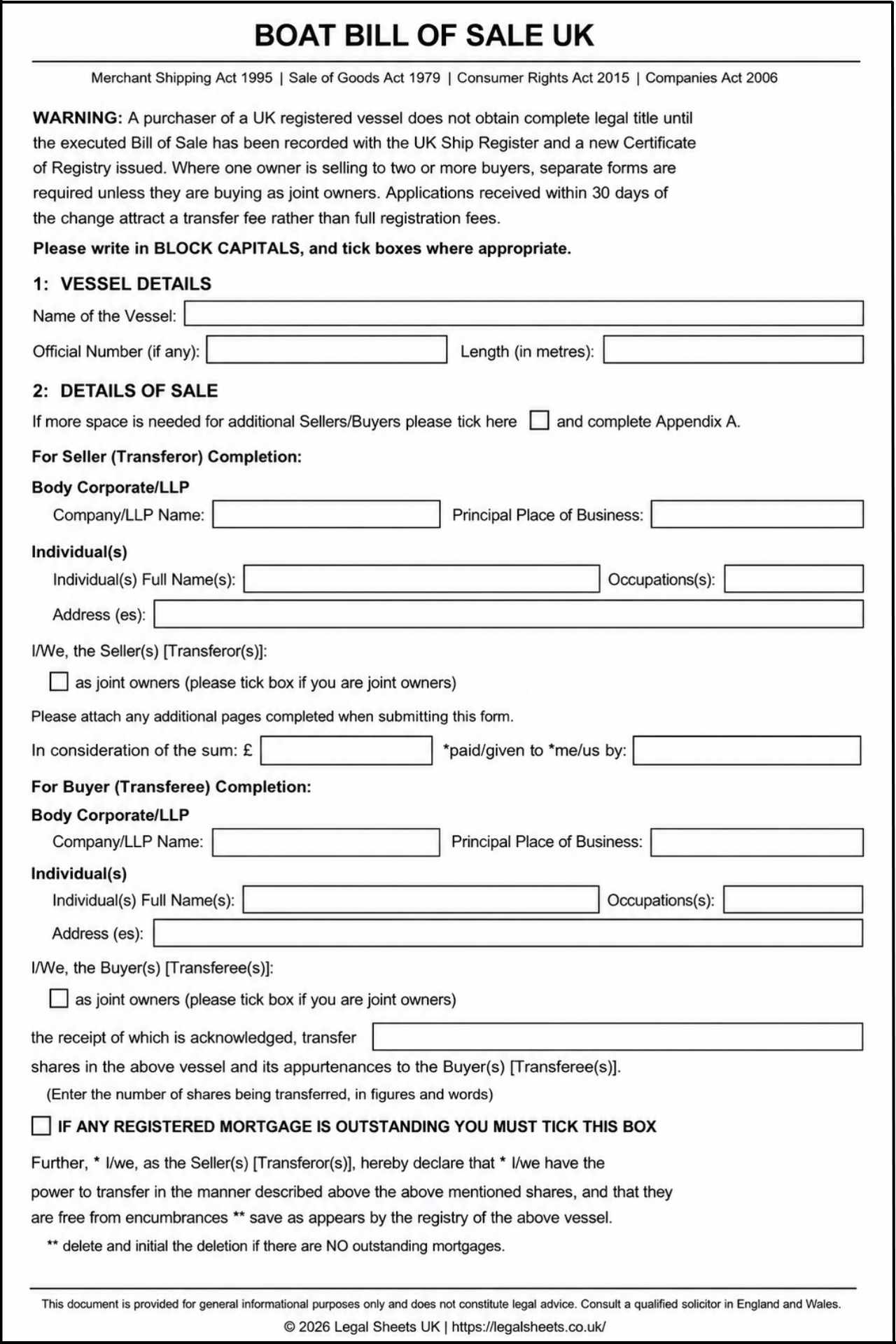
Customised Do-it-yourself Bill of Sale
When a Boat Bill of Sale Is Needed
Private sale of an unregistered boat
Private sales remain one of the most common situations requiring a Boat Bill Of Sale. Although there is no statutory requirement for a particular form when selling an unregistered vessel, a written agreement provides valuable evidence if ownership is later disputed. It identifies the parties, confirms the agreed price, and records precisely which boat was transferred.
If disagreement reaches the County Court, a properly completed document is likely to carry considerably more evidential weight than relying solely on emails or verbal discussions.
Sale of a Part I registered vessel
The position changes for vessels registered on Part I of the UK Ship Register. Under the Merchant Shipping Act 1995, the property in a Part I registered vessel is legally divided into exactly 64 shares. Any transfer of these shares must be executed using the official Maritime and Coastguard Agency (MCA) form—MSF 4705—signed in the physical presence of an independent attesting witness. Relying on an ordinary contract template will cause the Registrar of Shipping to instantly reject the transfer, leaving legal title unperfected
Simply exchanging money and taking possession does not complete the registration process where statutory requirements have not been satisfied.
Boat broker transactions
Broker sales frequently create confusion because the broker may simply introduce buyer and seller rather than becoming the legal seller. Under English agency law, if a yacht broker fails to explicitly disclose in writing on the Bill of Sale that they are executing the document purely as an agent for a private vendor, they become personally liable as the contractual principal. This operational failure strips away the protection of a private sale and binds the brokerage directly to the strict consumer quality standards of the Consumer Rights Act 2015.
Transfer between family members
Family transfers are often completed without money changing hands, yet a written Boat Bill Of Sale remains valuable. It records the change of ownership, identifies the vessel accurately, and provides documentary evidence for insurers, future purchasers, or registration authorities.
Years later, ownership history may become difficult to establish if no written transfer exists.
Sale of narrowboats and inland waterway vessels
Most inland boats are transferred through private agreements rather than formal registration systems. A Boat Bill Of Sale creates a permanent ownership record that can assist when applying for new waterway licences, arranging insurance, or selling the vessel again in the future.
It also helps distinguish which fixtures, equipment, and accessories formed part of the agreed purchase.
Recording ownership for insurance and finance purposes
“Insurers and finance providers frequently request documentary evidence showing how ownership was acquired for commercial leasing. A properly completed Boat Bill Of Sale establishes the purchase date, identifies the vessel, and records the agreed consideration.
Incomplete documents can delay finance approval or insurance arrangements because ownership cannot easily be verified.
Information That Should Appear in a Boat Bill of Sale
Buyer and seller details
Record each party’s full legal name and residential address. Accurate identification reduces uncertainty if either party later needs to enforce the agreement or confirm ownership.
Boat identification details
The vessel should be described with enough detail that it cannot reasonably be mistaken for another boat. A vague description may create difficulties if ownership is later challenged.
Hull Identification Number (HIN)
The Hull Identification Number is one of the most important identifiers. Even a single incorrect character can create registration problems or confusion over the vessel being transferred.
Before signing, both parties should compare the recorded HIN against the physical marking on the hull.
Registration number
Where applicable, include the vessel’s registration number exactly as it appears on the registration documents. Any discrepancy may delay future registration updates.
Make and model
State the manufacturer’s name together with the model designation. This supports accurate identification and assists future buyers when reviewing ownership history.
Year of manufacture
Including the year of manufacture provides additional certainty, particularly where similar models were produced over several years.
Engine details
The agreement should identify the engine supplied with the boat, including any available serial numbers where appropriate. This reduces disputes about whether the original engine formed part of the sale.
Equipment included in the sale
Disagreements frequently arise over removable equipment rather than the vessel itself. List significant items included in the purchase, such as:
- Navigation equipment
- Anchors
- Safety equipment
- Covers
- Spare propellers
- Tender boats
- Electronics
- Mooring equipment
A detailed inventory is often easier than attempting to resolve disagreements after completion.
Purchase price and payment details
State the agreed purchase price together with how payment will be made. Recording whether payment has been received in full provides clarity if questions arise later.
Completion date
The completion date identifies when ownership and possession pass between the parties. This date may also become relevant for insurance, registration updates, and future ownership records.
Ownership declaration
Under the Sale of Goods Act 1979, private sellers must have the legal right to sell the vessel at the time ownership passes. Dealer sales are additionally subject to consumer protections under the Consumer Rights Act 2015.
Including an ownership declaration records the seller’s confirmation that they are entitled to transfer ownership.
Existing mortgages or marine finance
One of the most significant risks in boat purchases involves undisclosed marine mortgages. For Part I registered vessels, statutory requirements include declarations concerning registered mortgages or encumbrances.
An undischarged registered marine mortgage creates an absolute in rem claim that permanently attaches to the vessel itself, regardless of whether it is subsequently sold to an innocent buyer. If the underlying debt is defaulted upon, the lender holds the statutory right to secure an arrest warrant from the Admiralty Court, authorizing an Admiralty Marshal to physically seize, chain, and sell the boat to recover the funds.
Signatures and witnessing requirements
Execution requirements depend on the registration status of the vessel.
For Part I registered vessels, the Merchant Shipping Act 1995 requires execution by the transferor in the physical presence of an attesting witness using the prescribed statutory form.
For unregistered boats and Small Ships Register vessels, written signatures remain valuable evidence even where no equivalent statutory witnessing requirement applies.
Different Rules Depending on the Boat’s Registration Status
Part I UK Ship Register vessels
Part I registration carries the most formal transfer requirements. The prescribed statutory Bill of Sale must be completed correctly before the transfer can be recorded by the UK Ship Register. The executed document is submitted together with the required registration documentation to perfect legal title.
Errors in the prescribed form can prevent registration from being completed even if payment has already been made.
Small Ships Register (SSR) vessels
The Small Ships Register does not establish legal ownership. Following a sale, the buyer applies separately for a new SSR certificate, while the seller notifies the Maritime and Coastguard Agency of the transfer. The Boat Bill Of Sale remains a private ownership record rather than a document filed with the register.
Unregistered boats
For unregistered vessels, ownership normally transfers through ordinary contract principles supported by the written Boat Bill Of Sale. Although no statutory filing process exists, retaining signed copies provides valuable evidence if ownership is questioned in the future.
Why registration status changes the legal requirements
Many ownership problems occur because parties assume every vessel follows identical transfer procedures. Registration status determines whether statutory forms, witnessing requirements, or registration filings are necessary.
Using the wrong document for a Part I registered vessel may prevent the buyer from becoming the registered owner, whereas an unregistered boat generally relies on the private agreement itself to establish ownership history.