
Distribution Agreement Template UK [Free Fillable, Printable PDF]
A Distribution Agreement is often needed when a supplier is ready to expand sales through an independent reseller and wants certainty about who can sell its products, where those products can be sold, and what happens if the relationship comes to an end. Problems commonly emerge not at the start of the arrangement but months later, when territory rights, exclusivity promises, or stock commitments were discussed commercially yet never recorded properly.
In England, competition rules under the Competition Act 1998 can become relevant where restrictions on resale or market allocation are drafted too aggressively, particularly in exclusive distribution networks. It is also common to see disputes arise after a supplier appoints additional distributors without appreciating how earlier contractual wording may be interpreted by a court. The Distribution Agreement template that follows is designed for businesses that need clear commercial terms before products enter the market and expectations begin to diverge.
Distribution Agreement Template (PDF, Word)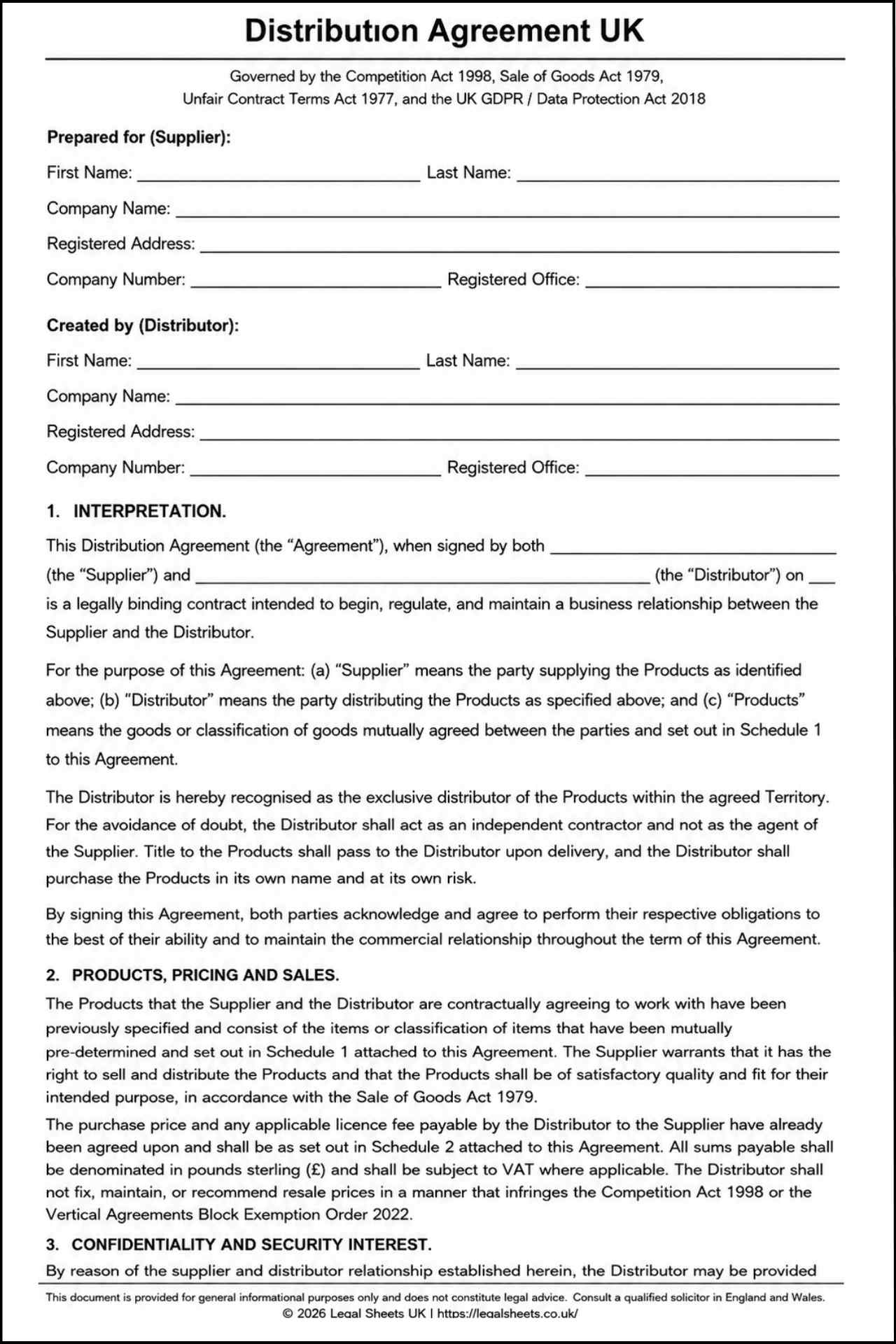
Before Using a Distribution Agreement, Decide What Commercial Model You Need
The commercial model selected at the outset often determines how disputes develop later.
Exclusive Distribution Agreement
An exclusive distribution agreement grants a distributor exclusive rights within a defined territory or customer group.
The supplier generally agrees not to appoint competing distributors within that area following shareholder changes. However, exclusivity clauses require careful drafting because certain restrictions may create competition law concerns.
Non-Exclusive Distribution Agreement
A non-exclusive arrangement allows multiple distributors to operate simultaneously.
This model often provides wider market coverage but may reduce the distributor’s incentive to invest heavily in promotion.
Selective Distribution Arrangements
Selective distribution systems permit suppliers to appoint distributors who satisfy defined standards.
These arrangements are commonly used for specialist, premium, or technical products.
Territory-Based Distribution Networks
Territory-based structures allocate rights by region or customer category.
Particular care should be taken to distinguish active sales restrictions from passive sales restrictions.
The Clauses That Usually Determine Whether the Relationship Succeeds or Fails
Product Scope and Specifications
The agreement should identify products precisely and address updates, replacements, technical specifications, and quality standards.
Poor drafting often leads to disputes regarding whether newly launched products fall within the distributor’s rights.
Territory and Customer Allocation
Geographic boundaries should be described clearly.
Vague territorial definitions frequently result in overlapping claims between distributors.
Ordering and Supply Procedures
Purchase order processes, forecasting obligations, acceptance mechanisms, and delivery requirements should be addressed in detail.
Pricing and Payment Structure
Pricing mechanisms should remain commercially workable throughout the life of the agreement.
Businesses often underestimate the disruption caused by unclear price review provisions in long-term service arrangements.
Minimum Purchase Commitments
Where sales targets exist, the agreement should define performance measurements and review periods.
Disputes commonly arise when targets are poorly defined or inconsistently measured.
Intellectual Property Permissions
Trademark usage rights should be documented carefully. Businesses can also review official government guidance on protecting trade marks through the UK trade mark registration process.
Brand owners frequently encounter problems when distributors continue using branding after termination.
Retention of Title (Romalpa) Clause
Retention of Title provisions become particularly significant when a distributor experiences financial difficulty.
Under English common law, if the distributor enters insolvency, ownership passes upon delivery unless expressly carved out. Without a robust, explicitly drafted Retention of Title clause, the supplier cannot recover goods and is left ranking at the bottom of the insolvency hierarchy as an unsecured creditor.
Competition Law Risks That Frequently Invalidate Distribution Clauses
Competition law issues represent one of the most common reasons distribution provisions become unenforceable.
Resale Price Maintenance (RPM) Risks
Under the Competition Act 1998 and VABEO 2022, suppliers cannot require distributors to sell products at fixed or minimum resale prices.
Recommended resale prices and maximum resale prices may be permitted, but fixed pricing requirements create significant legal exposure.
Restrictions on Passive Sales
Suppliers often misunderstand the limits of territorial protection.
Under the Competition Act 1998 and VABEO 2022, banning ‘passive sales’ (responding to unsolicited customer requests or participating in public procurement under the Procurement Act 2023) is a ‘hardcore restriction.’ While suppliers can restrict ‘active sales’ into exclusively allocated territories, prohibiting passive sales immediately strips the entire agreement of its block exemption safe harbour.
Exclusivity Clauses That Require Careful Drafting
Exclusive territories, customer allocations, and active sales restrictions require careful drafting to remain commercially effective.
Consequences of Competition Law Breaches
Potential consequences include:
- Unenforceable contractual provisions
- Loss of VABEO protection
- Competition and Markets Authority investigations
- Significant financial penalties
Managing Supply Chain Risk During the Life of the Agreement
Product Quality Disputes
Quality disputes often emerge long after products have entered the market.
Inspection procedures and defect reporting mechanisms reduce uncertainty when complaints arise.
Stock Management Problems
Excess inventory, forecasting failures, and obsolete stock can create significant financial losses.
The agreement should address responsibility for these risks.
Late Delivery Issues
Delivery failures frequently trigger broader commercial disputes.
Service expectations and delay management procedures should be documented clearly.
Product Recall Procedures
Product recalls often become expensive and disruptive following consultant recommendations.
The agreement should establish notification obligations, customer communication procedures, and cost allocation mechanisms.
Termination Provisions That Commonly Lead to Litigation
Termination disputes regularly reach the courts because commercial relationships rarely end smoothly.
Termination for Material Breach
The agreement should define material breaches, cure periods, and notice requirements.
Courts frequently examine whether a breach genuinely justified termination.
Termination Without Cause
Notice periods should be expressly stated.
Where no notice provision exists, common law may imply a requirement to provide reasonable notice, creating uncertainty for both parties.
Distributor Insolvency
Insolvency provisions often allow immediate termination.
However, suppliers may still encounter practical difficulties recovering stock and unpaid sums.
Post-Termination Obligations
The agreement should address:
- Return of confidential information
- Cessation of trademark use
- Outstanding customer orders
- Final account reconciliation
Common Drafting Errors That Create Expensive Commercial Disputes
Failing to Define Notice Periods
Undefined termination rights frequently generate litigation.
Parties often discover too late that reasonable notice is open to interpretation.
Poorly Defined Performance Targets
Vague sales targets make enforcement difficult and encourage disputes over underperformance.
Ambiguous Territory Descriptions
Unclear territorial definitions frequently result in competing claims between distributors.
Weak Retention of Title Wording
Weak ownership protection clauses may leave suppliers as unsecured creditors during insolvency proceedings.
Overly Broad Liability Exclusions
Under the Unfair Contract Terms Act 1977, liability limitations must satisfy the reasonableness requirement.
Under the Unfair Contract Terms Act 1977 (UCTA), B2B liability limitations must strictly satisfy the statutory ‘reasonableness’ test. If an English court deems a blanket exclusion or severe financial cap unreasonable given the parties’ bargaining power, it will sever the clause entirely, exposing the supplier to unlimited common law damages.
UK Legal Facts and Compliance Considerations
| Topic / Issue | England Legal Rule | Governing Law |
|---|---|---|
| Execution Formalities | Can generally be executed as a simple contract | Common Law |
| Statutory Notice Periods | If the contract is silent on termination limits, the courts will imply a right to terminate only upon “reasonable notice.” | Common Law |
| Resale Price Maintenance | Forcing a distributor to sell at a fixed or minimum price is a hardcore restriction and strictly prohibited. Businesses can review official Competition and Markets Authority guidance for further information. | Competition Act 1998 / VABEO 2022 |
| Implied Product Quality Terms | Goods supplied B2B must be of “satisfactory quality” and “fit for purpose” unless expressly and reasonably excluded under the Sale of Goods Act 1979. | Sale of Goods Act 1979 |
| Limitation of Liability | Clauses capping or excluding B2B liability for breach of contract or negligence are void unless they satisfy the statutory “reasonableness” test under the Unfair Contract Terms Act 1977. | Unfair Contract Terms Act 1977 (UCTA) |
| Corporate Bribery Liability for independent contractors | Suppliers face strict corporate criminal liability and unlimited fines if a distributor (“associated person”) pays a bribe to obtain/retain business on their behalf. | Bribery Act 2010 (Section 7) |
In practice, these rules influence how agreements are enforced when disputes reach the County Court or High Court. Product quality disputes often involve the implied terms contained within the Sale of Goods Act 1979, while liability clauses frequently receive detailed scrutiny when significant losses are claimed.
Competition law issues can also attract regulatory attention from the Competition and Markets Authority, particularly where pricing restrictions or unlawful territorial controls appear within the agreement.
How Distribution Agreements Differ From Agency Agreements
Ownership of Goods
A distributor purchases and owns inventory.
An agent generally does not take title to goods.
Commercial Risk Allocation
Distributors assume resale risk and profit from successful sales.
Agents usually receive commission payments.
Regulatory Treatment
Distribution agreements are not governed by the Commercial Agents Regulations 1993.
This distinction can significantly affect termination rights and commercial expectations.
Revenue Structure
Distributors earn profit through resale margins.
Agents earn commission under contractual arrangements.
Where Distribution Agreement Disputes Are Usually Resolved
County Court Claims
Lower-value contractual disputes and unpaid invoice claims are commonly pursued through the County Court.
High Court Commercial Disputes
Large-scale exclusivity disputes, wrongful termination claims, and substantial breach of contract cases often proceed to the High Court.
Competition and Markets Authority Investigations
The Competition and Markets Authority may investigate anti-competitive restrictions contained within distribution arrangements.
Frequently Asked Questions
Can a supplier force a distributor to sell at a minimum price?
No. Fixed or minimum resale pricing is generally prohibited under the Competition Act 1998 and VABEO 2022. Such provisions may be unenforceable and can expose businesses to regulatory scrutiny and significant financial penalties.
What happens if a Distribution Agreement does not contain a termination notice period?
Where the contract is silent, common law may imply a requirement to provide reasonable notice before termination. The length of reasonable notice depends on the facts and frequently becomes a source of dispute.
Is a Retention of Title clause automatically included in a Distribution Agreement?
No. Retention of Title protection must be specifically drafted into the agreement. Without appropriate wording, ownership may pass according to the contractual arrangements and general sale of goods principles.
Can an exclusive distributor stop all sales into its territory?
No. While an exclusive distributor can legally be protected from ‘active sales’ (targeted marketing or direct solicitation) by other distributors into their territory, they cannot be protected from ‘passive sales.’ A supplier cannot stop other distributors from fulfilling unsolicited orders from customers located within an exclusive territory, as this constitutes a hardcore restriction under VABEO 2022.
Does a Distribution Agreement need to be filed with Companies House?
No. A Distribution Agreement is generally a private commercial contract and does not require registration for validity. If the Distribution Agreement includes an exclusive trademark or patent licence, that specific intellectual property element should be registered with the UK Intellectual Property Office (UK IPO) to protect against third-party claims, but the commercial agreement itself remains entirely private.