
Free Shareholder Agreement Template (PDF, & Printable Formats)
Many businesses only start searching for a Shareholder Agreement when a new investor is coming in, a founder wants an exit route, or disagreements begin to emerge over who controls key decisions. One of the most common problems in England is discovering that the Shareholder Agreement says one thing while the company’s Articles of Association say another, creating uncertainty at precisely the moment shareholders need certainty.
In practice, disputes that reach the Business and Property Courts often reveal that arrangements concerning voting rights, director appointments, or share transfers were discussed extensively but never properly recorded. Because these arrangements operate alongside rights and protections contained within the Companies Act 2006, careful drafting matters long before any disagreement arises.
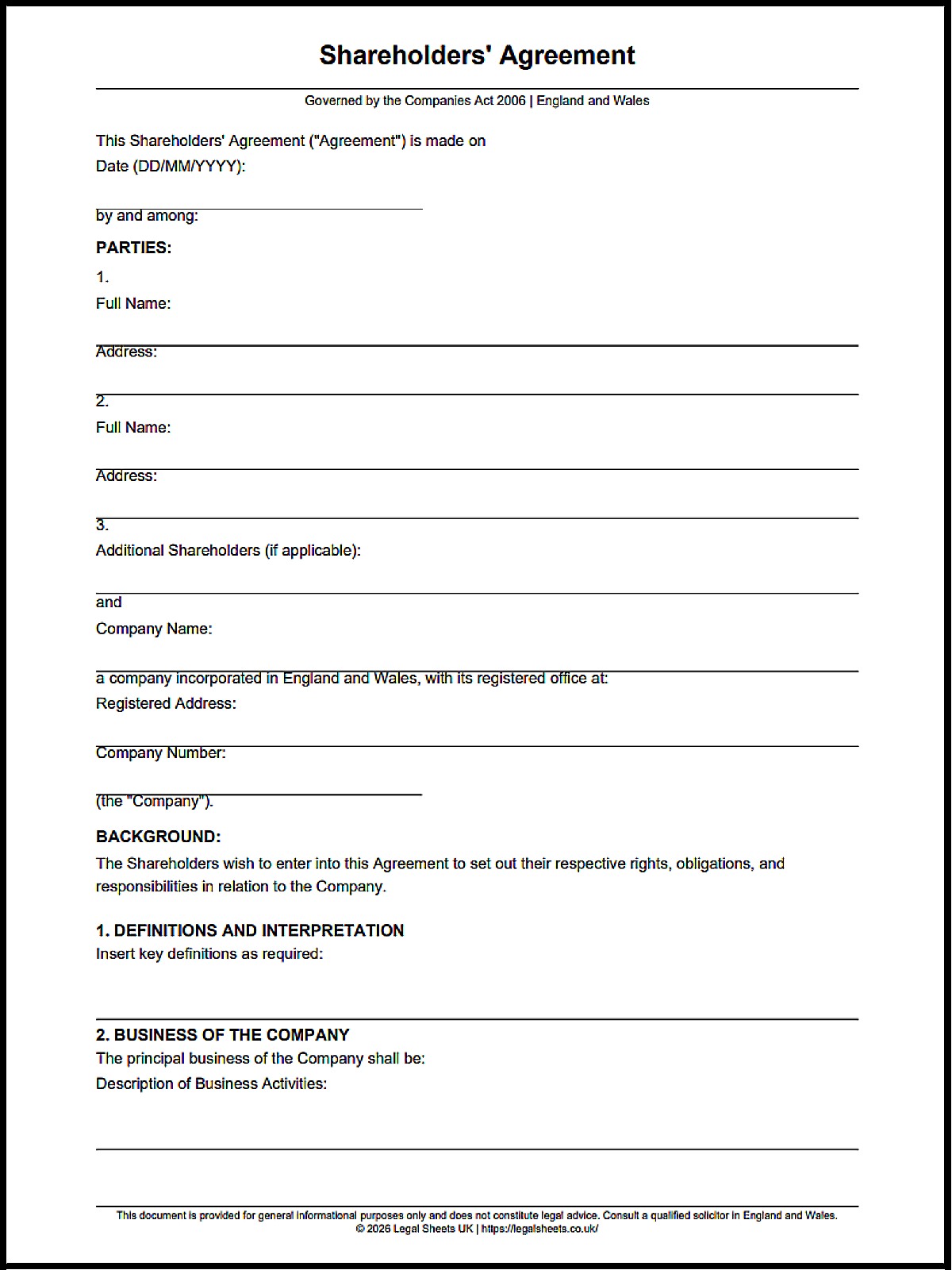
Whether you are establishing a new company or reviewing existing shareholder arrangements, the agreement and drafting guidance that follows can be used to record those commercial expectations in clear written terms.
Shareholder Agreement Template (PDF, Word & Printable Formats)
Why Businesses Use a Shareholder Agreement Alongside Their Articles
Many business owners assume that the Articles of Association provide complete protection against ownership disputes. In practice, the Articles and the shareholder agreement perform very different functions.
The distinction becomes increasingly important as the company grows and ownership interests become more diverse.
The Operational Gap Articles Often Leave Behind
Articles of Association primarily regulate the company’s constitutional administration. They address matters such as share rights, meetings, resolutions, and corporate governance procedures.
A shareholder agreement addresses a different concern: how shareholders behave toward one another.
This distinction allows businesses to regulate sensitive commercial matters privately while retaining standard constitutional arrangements publicly.
Companies often use shareholder agreements to obtain:
- Greater flexibility over ownership arrangements
- Confidential commercial protections
- Tailored investor rights
- Detailed transfer procedures
- Bespoke exit arrangements
Many of the disputes encountered in private companies arise not because the Articles are defective, but because they were never intended to regulate personal shareholder relationships in sufficient detail.
Decisions Commonly Controlled Through the Agreement
Certain decisions can significantly affect shareholder value and control.
For that reason, shareholder agreements often require enhanced approval before actions such as:
- Issuing new shares
- Taking on substantial borrowing
- Changing the business strategy
- Appointing senior executives
- Entering major contracts
- Approving acquisitions or disposals
These provisions frequently become negotiation points between founders and investors. Minority shareholders often seek greater protection against decisions that could dilute ownership or fundamentally alter the business.
Risks of Relying Solely on Articles
Where businesses rely exclusively on the Articles, several practical weaknesses can emerge.
Common examples include:
- Limited minority investor protections
- Inadequate exit planning
- Weak deadlock procedures
- Reduced control over share transfers
- Increased ownership disputes
A recurring feature of shareholder litigation is that the dispute itself was entirely foreseeable. The real problem was that the shareholders never agreed in advance how the issue would be managed.
Founder departures, investment rounds, succession events, and ownership sales are rarely unexpected events. The absence of a contractual process for dealing with them is often what creates the dispute.
Ownership Problems the Agreement Is Designed to Prevent
Most shareholder agreements are drafted to manage future ownership risks rather than existing disagreements.
The strongest agreements identify predictable sources of conflict and establish procedures before those conflicts arise.
Unwanted Third-Party Share Acquisitions
Business owners often assume they will have some control over who acquires shares in their company.
Without contractual restrictions, that assumption may prove incorrect.
Common mechanisms used to regulate ownership transfers include:
- Transfer restrictions
- Rights of first refusal
- Pre-emption arrangements
- Compulsory transfer provisions
These clauses are designed to prevent situations where existing shareholders suddenly find themselves sharing ownership with an individual or organisation they never intended to admit into the business.
Minority Shareholder Vulnerabilities
Minority shareholders frequently focus on obtaining protections that reduce the risk of exclusion from major business decisions.
Common protections include:
- Information rights
- Voting safeguards
- Reserved matters
- Anti-dilution provisions
However, contractual protections have limits. Pursuant to the Companies Act 2006, shareholders cannot completely contract out of statutory rights relating to derivative actions or unfair prejudice claims. Agreements may introduce dispute resolution procedures, but they cannot entirely extinguish those statutory remedies.
Founder Relationship Breakdown
Founder disputes are among the most expensive ownership conflicts encountered by private companies.
Common causes include:
- Strategic disagreements
- Management disputes
- Unequal contributions
- Departure scenarios
- Competing business activities
Where the agreement contains no clear deadlock procedures, even relatively minor disagreements can prevent important decisions from being implemented. In closely held companies with equal ownership, operational paralysis can develop surprisingly quickly.
Investor and Founder Misalignment
Investors and founders frequently have different commercial objectives.
Areas of disagreement often include:
- Growth expectations
- Dividend policies
- Exit timing
- Strategic control
Many disputes arise because these issues were discussed informally during investment negotiations but never translated into enforceable contractual provisions. Once business performance changes or market conditions deteriorate, those differing expectations can become a significant source of conflict.
Clauses That Usually Drive Negotiations
Not every clause receives the same level of scrutiny during negotiations. In practice, shareholders often spend relatively little time discussing boilerplate provisions and significantly more time negotiating control rights, ownership protections, and exit arrangements.
The clauses that attract the most attention are usually those that affect power, money, or future ownership.
Reserved Matters and Veto Rights
Reserved matters are commonly used where shareholders want certain decisions to require enhanced approval rather than allowing management or majority shareholders to act independently.
Typical examples include:
- Significant capital expenditure
- Major borrowing arrangements
- Acquisitions and disposals
- Changes to business activities
- Issuing additional shares
These provisions frequently become contentious where investors seek extensive veto rights while founders wish to preserve operational flexibility.
Poor drafting can create practical difficulties. If approval thresholds are set too low, routine management decisions may become unnecessarily delayed. If thresholds are set too high, minority shareholders may find themselves unable to prevent decisions that materially affect their interests.
Share Transfer Controls
Ownership changes often trigger the most serious shareholder disputes.
As a result, transfer provisions are usually among the most heavily negotiated parts of a shareholder agreement.
Common transfer controls include:
- Pre-emption rights
- Tag-along rights
- Drag-along rights
- Permitted transfer provisions
Negotiations frequently focus on balancing flexibility with protection. Founders may wish to retain freedom to reorganise ownership structures, while investors typically seek safeguards against being left behind in a sale transaction.
A poorly drafted transfer clause may create uncertainty at the exact moment a transaction needs to proceed quickly, increasing the likelihood of litigation.
Director Control and Board Composition
Board control often becomes a sensitive issue once outside investment is introduced.
Shareholders commonly negotiate:
- Appointment rights
- Removal rights
- Observer rights
- Quorum requirements
Many disputes arise because shareholders focus heavily on ownership percentages while paying insufficient attention to board mechanics.
A shareholder with a substantial equity interest may discover that practical control rests with those who control board appointments. For that reason, governance provisions frequently carry greater commercial significance than their length might suggest.
Profit Distribution Provisions
Dividend expectations are often aligned during periods of growth but become contentious when profitability increases.
Common provisions address:
- Dividend policies
- Retained earnings decisions
- Capital reinvestment expectations
Founders frequently prefer reinvestment into the business, whereas investors may seek returns through distributions.
Without clear expectations, disagreements can emerge even where the company is performing successfully.
Confidentiality and Competitive Restrictions
Shareholders typically gain access to commercially sensitive information.
For that reason, agreements commonly contain provisions dealing with:
- Confidential business information
- Customer relationships
- Supplier relationships
- Competitive activities
Particular care is required when drafting restrictive covenants.
Under English common law principles relating to restraint of trade, courts will not enforce restrictions that are excessively broad in duration, geographic scope, or commercial reach. Where a restriction goes beyond what is reasonably necessary, the court may strike it down entirely.
Drafting Deadlock Mechanisms Before a Dispute Happens
Deadlock provisions often receive limited attention during drafting because shareholders assume they will never need them.
In reality, deadlock mechanisms frequently become some of the most valuable provisions in the entire agreement.
Circumstances That Commonly Create Deadlock
Deadlock is most common where ownership and voting power are evenly balanced.
Typical triggers include:
- Equal ownership structures
- Founder disagreements
- Strategic direction disputes
- Funding disagreements
A business may remain profitable while still becoming incapable of making important decisions. When neither side possesses sufficient authority to break the impasse, operational paralysis can follow.
Resolution Models Often Used
Different businesses adopt different approaches depending on their ownership structure and commercial objectives.
Common approaches include:
- Escalation meetings
- Mediation requirements
- Expert determination
- Buy-sell procedures
- Shoot-out clauses
The objective is not necessarily to prevent disagreement. Instead, the objective is to ensure that disagreement eventually produces an outcome rather than indefinite stalemate.
Drafting Risks That Cause Enforcement Problems
Many deadlock provisions appear effective on paper but become difficult to operate in practice.
Common drafting failures include:
- Ambiguous trigger events
- Undefined valuation methodologies
- Missing procedural deadlines
- Incomplete notice requirements
One recurring problem involves buy-out procedures that require an independent valuation but fail to explain how that valuation should be conducted.
Where the methodology is unclear, the valuation process itself can become the subject of dispute, delaying the very resolution mechanism that was intended to end the disagreement.
Share Transfer Events That Require Special Planning
Many shareholder agreements are tested for the first time when ownership changes occur.
A transfer event often exposes weaknesses that remained hidden while all shareholders were actively involved in the business.
Voluntary Share Sales
A shareholder may wish to dispose of shares for entirely legitimate reasons, including retirement, personal financial planning, or changing commercial priorities.
Transfer provisions generally determine:
- Who must be notified
- Who receives priority purchase rights
- How pricing is determined
- What approvals are required
Without a structured process, disputes frequently arise over valuation, timing, and purchaser suitability.
Death or Incapacity of a Shareholder
Unexpected events can create immediate uncertainty regarding ownership and voting rights.
Businesses commonly address: Succession arrangements, Transfer obligations, Valuation procedures, Funding mechanisms and estate planning.
The absence of planning can leave remaining shareholders negotiating with personal representatives who may have entirely different objectives from the deceased shareholder.
Retirement or Departure of a Founder
Founder departures often create operational as well as ownership challenges following resignation decisions.
The agreement may regulate:
- Share transfers
- Continuing involvement
- Voting rights
- Transitional obligations
Without clear provisions, a departing founder may retain substantial ownership influence despite no longer contributing to the business.
Good Leaver and Bad Leaver Provisions
These provisions frequently become contentious because they directly affect share value.
Circumstances Triggering Each Category
The agreement typically defines events that determine whether a shareholder is treated as a good leaver or bad leaver.
Triggers may include:
- Retirement
- Ill health
- Resignation
- Misconduct
- Competitive activities
The drafting must be sufficiently precise to minimise future disputes.
Valuation Consequences
Valuation disputes are among the most common enforcement problems involving leaver provisions.
The agreement should clearly explain:
- Who conducts the valuation
- What methodology applies
- Whether discounts apply
- How disagreements are resolved
A common operational failure occurs when the agreement appoints an independent accountant but provides no meaningful valuation framework. This often results in lengthy disputes over methodology before any valuation can even begin.
Compulsory Transfer Obligations
Many agreements require departing shareholders to transfer shares in specified circumstances after business separation.
The practical enforceability of these provisions often depends upon precise drafting and clearly defined procedures.
Protecting Business Continuity During Ownership Changes
Ownership transitions can destabilise a business if they occur without planning.
Common continuity measures include:
- Succession planning
- Transitional voting arrangements
- Funding purchase obligations
Well-structured provisions seek to ensure that changes in ownership do not simultaneously create uncertainty regarding management and operational control.
Avoiding Conflicts Between the Agreement and the Articles
Conflicts between a shareholder agreement and the Articles of Association create some of the most frustrating disputes encountered in private companies.
The parties may believe they have agreed a clear contractual position, only to discover that the company remains entitled to act under conflicting constitutional provisions.
Why Conflicts Create Practical Enforcement Difficulties
The Articles regulate the company’s internal administration.
The shareholder agreement creates contractual obligations between the parties.
These are separate legal mechanisms with different enforcement routes.
Where conflict arises, shareholders may discover that the company can validly act under the Articles while a shareholder simultaneously faces allegations of contractual breach.
This often creates delay, additional costs, and uncertainty.
The Role of a Supremacy Clause
Many agreements include provisions designed to minimise constitutional conflicts.
Common mechanisms include:
- Obligations to align constitutional documents
- Shareholder voting commitments
- Rectification procedures
The practical objective is to ensure that shareholders remain contractually obliged to support amendments necessary to maintain consistency between the two documents.
Common Areas Where Conflicts Arise
Recurring conflict areas include:
- Director appointments
- Share transfers
- Voting thresholds
- Class rights
These matters often appear in both documents, increasing the possibility of inconsistency if amendments are made without coordinated review.
Consequences of Leaving Conflicts Unresolved
Failure to address inconsistencies can create significant enforcement difficulties.
Potential consequences include:
- Contract claims rather than operational remedies
- Delayed enforcement
- Increased litigation costs
- Commercial uncertainty
A particularly problematic situation arises where shareholders believe a contractual restriction prevents certain action, while the Articles permit the company to proceed. By the time the dispute reaches court, the practical damage may already have occurred.
Execution Mistakes That Can Make the Agreement Unenforceable
Many shareholder disputes focus on substantive rights. However, enforceability problems often originate much earlier during execution.
An agreement that has not been properly executed may create uncertainty precisely when the parties need certainty most.
When Consideration Becomes a Problem
Consideration issues commonly arise where existing shareholders agree to assume new obligations without receiving fresh value in return.
Examples include:
- Existing shareholders accepting new restrictions
- Amendments imposing additional obligations
- New parties joining existing arrangements
Under English common law contract principles, a lack of fresh consideration can create enforceability concerns.
Circumstances Requiring Deed Execution
Where no clear fresh consideration exists, execution as a deed may be required.
Pursuant to the Law of Property (Miscellaneous Provisions) Act 1989, execution as a deed can preserve enforceability where consideration would otherwise be problematic.
This issue frequently arises when amending an existing agreement or introducing a deed of adherence for incoming shareholders.
Individual Signature Requirements
Where an individual executes the agreement as a deed, witnessing requirements become particularly important.
Practical errors often include:
- Missing witness signatures
- Incomplete execution blocks
- Poor record keeping
These problems may remain unnoticed until enforcement becomes necessary.
Company Execution Requirements
Where the company itself is a party to the agreement, execution requirements must be considered carefully.
Pursuant to Section 44 of the Companies Act 2006, a company may execute the document through:
- Two authorised signatories
- A director and company secretary
- A single director in the presence of a witness
Execution errors are frequently discovered only after a dispute arises, at which point rectification can become considerably more difficult.
UK Legal Facts and Compliance Framework
The legal effectiveness of a shareholder agreement often depends as much on execution and drafting discipline as it does on the commercial terms themselves. Many disputes that eventually reach the courts arise because the parties assumed that signing a document automatically guarantees enforceability.
The following legal framework reflects the principal rules that influence shareholder agreements governed by the law of England.
| Topic / Issue | England Legal Rule | Governing Law |
|---|---|---|
| Execution Formalities | If no fresh consideration exists, execution as a deed may be required. Individual deeds require witnessing. | Law of Property (Miscellaneous Provisions) Act 1989, s.1 |
| Corporate Capacity & Execution | Company execution depends upon authorised signatories and witnessing requirements. | Companies Act 2006, s.44 |
| Statutory Fettering of Powers | A company cannot be contractually prevented from exercising its statutory powers, although shareholders may agree personal voting obligations. | English Common Law / Russell v Northern Bank Development Corp Ltd [1992] |
| Minority Protection Exclusions | Rights relating to unfair prejudice and derivative claims cannot be completely excluded by private agreement. | Companies Act 2006, ss.260–264 and s.994 |
| Variation and Amendments | Amendments must comply with the contractual variation mechanism agreed by the parties. | English Common Law of Contract |
Businesses often focus heavily on negotiating commercial provisions while paying comparatively little attention to execution requirements and enforceability risks.
In practice, however, many disputes centre on whether an amendment was validly made, whether shareholders were properly bound, or whether a clause can actually be enforced against the company itself.
Further information regarding the Companies Act 2006 and the Law of Property (Miscellaneous Provisions) Act 1989 can be accessed through the official legislation database.
Practical Legal Impact
The legal rules above directly influence how shareholder agreements are drafted, amended, and enforced.
How the Companies Act Influences Drafting Decisions
Many provisions that appear straightforward commercially can become problematic if they attempt to interfere with statutory company powers.
Particular care is often required when drafting:
- Reserved matters provisions
- Voting arrangements
- Constitutional interactions
- Minority protections
A common misunderstanding is that shareholders can simply prohibit the company from exercising statutory powers through a private agreement. English law distinguishes between restrictions imposed on the company itself and personal contractual obligations imposed on shareholders.
This distinction frequently becomes critical during enforcement proceedings.
How Execution Rules Affect Enforceability
Execution problems rarely attract attention until a dispute emerges.
Areas commonly scrutinised include:
- Deed execution requirements
- Witnessing arrangements
- Corporate execution procedures
Where enforceability depends upon execution as a deed, an incorrectly completed signature process can undermine the very protections the parties intended to create.
Clauses That Require Particular Care
Certain provisions generate a disproportionate number of disputes.
Examples include:
- Voting obligations
- Share transfer restrictions
- Amendment procedures
- Minority protection clauses
These clauses often sit at the intersection of contractual rights and company law principles, increasing the importance of precise drafting.
Consequences of Ignoring Legal Requirements
Failure to address legal requirements properly can result in:
- Unenforceable provisions
- Invalid amendments
- Corporate governance disputes
- Increased litigation exposure
By the time these issues are discovered, the parties are often already involved in a wider ownership dispute, making resolution considerably more expensive.
Confidentiality, Filing Obligations and the Companies House Filing Trap
One reason many businesses favour shareholder agreements is that they generally remain private.
Confidentiality allows shareholders to regulate sensitive commercial arrangements without making those arrangements publicly available.
Why Most Shareholder Agreements Remain Private
Unlike Articles of Association, a shareholder agreement is ordinarily a private contractual document.
There is generally no requirement to file the agreement with Companies House, HM Land Registry, or another public register merely because the parties have entered into it.
For many businesses, this confidentiality is commercially valuable.
Circumstances That May Trigger a Filing Requirement
Problems can arise where drafting unintentionally causes the agreement to operate like a constitutional document rather than a private contract.
The risk is not always obvious when the agreement is first prepared.
The Section 29 Constitutional Alteration Risk
If provisions effectively apply to all members and alter the company’s constitutional arrangements in a manner similar to a special resolution, filing obligations may arise.
Under Sections 29 and 30 of the Companies Act 2006, certain agreements that effectively alter constitutional rights may need to be filed within 15 days.
Further details regarding these provisions can be reviewed within the official Companies Act 2006.
Drafting Techniques Used to Preserve Confidentiality
To reduce filing risks, agreements are commonly drafted as personal contractual obligations between shareholders rather than direct alterations of constitutional rights.
Common approaches include:
- Personal shareholder covenants
- Voting commitments
- Contractual obligations to support specified actions
The objective is to regulate shareholder conduct rather than rewrite constitutional mechanics through a private document.
Consequences of Missing the 15-Day Filing Requirement
Where a filing obligation arises and is overlooked, consequences may include:
- Statutory offences
- Financial penalties
- Potential liability for officers in default
This is one reason why constitutional interaction should be reviewed carefully whenever shareholder agreements are updated or expanded.
How Shareholder Agreement Disputes Are Usually Enforced
When shareholder relationships deteriorate, enforcement becomes less about drafting theory and more about practical remedies.
The remedy sought often determines the litigation strategy.
Typical Breaches That Lead to Litigation
Common claims arise from:
- Unauthorised share sales
- Voting breaches
- Confidentiality breaches
- Failures to follow deadlock procedures
Many disputes begin as relatively narrow contractual disagreements but expand rapidly once trust between shareholders disappears.
When Damages Are Not Enough
Financial compensation is not always an adequate remedy.
For example, where a shareholder attempts to transfer shares in breach of agreed restrictions, the commercial harm may be impossible to quantify accurately.
In such circumstances, parties may seek:
- Interim injunctions
- Specific performance orders
- Urgent court intervention
These remedies are particularly common in high-value private company disputes.
Why Delay Can Damage a Claim
Shareholders sometimes assume they can wait until commercial negotiations conclude before taking legal action.
That approach can be dangerous.
Where equitable remedies such as injunctions or specific performance are sought, delay may weaken the claimant’s position considerably.
Courts frequently examine whether the claimant acted promptly once the alleged breach became known.
Choosing the Correct Legal Route
Not every shareholder dispute belongs in the same type of legal proceeding.
Possible routes include:
- Breach of contract claims
- Unfair prejudice petitions
- Derivative actions
- Alternative dispute resolution procedures
A recurring mistake is assuming that every disagreement should be pursued through an unfair prejudice petition.
In many cases, a straightforward contractual claim may be the more appropriate and proportionate remedy.
Disputes involving shareholder agreements are generally civil matters and may be heard in the County Court or, for more complex corporate disputes, the High Court’s Chancery Division.
Common Drafting Failures That Create Expensive Shareholder Disputes
Many costly disputes can be traced back to relatively small drafting omissions.
The problem is often not the absence of a clause, but the absence of sufficient detail.
Undefined Share Valuation Methodologies
Valuation provisions frequently trigger disputes during exits and compulsory transfers.
Problems commonly arise where the agreement identifies a valuer but fails to specify:
- Valuation methodology
- Applicable discounts
- Assumptions to be applied
- Treatment of minority holdings
The result is often disagreement before the valuation process has even begun.
Overly Broad Restrictive Covenants
Non-compete and non-solicitation provisions must be drafted carefully.
Restrictions that extend too far geographically, commercially, or temporally may be vulnerable to challenge under English restraint of trade principles.
Businesses often discover this weakness only after attempting enforcement.
Poorly Drafted Transfer Provisions
Transfer provisions regularly fail because they omit practical details such as:
- Notice requirements
- Response periods
- Completion procedures
- Valuation mechanisms
Even where the commercial intention is clear, procedural uncertainty can delay implementation.
Missing Amendment Procedures
Many shareholder agreements assume amendments will be straightforward.
In reality, future amendments frequently become contentious.
Without a clear variation mechanism, parties may later disagree about:
- Required approval thresholds
- Signing requirements
- Effective dates
Failure to Address Future Investment Rounds
Companies expecting growth often overlook the impact of future fundraising through investor introductions.
New investment may alter:
- Ownership percentages
- Voting rights
- Board composition
- Exit arrangements
A document drafted solely for the current ownership structure may become increasingly difficult to operate as the business expands.
Ambiguous Voting Thresholds
Voting provisions must be precise.
Unclear thresholds can create uncertainty regarding whether approvals have been validly obtained.
When significant transactions depend upon those approvals, ambiguity can become extremely expensive.
Frequently Asked Questions
Can a shareholder agreement stop a shareholder bringing an unfair prejudice claim?
No. While parties may agree contractual dispute resolution procedures, statutory rights relating to unfair prejudice claims and derivative actions cannot be completely excluded through a private agreement under the Companies Act 2006.
What happens if the shareholder agreement conflicts with the Articles of Association?
Conflicts can create significant enforcement difficulties. The company may continue operating under the Articles while shareholders pursue contractual remedies for breach of the agreement. Many agreements therefore include provisions requiring shareholders to support amendments that align the two documents.
Does a shareholder agreement need to be filed at Companies House?
Generally, no. A shareholder agreement is ordinarily a private document. However, filing obligations may arise where the agreement effectively alters constitutional arrangements in a manner that triggers the Companies Act 2006 provisions concerning constitutional alterations.
Can an existing shareholder agreement be amended without new consideration?
Where amendments involve new obligations without fresh consideration, enforceability issues may arise. In some circumstances, execution as a deed may be required pursuant to Section 1 of the Law of Property (Miscellaneous Provisions) Act 1989.
What problems arise if a good leaver or bad leaver clause does not explain how shares are valued?
Valuation disputes are one of the most common sources of shareholder litigation. If the agreement fails to specify the methodology, assumptions, or valuation process, enforcement can stall while the parties argue about how the shares should be assessed. This frequently increases costs and delays the resolution of the underlying dispute.