
Commission Agreement Template UK [Free PDF]
Commission arguments rarely start when a deal is signed; they usually begin months later when someone believes they generated the sale and someone else disagrees. A Commission Agreement is often used by businesses, sales agents, consultants, and introducers in England to record exactly when commission becomes payable, how it is calculated, and what happens if a customer cancels, delays payment, or places repeat orders.
Where commission earners negotiate the sale of goods, they fall under the Commercial Agents (Council Directive) Regulations 1993. Following the UK Government’s 2025 decision to retain these rules as ‘assimilated law,’ principals remain strictly bound by mandatory termination rights, yet many agreements still rely on vague, non-compliant wording that completely ignores these non-excludable statutory protections. County Court disputes regularly arise when a business assumes commission is due only after it receives payment, while the agreement says something different or says nothing at all. The template and drafting notes below focus on the clauses that most often determine whether a commission claim succeeds or turns into an expensive disagreement.
Commission Agreement Template (PDF, Word & Printable Formats)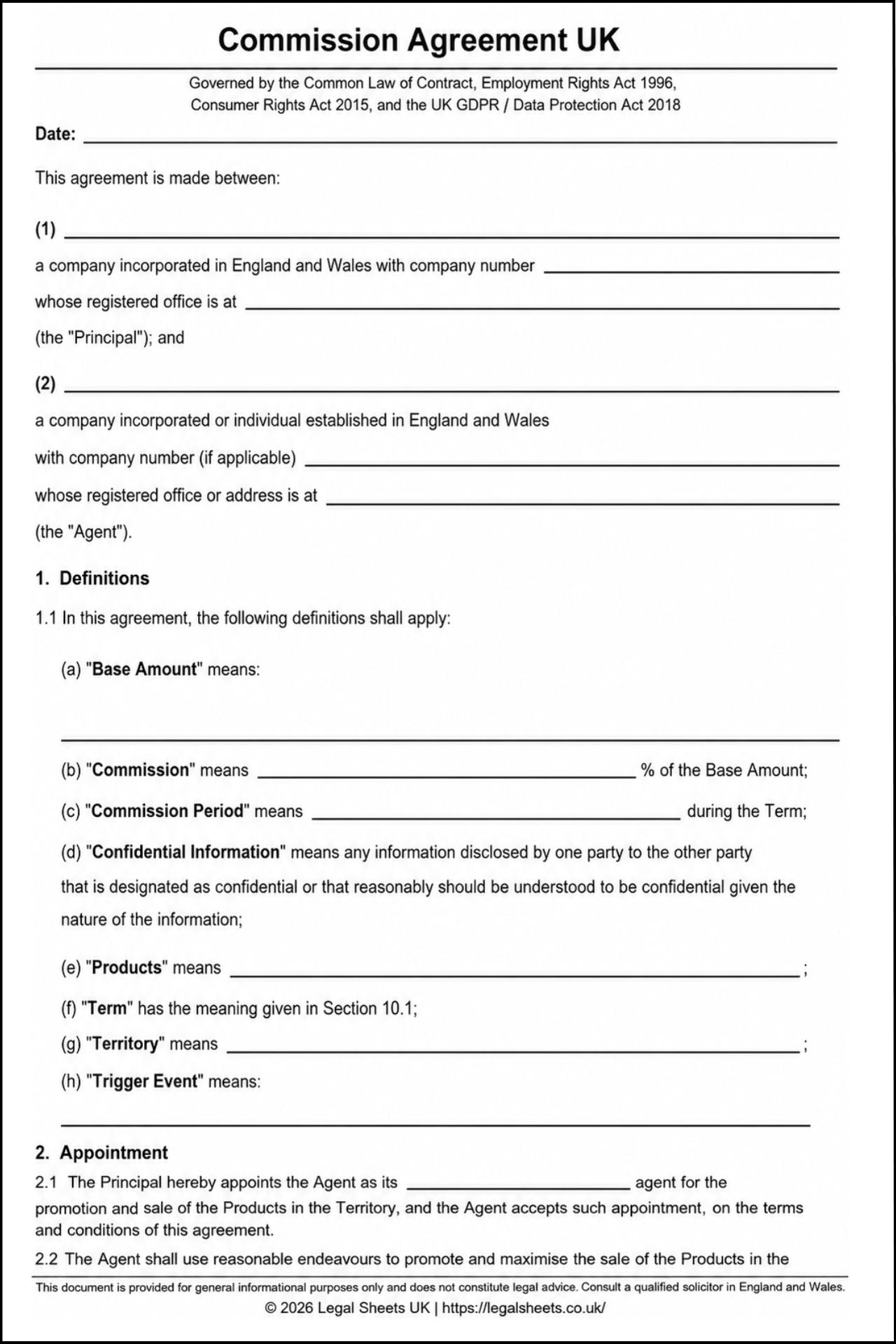
Before Using a Commission Agreement, Decide What Actually Triggers Payment
Many County Court commission disputes begin with a simple question: what exactly earned the commission?
Simple Introduction vs Completed Sale
Different businesses use different commission events.
- Referral of contact details only
- Qualified lead generation
- Signed customer contract
- Customer payment received
- Recurring customer revenue
A business may believe commission becomes payable only when money reaches its bank account. The introducer may believe payment was earned once the customer was introduced. Unless the agreement clearly addresses this point, disagreements often emerge months after the introduction occurred.
Why “Effective Cause” Disputes Commonly Reach Court
Under common law principles referenced in the legal brief, courts frequently examine whether the introducer was the effective cause of the transaction. Problems often arise where:
- Multiple parties contributed to the sale
- Internal sales teams completed negotiations
- Sales cycles lasted many months
- Revenue attribution remains unclear between affiliate partners.
The longer the sales process, the more difficult proving entitlement can become.
Defining the Commission Event
A well-drafted commission contract should identify the precise trigger.
Examples include:
- First introduction
- Successful meeting
- Signed agreement
- Customer onboarding
- Revenue collection milestone
Structuring the Commercial Relationship Correctly
The structure chosen at the beginning frequently determines future liability.
Introducer Arrangement
An introducer typically limits their role to creating opportunities.
Common characteristics include:
- Introduces opportunities only
- No authority to negotiate
- No authority to bind the business
Many organisations intentionally adopt this model to reduce disputes regarding authority and responsibility.
Sales Commission Arrangement
A sales-focused arrangement often involves greater participation.
Typical features include:
- Active participation in the sales process
- Potential involvement in negotiations
- Performance-linked commission structure
As participation increases, additional legal considerations may arise.
When a Commission Earner May Become a Commercial Agent
A significant risk emerges where the commission earner negotiates the sale of goods on behalf of the principal.
Factors frequently examined include: Negotiating sales of goods for distribution networks
- Acting on behalf of the principal
- Participating in contractual discussions
The Costly Reclassification Risk Businesses Often Miss
Businesses sometimes label someone an introducer while operationally treating them as a commercial agent.
Potential consequences include:
- Statutory termination rights
- Mandatory notice periods
- Compensation or indemnity exposure
- Unexpected post-termination payments
The legal brief highlights that mandatory protections may apply under the Commercial Agents (Council Directive) Regulations 1993 where the relationship falls within their scope.
Commission Clauses That Prevent Expensive Disputes
Most litigation revolves around payment calculations rather than whether a relationship existed.
Calculating the Commission Percentage
Common structures include:
- Fixed percentage model
- Tiered commission structure
- Revenue-based calculations
- Profit-based calculations
Businesses should avoid vague formulas that require later interpretation.
Defining What Revenue Counts
A surprising number of disputes involve deductions and adjustments.
The agreement should address:
- Gross revenue
- Net revenue
- VAT treatment
- Refunds and chargebacks
- Customer credits
The legal brief notes that commission payments are generally subject to VAT where applicable and the introducer is VAT-registered.
Timing of Payments
Payment timing often becomes contentious where customers pay in stages.
Common approaches include:
- Monthly payment cycles
- Quarterly payment cycles
- Payment after customer settlement
- Deferred payment models
Handling Cancelled or Unpaid Customer Contracts
A commission agreement should address circumstances where the customer relationship fails.
Key provisions often include:
- Commission clawback provisions
- Partial commission adjustments
- Customer default scenarios
Managing Pipeline Commission After Termination
Post-termination commission claims frequently involve substantial sums.
Clients Introduced Before the Agreement Ends
The most difficult cases often involve customers who were introduced before termination but sign contracts later.
Examples include:
- Ongoing negotiations
- Delayed contract signing
- Multi-stage sales processes
Tail Commission Provisions
Tail commission clauses attempt to deal with future revenue streams.
Common models include:
- Fixed tail periods
- Unlimited tail rights
- Revenue-sharing after termination
Common Drafting Failures
Recurring drafting mistakes include:
- No post-termination wording
- Unclear entitlement rules
- Ambiguous customer ownership
The legal brief specifically identifies pipeline commission ambiguity as a major source of High Court litigation.
High-Value Disputes Frequently Seen in Practice
Large claims often arise in: Technology contracts with service providers
- Property transactions
- Long-term service agreements
- Enterprise sales arrangements
Anti-Bribery and Compliance Protections
Commission payments create commercial incentives. Without safeguards, they can also create compliance exposure.
Why Commission Payments Can Create Regulatory Risk
Risk factors frequently include:
- Hidden referral payments
- Undisclosed incentives
- Third-party influence concerns
Anti-Bribery Clauses Worth Including
Businesses commonly include:
- Compliance obligations
- Audit rights
- Record-keeping requirements
- Immediate termination rights
The legal brief notes that failure to include appropriate anti-bribery protections can expose organisations to significant liability under the Bribery Act 2010.Corporate Liability Exposure
Potential consequences include:
- Associated persons risk
- Failure-to-prevent offences
- Reputational damage
- Financial penalties
Regulated Industries Requiring Additional Protection
Not every introduction can be treated as a simple referral.
Financial Services Introductions
Additional issues can arise regarding:
- FCA-related considerations
- Authorised activity restrictions
- Consumer disclosure obligations
Introducing customers to regulated financial services, insurance, or credit facilities without explicit Financial Conduct Authority (FCA) authorisation—or a valid statutory exemption—is a criminal offence under the Financial Services and Markets Act 2000 (FSMA) and can render the underlying consumer contracts totally unenforceable
Mortgage and Credit Introductions
Particular attention should be given to:
- FSMA risks
- Criminal offence exposure
- Regulatory enforcement concerns
Insurance Referral Arrangements
Areas commonly requiring additional review include:
- Commission disclosure obligations
- Regulated activity limitations
Preventing Employment Status Claims
Commission-only arrangements do not automatically prevent employment-related claims.
When Commission Earners Claim Worker Rights
Claims frequently arise where businesses exercise substantial control through:
- Excessive supervision
- Fixed working patterns
- Operational control
Clauses That Support Independent Contractor Status
Businesses commonly reinforce independence by providing:
- Business independence
- Freedom to work elsewhere
- Self-managed activities
Consequences of Worker Reclassification
Potential consequences include:
- Holiday pay claims
- Wage-related claims
- Employment Tribunal proceedings
Under the Employment Rights Act 1996, if a business exercises excessive operational control over a sole-trader commission earner, an Employment Tribunal can pierce the ‘independent contractor’ label and reclassify them as a ‘worker,’ instantly unlocking backdated holiday pay and National Minimum Wage arrears for unremunerated prospecting hours
Audit Rights and Sales Verification Procedures
Trust often becomes strained once commission payments begin.
Why Introducers Often Suspect Underreporting
Common complaints include:
- Lack of sales visibility
- Missing customer updates
- Revenue reporting disputes
Records the Agreement Should Require
Good record management commonly includes:
- Sales reports
- Customer status updates
- Commission statements
- Supporting financial records
Audit Clauses That Reduce Litigation Risk
Useful provisions may include:
- Inspection rights
- Information requests
- Reporting deadlines
Without reporting rights, introducers may be forced to pursue disclosure applications before obtaining evidence of completed sales.
Ending the Relationship Without Creating Future Liability
Termination clauses deserve the same attention as commission clauses.
Ordinary Termination Provisions
Most agreements address:
- Notice requirements
- Immediate termination events
- Material breach provisions
Commercial Agency Notice Rules for Goods Sales
Where commercial agency legislation applies, the legal brief notes that mandatory notice protections may arise and cannot be excluded.
Compensation vs Indemnity Exposure
Businesses frequently overlook the financial impact of termination.
Considerations include:
- Financial implications for business loans
- Drafting considerations
- Risk allocation strategy
If the agreement involves the sale of goods and fails to explicitly elect an ‘indemnity’ cap, the statute automatically defaults to ‘compensation.’ Under English common law, this requires the principal to pay out the hypothetical market value of the commission stream as a going concern at termination—a drastically more expensive outcome.
UK Legal Facts Relevant to a Commission Agreement
| Topic / Issue | England Legal Rule | Governing Law |
|---|---|---|
| Execution Formalities | Can be validly executed as a simple contract under hand; formal deeds are only required if granting a Power of Attorney. | Common Law |
| Payment Deductions | Unauthorised commission deductions are strictly unlawful if the individual tribunal-tests as a “worker,” triggering immediate arrears claims. | Employment Rights Act 1996 |
| Corporate Bribery Prevention | Principals carry strict corporate criminal liability if an introducer (“associated person”) pays a kickback to secure a contract. | Bribery Act 2010 |
| Regulated Introductions | Introducing clients for regulated financial products without direct FCA authorisation or an Appointed Representative exemption is a criminal offence. | Financial Services and Markets Act 2000 |
| Statutory Notice Periods | Mandatory minimum termination notices (1–3 months) automatically apply if the agent negotiates goods, and cannot be contracted out of. | Commercial Agents Regulations 1993 |
| VAT on Commission | Standard-rate VAT applies to B2B commission payments if the introducer is registered, unless a strict statutory financial/insurance exemption is met. | Value Added Tax Act 1994 |
These legal rules affect commission agreements in very different ways depending on the underlying business model. A referral arrangement for consultancy services may primarily involve contractual interpretation issues. By contrast, goods-based sales activity can create commercial agency liabilities, while regulated financial introductions may trigger regulatory scrutiny.
In practice, many disputes stem from drafting decisions made at the start of the relationship rather than events occurring at termination.
Common Mistakes That Make Commission Agreements Difficult to Enforce
Failing to Define the Trigger Event
Unclear payment triggers often create disputes over whether commission was earned.
Ignoring Post-Termination Commission Rights
Tail commission disagreements regularly arise after successful long-term sales efforts.
Allowing Negotiation Activity Without Assessing Agency Risk
Businesses sometimes create commercial agency exposure without recognising it.
Omitting Audit and Reporting Rights
A lack of transparency often increases litigation costs.
Paying Referral Fees Without Compliance Controls
Anti-bribery concerns become more difficult to manage where no compliance framework exists.
Frequently Asked Questions
Can I refuse commission if my internal sales team completed most of the deal?
Possibly. The answer depends on how the commission agreement defines entitlement and whether the introducer can demonstrate they were the effective cause of the transaction. Where the wording is unclear, disputes frequently reach the civil courts.
What happens if a customer signs after the Commission Agreement has ended?
The outcome depends on the post-termination commission provisions and any tail commission wording. Agreements that fail to address pipeline customers often generate expensive disputes.
Can a commission-only individual claim worker rights?
Potentially yes. Excessive control over working practices may support a worker-status argument, potentially leading to Employment Tribunal claims for statutory rights.
Does a Commission Agreement need to be filed with a government authority?
Generally no, as standard B2B commission agreements are purely private contracts. However, there is a strict regulatory exception: if the introducer acts as an Appointed Representative (AR) for an FCA-regulated principal regarding financial products, the principal is legally mandated to register the AR on the public Financial Services Register.
When can a Commission Agreement accidentally become a Commercial Agency Agreement?
This commonly occurs where the commission earner moves beyond introductions and begins negotiating the sale of goods on behalf of the principal. That operational change can trigger statutory protections and termination liabilities that were never anticipated when the relationship began.