Equipment Bill Of Sale Template UK | Word & PDF
Selling a piece of business equipment often seems straightforward until someone asks for proof of exactly what changed hands. An Equipment Bill Of Sale records the transfer of machinery, tools, plant, office equipment or other business assets, and in England it works alongside the Sale of Goods Act 1979, while sales made by traders are also affected by the Consumer Rights Act 2015.
A common problem appears when expensive equipment is described too vaguely or serial numbers, model details and included accessories are omitted, leaving ownership and condition open to challenge if a dispute reaches the County Court. Whether you’re buying or selling construction equipment, agricultural machinery, workshop tools or commercial assets, the template below provides clear wording to document the transaction accurately and create a reliable record of the sale.
Equipment Bill Of Sale Template (PDF, Word, Fillable Formats)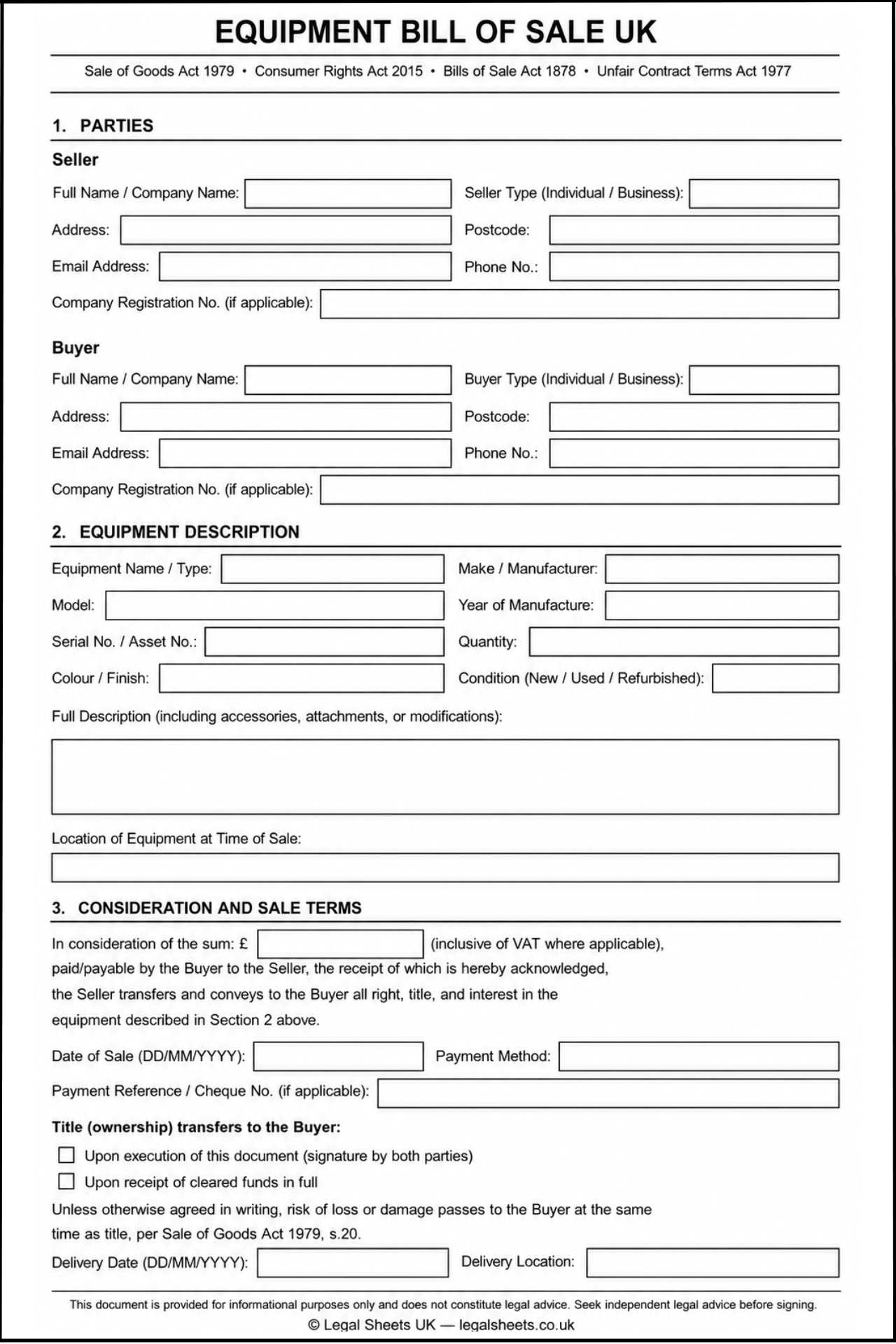
Situations Where an Equipment Bill Of Sale Is the Right Document
The document can be adapted for many different industries provided the transaction involves an outright transfer of ownership.
Selling Heavy Machinery
Heavy industrial machinery represents a significant financial investment. Recording the machine’s identification details and condition reduces uncertainty if defects or ownership issues are later raised.
Selling Industrial Equipment
Factories replacing manufacturing equipment frequently document each asset individually to avoid confusion during collection and installation.
Transferring Business Equipment
Business asset transfers often involve multiple items sold together between business partners. Listing each asset separately within the document makes it easier to confirm exactly what formed part of the sale.
Private Equipment Sales
Private sellers may not have formal invoices or commercial contracts. A properly completed bill of sale creates an independent record showing what was agreed between the parties.
Agricultural Machinery Transactions
Agricultural equipment commonly includes removable attachments and accessories. Listing these individually avoids later disagreements over whether they formed part of the purchase price.
Construction Plant Sales
Construction equipment frequently changes location between projects. Recording collection dates, operating hours and identifying marks provides useful evidence if ownership is challenged.
Commercial Kitchen Equipment Sales
Commercial catering equipment often has manufacturer identification plates and servicing records. Including these references strengthens the document’s evidential value.
Office Equipment Disposal
Office asset disposals are often completed in batches. Recording model numbers and asset tags assists with inventory reconciliation after the transaction.
Workshop Tool Transfers
Professional workshops may dispose of specialist diagnostic equipment or expensive power tools. Individual identification reduces the risk of disputes where similar equipment remains on the seller’s premises.
Information You Should Gather Before Completing the Document
Preparing the information in advance usually results in a more accurate document and fewer drafting errors.
Seller Information
Record the seller’s full legal name, address and contact information exactly as they wish to appear in the agreement.
Buyer Information
The buyer’s identifying details should be equally complete so there is no uncertainty regarding who acquired ownership.
Equipment Identification Details
Equipment should be described with enough precision that it cannot be confused with another similar asset.
Make and Manufacturer
Include the manufacturer’s name exactly as displayed on the equipment.
Model Number
Model references distinguish equipment that may otherwise appear identical.
Serial Numbers
Serial numbers are often the strongest evidence of ownership because they uniquely identify a specific piece of equipment. Recording an incorrect number can create unnecessary disputes if ownership later becomes contested.
Asset Tags
Many businesses apply internal asset labels to equipment. Including these references assists with inventory records and confirms precisely which item has been transferred.
Operating Hours (Where Applicable)
Construction machinery, generators and agricultural equipment commonly record operating hours. Buyers often use these figures when assessing wear and expected maintenance.
Existing Defects
Known faults should be described clearly rather than relying on informal conversations. If defects are documented before the sale, there is less scope for disagreement about whether damage existed at the point ownership changed.
Accessories Included
List every attachment, cable, remote control, attachment kit or accessory forming part of the sale.
Manuals and Documentation
Where operating manuals, maintenance logs or service documentation are included, these should also be recorded within the agreement.
Purchase Price
The agreed purchase price should be written consistently throughout the document. Even small numerical errors can create unnecessary payment disputes.
VAT Considerations
Where VAT forms part of the transaction, both parties should record the agreed pricing clearly so there is no misunderstanding regarding the total amount payable.
Delivery Arrangements
Specify whether the buyer collects the equipment or the seller arranges delivery, together with the agreed completion date where applicable.
Accurately Identifying the Equipment Being Sold
Disputes over equipment sales often begin with vague descriptions. Simply stating “compressor” or “industrial oven” leaves room for disagreement if similar equipment is stored at the seller’s premises. The more precisely the equipment is identified, the easier it becomes to establish ownership.
Why Serial Numbers Matter
Serial numbers uniquely identify individual equipment. If ownership is challenged or finance issues later emerge, the serial number usually becomes the primary reference used by both parties.
Recording Asset Identification Marks
Many businesses apply internal asset labels. Recording both manufacturer serial numbers and business asset tags creates a stronger audit trail.
Including Attachments and Accessories
Attachments, removable components and accessories should be listed individually rather than assumed to be included in the purchase price.
Listing Spare Parts
If spare parts, replacement components or consumables form part of the sale, they should appear within the document to avoid later disagreement.
Recording Existing Damage
Known dents, cosmetic damage or mechanical faults should be described honestly. Written disclosure reduces the likelihood of later allegations that defects were concealed.
Describing Operational Condition
Rather than using vague statements such as “good condition,” describe the equipment’s actual operating status where known.
Photographing the Equipment Before Sale
Photographs taken immediately before collection provide useful supporting evidence if disputes arise regarding condition or missing accessories.
Clauses That Prevent Future Ownership Disputes
Several clauses regularly appear in well-drafted equipment sale documents because they address issues that commonly arise after completion.
Transfer of Legal Ownership
State clearly when ownership passes from seller to buyer.
Purchase Price Clause
Record the exact agreed purchase price without inconsistencies.
Payment Terms
Specify whether payment is made by bank transfer, cash or another agreed method.
Deposit Arrangements
Where a deposit has been paid, record both the amount and the balance outstanding.
Completion Date
The completion date establishes when the transaction became legally effective.
Delivery and Collection
State who is responsible for transporting the equipment and when collection or delivery will occur.
Risk Passing to the Buyer
Ownership and physical risk do not always become contentious until damage occurs during transport. Recording when risk transfers reduces uncertainty.
Title Transfer
Under the Sale of Goods Act 1979 and the Consumer Rights Act 2015, the seller is expected to have the legal right to sell the equipment and transfer good title free from undisclosed encumbrances.
Entire Agreement Clause
Recording the complete agreement in writing reduces arguments based upon alleged verbal promises.
Governing Law Clause
A governing law clause confirms that the agreement is interpreted under the law of England.
Warranty Choices and Liability Allocation
Selling Without Warranty
Private sales commonly proceed without ongoing warranties, provided the document accurately reflects the parties’ agreement.
Limited Warranty Provisions
Businesses sometimes provide limited contractual warranties covering specific aspects of the equipment.
Business-to-Business Sales
In Business-to-Business (B2B) transactions, Section 6(1A) of the Unfair Contract Terms Act 1977 dictates that any clause attempting to exclude or restrict the implied statutory terms of satisfactory quality or fitness for purpose must satisfy the strict statutory ‘reasonableness test’ set out in Section 11. If a court deems a blanket exclusion unfair based on the parties’ relative bargaining positions, the entire clause is struck down.
Private Sales
Private sellers should avoid making factual statements they cannot support, as inaccurate statements may give rise to claims under the Misrepresentation Act 1967.
Consumer Sales Restrictions
Under Section 31 of the Consumer Rights Act 2015, any clause in a Business-to-Consumer (B2C) Bill of Sale that attempts to restrict, exclude, or limit statutory consumer rights—such as using phrases like ‘sold as seen’ or ‘no refunds’—is entirely legally void. Using these terms can also expose a commercial trader to direct regulatory enforcement and penalties by Trading Standards.
When “Sold As Seen” Clauses Can Fail
A blanket “sold as seen” clause may not protect a business seller where the exclusion is found to be unreasonable in a business transaction. Consumer sales provide even less scope for excluding statutory protections.
Limiting Liability Correctly
Liability clauses should reflect the nature of the transaction rather than attempting to exclude every possible claim.
Common Commercial Risks Before Signing
- Equipment subject to hire purchase
- Equipment under finance agreements
- Outstanding asset charges
- Leased equipment
- Stolen equipment risks
- Missing ownership records
- Incorrect serial numbers
- Misdescribed equipment
Under Section 21 of the Sale of Goods Act 1979, the strict principle of nemo dat quod non habet (no one gives what they do not have) applies to commercial machinery. The statutory title protection for innocent, good-faith buyers of financed assets under the Hire-Purchase Act 1964 applies exclusively to motor vehicles. Consequently, an innocent purchaser of leased or financed industrial equipment acquires zero legal title, leaving the asset finance provider legally entitled to repossess the equipment immediately
Practical Checks Buyers Should Carry Out Before Paying
- Verify ownership
- Request service history
- Inspect maintenance records
- Test operational condition
- Confirm no outstanding finance
- Review safety certificates
- Check included accessories
- Compare serial numbers
These practical checks often reveal problems before money changes hands, reducing the likelihood of later County Court proceedings.
Mistakes That Frequently Lead to Equipment Sale Disputes
- Incomplete equipment descriptions
- Missing serial numbers
- Incorrect purchase price
- Ambiguous payment terms
- Failure to record defects
- Oral promises not included in the agreement
- Missing signatures
- Incorrect dates
- Failure to keep copies
Many disputes arise because one party relies upon conversations that never appear in the written document.
Equipment Sales That Require Extra Legal Attention
- High-value industrial machinery
- Manufacturing equipment
- Medical equipment
- Agricultural machinery
- Construction plant
- IT infrastructure
- Specialist engineering equipment
Complex assets frequently justify additional contractual provisions through independent contractors beyond a basic bill of sale.
Registration and Filing Requirements
A standard Equipment Bill Of Sale used for an outright sale is a private agreement. It does not require registration with Companies House, the courts or any government department.
Standard Equipment Sales
No filing requirements normally apply.
Private Agreements
The signed document should simply be retained by both parties.
Security Bills of Sale
Where equipment is used as security for a loan while remaining in the owner’s possession, different statutory requirements apply.
High Court Registration Requirements
If an individual or sole trader uses business tools as loan security while retaining physical possession, Section 8 of the Bills of Sale Act 1882 requires the document to be executed as a deed and physically filed at the King’s Bench Division of the High Court. The filing must include a true copy and a sworn affidavit validating the exact time of execution and witness details.
Time Limits for Registration
Registration must take place within 7 clear days. Failure makes the security ineffective.
Corporate Borrowers and Companies House Charges
Where a limited company grants security over equipment, a Bill of Sale is generally not the appropriate document. Companies instead use fixed or floating charges registrable under the Companies Act 2006.
If the Equipment Is Being Used as Loan Security Instead of Being Sold
A genuine sale and a security arrangement are legally different transactions.
Difference Between a Sale and a Security Bill
A sale permanently transfers ownership. A security Bill of Sale temporarily transfers legal title to secure repayment of a loan while possession remains with the borrower.
Bills of Sale Acts Requirements
Statutory Bills of Sale must comply with the requirements of the Bills of Sale Act 1878 and the Bills of Sale Act (1878) Amendment Act 1882.
Prescribed Statutory Wording
Failure to use the prescribed statutory wording can invalidate the security.
Mandatory Equipment Inventory
The equipment covered by the security must be accurately identified in an attached inventory.
Seven-Day Registration Deadline
Missing the statutory registration deadline leaves the lender without valid security.
Consequences of Invalid Registration
If registration requirements are not satisfied, the lender may rank only as an unsecured creditor if the borrower becomes insolvent.
UK Legal Facts You Should Know
| Topic / Issue | Precise English Legal Rule | Governing Statute / Precedent |
| Outright Asset Transfer | Functions as a simple contract for the sale of goods. It requires no public registration or mandatory execution formalities to pass legal title. | Sale of Goods Act 1979 / Common Law |
| B2B Quality Standards | Equipment sold by a business must be of satisfactory quality and fit for its specified purpose unless defects are explicitly brought to the buyer’s attention prior to signing. | Sale of Goods Act 1979 (Section 14) |
| B2B Liability Waivers | Contractual exclusions (such as ‘sold as seen’) are only valid if they pass the statutory test of being fair and reasonable under all circumstances. | Unfair Contract Terms Act 1977 (Sections 6 & 11) |
| Financed Asset Title | Commercial buyers cannot gain ownership of leased or financed equipment from a seller who lacks clear title. The original finance provider retains full repossession rights. | Sale of Goods Act 1979 (Section 21 – Nemo Dat) |
| Security for Individuals | If an individual or sole trader uses machinery as loan security while keeping it on-site, the document must mirror the strict statutory schedule and be registered within 7 clear days. | Bills of Sale Act (1878) Amendment Act 1882 |
| Corporate Asset Security | Limited companies cannot utilize a Bill of Sale to secure lending against equipment. They must register a formal fixed or floating charge at Companies House within 21 days. | Companies Act 2006 (Part 25) |
In practice, most disputes are resolved in the County Court. Success often depends less upon verbal discussions and more upon the accuracy of the written document, payment records and equipment identification.
If a Dispute Arises After the Sale
Possible claims include:
- Ownership disputes
- Misrepresentation claims
- Faulty equipment claims
- Breach of contract
- Recovery of the purchase price
Depending on value, proceedings may be allocated to the Small Claims Track, Fast Track or Multi-Track.
Practical Tips for Keeping the Transaction Legally Secure
- Retain signed copies.
- Keep proof of payment.
- Save inspection reports.
- Store photographs of the equipment.
- Record collection or delivery.
- Keep emails and written communications.
Equipment Bill Of Sale vs Similar Documents
| Document | Main Difference |
| Equipment Bill Of Sale vs Equipment Sale Agreement | A sale agreement may contain more detailed commercial obligations. |
| Equipment Bill Of Sale vs Asset Purchase Agreement | Asset purchase agreements commonly cover wider business asset acquisitions. |
| Equipment Bill Of Sale vs Purchase Invoice | An invoice records payment rather than transferring ownership terms. |
| Equipment Bill Of Sale vs Delivery Note | A delivery note confirms receipt rather than legal ownership. |
| Equipment Bill Of Sale vs Hire Purchase Agreement | Hire purchase does not immediately transfer ownership. |
| Equipment Bill Of Sale vs Equipment Lease Agreement | Leasing grants possession, not ownership. |
| Equipment Bill Of Sale vs Security Bill Of Sale | A security Bill of Sale secures borrowing rather than recording an outright sale. |
Frequently Asked Questions
Can I sell equipment that is still under a finance agreement?
Selling financed equipment without authority can result in the buyer failing to obtain legal ownership, allowing the finance company to recover the asset.
Is a “sold as seen” clause always legally enforceable?
No. Its effectiveness depends on the type of transaction. Consumer rights cannot be excluded, and business exclusion clauses must satisfy the statutory reasonableness test.
Does an Equipment Bill Of Sale need to be registered?
No. An ordinary bill of sale used for an outright sale remains a private agreement. Registration requirements generally apply only to statutory security Bills of Sale.
What happens if the serial number recorded in the document is incorrect?
An incorrect serial number may create uncertainty about which equipment was sold and can complicate ownership disputes.
Can an Equipment Bill Of Sale be used as security for a loan?
Not in its ordinary form. A transaction intended as loan security must comply with the statutory Bills of Sale legislation rather than relying on a standard equipment sale document.