
Deed of Gift | PDF & Word
A Deed of Gift in England needs more care than simply recording that an asset is being given away. Where the transaction is executed as a deed, the formal requirements under the Law of Property (Miscellaneous Provisions) Act 1989 matter, and gifts involving land can also engage the registration regime under the Land Registration Act 2002.
A recurring practical problem is using a document that does not properly reflect the type of asset being transferred, particularly where property is involved and registration or additional conveyancing steps are required. The person making the gift should therefore check the asset, parties, consideration and execution requirements before signing. The appropriate deed wording and completion details should then be prepared around the particular gift being made.
Deed of Gift Template (PDF, Word & Printable Formats)
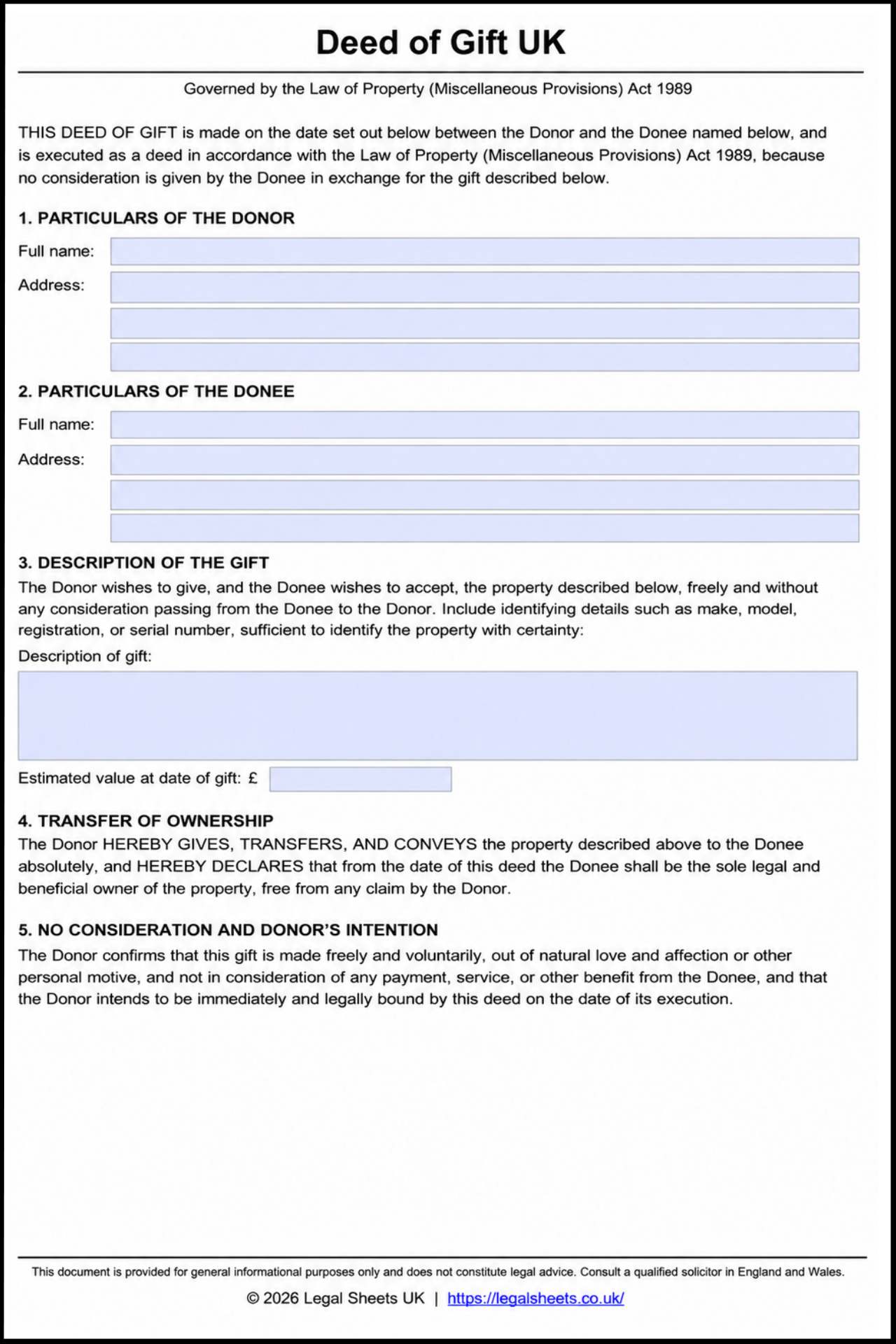
When a Deed of Gift Is Used in Practice
A gift becomes more complicated when the asset has its own ownership or registration system. This is why the first practical question should be: what exactly is being gifted?
Transferring an Asset Without Monetary Consideration
A Deed of Gift is intended for a gratuitous transfer. The donor is not receiving a purchase price or other valuable consideration from the donee.
Common situations include:
- A parent transferring an asset to an adult child
- A family member giving valuable personal property
- A shareholder gifting shares
- A donor transferring another identifiable asset without payment
The document should make the absence of consideration clear. The supplied legal facts also identify the need for unequivocal donative intention rather than provisions suggesting that the recipient must provide something in return.
Gifts That Require Additional Steps
The type of asset affects what happens after the deed is signed.
For registered land, the private deed does not by itself complete the registered transfer. The relevant Land Registry process must also be completed.
For company shares, additional company documentation and registration steps may be required.
For physical personal property, delivery of the asset can be particularly important.
For cash and other tangible personal property, the document may remain a private record rather than something that is filed with a public authority.
How to Prepare the Deed Before Signing
The most avoidable problems often begin before anyone signs. If the parties or the asset are described inaccurately, correcting the document later can become considerably more difficult.
Identify the Donor and Donee Correctly
The document should clearly identify:
- The donor
- The donee
- Their full legal names
- Relevant addresses
- Their respective capacity
- The person who is intended to receive the gift
The identity of the recipient should not be left uncertain. A deed that identifies the wrong person or describes the parties ambiguously can create an ownership dispute when the document is later relied upon.
Describe the Gift Precisely
The asset should be identified with enough detail to distinguish it from other property owned by the donor.
For land, this includes the relevant property details. For shares, the shareholding should be clearly identified. For valuable personal property, a sufficiently precise description reduces the risk of later disagreement about what was actually gifted.
This is particularly important where the donor owns several similar assets.
Confirm the Gift Is Made Without Consideration
The deed should clearly record that the transfer is a gift rather than a sale.
The supplied legal facts identify three important drafting points:
- The transfer should reflect genuine donative intention.
- The absence of monetary consideration should be clear.
- The deed may state that the gift is absolute, unconditional and irrevocable.
The purpose is to avoid a document that appears to impose a reciprocal obligation on the recipient when the transaction is intended to be gratuitous.
Deed Execution and Witnessing Requirements
Execution is one of the areas where a seemingly minor mistake can cause a major problem.
What Must Happen When the Donor Signs
Under the supplied England legal framework, the deed must satisfy the execution requirements identified in Section 1 of the Law of Property (Miscellaneous Provisions) Act 1989. The document should be written and appropriately designated as a deed, signed by the donor in the physical presence of a witness, attested by that witness and delivered.
The execution process should therefore be treated as a sequence rather than simply a signature exercise:
- Prepare the written deed
- Use an appropriate deed designation
- Have the donor sign
- Ensure the witness is physically present
- Have the witness attest the signature
- Complete delivery of the deed
The official legislation can be consulted through the Law of Property (Miscellaneous Provisions) Act 1989.
Why Delivery Matters
A common misunderstanding is that signing automatically completes the transaction. The supplied legal facts specifically identify delivery as a separate requirement.
Delivery means that the donor demonstrates an intention to be immediately and unconditionally bound by the deed. For physical assets, physical possession of the asset, or relevant keys or access mechanisms, may also be relevant to establishing completed delivery.
Gifts of Land and Registered Property
Land transfers require particular care because the private deed and the registration process perform different functions.
Why a Deed Alone Does Not Complete a Registered Land Transfer
The supplied legal framework states that a conveyance of a legal estate in land must be made by deed. It also identifies the Land Registration Act 2002 as governing compulsory registration of relevant gifted legal estates.
This means a donor should not assume that handing the signed deed to the donee completes registered ownership.
The transfer must also proceed through the applicable Land Registry process.
TR1, TP1 and Registration Steps
The supplied facts identify Form TR1 for a whole registered title and Form TP1 for a transfer of part of a registered title.
They also identify the requirement for the consideration position to be recorded as a pure gift where applicable. Failure to use the required transfer documentation can result in the registration application being rejected, preventing legal title from passing to the intended donee.
The relevant statutory framework is the Land Registration Act 2002 and Land Registration Rules 2003.
Gifts of Shares and Valuable Personal Property
A Deed of Gift can also be used for assets that are not land, but the completion process can still differ.
Company Shares
Where company shares are gifted, the supplied legal facts identify the use of a Stock Transfer Form (Form J30) alongside the deed.
The share certificate and company records also need to be considered. The stated process involves submission to the company’s directors, cancellation of the donor’s share certificate, issue of the relevant certificate to the donee and updating the company’s Register of Members under Section 113 of the Companies Act 2006.
A signed deed should therefore not be treated as the end of the share-transfer process.
Physical Personal Property
Physical assets such as jewellery, artwork or vehicles can raise a different issue.
The supplied legal facts state that legal title to physical personal property may pass through an executed deed or through unequivocal physical delivery accompanied by donative intention.
For this reason, the parties should retain evidence showing what was gifted, when the transfer occurred and what happened to possession of the asset.
Gifts Made by Attorneys Under a Lasting Power of Attorney
A person acting under a Lasting Power of Attorney cannot simply use their authority to make any gift they choose.
Limits on an Attorney’s Authority to Make Gifts
The supplied legal framework identifies Section 12 of the Mental Capacity Act 2005 as governing an attorney’s gifting powers.
The stated limits distinguish between customary gifts, including seasonal or charitable gifts, and substantial or unusual lifetime gifts. The latter may require prior Court of Protection approval.
This distinction matters particularly where the proposed recipient is the attorney themselves or a relative.
Risks of Unauthorised Gifting
An attorney who transfers the donor’s property or funds without appropriate authority can create serious consequences.
The supplied facts identify possible:
- Recovery of improperly transferred assets
- Office of the Public Guardian involvement
- Civil restitution claims
- Potential personal liability
- Court of Protection proceedings
The Mental Capacity Act 2005 is therefore particularly relevant where the donor lacks capacity and another person is attempting to execute the transaction on their behalf.
The official legislation is available through the Mental Capacity Act 2005.
Tax and Financial Consequences to Check Before Making the Gift
A gift can be legally completed yet still create tax or financial consequences for the donor or recipient.
Inheritance Tax and the Seven-Year Rule
The supplied legal framework identifies the Inheritance Tax Act 1984 and Finance Act 1986 as relevant to the inheritance-tax treatment of gifts.
It specifically refers to Potentially Exempt Transfers and the seven-year period. The practical tax outcome depends on the circumstances surrounding the gift, so completing the deed does not itself establish that the transfer will fall outside the donor’s estate for inheritance-tax purposes.
Gifts With Reservation of Benefit
A particularly important situation arises when the donor gives away an asset but continues to benefit from it.
The supplied facts use the example of a parent gifting a home to an adult child while continuing to live there rent-free or below open-market rent. The stated consequence is that the property may remain within the donor’s estate for inheritance-tax purposes under the gift-with-reservation provisions.
The practical point is simple: transferring legal ownership does not necessarily produce the intended tax treatment if the donor continues to enjoy the asset.
Gifts Made Before Financial Difficulty or Bankruptcy
A substantial gift should also be considered against the donor’s financial position.
The supplied framework identifies transactions at an undervalue under the Insolvency Act 1986 as a potential source of challenge. Section 339 and the related provisions can become relevant where the statutory conditions are satisfied.
Common Deed of Gift Mistakes That Cause Problems
Signing Without Proper Witnessing
A donor signing outside the physical presence of the witness, or failing to complete the attestation correctly, creates an execution problem.
The supplied facts identify defective witnessing as a specific failure under Section 1 of the Law of Property (Miscellaneous Provisions) Act 1989.
Treating a Private Deed as Sufficient for Registered Land
A signed private deed should not be confused with completion of the Land Registry process.
Where registered land is involved, failing to complete the relevant registration steps can prevent legal title from passing to the intended recipient.
Gifting Assets While Facing Creditor Problems
Making a substantial gift while facing financial difficulty or potential creditor claims can create a later challenge.
The supplied framework identifies the insolvency provisions as a particular risk where the statutory conditions for a transaction at an undervalue are satisfied.
Continuing to Benefit From the Gift
A donor who transfers an asset but continues to use or enjoy it should consider the gift-with-reservation consequences.
This is particularly relevant to family transfers involving the donor’s home.
An Attorney Making a Gift Without Proper Authority
An attorney should not assume that their general authority to manage someone’s finances permits a substantial gift.
The supplied framework identifies Court of Protection involvement for substantial lifetime gifts outside the permitted scope.
What Happens If a Deed of Gift Is Challenged?
A dispute can arise long after the document was signed. The central question may not simply be whether there is a signed deed, but whether the gift was properly made, completed and authorised.
Disputes About Capacity or Undue Influence
Questions may arise about the donor’s ability to make the decision or whether the donor acted freely.
The supplied facts identify undue influence as a practical dispute issue, particularly where there is a relationship of trust and confidence and the gift is substantial. Evidence surrounding the donor’s intention and independent advice can become important.
Disputes About Ownership
Ownership disputes can focus on whether the gift was actually completed.
Delivery, registration and the donor’s intention may all become relevant. For registered land and company shares, incomplete registration or failure to update the relevant records can create particular difficulties.
Insolvency and Creditor Challenges
Where insolvency is involved, the dispute may move beyond the donor and donee.
A Trustee in Bankruptcy may seek to challenge a transaction where the statutory conditions are met. The supplied framework identifies the five-year period relevant to transactions at an undervalue under the stated insolvency provisions.
Deed of Gift vs Other Estate-Planning Documents
Deed of Gift vs Will
The key difference is timing.
A Deed of Gift concerns a lifetime transfer. A Will concerns distribution on death. A person who wants to transfer ownership immediately should therefore not assume that instructions intended for their Will achieve the same result during their lifetime.
Deed of Gift vs Trust Arrangement
A direct gift transfers the asset to the intended recipient, whereas a trust arrangement involves property being held under the relevant trust structure.
The appropriate arrangement depends on the intended ownership structure and the circumstances of the transfer.
Deed of Gift vs Letter of Wishes
A Letter of Wishes serves a different purpose from a deed that transfers an asset.
The supplied outline identifies a Letter of Wishes as non-binding estate-planning guidance rather than an instrument that itself transfers ownership. A person should therefore not use a Letter of Wishes as a substitute where an immediate transfer of an asset is intended.
Practical Completion Checklist
Before treating the transaction as complete, check:
- Confirm the donor and donee’s identities.
- Identify the asset precisely.
- Confirm that the transfer is being made without consideration.
- Check whether additional transfer documentation is required.
- Prepare the appropriate execution clause.
- Arrange an appropriate witness.
- Ensure the donor signs in the witness’s physical presence.
- Ensure the witness properly attests the signature.
- Complete delivery of the deed.
- Complete registration or company procedures where applicable.
- Retain the signed deed and supporting evidence.
The checklist should not be treated as evidence that every asset follows the same transfer process. Registered land, company shares and gifts made by attorneys have additional considerations under the supplied legal framework.
Frequently Asked Questions
Can a Deed of Gift be used to transfer property?
Yes, but the process depends on the type of property. For registered land, the deed must be accompanied by the applicable Land Registry transfer and registration process. A private deed alone does not complete registered legal title.
Does a Deed of Gift need to be witnessed?
The supplied England legal framework states that the donor must sign the deed in the physical presence of a witness who attests the signature. Defective witnessing can create a serious execution problem.
Can an attorney make a Deed of Gift on behalf of someone else?
An attorney’s gifting authority is restricted. The supplied framework distinguishes ordinary customary gifts from substantial or unusual lifetime gifts, with the latter potentially requiring prior Court of Protection approval.
Can a Deed of Gift be challenged after it has been signed?
Yes. The supplied legal facts identify capacity, undue influence, incomplete transfer and insolvency as circumstances that can lead to disputes or challenges. A signed document does not remove every possible challenge to the transaction.
Does a Deed of Gift avoid Inheritance Tax?
Not automatically. The supplied framework identifies the seven-year Potentially Exempt Transfer rules and the gift-with-reservation provisions. Continuing to benefit from gifted property can affect the inheritance-tax treatment.
Is a Deed of Gift enough to transfer registered land?
No. The supplied framework distinguishes the execution of the deed from completion of the Land Registry process. The appropriate transfer form and registration steps must also be completed for registered land.