
Lasting Power Of Attorney UK – (Free PDF & WORD)
People often start searching for a Power Of Attorney after discovering that a bank, solicitor, or property transaction requires formal authority rather than informal family consent. In England, choosing the wrong document or overlooking the execution and registration requirements under the Mental Capacity Act 2005 and the Powers of Attorney Act 2023 can create difficulties at the point the authority is actually needed, particularly where the Office of the Public Guardian refuses to register a defective application.
It is not unusual for families to realise the problem only after the donor has lost mental capacity, leaving the Court of Protection as the only route to obtain legal authority over financial or property decisions. The template, example wording, and completion guidance that follow are intended to help you prepare the correct document and understand the formal steps required before it can be relied upon in England.
Table of Contents
ToggleLasting Power of Attorney Template (PDF, Word & Printable Formats)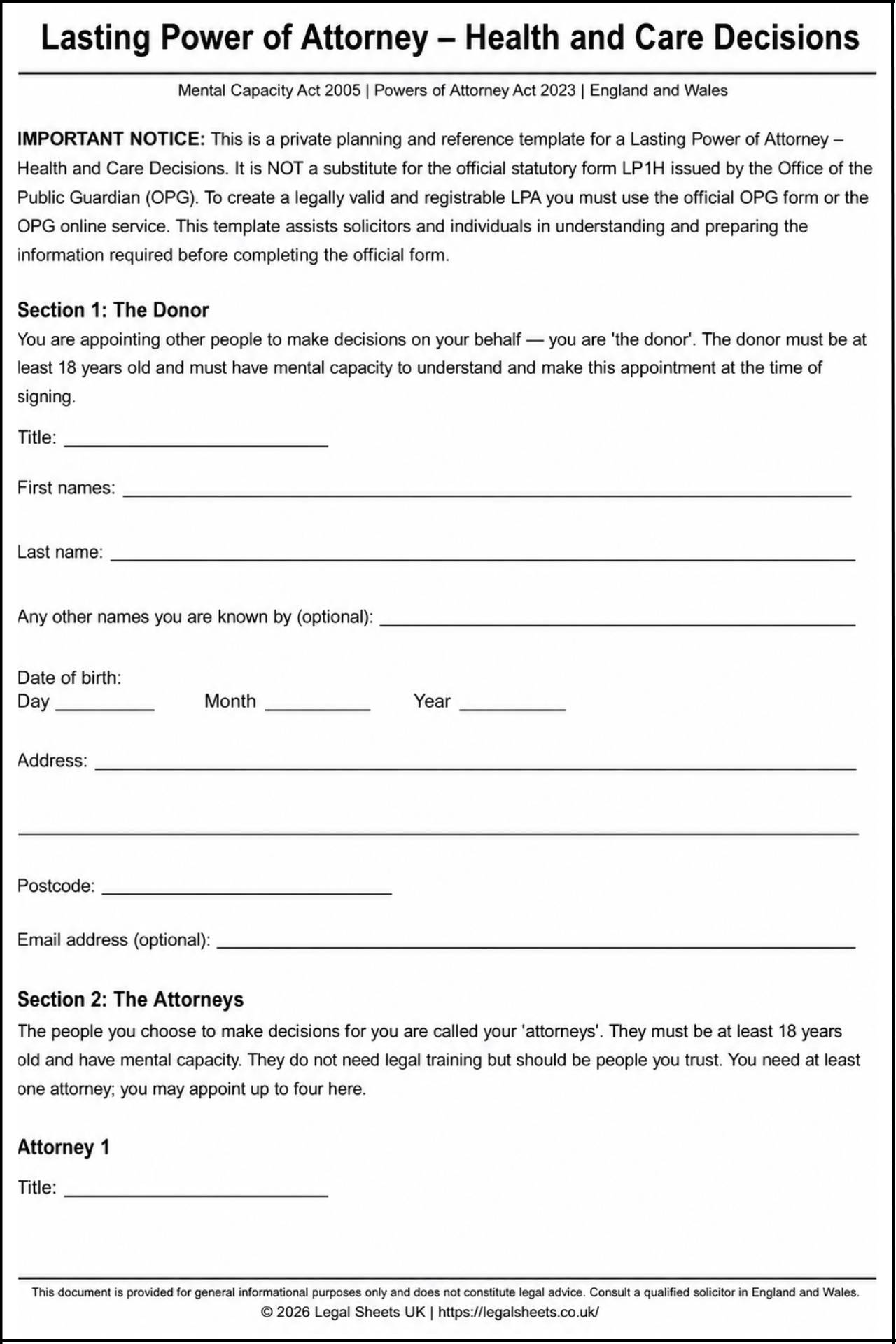
Situations Where This Template May Not Be Suitable
An LPA is not appropriate if the donor has already lost mental capacity before signing. In those circumstances, authority normally has to be obtained through the Court of Protection. Likewise, an LPA is unsuitable for temporary arrangements where someone only needs short-term authority to deal with finances or property.
Documents That May Be Needed Alongside an LPA
Depending on your circumstances, you may also need:
- Will
- General Power of Attorney
- Advance Decision (Living Will)
- Advance Statement
- Deputyship Order
Each document serves a different purpose and should not be treated as a replacement for an LPA.
Choosing the Right Lasting Power of Attorney
England has two different types of LPA. Each covers separate decision-making powers, so choosing the correct document depends on the authority you want your attorney to have.
Property and Financial Affairs LPA
A Property and Financial Affairs LPA allows attorneys to manage financial matters such as bank accounts, bills, investments and property sales. Attorneys must always act in the donor’s best interests and keep the donor’s money separate from their own. Mixing funds may amount to a breach of fiduciary duty and can lead to an OPG investigation.
Health and Welfare LPA
A Health and Welfare LPA allows attorneys to make decisions about medical treatment and personal care once the donor lacks capacity. If the donor wants the attorney to decide about life-sustaining treatment, the specific election within Section 5 of Form LP1H must be completed correctly. Otherwise, healthcare professionals will make those decisions under the Mental Capacity Act 2005.
Should You Have Both Types?
Many people create both LPAs because financial decisions and healthcare decisions often arise together during family separation. Having both documents ensures different aspects of personal affairs can be managed if capacity is lost.
Choosing the Most Suitable Option for Your Situation
Consider who you trust, the responsibilities they will have and whether different people should deal with financial matters and healthcare decisions. It is also sensible to appoint replacement attorneys in case an original attorney can no longer act.
Before You Complete an LPA
Most registration problems arise because important decisions are left until after the forms have been completed. Before signing, decide who will act as attorney, whether replacement attorneys are required, who will act as the Certificate Provider and whether anyone should receive safeguarding notifications during registration.
Who Can Make a Lasting Power of Attorney?
Only someone who has mental capacity to understand the nature and effect of the document can create an LPA. The donor must understand the authority being granted and make the decision voluntarily.
Mental Capacity Requirements
The Certificate Provider must confirm that the donor understands the LPA and is not acting under fraud or coercion. If capacity is later disputed, the Court of Protection can determine whether the LPA was validly created.
Choosing an Attorney
Choose someone trustworthy who understands the responsibility involved. Attorneys owe a legal duty to act in the donor’s best interests, support the donor’s own decision-making wherever possible and remain within the authority granted by the LPA.
Appointing Replacement Attorneys
Replacement attorneys can step in if an original attorney dies, resigns or becomes unable to act. Including replacements can prevent practical problems years after the LPA has been registered.
Choosing a Certificate Provider
Every LPA requires an independent Certificate Provider. Their role is to confirm that the donor has mental capacity and is making the LPA freely. Without this declaration, the Office of the Public Guardian will reject the registration application.
Deciding How Attorneys Will Act
The donor must decide how multiple attorneys will exercise their authority.
Jointly
All attorneys must make every relevant decision together. This offers additional oversight but may slow decision-making if one attorney becomes unavailable.
Jointly and Severally
Each attorney can usually act independently for business matters. This arrangement offers greater flexibility while still requiring every attorney to comply with their fiduciary duties.
Mixed Decisions
The donor may require attorneys to act jointly for certain decisions and jointly and severally for others. Any instructions should be clear to avoid uncertainty when banks, healthcare providers or other organisations rely on the registered LPA.
Information You’ll Need Before Completing the Form
Preparing the required information before filling in the forms reduces the risk of delays or rejection during registration.
Donor Details
Enter the donor’s full legal name and personal details accurately. Inconsistent information across the form may result in registration queries.
Attorney Details
Include the full details of every attorney being appointed. Each attorney will later sign the prescribed statutory declaration.
Replacement Attorney Details
If replacement attorneys are appointed, complete their information in full so they can act if an original attorney is no longer able to do so.
Certificate Provider Information
Provide the Certificate Provider’s details accurately. Their declaration confirms the donor has mental capacity and is acting voluntarily.
People to Notify
The donor may nominate people to be told when the LPA is submitted for registration. The Office of the Public Guardian (OPG) is responsible for issuing these statutory notifications and allowing time for safeguarding objections.
Preferences
Preferences let the donor explain personal wishes without legally binding the attorney. They can help attorneys make decisions that reflect the donor’s values.
Instructions
Instructions are legally binding. They should be clear, practical and unambiguous, as unclear wording may create difficulties when organisations rely on the LPA.
Life-Sustaining Treatment Decision
For a Health and Welfare LPA, authority over life-sustaining treatment only exists if the donor correctly completes and signs the required election in Section 5 of Form LP1H.
Completing the Official LPA Form
LP1F – Property and Financial Affairs
Use Form LP1F for financial matters such as managing bank accounts, paying bills and dealing with property. Attorneys must never mix the donor’s funds with their own.
LP1H – Health and Welfare
Use Form LP1H for healthcare and welfare decisions. To grant an attorney the absolute legal authority to refuse or consent to life-sustaining treatment, the donor must explicitly opt-in by executing ‘Option A’ in Section 5 of the prescribed form; a generic grant of authority over medical care is legally void for this purpose
Writing Effective Instructions
Keep instructions simple, specific and capable of being followed in practice. Complicated wording can delay acceptance by banks or healthcare providers.
Recording Personal Preferences
Preferences provide guidance rather than mandatory directions. They help attorneys understand how the donor would like decisions to be approached.
Avoiding Common Drafting Mistakes
Avoid using the wrong form, leaving mandatory sections blank, changing prescribed wording or giving conflicting instructions.
Signing the Lasting Power of Attorney Correctly
Proper execution is essential because the LPA must be executed as a deed before registration.
Correct Signing Order
For traditional paper applications under the Mental Capacity Act 2005, execution must follow a strict chronological sequence: the donor signs first, followed by the Certificate Provider, and finally the attorneys. However, under the Powers of Attorney Act 2023 digital rollout, the OPG’s mandatory online portal utilizes integrated identity verification that electronically controls this sequence, immediately flagging errors to prevent invalid submissions.
Witness Requirements
The donor’s signature must be properly witnessed as required for a deed.
Who Cannot Witness the LPA
An appointed attorney or replacement attorney cannot witness the donor’s signature.
Certificate Provider Declaration
The Certificate Provider confirms the donor understands the LPA, has mental capacity and is acting without coercion.
Attorney Declarations
Every attorney and replacement attorney must sign the prescribed declaration acknowledging their legal responsibilities.
Mistakes That Commonly Invalidate an LPA
Common reasons the OPG rejects applications include:
- Incorrect signing order
- Missing signatures
- Incorrect witnesses
- Using the wrong official form
- Incomplete mandatory sections
- Altered prescribed wording
- Missing life-sustaining treatment election where required
Some of these mistakes cannot be corrected after signing and require a completely new application.
Registering the Lasting Power of Attorney
Registration with the Office of the Public Guardian is mandatory. An unregistered LPA has no legal effect and cannot be used by an attorney. Before submitting your application, you can check the latest registration process, fees and official guidance on the UK Government’s Power of Attorney guidance.
Using a Registered Lasting Power of Attorney
Once registered, attorneys can use the LPA within the authority granted. Many banks, NHS organisations and public bodies now verify registered LPAs using the official digital access code rather than relying solely on paper copies for company shareholders.
Powers and Responsibilities of an Attorney
Attorneys must always act in the donor’s best interests, support the donor’s own decision-making where possible, keep accurate financial records and protect confidential information. They cannot delegate their authority to someone else unless expressly permitted within the LPA.
Situations That Can End or Cancel an LPA
An LPA may end if:
- The donor revokes it while they still have capacity.
- The donor dies.
- Bankruptcy affects a Property and Financial Affairs LPA where applicable.
- An attorney resigns.
- The Court of Protection removes an attorney or revokes the LPA.
Practical Problems Attorneys Often Face
In practice, attorneys sometimes encounter delays because banks require additional verification for loan accounts. Family disputes or concerns about attorney conduct may also lead to investigations by the Office of the Public Guardian or proceedings before the Court of Protection.
UK Legal Requirements
| Topic / Issue | Precise English Legal Rule | Governing Statute / Administrative Regulation / Provincial Code |
| Execution as a Deed | Every Power of Attorney (Ordinary or Lasting) must be executed, witnessed, and delivered strictly as a deed to hold legal validity. | Law of Property (Miscellaneous Provisions) Act 1989 (Section 1) |
| Exclusive Registration Rights | Only the donor possesses the legal right to apply to register an LPA; attorneys are statutorily barred from initiating registration. | Powers of Attorney Act 2023 |
| Safeguarding Notifications | The Office of the Public Guardian (OPG) bears the sole statutory duty to independently notify any nominated individuals before an LPA is registered. | Powers of Attorney Act 2023 |
| Capacity Requirement | The donor must possess full mental capacity at the exact moment of execution. An Ordinary POA automatically becomes void the moment capacity is lost. | Mental Capacity Act 2005 (Sections 2 & 3) |
| Certificate Provider | An LPA is legally invalid unless signed by an independent Certificate Provider confirming the donor understands the document and is free from coercion. | Mental Capacity Act 2005 (Schedule 1) |
| Fiduciary Duty & Delegation | Attorneys owe a strict fiduciary duty to act in the donor’s best interests and cannot legally delegate their decision-making authority to third parties. | Mental Capacity Act 2005 / Trustee Delegation Act 1999 |
Failure to comply with these statutory requirements usually results in registration being refused. Where disputes arise over capacity, attorney conduct or the validity of the LPA, the Court of Protection has the final authority to determine the outcome.
Before You Send Your LPA for Registration
Final Checklist
- Complete the correct official form.
- Check every mandatory section.
- Follow the correct signing order.
- Ensure all declarations are signed.
- Confirm witnesses are eligible.
- Review instructions and preferences carefully.
Related Documents You May Also Need
- General Power of Attorney
- Advance Decision (Living Will)
- Will
- Deputyship Order
- Advance Statement
Frequently Asked Questions
Can I register an LPA after losing mental capacity?
No. Because the Powers of Attorney Act 2023 strictly dictates that only the donor possesses the legal right to apply for registration, an LPA becomes permanently unregisterable if the donor loses capacity before the application is submitted. In this scenario, the family must instead endure the costly and protracted process of applying to the Court of Protection for a Deputyship Order.
What happens if the signing order is incorrect?
The Office of the Public Guardian may reject the application because the statutory execution sequence has not been followed.
Can someone challenge my registered LPA?
Yes. Concerns about fraud, coercion, capacity or attorney misconduct may be investigated by the Office of the Public Guardian, and the Court of Protection can determine disputes.
Can I change or cancel my LPA after registration?
Yes, provided you still have mental capacity. The donor may revoke the LPA in accordance with the applicable legal requirements.
Do banks have to accept a certified copy of my LPA?
Many organisations will accept certified copies, although some now prefer to verify the registered LPA using the official digital access code provided through the Government service.
Author
-

Ankur is the founder and editorial reviewer at LegalSheets. He researches, writes, and reviews legal content, ensuring every template and guide is clear, accurate, and based on current UK laws and official government guidance. His focus is on making legal documents easier for individuals and businesses to understand and use.
