
Disciplinary Hearing Invite Letter Free Word & Fillable PDF
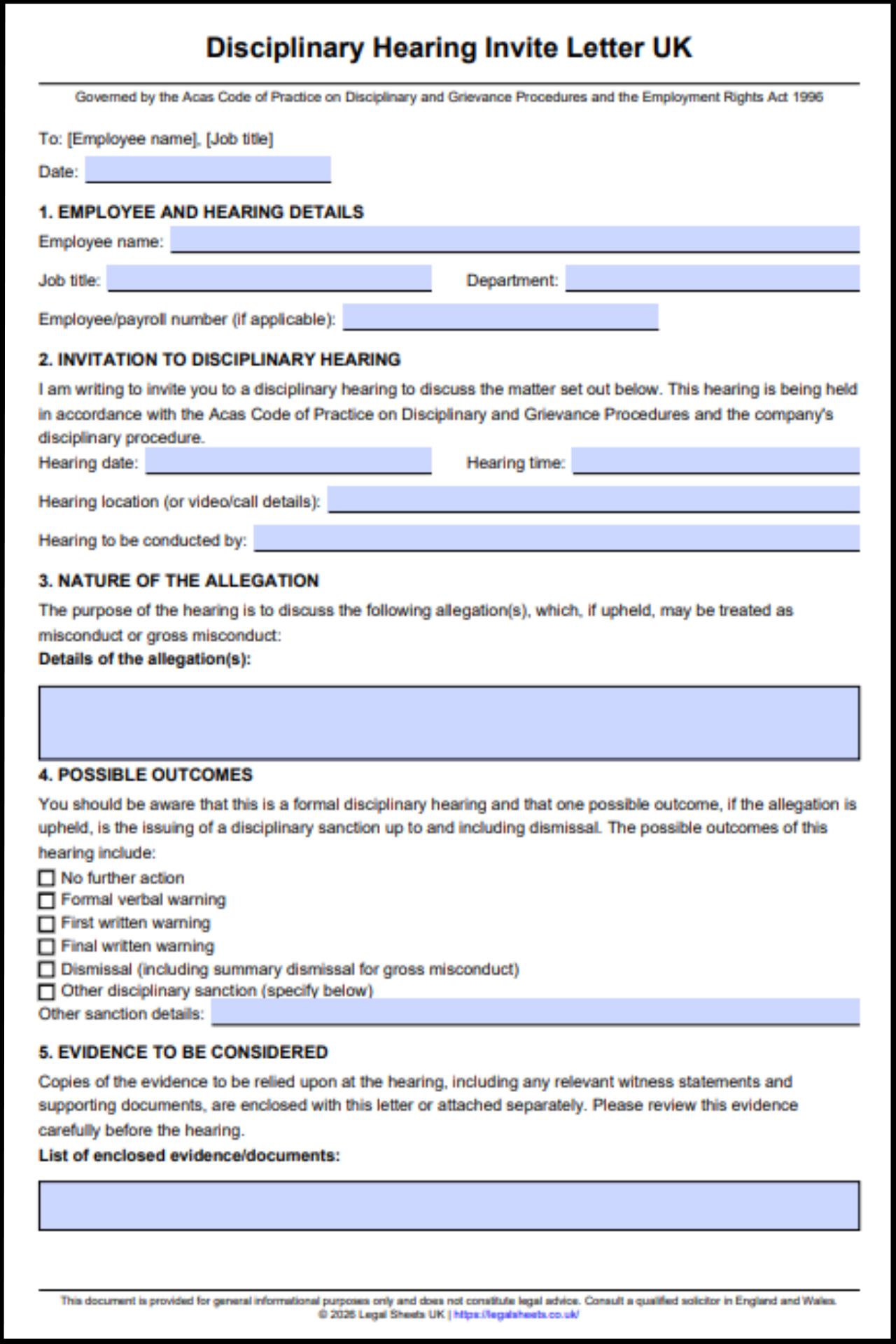
A Disciplinary Hearing Invite Letter needs to give an employee enough information about the concern being considered and the possible outcome before they attend the hearing. In England, employers should follow the Acas Code of Practice on disciplinary and grievance procedures, which requires a fair procedure and reasonable opportunity for the employee to prepare; the employee should also be told about their right to be accompanied at the disciplinary hearing.
A common practical problem is sending a vague invitation that does not clearly identify the alleged misconduct or performance issue, leaving the employee unable to understand what they need to respond to. Acas guidance also recommends providing relevant written evidence with the notification where appropriate. The letter below is designed around those practical requirements, including the hearing arrangements, allegations, possible consequences, evidence and accompaniment rights.
Table of Contents
ToggleDisciplinary Hearing Invite Letter Template (PDF, Word & Printable Formats)
What Should Be Checked Before Sending the Invitation?
Confirm That an Investigation Has Taken Place
A disciplinary hearing should not be treated as the first opportunity to establish basic facts. The employer should first consider whether an investigation has been carried out and whether the available information supports moving to formal disciplinary action.
The investigation and disciplinary hearing have different purposes. An investigation is concerned with establishing the facts, while the disciplinary hearing gives the employee an opportunity to respond to the allegations before a disciplinary decision is made.
Where practicable, keeping the investigation and disciplinary decision-making stages separate can help prevent the hearing from appearing predetermined. A letter that effectively announces the employee’s guilt before the hearing can become important evidence if the process is later challenged.
Decide Whether a Formal Disciplinary Hearing Is Appropriate
The circumstances may involve:
- Misconduct
- Poor performance
- Gross misconduct
- Serious workplace concerns
- Conduct that could potentially lead to dismissal
Not every workplace concern necessarily requires the same response. The employer should consider the nature of the allegation, the employment contract, and the applicable workplace disciplinary procedure before issuing the invitation.
What Information Should the Employee Receive?
Clearly State the Allegation
The employee should be able to understand exactly what they are being asked to answer.
The invitation should:
- Describe the alleged misconduct or poor performance
- Provide sufficient factual detail
- Identify the relevant incident or concern
- Avoid language that assumes the allegation has already been proved
- Distinguish the allegation from any eventual disciplinary finding
Precision in wording is paramount. Framing the matter as an ‘alleged breach’ rather than an established fact prevents claims of pre-determination. Employment Tribunals treat letters that presume guilt as evidence of an unfair, biased process under Section 98(4) of the Employment Rights Act 1996.
Explain the Possible Consequences
The employee should know what disciplinary outcomes could potentially follow from the hearing.
Depending on the circumstances, these may include:
- A formal warning
- A final written warning
- Other disciplinary action
- Dismissal where that is a possible outcome
Where gross misconduct is alleged and summary dismissal could be considered, the potential consequence should be made clear before the hearing.
Provide the Relevant Evidence
The invitation should be accompanied by the written evidence that the employer intends to rely upon.
This may include:
- Witness statements
- Emails and correspondence
- Investigation records
- Audit trails
- CCTV records
- Other relevant documentary material
Withholding critical witness statements, investigation reports, or CCTV logs to create a surprise at the hearing breaches basic rules of natural justice. Under paragraph 9 of the Acas Code of Practice, employees must receive all documentary evidence in advance to prepare their defence.
Giving the Employee Enough Time to Prepare
Choosing the Hearing Date
The employee should receive reasonable advance written notice of the hearing.
The relevant considerations include:
- The amount of evidence supplied
- The complexity of the allegations
- The time reasonably required to prepare a response
- The employee’s availability
- Any practical difficulty affecting attendance
A large evidence bundle delivered immediately before a hearing can create a preparation problem even where the hearing date itself was previously known.
Serving a dense evidence bundle on a Friday afternoon for a Monday morning hearing is a classic procedural pitfall. Employers should provide at least two to five clear working days, extending the notice window for complex cases involving voluminous witness statements or financial audits.
When a Companion Cannot Attend
An employee may have a statutory right to be accompanied, and practical arrangements may need to be reconsidered where the proposed companion cannot attend.
The employer should deal reasonably with postponement requests rather than automatically treating the original hearing date as fixed regardless of the circumstances.
The Right to Be Accompanied
Who Can Accompany the Employee?
The statutory right under section 10 of the Employment Relations Act 1999 covers accompaniment by:
- A fellow worker
- A trade union representative
- An official employed by a trade union
Under Section 10 of the Employment Relations Act 1999, the statutory right to be accompanied by a certified trade union official or workplace colleague applies regardless of whether the employer formally recognises the union. Refusing a qualifying companion exposes the business to standalone tribunal claims awarding up to two weeks’ statutory capped pay.
What Can the Companion Do?
The companion may:
- Put the employee’s case
- Sum up the employee’s case
- Respond to points raised at the hearing
- Confer with the employee
- Take notes
The companion does not simply replace the employee in answering every question. The employee remains the person whose conduct or performance is being considered.
What If the Employer Refuses the Requested Companion?
An employer should not refuse a qualifying companion merely because the organisation does not recognise a trade union.
The right is statutory, and refusal can result in a separate Employment Tribunal issue as well as contributing to wider procedural problems in a disciplinary case.
Avoiding Pre-Determination in the Invitation Letter
Do Not Write the Employee’s Guilt Into the Letter
The invitation should describe what is alleged rather than announce the conclusion.
For example, wording should refer to an allegation of misconduct rather than stating that the employee committed the misconduct as an established fact.
This distinction matters because a disciplinary hearing should provide a genuine opportunity for the employee to respond. If the invitation makes the eventual decision appear inevitable, the employer may later have difficulty demonstrating that the process was fair.
Do Not Withhold Evidence for the Hearing
The employer should not deliberately hold back key witness statements or other evidence to surprise the employee during the meeting.
If important new evidence genuinely emerges later, it should be dealt with fairly rather than simply introduced without giving the employee an opportunity to consider it.
The employee needs sufficient information to understand and prepare their response to the case being considered.
Reasonable Adjustments and Accessibility
When an Employee Has a Disability
The employer should consider whether reasonable adjustments are required for the disciplinary process.
Depending on the circumstances, this could concern:
- The timing of the hearing
- The location
- The format of the meeting
- Accessibility of evidence
- Communication arrangements
Section 20 of the Equality Act 2010 imposes a mandatory duty on employers to make reasonable adjustments for disabled employees. This may require offering a hybrid or remote hearing, adjusting meeting times to manage fatigue, or permitting a family member or support worker to attend alongside a statutory companion..
A standard invitation should therefore not be treated as automatically suitable where the employee has a disability affecting participation in the process.
How Should the Letter Be Sent?
Service and Record-Keeping
The Disciplinary Hearing Invite Letter does not need to be filed with ACAS, an Employment Tribunal or another government body when issued. It is a private internal HR document.
Depending on the employment arrangements, it may be:
- Handed to the employee
- Sent by email
- Sent by first-class or recorded post
Where an employee is suspended or absent from work, sending the invitation to an appropriate personal address may become relevant.
The employer should retain evidence of service, such as delivery confirmation, read receipts or courier records. This can become important if the employee later says they did not receive the invitation or supporting evidence.
What Happens After the Invitation Is Sent?
Preparing for the Hearing
HR should keep a record of:
- Attendance confirmation
- Requests for a companion
- Postponement requests
- The evidence bundle
- The person chairing the hearing
- The person responsible for taking notes
The preparation should correspond with what was actually stated in the invitation. If the employer changes the allegations or introduces substantial new material, the employee may need an opportunity to consider the change.
Conducting the Disciplinary Hearing
At the hearing, the employer should:
- Explain the allegations
- Consider the evidence
- Allow the employee to respond
- Consider relevant information provided by the employee
- Deal with relevant questions
- Allow the companion to participate within their statutory role
The hearing should remain a genuine opportunity for the employee to answer the case.
Deciding the Outcome
The decision should not be treated as settled before the employee has had the opportunity to respond.
The employer should consider whether further investigation is needed and then determine the appropriate disciplinary outcome. The decision should be communicated in writing together with a disciplinary outcome letter and information about any applicable appeal rights.
Common Problems With Disciplinary Hearing Invitations
Sending the Letter Too Late
An invitation issued shortly before the hearing can create an obvious preparation problem.
This becomes more serious where the evidence bundle is substantial or the allegations are complex. Refusing a reasonable request for additional preparation time can add to the procedural risk.
Making the Allegation Too Vague
A vague allegation can leave the employee unsure what conduct or performance issue they actually need to address.
The invitation should contain enough information for the employee to understand the case and prepare a response.
Leaving Out the Possible Outcome
If dismissal could result from the hearing, the employee should be warned that their employment may be at risk.
This is particularly relevant where gross misconduct is alleged and summary dismissal may be considered.
Refusing the Right to Be Accompanied
An employer should not assume that the absence of trade union recognition removes the employee’s statutory right to a qualifying companion.
Refusing that right can create a separate statutory issue and contribute to an unfair disciplinary process.
Treating the Hearing as a Foregone Conclusion
A letter that states the employee is guilty before the hearing has taken place can suggest that the decision was already made.
That creates a direct procedural fairness problem and may become significant evidence in a later Employment Tribunal dispute.
UK Legal Facts About Disciplinary Hearing Invite Letters
Legal Requirements Table
| Topic / Issue | Precise Legal Rule | Governing Statute / Statutory Code |
| Procedural Fairness Standard | Dismissals are assessed for substantive and procedural fairness, requiring adequate notice, clear charges, and an impartial hearing. | Employment Rights Act 1996 (Section 98(4)) |
| Statutory Disciplinary Code | Employment Tribunals must evaluate disciplinary processes against the statutory standards set out in the Acas Code. | TULRCA 1992 (Section 207) / Acas Code of Practice |
| Acas 25% Compensation Uplift | Tribunals can adjust financial compensation by up to 25% for an unreasonable failure to follow the Acas Code. | Trade Union and Labour Relations (Consolidation) Act 1992 (Section 207A) |
| Right to Be Accompanied | Workers have a statutory right to be accompanied by a colleague or certified trade union official. | Employment Relations Act 1999 (Section 10) |
| Hearing Postponement Window | If a chosen companion is unavailable, the employer must postpone the hearing to an alternative date within 5 working days. | Employment Relations Act 1999 (Section 10(4)–(5)) |
| Disability Adjustments | Employers must implement reasonable adjustments (format, timing, support) for disabled workers facing disciplinary hearings. | Equality Act 2010 (Section 20) |
| Advance Evidence Disclosure | Employers must provide all supporting documentary evidence and witness statements alongside the hearing invite. | Acas Code of Practice on Disciplinary & Grievance Procedures (Para 9) |
The verified legal framework identifies the ACAS Code, section 98(4) of the Employment Rights Act 1996, section 10 of the Employment Relations Act 1999 and section 20 of the Equality Act 2010 as the principal legal references for this document and its surrounding procedure.
Practical Legal Impact
The invitation letter can later become part of the evidence examined in an Employment Tribunal dispute. A tribunal may look at whether the employee knew the allegations, received the relevant evidence, had reasonable time to prepare and was given the statutory opportunity to be accompanied.
The verified facts also identify the ACAS Code as having potential compensation consequences where it is not properly followed. Section 207A of TULRCA 1992 may allow an Employment Tribunal to increase compensation by up to 25% in appropriate circumstances.
A procedural defect cannot necessarily be dismissed simply because the employer believes the underlying misconduct occurred. The process still needs to be handled fairly.
Disciplinary Hearing Invite Letter vs Related HR Documents
Disciplinary Hearing Invite Letter vs Investigation Meeting Letter
An investigation meeting is concerned with gathering and establishing facts before formal disciplinary action. A disciplinary hearing occurs later, when the employee is formally asked to respond to the allegations.
Keeping these stages distinct helps prevent the disciplinary decision from appearing predetermined.
Disciplinary Hearing Invite Letter vs Disciplinary Outcome Letter
The invitation is issued before the hearing and tells the employee what case they need to answer.
The outcome letter comes after the decision and records the disciplinary result and relevant next steps. These documents therefore serve different stages of the same process including any post-employment restrictions where applicable.
Disciplinary Hearing Invite Letter vs Disciplinary Appeal Letter
A disciplinary appeal takes place after a disciplinary decision has been made. It is therefore different from the initial hearing, where the allegations are considered for the first time.
Where possible, the appeal should be handled impartially, with separate arrangements appropriate to the appeal stage.
Frequently Asked Questions
How much notice should an employee receive for a disciplinary hearing?
The employee should receive reasonable advance written notice that gives them sufficient time to prepare. The amount of preparation time can depend on the allegations and the volume or complexity of the evidence.
What evidence should be included with a disciplinary hearing invitation?
The invitation should be accompanied by relevant written evidence the employer intends to rely upon, such as witness statements, audit trails, CCTV records or other relevant documents.
Can an employee ask to postpone a disciplinary hearing?
Yes. Under Section 10(4) of the Employment Relations Act 1999, if an employee’s chosen companion is unavailable, the employee can propose an alternative date within five working days of the original hearing. Employers must accept reasonable postponement requests unless there is an overwhelming business justification to refuse.
Can an employer refuse an employee’s chosen companion?
The statutory right to be accompanied covers a fellow worker, a trade union representative or an official employed by a trade union. Trade union recognition by the employer is not itself a condition of that statutory right.
Can a disciplinary hearing invitation say that dismissal is a possible outcome?
Yes, where dismissal is genuinely a possible disciplinary outcome, the employee should be told before the hearing. This is particularly relevant where the allegation involves gross misconduct and summary dismissal may be considered.
Author
-

Ankur is the founder and editorial reviewer at LegalSheets. He researches, writes, and reviews legal content, ensuring every template and guide is clear, accurate, and based on current UK laws and official government guidance. His focus is on making legal documents easier for individuals and businesses to understand and use.
