
Termination Letter UK– Free PDF & Legal Guide
A Termination Letter is often drafted at the point where an employer believes the difficult part is over, yet it is frequently the document that receives the closest scrutiny if a dismissal later reaches the Employment Tribunal. Problems commonly arise when the letter records a different reason from the one discussed during the disciplinary process, or when appeal rights are overlooked, creating procedural arguments that can overshadow the original dismissal decision. Under the Employment Rights Act 1996, employers must clearly identify the reason for dismissal and accurately record the Effective Date of Termination,
while the Employment Rights Act 2025 has increased the importance of documenting fair dismissal grounds from the outset. In practice, tribunals regularly compare the termination of employment letter against investigation findings, hearing notes, and internal records to assess whether the employer’s explanation has remained consistent throughout the process. The template and guidance that follow are designed to help employers prepare a termination letter that reflects the dismissal decision accurately and addresses the practical issues that most often become disputed.
Termination Letter Template (PDF, Word & Printable Formats)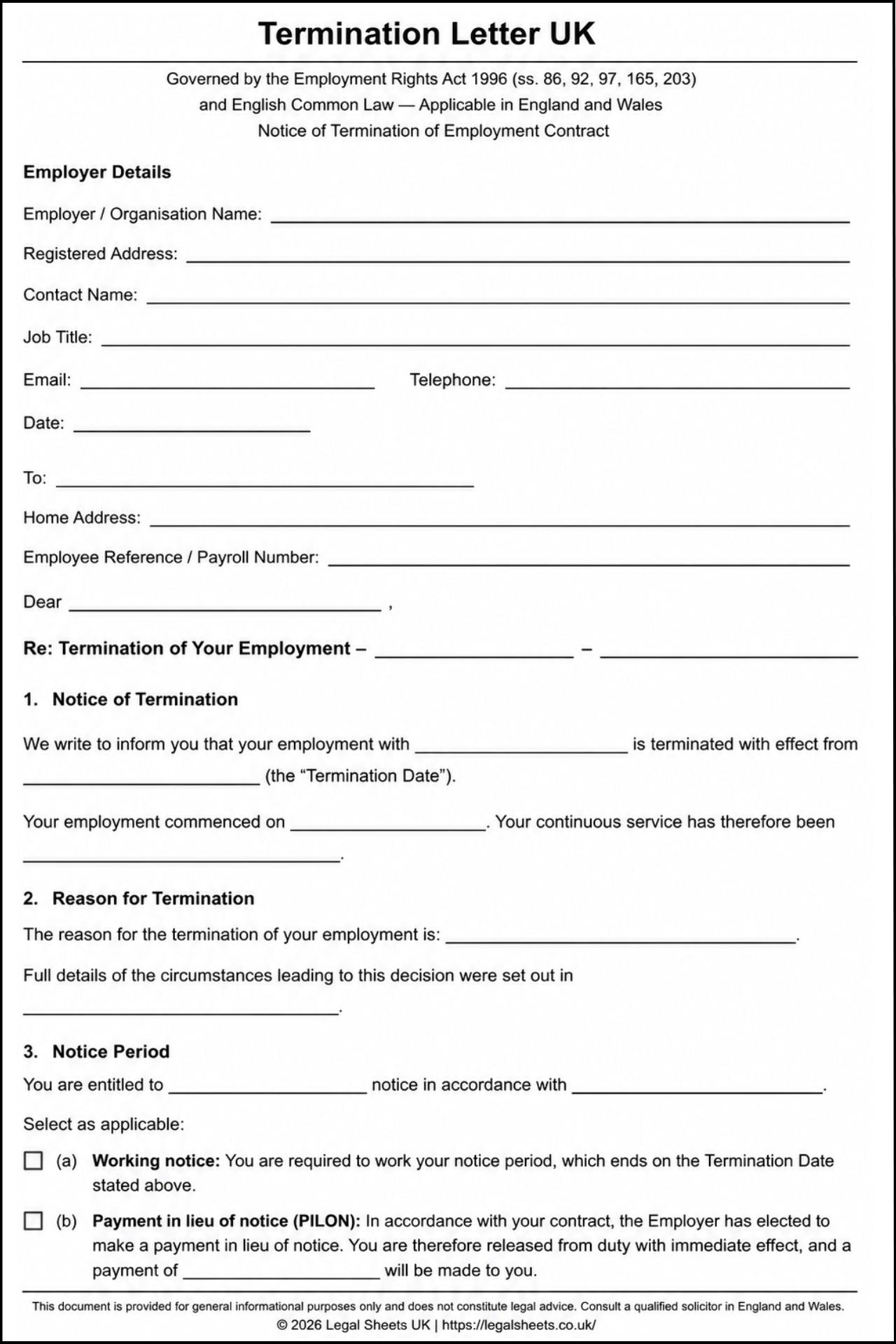
Before Issuing a Termination Letter: Critical HR Checks
Many tribunal disputes begin long before the letter is written. The document often exposes flaws that occurred earlier in the dismissal process.
Confirm the Dismissal Reason Matches the Evidence
The reason stated in the letter should reflect the actual reason relied upon by the employer.
Common potentially fair reasons include:
- Conduct.
- Capability or performance.
- Redundancy.
- Statutory illegality.
- Some Other Substantial Reason (SOSR).
Under Section 98 of the Employment Rights Act 1996, an employer must clearly establish a valid statutory reason. With the Employment Rights Act 2025 slashing the unfair dismissal qualifying period from two years to just six months (effective January 2027) and abolishing the compensatory cap, failing to strictly document a fair statutory reason exponentially increases your litigation exposure
Ensure the Decision Was Not Pre-Determined
One of the most damaging disclosure issues in tribunal proceedings occurs when evidence suggests the outcome was decided before the hearing took place.
Employers should ensure:
- Investigations were completed first.
- The employee was allowed to respond.
- A disciplinary meeting occurred.
- The final decision was made after considering the evidence.
If a tribunal concludes the process was predetermined, the dismissal may be viewed as procedurally unfair regardless of the employee’s conduct.
Verify Notice Entitlements
Before drafting the letter, employers should review:
- Statutory notice requirements.
- Contractual notice obligations.
- Garden leave provisions.
- Any contractual PILON clause.
Notice errors frequently become wrongful dismissal claims rather than unfair dismissal claims.
Review Protected Characteristics and Equality Risks
Dismissals involving disability, pregnancy, age, religion, race, sex, or other protected characteristics require careful consideration.
A termination letter should never contain wording that creates an inference of discriminatory treatment. Even a poorly chosen explanation can become significant evidence in later proceedings.
The Information That Must Appear in a Termination Letter
A termination letter succeeds or fails based on the information it contains.
The Exact Reason for Dismissal
The letter should explain:
- The reason for dismissal.
- The findings reached.
- Evidence relied upon.
- Why the employer concluded dismissal was appropriate.
Employers sometimes attempt to soften difficult conversations by using vague language such as “not a good fit” or “business reasons.” In practice, these explanations often create more problems than they solve.
The Effective Date of Termination (EDT)
The Effective Date of Termination is one of the most important dates in employment law.
The letter should clearly identify:
- The employment end date.
- Notice arrangements.
- Any garden leave period.
- Any PILON arrangements.
Under Section 97 of the Employment Rights Act 1996, uncertainty regarding the EDT can create disputes involving limitation periods, payroll calculations, and continuous service.
Notice or Immediate Dismissal Position
The letter should confirm whether dismissal is:
- On notice.
- Subject to garden leave.
- Subject to PILON.
- Immediate due to gross misconduct.
The wording must match the contractual position and the disciplinary outcome.
Appeal Rights
A dismissal letter should clearly explain:
- The right to appeal.
- The appeal deadline.
- The person receiving the appeal.
- How the appeal should be submitted.
Under Section 207A of the Trade Union and Labour Relations (Consolidation) Act 1992, employers must strictly follow the Acas Code of Practice on Disciplinary and Grievance Procedures. Failing to explicitly offer a right of appeal in the termination letter renders the dismissal procedurally unfair, allowing the Employment Tribunal to automatically uplift any compensation awarded to the employee by up to 25%.
Final Employment Arrangements
The letter should address:
- Final salary.
- Outstanding holiday entitlement.
- Benefits cessation.
- Return of company property.
This section often prevents avoidable disputes after employment ends following resignation.
Common Termination Scenarios and Drafting Differences
Different dismissal reasons require different drafting approaches.
Dismissal for Misconduct
Information Typically Included
- Findings from disciplinary proceedings.
- Evidence reviewed.
- Policy breaches identified.
- Appeal rights.
Tribunals frequently compare disciplinary records against the wording used in the termination letter. Any inconsistency may undermine the employer’s defence.
Dismissal for Poor Performance
Information Typically Included
- Performance concerns.
- Improvement measures.
- Review outcomes.
- Reasons dismissal became necessary.
Employers often struggle when performance concerns were discussed informally but not documented properly during probation.
Redundancy Dismissal
Information Typically Included
- Business rationale.
- Consultation process.
- Redundancy payment information.
- Notice arrangements.
A redundancy letter should accurately reflect the underlying reason. Attempting to disguise misconduct or capability concerns as redundancy can create substantial legal problems later.
Summary Dismissal for Gross Misconduct
Information Typically Included
- Findings of gross misconduct.
- Immediate termination.
- Reasons notice is not being provided.
- Appeal process.
Summary dismissal is one of the highest-risk termination scenarios because wrongful dismissal claims frequently arise where employers overstate the seriousness of the conduct.
Where Employers Most Commonly Create Tribunal Problems
Using a Different Reason Than the Actual Reason
A common mistake occurs when employers attempt to make the dismissal sound less confrontational.
Examples include:
- Calling misconduct redundancy.
- Describing performance issues as restructuring.
- Using vague explanations instead of the genuine reason.
Once a reason is recorded in writing, it becomes difficult to replace later.
Omitting Appeal Rights
Appeal rights remain one of the most important procedural safeguards in the dismissal process.
Failure to provide them may increase compensation exposure where a tribunal concludes the Acas Code was not followed.
Miscalculating the Effective Date of Termination
EDT disputes commonly arise where employers combine:
- Notice periods.
- Garden leave.
- Accrued holiday.
- PILON arrangements.
A single date error can affect claim deadlines and employment rights calculations.
Failing to Address Holiday Pay
Holiday pay disputes remain common after dismissal.
The termination letter should clearly explain whether accrued but untaken holiday:
- Will be paid.
- Will be taken during notice.
- Has already been accounted for.
Issuing the Letter Before the Hearing Has Concluded
A termination letter drafted before the disciplinary process finishes can become powerful evidence that the outcome was predetermined.
Tribunals frequently take a dim view of such practices.
Serving the Termination Letter Correctly
The content of the letter matters, but service can also become disputed.
In-Person Delivery
Advantages
- Immediate communication.
- Strong evidence of receipt.
- Clear notice commencement date.
Many employers hand the letter to the employee during the dismissal meeting for this reason.
Email Service
Practical Considerations
- Contractual notice provisions.
- Evidence of delivery.
- Retention of electronic records.
Email often provides a useful secondary method of service.
Postal Service
Risks Employers Often Miss
Under the binding English common law precedent set in Newcastle upon Tyne Hospitals NHS Foundation Trust v Haywood, a mailed termination notice does not legally take effect upon postage or even delivery to the property. The notice period strictly commences only when the employee actually receives the letter and has a reasonable opportunity to read it.
Creating an Audit Trail
Employers should retain:
- Meeting notes.
- Investigation reports.
- Delivery records.
- Email evidence.
- Personnel file documentation for HR services.
These records often become critical evidence during tribunal proceedings.
Notice Periods, PILON and Garden Leave
Understanding Statutory Notice Obligations
Section 86 of the Employment Rights Act 1996 establishes statutory minimum notice requirements based on continuous service.
Employers should calculate notice carefully before drafting the termination letter and may wish to review the official statutory notice rules set out in the Employment Rights Act 1996.
When Contractual Notice Overrides Statutory Notice
Where the contract provides a longer notice period than the statutory minimum, the longer contractual period usually applies.
This is often overlooked when standard templates are used.
PILON Risks Employers Frequently Overlook
One of the most expensive drafting mistakes occurs when an employer pays an employee in lieu of notice without an express PILON clause in their employment contract. Under English common law, this constitutes a repudiatory breach of contract (Wrongful Dismissal), which instantly frees the employee from all post-termination obligations and permanently voids any restrictive covenants or non-competes.
Garden Leave and the EDT
Garden leave often creates confusion regarding:
- Employment status.
- Benefits.
- Notice periods.
- Restrictive covenant timing.
The termination letter should clearly explain how garden leave affects the employment relationship.
UK Legal Facts and Compliance Framework
Legal Requirements Table
| Topic / Issue | England Legal Rule | Governing Law |
|---|---|---|
| Statutory Notice Periods | Employers must provide a minimum of 1 week’s notice per full year of continuous service, strictly capped at 12 weeks. | Employment Rights Act 1996, s.86 |
| Contractual Notice | Longer contractual notice prevails | ACAS Notice Periods |
| Written Reasons for Dismissal | Employees hold a strict statutory right to a written statement explicitly detailing the exact reasons for their dismissal. | Employment Rights Act 1996, s.92 |
| Procedural Fairness | Dismissals for conduct or performance must follow fair procedures—including the explicit right of appeal—or face up to a 25% compensation uplift. | TULRCA 1992 s.207A / Acas Code |
| Summary Dismissal | Immediate dismissal without notice (gross misconduct) is only lawful if the employee commits a fundamental repudiatory breach of contract. | ACAS Dismissal Guidance |
| Effective Service of Notice | A mailed termination letter legally takes effect only when the employee actually receives it and has a reasonable opportunity to read it. | Haywood case |
| Fair Statutory Reason | Employer must identify a potentially fair reason | Employment Rights Act 1996 s.98 / ERA 2025 |
Practical Legal Impact
These rules directly affect how a dismissal letter is drafted and defended.
In tribunal proceedings, the termination letter is frequently compared against disciplinary records, witness evidence, investigation reports, and internal communications. Where inconsistencies exist, employers often struggle to justify the dismissal decision.
The document therefore operates as both a communication tool and a piece of evidence.
How a Termination Letter Is Examined in Employment Tribunal Proceedings
Why the Letter Becomes the Key Piece of Evidence
Tribunals frequently regard the termination letter as the employer’s definitive explanation of the dismissal.
It records:
- The reason for dismissal.
- The dismissal date.
- Notice arrangements.
- Appeal rights.
Documents Commonly Compared Against the Letter
Tribunals often compare the letter with:
- Investigation reports.
- Disciplinary hearing notes.
- Witness statements.
- Performance records.
Inconsistencies That Frequently Damage Employer Defences
Common problems include:
- Different reasons appearing in different documents.
- Missing appeal rights.
- Contradictory dates.
- Inconsistent disciplinary findings.
Even small inconsistencies can significantly weaken credibility.
Documents Often Used Alongside a Termination Letter
Disciplinary Outcome Letter
Used to confirm disciplinary findings before dismissal is formally communicated.
Redundancy Consultation Documents
Used to evidence consultation and support redundancy decisions.
Settlement Agreement
Sometimes used where both parties wish to conclude matters without further disputes.
Appeal Outcome Letter
Records the result of any appeal and completes the dismissal process.
Frequently Asked Questions
Can an employer dismiss an employee immediately without notice?
Yes, but generally only where gross misconduct amounts to a fundamental repudiatory breach of contract. Immediate dismissal without sufficient grounds may create wrongful dismissal exposure.
What happens if a termination letter does not include a right of appeal?
Failure to include appeal rights may contribute to a finding of procedural unfairness and can increase compensation exposure under the Acas framework.
Can an employer use PILON if the employment contract does not contain a PILON clause?
No. Doing so constitutes a fundamental breach of contract (Wrongful Dismissal) under English common law. This fatal error legally releases the departing employee from all post-termination obligations, immediately voiding any non-compete or non-solicitation restrictive covenants you hold over them.
Why is the Effective Date of Termination so important?
The EDT affects notice calculations, final pay, employment rights, and tribunal limitation periods. Errors frequently create avoidable disputes.
Can a termination letter be challenged even if the employee committed misconduct?
Yes. A tribunal may still find the dismissal unfair if the employer failed to follow a fair procedure or omitted important procedural protections during the dismissal process.