
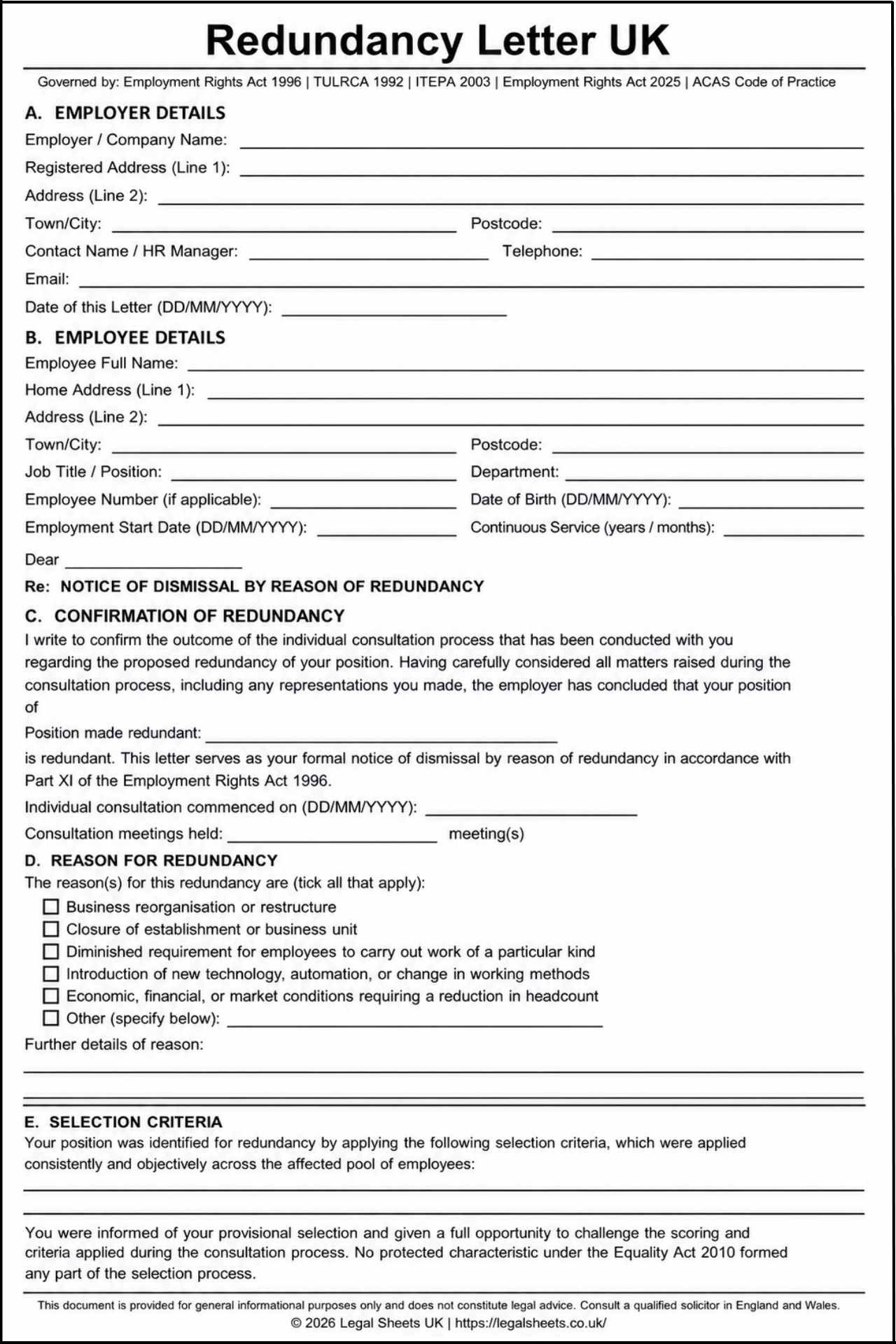
Redundancy Letter Template PDF, Word & Editable Formats
A Redundancy Letter is often prepared only after consultation has finished, yet many employers discover that the final document becomes one of the first records examined if the dismissal is later challenged. In England, the Employment Rights Act 1996 requires redundancy dismissals to follow a fair procedure, and a letter containing inconsistent notice dates or failing to explain the redundancy decision can become a significant issue before an Employment Tribunal.
The problem is rarely the existence of a genuine redundancy situation; it is more often the way the outcome is communicated and evidenced once the process concludes. Whether you are confirming an individual redundancy or completing the final stage of a wider workforce reduction, the template and guidance that follow provide wording designed for current England employment practice.
Table of Contents
ToggleRedundancy Letter Template (PDF, Word & Printable Formats)
Situations Where a Redundancy Letter Should Be Issued
Timing is one of the most misunderstood parts of a redundancy process. The final letter should only be issued after the employer has completed a fair procedure and reached a genuine decision that the role is no longer required.
A redundancy letter is generally issued:
- After meaningful consultation has finished.
- When the redundancy decision has been finalised.
- When statutory or contractual notice is ready to begin.
- Following a genuine redundancy situation rather than concerns about an individual’s performance or conduct.
Issuing the letter too early can undermine the entire process. Employment Tribunals frequently examine whether consultation was genuine or whether the employer had already made its decision before discussions with the employee began. If consultation appears to have been merely a formality, the dismissal may be found procedurally unfair even where there was a legitimate business reason for reducing staff.
Before Sending the Letter: The HR Process That Must Already Be Complete
The redundancy letter represents the conclusion of the employer’s decision-making process rather than its starting point. Before preparing the document, several important steps should already have been completed.
Identifying a genuine redundancy situation
The employer should first establish that the redundancy is genuine. A redundancy usually arises because the business no longer requires employees to carry out particular work or needs fewer employees in a specific role. Simply wishing to replace one employee with another performing substantially the same duties is unlikely to support a genuine redundancy dismissal.
Creating a fair selection pool
Where more than one employee performs similar work, employers normally need to identify an appropriate selection pool before deciding who may be made redundant. A poorly chosen pool often becomes one of the first issues challenged during Employment Tribunal proceedings.
Applying objective selection criteria
Selection should be based on objective and measurable criteria rather than personal preference. Employers who rely on unsupported opinions or inconsistent scoring often face criticism if the dismissal is challenged. Careful records of scoring decisions can be as important as the scores themselves.
Holding individual consultation meetings
Meaningful consultation should take place before any final decision is communicated. These meetings allow employees to understand the proposed redundancy, comment on the selection process, raise concerns, and suggest possible alternatives.
Under the verified legal requirements, issuing the redundancy letter before meaningful consultation has taken place is one of the most common procedural failures leading to unfair dismissal findings.
Considering suitable alternative employment
Before confirming dismissal, employers should consider whether any suitable vacancies exist within the organisation. This review should be genuine rather than simply administrative. Where appropriate vacancies are available, employees should be informed before employment is terminated.
Certain employees, including those protected by the Protection from Redundancy (Pregnancy and Family Leave) Act 2023, receive enhanced priority for suitable alternative vacancies.
Completing the final redundancy decision
Only after consultation has concluded, selection has been confirmed, and alternative employment has been considered should the employer prepare the final redundancy letter.
At this stage, the employer should already know:
- The employee’s final working day.
- Whether notice will be worked or dealt with differently under the employment contract.
- The employee’s redundancy payment entitlement.
- Outstanding salary and holiday payments.
- The person responsible for handling any appeal.
Preparing these details in advance reduces the risk of inconsistent information being provided after dismissal.
Information Every Redundancy Letter Should Clearly Confirm
The final letter should answer the practical questions employees usually have once redundancy has been confirmed. Unclear wording often creates unnecessary follow-up correspondence and can complicate later disputes.
Reason for redundancy
The letter should explain that employment is ending because of redundancy and briefly identify the business reason supporting that decision. Employees with qualifying service have a statutory right to written reasons for dismissal.
Effective Date of Termination
The Effective Date of Termination (EDT) should be stated clearly. This date affects notice, final payments, statutory rights, and the time limits that apply if the employee later brings a claim before an Employment Tribunal.
Notice arrangements
The employer should explain how notice will be handled, including whether the employee will:
- Work their notice period.
- Be placed on garden leave.
- Receive Pay in Lieu of Notice (PILON) where permitted by the employment contract.
Leaving these arrangements unclear can create uncertainty about contractual obligations and final pay.
Statutory redundancy pay
Where the employee qualifies, the letter should explain their entitlement to Statutory Redundancy Pay and include the written redundancy payment calculation. Providing this calculation gives the employee a clear explanation of how the payment has been determined.
Outstanding salary and holiday pay
Employees should know when they will receive:
- Outstanding salary.
- Accrued but untaken holiday pay.
- Any other contractual payments due upon termination.
Providing this information within the redundancy letter often prevents later payroll queries.
Pension or contractual benefits
If pension contributions, private healthcare, company vehicles, or other contractual benefits are affected by the termination date, the letter should explain when these arrangements will end or how they will be administered.
Right to appeal
A fair redundancy process normally includes the opportunity to appeal the decision. The letter should identify:
- Who the appeal should be sent to.
- The expected timeframe for submitting the appeal.
- Any practical instructions for doing so.
Denying an employee the right to appeal fundamentally breaches the requirements of procedural fairness. Even if the underlying commercial need to reduce headcount is entirely genuine, an Employment Tribunal will routinely rule the dismissal unfair under Section 98(4) of the Employment Rights Act 1996 solely due to this procedural failure.
Returning company property
The employee should also receive clear instructions about returning company equipment, documents, identification cards, laptops, mobile phones, keys, or other business property before employment ends.
Calculating Notice and Redundancy Payments
Financial information is often the part of the redundancy letter employees review most carefully. Errors in notice or redundancy calculations can quickly become formal disputes.
Statutory notice periods
Under the Employment Rights Act 1996, statutory minimum notice depends upon the employee’s continuous service. Employees receive one week’s notice after between one month and two years of service, followed by one week for each complete year of service up to a statutory maximum of twelve weeks.
Where the employment contract provides a longer notice period, the contractual entitlement generally applies instead.
Contractual notice where it exceeds the statutory minimum
Many employment contracts offer notice periods that exceed the statutory minimum. Employers should verify both contractual and statutory entitlements before preparing the letter to ensure the correct period is given.
Employees entitled to Statutory Redundancy Pay
Employees with at least two years’ continuous service may qualify for Statutory Redundancy Pay. Eligibility should be confirmed before issuing the redundancy letter so the employee understands what payment they can expect.
How redundancy pay is calculated
Statutory Redundancy Pay is calculated using:
- The employee’s age.
- Continuous length of service.
- The applicable statutory weekly pay limit.
Employers should calculate these figures carefully before finalising the dismissal documentation, as mistakes frequently become the subject of later queries or claims.
Providing the written redundancy pay calculation
Under Section 165 of the Employment Rights Act 1996, providing a written statement detailing the exact calculation of Statutory Redundancy Pay is a strict legal obligation, not merely best practice. Failing to provide this written calculation without reasonable excuse is a statutory offence that exposes the employer to an automatic tribunal complaint and a financial penalty.
Alternative Employment Before Dismissal
Before redundancy becomes final, employers should take a genuine look at whether suitable alternative roles are available within the organisation. This stage is sometimes treated as a formality, but Employment Tribunals often examine whether realistic opportunities were properly considered.
When employers must consider suitable vacancies
Available vacancies should be reviewed before employment ends. Where a suitable role exists, employers should discuss it with the employee rather than waiting until after dismissal has taken effect.
Trial periods for alternative roles
Where an alternative position is offered, a trial period may allow both the employer and employee to determine whether the new role is suitable before redundancy becomes permanent.
Enhanced protection for pregnancy and family leave
Employees who are pregnant or returning from maternity, adoption, or shared parental leave receive enhanced protection. Under the verified legal framework, qualifying employees have priority for suitable alternative vacancies and should not be required to compete with colleagues for those roles where the statutory protection applies.
When refusing an alternative role may affect redundancy pay
If an employee unreasonably refuses a suitable alternative position, this may affect their entitlement to redundancy pay. For that reason, employers should record offers of alternative employment carefully and explain the details clearly before the redundancy process concludes.
Collective Redundancies and Additional Employer Duties
Most redundancy letters are issued as part of an individual dismissal process. However, where an employer proposes to make 20 or more employees redundant at one establishment within a 90-day period, additional legal obligations apply before any final redundancy notices are issued.
When collective consultation rules apply
Collective consultation is triggered when the proposed number of redundancies reaches the statutory threshold. This process is separate from individual consultation, meaning employers must comply with both requirements where applicable.
Employers sometimes assume that issuing an individual employee redundancy letter is enough once consultation with affected staff has taken place. In reality, collective consultation has its own statutory timetable and procedural requirements that must be completed before final dismissal decisions are confirmed.
For official guidance on collective consultation requirements, see theTrade Union and Labour Relations (Consolidation) Act 1992, Section 188..
Minimum consultation periods
Where collective consultation is required, minimum consultation periods apply before redundancy notices can be issued.
The verified legal requirements provide for:
- 30 days’ consultation in certain collective redundancy exercises.
- 45 days’ consultation where larger-scale redundancies meet the higher statutory threshold.
Beginning consultation too late or treating it as a formality creates significant legal exposure. Employment Tribunals regularly examine whether consultation was meaningful rather than simply whether meetings took place.
Form HR1 notification requirements
Large-scale redundancy projects involve an additional administrative obligation that many smaller employers overlook.
Before issuing final redundancy notices, employers proposing qualifying collective redundancies must submit Form HR1 to the Redundancy Payments Service on behalf of the Secretary of State for Business and Trade.
Criminal consequences of failing to notify
Unlike many procedural errors that lead to Employment Tribunal claims, failure to submit Form HR1 carries potentially much more serious consequences.
According to the verified legal facts, failing to make the required notification is a criminal offence that can expose both the company and its directors to unlimited fines. This obligation exists independently of any claim brought by affected employees.
Serving the Redundancy Letter Correctly
A carefully drafted redundancy letter can still create unnecessary disputes if there is uncertainty about when the employee actually received it. Employers should therefore use a delivery method that creates reliable evidence of service.
Hand delivery during the final consultation meeting
Many employers provide the final redundancy letter during the last consultation meeting after the decision has been confirmed.
This approach allows the employee to ask immediate questions about notice, redundancy payments, appeal rights, and final salary arrangements while also giving the employer clear evidence of the date formal notice was given.
Recorded delivery
If the employee is not attending the workplace, sending the letter by recorded delivery provides evidence of posting and receipt. Retaining postal records can be valuable if there is later disagreement about the Effective Date of Termination or statutory limitation periods.
Email as an established communication method
Email may also be appropriate where it has become the normal method of formal communication during employment.
Where possible, employers should retain delivery confirmations or read receipts together with a copy of the sent email. These records may later assist in demonstrating exactly when notice was communicated.
Keeping evidence of service
Good record keeping often becomes just as important as the wording of the redundancy notice template itself.
Employers should retain copies of:
- The signed redundancy letter.
- Postal tracking information where applicable.
- Email delivery records.
- Notes of the final consultation meeting.
- Any acknowledgement received from the employee.
These documents frequently become important evidence if procedural fairness is later questioned.
Common Mistakes That Lead to Employment Tribunal Claims
Many unsuccessful redundancy cases arise because of procedural mistakes rather than because the business lacked a genuine commercial reason for reducing staff.
Issuing the letter before genuine consultation
One of the most common errors is sending the redundancy letter before consultation has genuinely finished.
Employment Tribunals often look beyond the meeting schedule itself and consider whether the employer had already made its decision before listening to the employee’s representations.”If consultation is treated as a ‘fait accompli’—meaning the decision was finalized before the employee was warned they were at risk—the Employment Tribunal will rule the dismissal automatically procedurally unfair, regardless of the company’s financial justification for the cuts.
Using subjective selection criteria
Selection decisions based on unsupported opinions, inconsistent scoring, or undocumented assessments frequently attract criticism.
Employers should be able to explain how each employee was assessed using objective evidence rather than personal preference.
Failing to explain redundancy pay
Employees entitled to Statutory Redundancy Pay should receive a written explanation showing how the payment has been calculated.
Leaving this information out of the redundancy letter creates uncertainty and may lead to avoidable disputes regarding final payments.
Omitting appeal rights
Although employers may believe the redundancy decision is final, employees should still be offered an opportunity to appeal.
An omitted appeal process is often viewed as a procedural weakness when Employment Tribunals assess whether the dismissal was fair overall.
Not confirming the Effective Date of Termination
The Effective Date of Termination affects notice, limitation periods, final salary, redundancy payments, and Employment Tribunal deadlines.
If the date is unclear or inconsistent across different documents, disputes can arise over when employment legally ended.
Replacing the redundant employee shortly afterwards
A redundancy concerns the disappearance or reduced need for a role rather than simply replacing one individual with another.
Recruiting someone into substantially the same position shortly after dismissal may suggest the redundancy was not genuine, exposing the employer to an unfair dismissal claim.
Ignoring protected employees’ priority rights
Employees covered by the Protection from Redundancy (Pregnancy and Family Leave) Act 2023 receive enhanced protection regarding suitable alternative vacancies.
Under the Protection from Redundancy (Pregnancy and Family Leave) Act 2023, protected employees possess an absolute statutory right of first refusal for any suitable alternative vacancies. Bypassing a protected employee to offer the vacancy to a non-protected colleague via a competitive interview directly triggers a finding of Automatic Unfair Dismissal.
Discriminatory redundancy selection
Selection criteria must not disadvantage employees because of protected characteristics or protected absences.
For example, relying on attendance records that include pregnancy-related illness or disability-related treatment may expose the employer to discrimination claims in addition to unfair dismissal proceedings.
What Happens After the Employee Receives the Letter
Receiving the redundancy letter begins the final stage of employment rather than ending the employer’s obligations immediately.
Notice period responsibilities
The employee should continue working during the notice period unless alternative arrangements such as garden leave or Pay in Lieu of Notice apply.
Employers should continue to communicate clearly about work expectations, access to systems, and any handover requirements.
Paid time off to look for work
Employees with at least two years’ continuous service who are under notice of redundancy have a statutory right to reasonable paid time off to seek new employment or arrange training.
Final salary arrangements
The employer should confirm when outstanding salary, holiday pay, redundancy payments, and any other contractual amounts will be paid.
Providing clear payroll information reduces confusion after employment ends.
Redundancy payment timing
Employees who qualify for Statutory Redundancy Pay should receive payment together with any supporting calculation previously provided.
Any unexpected deductions should be explained before payment is made to minimise later disputes.
Appeal process
If the employee wishes to challenge the redundancy decision, they should follow the appeal procedure explained in the redundancy letter.
Employers should deal with appeals fairly and maintain written records throughout the process.
Employment ending on the Effective Date of Termination
Employment ends on the Effective Date of Termination stated in the redundancy letter unless a different lawful arrangement has been agreed.
That date also determines the limitation period for many Employment Tribunal claims. Under the verified legal framework, employees generally have three months less one day from the Effective Date of Termination to begin the ACAS Early Conciliation process before presenting most redundancy-related tribunal claims.
UK Legal Requirements Affecting a Redundancy Letter
A redundancy letter is more than an administrative document. It records that the employer has reached the end of a fair redundancy process and provides evidence that key statutory obligations have been met. Employment Tribunals frequently review the contents of the letter alongside consultation records, redundancy scoring, and payroll information when assessing whether a dismissal was fair.
| Topic / Issue | Precise English Legal Rule | Governing Statute / Statutory Instrument |
| Statutory Notice Periods | The letter must outline minimum statutory notice: 1 week per complete year of service (up to a 12-week maximum) or the contractual notice, whichever is greater. | Employment Rights Act 1996 (Section 86) |
| Written SRP Calculation | Employers are legally mandated to provide a written statement demonstrating exactly how the statutory redundancy pay was calculated. | Employment Rights Act 1996 (Section 165) |
| Written Reasons for Dismissal | Employees with over 2 years of continuous service hold an absolute statutory right to receive a written statement confirming the reasons for dismissal. | Employment Rights Act 1996 (Section 92) |
| Family Leave Protections | Pregnant employees and those returning from family leave hold statutory priority over other staff to be offered suitable alternative vacancies. | Protection from Redundancy (Pregnancy and Family Leave) Act 2023 |
| Time Off to Seek Work | Employees facing redundancy with 2+ years of service have a statutory right to reasonable paid time off to look for new work or training. | Employment Rights Act 1996 (Section 52) |
| Collective Consultation (HR1) | Dismissing 20+ staff at one establishment within 90 days legally requires filing Form HR1 and observing a 30- or 45-day minimum consultation period. | Trade Union and Labour Relations (Consolidation) Act 1992 (Section 188) |
| Tribunal Time Limits | Employees must commence ACAS Early Conciliation within exactly 3 months less one day from the Effective Date of Termination (EDT) to bring a valid claim. | Employment Rights Act 1996 / ACAS Procedural Rules |
In practice, employers rarely lose redundancy disputes because the business lacked commercial reasons to reduce staff. More often, claims succeed because consultation was rushed, appeal rights were omitted, selection decisions could not be justified, or statutory information was missing from the dismissal process. Keeping complete records alongside the redundancy letter can make a significant difference if the matter reaches an Employment Tribunal.
Practical Legal Impact
Procedural fairness carries as much weight as the underlying business reason for redundancy. Even where an employer genuinely needs to reduce its workforce, failing to follow a fair process can result in an otherwise lawful redundancy being found unfair.
A properly drafted redundancy letter supports legal compliance by:
- Recording the Effective Date of Termination.
- Explaining notice arrangements clearly.
- Confirming redundancy payments.
- Providing appeal rights.
- Demonstrating that the redundancy process has reached its conclusion rather than beginning with the dismissal letter.
Employers should also retain consultation notes, redundancy scoring records, copies of correspondence, and evidence showing how alternative employment opportunities were considered. These documents often become just as important as the letter itself if the dismissal is challenged.
Employment Tribunal Risks Following an Unfair Redundancy
A redundancy letter does not prevent legal claims if the process leading to dismissal was defective. The Employment Tribunal considers the overall fairness of the redundancy exercise rather than the wording of the final document alone.
Procedural unfair dismissal
A common reason employers lose redundancy cases is failing to conduct meaningful consultation before making the final decision. Even a genuine redundancy may be ruled unfair if consultation was not carried out properly.
Wrongful dismissal
“If the business breaches the employment contract by failing to provide the correct statutory or contractual notice—or forces Pay In Lieu of Notice (PILON) upon the employee without an express contractual right to do so—the employee can launch a civil claim for wrongful dismissal in either the Employment Tribunal or the County Court.
Discrimination claims
Selection decisions influenced by protected characteristics or protected absences can result in discrimination claims under the Equality Act 2010. These claims are considered separately from unfair dismissal and may carry significant financial consequences.
Failure to pay redundancy pay
Employees who qualify for Statutory Redundancy Pay may challenge incorrect calculations or unpaid entitlements. Providing the written calculation with the redundancy letter reduces the likelihood of later disagreement.
ACAS Early Conciliation requirements
Before presenting most Employment Tribunal claims relating to redundancy, employees must begin the ACAS Early Conciliation process and obtain an Early Conciliation Certificate.
Tribunal limitation periods
The verified legal framework provides that employees generally have three months less one day from the Effective Date of Termination to begin ACAS Early Conciliation. Missing this deadline may prevent many redundancy-related claims from proceeding.
Redundancy Letter vs Similar Employment Documents
Redundancy Letter vs Dismissal Letter
A redundancy letter confirms employment is ending because the role has become redundant following a fair redundancy process. A dismissal letter may instead relate to conduct, capability, or another lawful reason for termination.
Redundancy Letter vs Settlement Agreement
A redundancy letter records the employer’s decision to dismiss for redundancy. A settlement agreement is a separate legal document used where both parties agree to settle potential employment claims, often in return for compensation and confidentiality obligations.
Redundancy Letter vs Notice of Termination
A notice of termination simply informs an employee that employment is ending. A redundancy letter provides additional information specific to redundancy, including the business reason, redundancy payments, appeal rights, and other statutory information.
Redundancy Letter vs At Risk of Redundancy Letter
An At Risk of Redundancy Letter is issued at the beginning of the consultation process to explain that redundancy is being considered. A Redundancy Letter is issued only after consultation has concluded and the final decision has been made.
Frequently Asked Questions
Can a redundancy letter be issued before consultation has finished?
No. The redundancy letter should only be issued after meaningful consultation has concluded and the employer has reached a final decision. Issuing it too early may undermine the fairness of the entire redundancy process.
Does every redundancy letter need to include the redundancy pay calculation?
Where the employee qualifies for Statutory Redundancy Pay, the employer should provide a written explanation showing how the payment has been calculated. This is a statutory requirement under the Employment Rights Act 1996.
What happens if the redundancy letter does not offer a right of appeal?
Omitting appeal rights can weaken the employer’s position if the redundancy is challenged. Employment Tribunals frequently consider whether the employee was given a genuine opportunity to appeal when assessing procedural fairness.
Can an employee challenge a redundancy if someone else is recruited into the same role shortly afterwards?
Yes. Recruiting another employee to perform substantially the same work soon after the dismissal may indicate that the role was not genuinely redundant. Depending on the circumstances, this could support an unfair dismissal claim if the redundancy process is challenged.
Author
-

Ankur is the founder and editorial reviewer at LegalSheets. He researches, writes, and reviews legal content, ensuring every template and guide is clear, accurate, and based on current UK laws and official government guidance. His focus is on making legal documents easier for individuals and businesses to understand and use.
