
Zero Hours Contract Template UK [Free Printable PDF]
Many employers search for a Zero Hours Contract only after a casual working arrangement has already started to create problems, particularly when workers begin questioning cancelled shifts, holiday pay, or expectations around accepting work. A recurring issue in Employment Tribunal claims is that the contract describes complete flexibility, yet managers operate as though staff must remain available whenever work is offered .Under Section 1 of the Employment Rights Act 1996, written particulars must expressly define the lack of guaranteed hours.
Furthermore, the sweeping reforms established by the Employment Rights Act 2025—enforced by the newly operational Fair Work Agency—mean irregular-hours practices are now strictly audited to ensure compliance with upcoming guaranteed-hours and shift-cancellation mandates. Employers who continue using outdated wording or informal scheduling practices often discover that the tribunal examines day-to-day conduct as closely as the contract itself. The template and guidance that follow are intended for businesses and workers who need a zero-hours arrangement that reflects how the relationship is actually expected to operate.
Zero Hours Contract Template (PDF, Word & Printable Formats)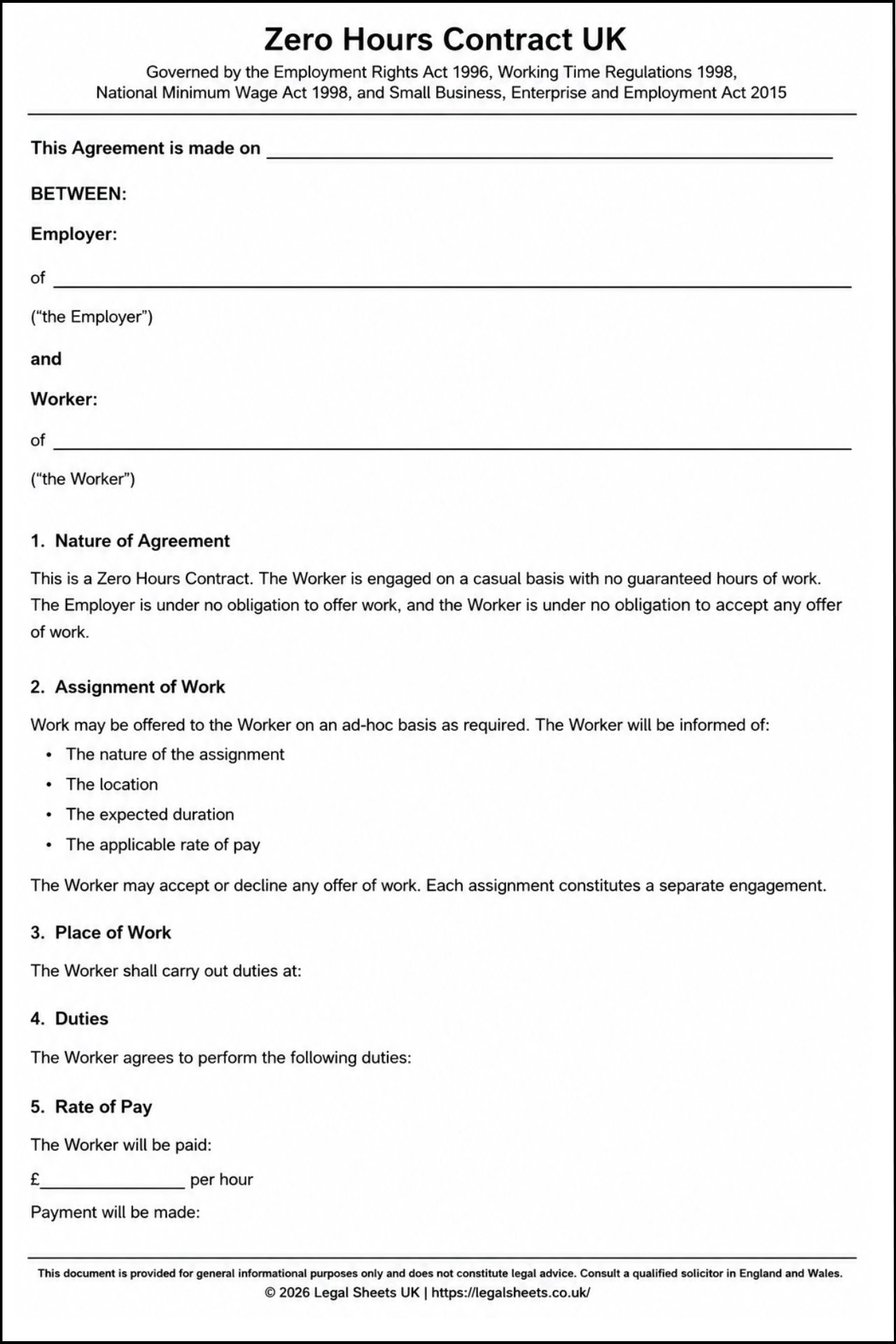
A zero hour contract template is most suitable where work is offered on an ad hoc basis and there is no guarantee that shifts will be available each week.
When a Zero Hours Contract Solves a Real Workforce Problem
Many employers turn to a zero hours employment contract because their staffing requirements are genuinely unpredictable.
Managing Unpredictable Demand
Certain industries experience substantial fluctuations in labour requirements.
Examples include:
- Seasonal tourism periods
- Christmas retail demand
- Sporting events
- Music festivals
- Emergency staff shortages
- Unexpected increases in customer demand
In these circumstances, guaranteed-hours arrangements may create unnecessary payroll obligations during quieter periods.
Providing Flexibility for Workers
Not all workers want a fixed schedule.
Zero hours arrangements can suit:
- Students
- Semi-retired individuals
- Workers holding multiple jobs through separate consultancy roles.
- Individuals with caring responsibilities
- People seeking occasional income through affiliate marketing.
The practical value often lies in flexibility for both parties rather than one-sided employer control.
Avoiding Informal Casual Working Arrangements
Informal arrangements frequently create avoidable disputes.
Problems often arise regarding:
- Holiday pay entitlement
- Shift acceptance expectations
- Payment arrangements
- Employment status
- Availability requirements
Documenting the arrangement from the outset creates a clear evidential record should disagreements emerge later.
Clauses That Matter Most in a Zero Hours Contract
Certain provisions carry substantially greater legal significance than others.
No Guaranteed Hours Provision
Under the Employment Rights Act 1996, employers must provide written particulars that accurately describe the relationship.
The contract should clearly state:
- The employer is not obliged to offer work
- The worker is not obliged to accept work
- Hours will vary according to business requirements
This clause establishes the mutuality-of-obligation position that sits at the centre of most zero-hours arrangements.
Failure to draft this section correctly creates significant risk. Employment Tribunals may imply regular working arrangements where the contract does not accurately describe the relationship.
Shift Offer and Acceptance Process
Operational disputes often arise because employers fail to document how shifts will be offered.
The contract should specify:
- Whether shifts are communicated by email, app, text message, or telephone
- Expected response times
- Procedures for accepting shifts
- Procedures for declining shifts
Clear systems reduce misunderstandings and create evidence if disputes later arise.
Shift Cancellation and Compensation Terms
The Employment Rights Act 2025 established strict statutory protections (taking full operational effect in 2027) legally entitling workers to reasonable advance notice of shifts and mandatory financial compensation if an employer cancels, moves, or curtails a shift at short notice.
Employers should establish:
- How cancellation notices are communicated
- Internal approval procedures
- Payroll handling processes
- Record retention requirements
A recurring problem occurs where managers cancel shifts informally without understanding the compensation consequences.
Holiday Pay Arrangements
Holiday pay remains one of the most litigated areas of irregular-hours working.
For irregular-hours workers, holiday accrues at 12.07% of hours worked under the Working Time Regulations 1998 as amended in 2024.
Where rolled-up holiday pay is used, employers must ensure that:
- The arrangement is clearly documented
- Holiday pay is separately identified
- Payslips contain proper itemisation
Failure to itemise rolled-up holiday pay can expose employers to unlawful deduction claims and potential double-payment liabilities.
Secondary Employment Rights
Many employers wrongly assume that they can prevent workers from accepting work elsewhere.
They cannot.
Exclusivity clauses in zero-hours arrangements are prohibited.
Employers cannot:
- Ban secondary employment
- Require permission before accepting other work
- Penalise workers for taking another job
Attempting to impose such restrictions creates significant Employment Tribunal exposure.
The Tribunal Risk Most Employers Miss: Employee Status Drift
Many disputes arise not because the contract is defective but because the working relationship evolves beyond the contract’s terms.
When a Zero Hours Worker Starts Looking Like an Employee
Under English common law, Employment Tribunals will pierce the ‘zero-hours’ label. If an employer operationally enforces a requirement to accept shifts, the tribunal will find that ‘mutuality of obligation’ exists, instantly reclassifying the worker as an ’employee’ with full unfair dismissal rights.
Warning signs include:
- Requiring workers to remain constantly available
- Penalising workers for declining shifts
- Providing regular fixed schedules
- Treating workers as permanent staff
- Applying disciplinary consequences for refusing work
Over time, these practices can undermine the intended structure of the arrangement.
Evidence Employment Tribunals Commonly Examine
In employment disputes, tribunals often review:
- Shift records
- Emails
- Internal messages
- Scheduling systems
- Payroll records
- Management instructions and written warnings
The written contract is only one piece of evidence.
The day-to-day reality frequently carries greater weight.
Practical Steps to Reduce Reclassification Risk
Employers seeking to preserve the intended arrangement should:
- Allow workers to decline assignments
- Avoid informal availability requirements
- Maintain accurate scheduling records
- Train managers on zero-hours obligations
- Ensure operational practices match contractual terms
Consistency is often more important than drafting sophistication.
Moving From Irregular Hours to Guaranteed Hours
When the Statutory Right Arises
Under the Employment Rights Act 2025 (taking effect in 2027), employers are legally mandated to offer eligible zero-hours workers a guaranteed-hours contract that accurately reflects the regular hours they have worked over a statutory 12-week reference period.
Employers should actively monitor: Hours worked during internship placements.
- Scheduling consistency
- Recurring work patterns
- Workforce requirements
Waiting for a complaint before reviewing eligibility often creates avoidable legal exposure.
Employer Obligations
Practical compliance involves:
- Reviewing attendance records
- Tracking working patterns
- Assessing eligibility thresholds
- Responding appropriately to requests
Businesses relying heavily on irregular-hours workers should establish internal review procedures rather than managing these issues informally.
Risks of Refusing a Transition
Ignoring statutory guaranteed-hours rights can result in:
- Employment Tribunal proceedings
- Detriment claims
- Unfair dismissal allegations
- Fair Work Agency intervention
The financial consequences can extend far beyond the value of the underlying hours themselves.
Payroll and Compliance Processes After the Contract Is Signed
HMRC Registration Requirements
Although the contract itself is not filed with any government body, employers must still register workers for PAYE and National Insurance purposes from Day 1. This applies even where earnings fluctuate significantly.
Pension Auto-Enrolment Considerations
Irregular earnings do not automatically remove pension obligations.
Employers should monitor:
- Earnings thresholds
- Eligibility changes
- Ongoing payroll assessments
Payroll systems frequently require adjustments where hours vary significantly from one period to the next for commission earners.
Payslip Requirements for Irregular Hours Workers
Accurate payslips become especially important where:
- Hours fluctuate
- Overtime occurs
- Rolled-up holiday pay is used
- Multiple pay rates apply
Record-keeping failures often become highly visible during Employment Tribunal proceedings.
Common Drafting Errors That Create Expensive Claims
Failing to Explain the Irregular Nature of the Work
If the contract does not clearly establish that no minimum hours are guaranteed, disputes over employment status become far more likely. Tribunals may look beyond the document and determine that the worker should have been treated differently from the outset.
Including an Unlawful Exclusivity Clause
Restrictions on working elsewhere are void. Employers that attempt to enforce these clauses risk tribunal claims and potential findings of unlawful detriment.
Omitting Shift Cancellation Procedures
Many employers underestimate the compliance implications of short-notice cancellations. What appears to be a simple scheduling issue can quickly develop into a wage dispute.
Mishandling Rolled-Up Holiday Pay
Improper payslip treatment remains one of the most common payroll errors involving irregular-hours workers. If holiday pay is not properly itemised, employers may face claims for unpaid holiday despite believing it has already been paid.
Using a Zero Hours Contract While Requiring Availability
This is the classic mutuality-of-obligation trap. The employer describes flexibility on paper while demanding availability in practice. Employment Tribunals regularly examine this contradiction.
Treating Casual Workers as Permanent Staff Operationally
Operational behaviour often determines outcomes more than document labels. If workers are managed as permanent employees, the contract title alone may offer little protection.
UK Legal Facts
Legal Requirements Table
| Topic / Issue | England Legal Rule | Governing Law |
|---|---|---|
| Exclusivity Clauses | Strictly banned. Employers cannot prohibit zero-hours workers from taking secondary jobs or subject them to detriment for doing so. | Exclusivity Terms in Zero Hours Contracts (Redress) Regulations 2015 |
| Guaranteed Hours | Workers gain the statutory right to be offered a guaranteed-hours contract reflecting their regular hours worked over a 12-week reference period. | Employment Rights Act 2025 |
| Shift Notice & Cancellation | Workers are statutorily entitled to reasonable advance notice of shifts and mandatory financial compensation for shifts cancelled or curtailed at short notice. | Employment Rights Act 2025 |
| Holiday Pay Accrual | For irregular-hours workers, holiday legally accrues at 12.07% of hours worked. “Rolled-up” holiday pay is permitted if strictly itemised as a separate line on payslips. | Working Time Regulations 1998 |
| Written Terms | Employers must provide a complete “Section 1 Statement” on or before Day 1, explicitly defining the lack of guaranteed hours, to avoid severe tribunal penalties. | Employment Rights Act 1996 |
| E-Signatures | Zero-hours contracts require no specific statutory formalities and can be validly executed electronically as simple contracts under hand. | Common Law |
Practical Legal Impact
The legal rules governing zero-hours arrangements have become significantly more important because enforcement is increasingly focused on the reality of working practices rather than contractual labels.
A Day-One written statement is not simply an administrative exercise. Where the irregular nature of the arrangement is not clearly documented, employers may face compensation awards and evidential difficulties during disputes.
Exclusivity clauses create immediate legal exposure because they are unenforceable. Employers who punish workers for accepting work elsewhere risk tribunal claims regardless of what the contract says.
Shift cancellation provisions require careful drafting. Failure to compensate workers appropriately can create payroll liabilities and attract scrutiny from the Fair Work Agency.
Holiday pay remains a common source of claims. Errors in accrual calculations or payslip itemisation frequently lead to unlawful deduction allegations that can become expensive to defend.
Signing and Implementing the Contract
Information to Complete Before Issue
Before issuing the contract, employers should gather:
- Worker details
- Pay rates
- Shift communication methods
- Holiday pay arrangements
- Payroll information
Incomplete information often creates compliance issues later.
Execution Requirements
No special statutory execution formalities apply.
The contract may generally be signed:
- Electronically
- In wet ink
- Through approved digital signature platforms
Signed copies should be retained as part of the employer’s personnel records for reference purposes.
Documents Commonly Issued Alongside the Contract
Many employers issue additional documents alongside the contract, including:
- Employee Handbook
- Data Protection Notice and confidentiality obligations
- Health and Safety Policies
- Shift Notification Procedures
These documents often become important evidence if a dispute later arises regarding working practices.
Frequently Asked Qu
estions
Can a zero hours worker legally refuse a shift without being penalised?
Yes. A genuine zero-hours arrangement is based on the principle that the worker is not required to accept every shift offered. Penalising workers for declining work can undermine the intended contractual structure.
Can an employer stop a zero hours worker from taking a second job?
No. Exclusivity clauses are prohibited. Employers cannot prevent workers from accepting work elsewhere or require consent before doing so.
What happens if shifts are repeatedly cancelled at short notice?
Workers may become entitled to statutory compensation protections. Repeated failures can result in wage-related claims and regulatory scrutiny.
Can a worker force an employer to provide guaranteed hours?
Eligible workers may become entitled to a guaranteed-hours offer where statutory requirements are satisfied and regular working patterns have developed.
Can a tribunal decide that a zero hours worker is actually an employee?
Yes. Under English common law, Employment Tribunals apply the ‘mutuality of obligation’ test rather than trusting contractual labels. If the employer operationally forces the worker to be available and regularly punishes them for declining shifts, the tribunal will legally reclassify them as an ’employee’, granting them full statutory protection against unfair dismissal.