
Agency Agreement Template UK (Free Fillable PDF)

Agency Agreement problems rarely appear when the relationship starts; they usually surface when commission payments are disputed or one side wants to terminate the arrangement. In England, Agency Agreements frequently operate alongside the Commercial Agents (Council Directive) Regulations 1993. Following the Retained EU Law (Revocation and Reform) Act 2023 and the government’s 2025 regulatory review, these rules are now entrenched as ‘assimilated law,’ meaning businesses are still routinely caught out when their contract wording unlawfully conflicts with strictly protected statutory agency rights

A common dispute arises after a successful sales relationship ends and the principal discovers that compensation obligations can survive termination despite what the agreement appears to say. County Court and High Court claims regularly turn on poorly drafted commission clauses, unclear territory provisions, or termination terms copied from generic templates. The template and guidance that follow focus on the clauses that matter most before an agency relationship begins generating business.

Agency Agreement Template (PDF, Word & Printable Formats)Agency Agreement
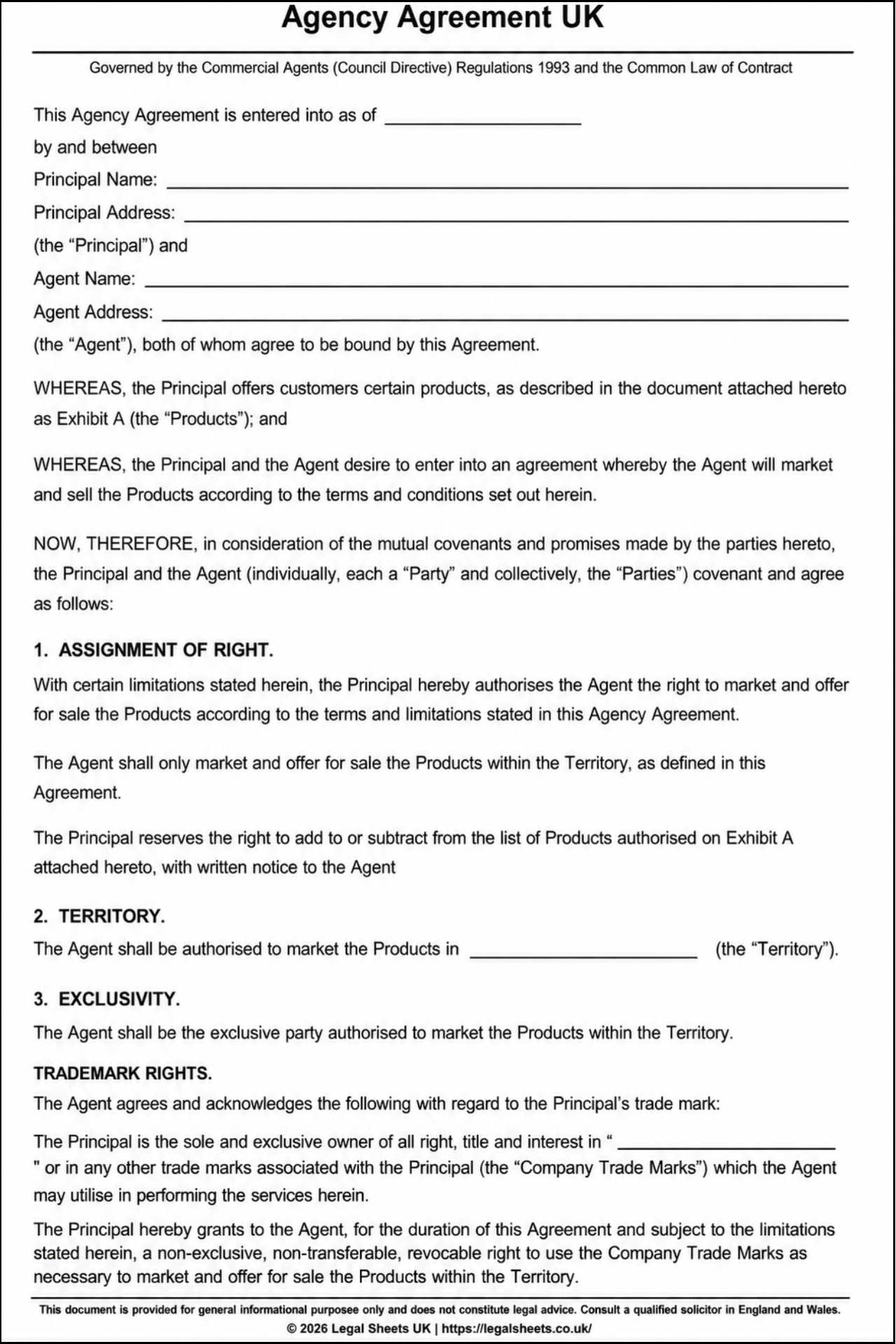
Get PDF | WORD

Why Businesses Use an Agency Agreement Instead of a Distribution Agreement

One of the most common commercial mistakes is assuming that an agency arrangement and a distribution arrangement achieve the same result. They may both involve selling products into a market, but the legal and commercial consequences are very different.

Agent Sells on Behalf of the Principal

In a sales agency agreement, the principal remains the contracting party with the customer. The agent’s role is normally to generate business opportunities, negotiate terms, or introduce customers in exchange for commission. The customer relationship ultimately belongs to the principal, and ownership of the goods generally remains with the principal until the sale takes place.

This structure is attractive to businesses entering new markets because it allows expansion without recruiting employees or establishing a physical presence. However, it also means disputes often focus on commission entitlement, customer ownership, and post-termination payments rather than product resale issues.

Distributor Buys and Resells

A distributor usually purchases goods and resells them independently. The distributor assumes commercial risk, determines its own resale strategy, and generates profit through the difference between purchase and resale prices.

The distinction becomes particularly important when a relationship ends. A distributor generally does not benefit from the same statutory protections that may apply to a commercial agent handling goods. Businesses that use the wrong agreement sometimes discover this difference only after a dispute arises.

Why Getting the Structure Wrong Creates Risk

The problem is not usually obvious when the relationship begins. It tends to emerge when one party attempts to terminate the arrangement or when commission claims arise after termination.

Where the reality of the relationship looks more like an agency arrangement than a distribution arrangement, statutory rights may apply regardless of how the contract is labelled. Principals are often surprised to discover that notice obligations and post-termination payment claims can arise despite believing they had complete freedom to end the relationship.

The Clauses That Usually Cause Problems During the Relationship

Most agency disputes are not caused by the commission percentage itself. They arise because the agreement failed to deal properly with authority, customer ownership, or the circumstances in which commission becomes payable.

Defining the Agent’s Authority

Authority disputes can become expensive because they often involve third parties. If an agent promises something to a customer that the principal never intended to offer, the disagreement may extend beyond the agency relationship and affect the underlying commercial transaction.

Authority to Negotiate

Many principals want agents to discuss pricing, delivery arrangements, and commercial opportunities without giving them unrestricted authority to commit the business.

Problems arise when the agreement does not clearly identify where negotiation authority ends. Customers may assume the agent has authority to make binding commitments, while the principal takes the opposite view. Once a dispute reaches court, the focus often shifts to the wording of the agreement and the conduct of the parties rather than what either side believed internally.

Authority to Conclude Contracts

Some agents are authorised to negotiate but not sign contracts. Others are given authority to conclude transactions on behalf of the principal.

This distinction should be addressed clearly. Businesses frequently assume that everyone understands the limits of the agent’s role, only to discover later that the customer relied upon statements or commitments the principal never intended to authorise.

Commission Clauses: Where Agency Relationships Commonly Break Down

Few disputes arise when commission is being paid regularly and the relationship remains positive. Problems usually appear after a major customer is secured, a sale completes shortly after termination, or the parties disagree about when commission becomes earned.

When Commission Is Earned

One of the most common drafting mistakes is assuming that identifying the commission percentage is enough.

In practice, the agreement should explain whether commission becomes payable when an order is placed, when the customer pays, when goods are delivered, or when the contract is completed. Each approach creates different commercial consequences. If the agreement remains silent, disputes often arise precisely when the sums involved become significant.

Pipeline Commission Disputes

Pipeline commission disputes are among the most common agency disagreements. An agent may spend months developing a customer relationship only for the transaction to complete after the agency relationship has ended through affiliate referrals.

The principal may argue that the agreement has terminated and no commission remains due. The agent may argue that the sale resulted directly from work completed before termination. According to the verified legal framework, these disputes frequently depend upon contractual drafting and evidence demonstrating the agent’s contribution to the eventual sale.

Exclusivity Provisions

Exclusivity can create significant value for an agent, but it can also create significant restrictions for a principal.

Exclusive Agency Rights

Where exclusivity is granted, the agreement should clearly identify the territory, customer group, or market sector affected.

Many disputes occur because exclusivity is described in broad commercial language without explaining whether the principal may continue servicing existing customers or appoint additional representatives in the same territory.

Non-Exclusive Arrangements

Non-exclusive arrangements offer greater flexibility, but they create their own challenges.

If multiple agents operate in the same market, disagreements frequently arise regarding which agent introduced a customer first and who is entitled to commission. Without accurate records and clear contractual wording, these disputes can become difficult to resolve long after the original introduction took place.

Termination: Where Most Agency Disputes Begin

Most agency relationships do not end because of a single dramatic event. More commonly, sales decline, business priorities change, or the parties gradually move in different directions. The legal issues usually begin when one side assumes it can simply end the arrangement immediately.

For commercial agents involved in the sale or purchase of goods, mandatory notice provisions may apply under the Commercial Agents (Council Directive) Regulations 1993. The statutory minimum is one month during the first year, two months during the second year, and three months from the third year onwards. Contract clauses attempting to provide less notice than these minimum periods are ineffective and may expose the principal to liability for damages. In practice, many businesses only discover this issue after serving a termination notice that does not comply with the statutory requirements.

The Indemnity vs Compensation Decision Most Principals Miss

Many principals spend considerable time negotiating commission rates and sales targets while paying very little attention to what happens when the agency relationship ends. In practice, the most expensive dispute often arises after termination rather than during the relationship itself. The financial consequences can vary dramatically depending on whether the agreement contains an indemnity provision or defaults to compensation under the Commercial Agents Regulations 1993.

Why This Clause Matters

The issue is frequently overlooked because termination may seem years away when the agreement is signed. However, once a successful customer base has been developed, the value of the agency relationship can become substantial. Principals are often surprised to discover that ending the relationship may trigger a significant payment obligation even where no contractual breach has occurred. The dispute is rarely about whether payment is due. The real argument is often about how that payment should be calculated.

Indemnity Election

If a principal wishes to rely on the indemnity approach, the agreement must expressly provide for it. Many businesses assume that indemnity applies automatically because it appears commercially reasonable. That assumption is often incorrect. The wording needs to be included at the drafting stage because it may affect the financial exposure that exists when the relationship eventually comes to an end.

What Happens If the Clause Is Missing

Where no indemnity election has been made, compensation becomes the statutory default position. This often creates a drastically more expensive outcome. Under English common law (established by the House of Lords in Lonsdale v Howard & Hallam), default statutory compensation requires a complex, expert-led valuation of the agency business as a ‘going concern’ at the exact moment of termination.. These disputes frequently require expert evidence and detailed valuation exercises. Businesses that overlooked the issue when the agreement was signed often discover that the omission becomes one of the most expensive clauses in the entire contract.

Restrictive Covenants After the Agency Ends

Many principals assume they can simply prevent a departing agent from contacting customers or working within the industry for several years. In reality, restrictive covenants face close scrutiny and overly aggressive restrictions often fail when tested in court.

Post-Termination Non-Compete Clauses

The objective is usually straightforward. A principal wants to protect customer relationships and confidential information that were developed during the agency relationship. The challenge is achieving that protection without imposing restrictions that go beyond what the law permits. A restriction that appears commercially sensible may still be unenforceable if it is drafted too broadly.

Permitted Restrictions

Under Regulation 20 of the Commercial Agents Regulations 1993, a post-termination restraint of trade clause is only valid if concluded in writing and strictly limited to both the specific geographical area (or customer group) and the specific kind of goods entrusted to the agent. Courts are far more willing to enforce provisions that protect genuine commercial interests than clauses that appear designed simply to eliminate competition. Careful drafting is often more valuable than broad drafting.

When Restrictions Become Unenforceable

Problems arise when restrictions extend beyond the territory, customers, or products actually handled by the agent. Similar issues occur where the restriction lasts longer than permitted. An English court may strike out the restriction entirely, leaving the principal without any protection at all. Many businesses discover that an overly ambitious clause provides less protection than a carefully tailored one.

Anti-Bribery Risks That Principals Often Overlook

Agency relationships can create risks that do not exist with direct employees. Agents often operate independently, interact with customers without direct supervision, and may be active in territories where commercial practices differ significantly from those expected in England.

Why Agency Relationships Create Additional Exposure

The principal may assume that the agent’s conduct is entirely the agent’s responsibility under separate business partnerships. However, under the Bribery Act 2010, an organisation may face liability if an associated person engages in bribery to obtain or retain business. In practice, businesses often focus on sales performance and market expansion while paying insufficient attention to compliance procedures.

Compliance Clauses Worth Including

Anti-bribery provisions are often treated as routine boilerplate wording. In reality, they may become critical evidence if a compliance investigation later occurs. Businesses frequently include warranties confirming compliance with anti-bribery laws together with obligations to report suspected misconduct. These provisions create contractual rights that may assist if concerns arise about the agent’s activities.

Audit Rights

Audit rights are particularly valuable where agents operate in higher-risk markets for consultancy services. The ability to inspect records, commission payments, and customer interactions can provide early warning signs of potential compliance issues. Businesses that fail to monitor agent activity often discover problems only after a regulator, customer, or competitor raises concerns.

Consequences of Non-Compliance

The consequences can extend well beyond termination of the agency relationship. Corporate criminal liability, unlimited fines, reputational damage, and regulatory scrutiny may follow if adequate procedures were not in place. The commercial cost of a bribery investigation often exceeds the value of the business generated by the agent in the first place.

Preventing an Agent From Becoming a Worker or Employee

One of the most common misunderstandings is the belief that describing someone as an “independent contractor” automatically prevents employment claims. Courts and tribunals focus on the reality of the relationship rather than the label used in the agreement.

The Contract Label Is Not Decisive

Businesses frequently rely on contractual wording while overlooking how the arrangement operates in practice. If the principal exercises extensive day-to-day control, dictates working patterns, or requires personal service, the written description may carry less weight than expected. Employment status disputes often focus on behaviour rather than terminology.

Common Mistakes

Excessive supervision, mandatory procedures, fixed working hours, and restrictions on delegation can all create difficulties. These arrangements may appear commercially sensible from a management perspective but can undermine the argument that the agent operates an independent business.

Employment Tribunal Risks

Where an individual successfully argues that they are a worker or employee, the financial consequences can extend far beyond the agency agreement itself. Under the Employment Rights Act 1996, these claims can suddenly unlock backdated holiday pay, National Minimum Wage arrears, and protection against unfair dismissal if the tribunal pierces the ‘independent contractor’ labelBusinesses often become aware of these risks only after the relationship has already broken down and proceedings have been commenced in the Employment Tribunal.

Agency Agreement Execution and Signing Requirements

Many businesses devote substantial attention to commission clauses and termination provisions while giving little thought to how the agreement is actually executed. Most of the time this causes no difficulty. The problem usually emerges later when one party disputes whether authority existed to enter the agreement or whether the person who signed had the power to bind the business.

Can an Agency Agreement Be Oral?

Unlike some legal documents, an agency agreement does not generally require a specific statutory form. Under common law principles, an agency relationship may arise through written agreements, verbal arrangements, or even conduct. The difficulty is not usually validity. The difficulty is proving precisely what was agreed once a dispute develops. Businesses that rely on informal arrangements often discover that commission structures, exclusivity rights, and termination terms become far harder to establish months or years later.

Right to Written Terms

For commercial agents involved in the sale or purchase of goods, either party is entitled to request signed written terms setting out the agreement. This right is often overlooked during the early stages of a successful commercial relationship because both parties are focused on generating business rather than documenting it. In practice, written terms frequently become most valuable when commission disputes arise or the relationship begins to deteriorate.

Power of Attorney Situations

Some agency relationships extend beyond sales activity and give the agent authority to execute documents on behalf of the principal. Where deeds are involved, additional formalities may apply because authority to execute deeds generally requires a Power of Attorney executed as a deed. Businesses occasionally assume that a standard agency agreement is sufficient authority when separate documentation is actually required.

Notices, Service, and Record Keeping

Agency disputes are often won or lost on evidence rather than legal arguments. Businesses regularly focus on the substance of the disagreement while overlooking the importance of notice procedures and documentary records.

Service of Notices

Termination notices, commission disputes, and contractual claims should be handled in accordance with the notice provisions contained in the agreement. Courts generally take a strict approach to agreed notice mechanisms. A party that uses the wrong address, incorrect delivery method, or fails to comply with contractual notice requirements may create unnecessary arguments about whether the notice was ever validly served.

Commission Records

Many commission disputes arise because neither party maintained adequate records. An agent may believe they introduced a customer while the principal attributes the sale to another source. Without supporting evidence, resolving the disagreement becomes increasingly difficult.

Businesses should retain: Customer communications, Sales records, Commission calculations, Order histories, Termination correspondence, and service records.

According to the verified legal framework, pipeline commission disputes are among the most common practical enforcement issues in agency litigation. Clear records often determine whether a claim succeeds or fails.

UK Legal Facts You Should Know

Legal Requirements Table

Topic / Issue England Legal Rule Governing Law
Right to Written Terms Either party holds a non-excludable right to demand a signed, written document setting out the terms of the agency. Commercial Agents Regulations 1993 (Reg 13)
Mandatory Minimum Notice Cannot be contracted out of: 1 month (Year 1), 2 months (Year 2), 3 months (Year 3+). Commercial Agents Regulations 1993 (Reg 15)
Post-Termination Payments “Compensation” (assessing the agency’s value as a going concern) is the automatic statutory default unless “Indemnity” (capped) is expressly drafted. Commercial Agents Regulations 1993 (Reg 17)
Restrictive Covenants Tribunals will ignore “independent contractor” labels if day-to-day control indicates worker/employee reality, triggering backdated statutory rights. Commercial Agents Regulations 1993 (Reg 20)
Anti-Bribery Liability Principals face strict corporate criminal liability and unlimited fines if an agent (“associated person”) pays a bribe to obtain or retain business. Bribery Act 2010
Execution Requirements Where an agent is authorised to execute deeds on behalf of the principal, the authority must be granted via a legally executed Power of Attorney. Powers of Attorney Act 1971

Practical Legal Impact

These legal rules rarely attract attention while the relationship is profitable. Their significance usually becomes apparent after termination or during litigation. Businesses are often surprised to discover that statutory notice rights cannot simply be removed through contract wording, that compensation may apply even where no breach has occurred, or that a poorly drafted restrictive covenant provides no protection at all.

Another recurring issue is compliance. Principals frequently focus on sales performance while overlooking anti-bribery procedures and employment status risks. By the time a dispute reaches the County Court, High Court, or Employment Tribunal, the opportunity to correct those mistakes has usually passed.

Filing, Registration, and Notice Requirements

Unlike many corporate transactions, an agency agreement is generally a private commercial arrangement and does not require government registration to become legally effective.

When No Registration Is Required

Businesses do not normally need to file an agency agreement with Companies House, HM Land Registry, or another public authority. The agreement takes effect through ordinary contractual principles rather than any registration process. This often surprises business owners who assume that commercial contracts require some form of official approval before they become enforceable.

Limited Exceptions

The main exception arises where a separate Power of Attorney is granted. In those circumstances, additional execution requirements may apply depending on the authority being delegated. However, this relates to the Power of Attorney itself rather than the underlying agency agreement.

If the Agency Relationship Breaks Down

Most agency agreements are signed when both parties expect a long and successful commercial relationship. The document often receives little attention until sales decline, commission becomes disputed, or one side decides the arrangement is no longer commercially viable. At that stage, the focus shifts from generating business to enforcing contractual rights.

Common Court Disputes

Agency disputes rarely involve a single issue. More commonly, several disagreements emerge at the same time, creating a complex and expensive dispute.

Commission Claims

Unpaid commission remains one of the most common causes of litigation. Disputes often arise where a customer was introduced by the agent but the sale completed after termination. The principal may argue that commission is no longer payable, while the agent may claim that the transaction resulted directly from work completed before the relationship ended. According to the verified legal framework, pipeline commission disputes are among the most frequent practical enforcement issues in agency litigation and often depend heavily on contractual drafting and documentary evidence.

Termination Payment Claims

Many principals are surprised to discover that ending an agency relationship may trigger a claim for compensation or indemnity following shareholder changes. These disputes frequently become the most expensive part of the litigation because they involve assessing the financial consequences of termination rather than simply calculating unpaid commission. Where the agreement failed to address the issue properly, the parties may face lengthy arguments regarding valuation methods and entitlement.

Restrictive Covenant Litigation

Former principals often seek to enforce post-termination restrictions when an agent begins contacting customers or working with competitors. The dispute usually centres on whether the restriction is enforceable rather than whether it has been breached. A clause that appears commercially sensible may still fail if it extends beyond the geographical area, customers, or products entrusted to the agent.

Breach of Fiduciary Duty Claims

Agency relationships involve trust. Problems can arise where an agent acts for competing principals without disclosure, receives undisclosed benefits, or places personal interests ahead of the principal’s interests. In those circumstances, the principal may seek equitable remedies, including an account of profits. These claims are often highly fact-specific and depend heavily on documentary evidence.

Where Disputes Are Usually Resolved

The forum used to resolve the dispute often depends on the nature and value of the claim.

County Court

Many lower-value commercial disputes are heard in the County Court. Claims for unpaid commission, notice breaches, and contractual disputes frequently begin here. Although the sums involved may be smaller than in High Court litigation, the evidential requirements remain important. Businesses that have failed to preserve records often encounter significant difficulties proving their case.

High Court

Complex agency disputes involving substantial compensation claims, international agency arrangements, or significant commercial consequences are often heard in the High Court. Compensation disputes arising after termination can become particularly expensive because expert evidence may be required to assess the value of the agency business. According to the verified legal framework, these cases are commonly heard in the King’s Bench Division or Commercial Court.

Employment Tribunal

Not every dispute remains within the civil courts. If an individual agent argues that they were actually a worker or employee rather than an independent commercial agent, the dispute may begin in the Employment Tribunal. Claims for holiday pay, worker status, and other employment rights often focus on the reality of the working relationship rather than the wording used in the agreement itself.

Frequently Asked Questions

Can a commercial agent insist on receiving written terms?

Yes. For commercial agents involved in the sale or purchase of goods, either party is entitled to request signed written terms setting out the agency relationship. While agency agreements can often be created orally, written terms usually reduce disputes regarding commission, authority, and termination rights.

What happens if the agreement does not include an indemnity clause?

Where no indemnity election has been made, compensation becomes the statutory default position. This can result in substantially greater termination costs because compensation may involve assessing the value of the agency business at the date of termination. Many principals only discover the significance of this distinction after the relationship has ended.

Can an agency agreement provide less notice than the statutory minimum?

No. For commercial agents handling goods, statutory minimum notice periods apply. Any contractual clause attempting to provide shorter notice is ineffective and the statutory minimum periods will apply instead. Principals who terminate without providing the correct notice may face claims for damages.

Can a non-compete clause stop an agent from working in the industry indefinitely?

No. By law, post-termination restrictive covenants must be documented in writing, cannot exceed 24 months, and must be strictly confined to the specific goods and the exact geographical area or customer group the agent actively handled Restrictions that go beyond those limits are vulnerable to challenge and may be struck out entirely by the court.

Can an independent agent later claim worker status?

Potentially. Employment tribunals focus on the reality of the working relationship rather than the contractual label used by the parties. Excessive control, mandatory working arrangements, and restrictions on delegation may all support an argument that the individual was a worker or employee rather than a genuinely independent agent.

Does an agency agreement need to be registered with Companies House?

No. An agency agreement is generally a private commercial contract and does not require registration with Companies House, HM Land Registry, or another government authority to be legally valid. The main exception is where a separate Power of Attorney is involved, as additional formalities may apply to that document.

What is the most common dispute under a commercial agency agreement?

In practice, commission disputes are among the most common causes of litigation, particularly where sales are completed shortly after termination. Questions regarding pipeline commission, customer ownership, and post-termination payments frequently become the focus of court proceedings because the financial stakes can be significant.

Author

  • Eva

    Eva Gray is a content writer and editorial reviewer at LegalSheets, where she writes and fact-checks articles on UK law, contracts, and everyday legal matters. She holds both a First-class BA and an MPhil from the University of Cambridge, and has gained hands-on legal experience through internships at Stephenson Harwood, Linklaters, and O'Keefe's Solicitors. A member of the Cambridge Law Society, Eva combines academic rigour with practical legal insight to produce clear, accurate, and trustworthy content that helps readers navigate complex legal topics with confidence.

Similar Posts

Leave a Reply

Your email address will not be published. Required fields are marked *