
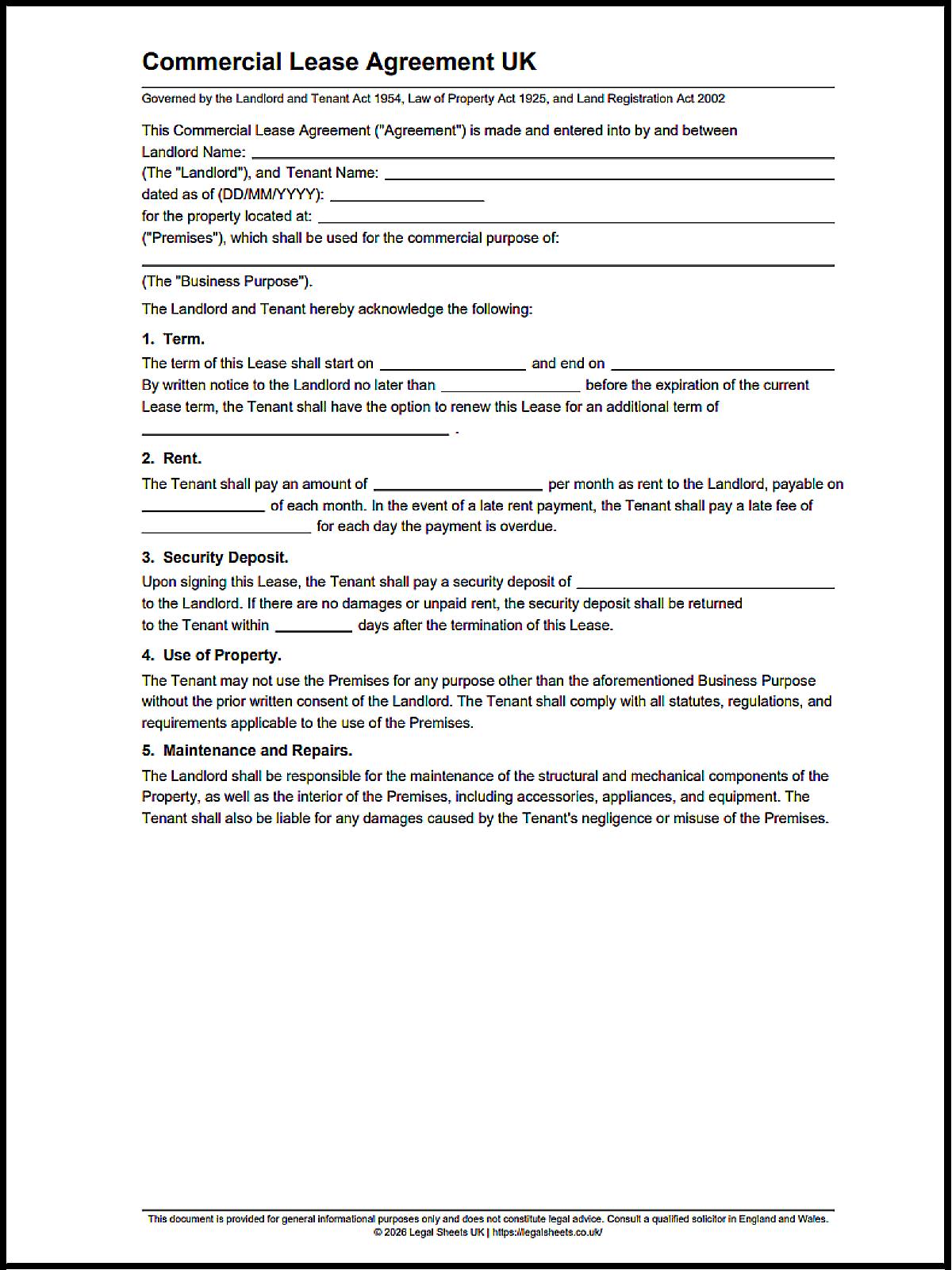
Commercial Lease Agreement Template (PDF & Printable Formats)
A Commercial Lease Agreement is often searched for when a landlord or business tenant is close to agreeing terms for premises and realises that a poorly drafted lease can create problems years after the keys are handed over. One of the most common difficulties in England arises where the parties intend to exclude security of tenure under the Landlord and Tenant Act 1954 but fail to complete the required procedure correctly, leaving unexpected renewal rights at the end of the term.
Property disputes of this kind can escalate into County Court proceedings when there is disagreement about whether a tenant is entitled to remain in occupation or whether a break clause has taken effect. Commercial premises also tend to involve ongoing issues such as repairs, service charges, alterations, and rent reviews, making precise drafting far more significant than many first-time landlords or tenants expect.
The template and accompanying guidance here are designed for those who need lease wording that reflects how a commercial property will actually be occupied and managed in England.
Table of Contents
ToggleCommercial Lease Agreement Template (PDF, Word & Printable Formats)
When Businesses Usually Need a Commercial Lease Agreement
New Occupation of Commercial Premises
Commercial leases are commonly used when occupying:
- Retail stores
- Professional offices
- Warehouses
- Industrial units
- Hospitality premises
Many disputes originate at the beginning of the tenancy because parties focus heavily on rent while giving insufficient attention to repair obligations, permitted use clauses, or future exit rights.
Expansion, Relocation, or Consolidation Projects
Businesses frequently require a new lease when: Opening additional trading locations through franchise or agency expansion
- Relocating operations
- Consolidating multiple sites
Operational growth plans often influence lease length, assignment flexibility, and break rights for new business locations.
Investment Property Transactions
Commercial leases are also critical during:
- Acquisition of occupied investment property
- Lease re-gearing exercises
- Asset management initiatives
Investors often assess lease quality before purchase because defects affecting renewal rights, assignment provisions, or registration can influence investment value.
Occupation Arrangements That Require Different Documents
A commercial lease is not always the correct solution.
Alternative documents include:
- Licence to Occupy
- Tenancy at Will
- Agreement for Lease
- Sublease
- Commercial Rent Deposit Deed
- Side Letter Agreements
Selecting the wrong document can create unintended rights that neither party expected.
Early Decisions That Shape the Entire Lease
Length of Term and Business Objectives
The lease term affects:
- Flexibility
- Future growth
- Exit strategy
- Investment value
A growing business may prioritise break rights and assignment flexibility, whereas an investor may favour a longer fixed term.
Security of Tenure: Renewal Rights or Contracting Out?
One of the most significant decisions concerns whether the tenancy will benefit from statutory renewal rights under Part II of the Landlord and Tenant Act 1954.
Protected business tenancies may allow tenants to seek a new tenancy when the contractual term expires.
Where the parties wish to exclude those rights, the statutory contracting-out process must be completed before the agreement becomes binding. Under Section 38A of the Landlord and Tenant Act 1954 (a framework the Law Commission officially retained in its recent mid-2026 interim statement), the landlord must serve a prescribed warning notice. The tenant must then respond with a simple declaration—or a sworn statutory declaration if the notice period is less than 14 days. Defective timing or improper execution renders the exclusion void, inadvertently granting the tenant full statutory renewal rights.
A common commercial mistake occurs when parties leave contracting-out formalities until immediately before completion. If the process is defective, the tenant may acquire renewal rights that the landlord never intended to grant.
Defining the Permitted Use
Use clauses determine how the premises may be occupied.
Drafting choices often include:
- Narrow use provisions
- Broad commercial use rights
- Planning-related restrictions
- Future operational flexibility
A restrictive use clause can become problematic if a business later diversifies its activities.
Rent Structure Choices
Commercial leases may use:
- Fixed rent
- Stepped increases
- Turnover rent
- Indexed reviews
The chosen structure frequently influences both affordability and future disputes.
Commercial Property Lease Clauses That Generate the Most Disputes
Repairing Obligations and Dilapidations Exposure
Repair clauses are among the most heavily litigated lease provisions.
Issues commonly arise regarding:
- Full repairing obligations
- Internal-only responsibilities
- Existing defects
- Schedules of condition
At lease expiry, landlords often pursue dilapidations claims. However, repair claims are not automatically recoverable in full. Financial recovery is strictly capped by Section 18(1) of the Landlord and Tenant Act 1927. This statutory ceiling ensures damages for breach of a repairing covenant cannot exceed the diminution in the value of the landlord’s reversionary interest. Crucially, if the landlord plans to demolish or substantially redevelop the premises, rendering the repairs obsolete, the tenant’s liability drops to zero.
Service Charge Provisions
Disputes often involve:
- Recoverable expenditure
- Excluded costs
- Major works
- Budget transparency
Tenants frequently challenge service charge demands where lease wording is unclear regarding recoverable expenses.
Insurance Responsibilities
Commercial leases usually allocate responsibility for:
- Building insurance
- Tenant contributions
- Uninsured risks
- Rent suspension arrangements
Many disputes arise after damage occurs because parties discover that assumptions about insurance cover differ from the actual lease wording.
Alterations and Fit-Out Works
Commercial occupiers often need flexibility for: Internal alterations for independent contractors
- Shop fitting
- Office layouts
- Operational improvements
Failure to address reinstatement obligations can create significant costs at lease expiry.
Assignment and Subletting Controls
Assignment provisions affect a tenant’s ability to exit the lease.
Key issues include:
- Landlord consent requirements
- Authorised Guarantee Agreements (AGAs)
- Group company transfers
- Underletting restrictions
For ‘new tenancies’ granted after 1 January 1996, Section 5 of the Landlord and Tenant (Covenants) Act 1995 automatically releases the outgoing tenant from lease covenants upon a lawful assignment. However, under Section 16, landlords routinely mandate an Authorised Guarantee Agreement (AGA) as a strict condition of consent, legally binding the outgoing tenant to guarantee their immediate assignee’s performance.
Landlords who delay consent decisions or impose unlawful restrictions may face disputes under statutory assignment rules.
Break Clauses
Break clauses regularly generate litigation because courts expect strict compliance.
Typical areas of dispute include:
- Notice periods
- Vacant possession requirements
- Payment conditions
- Service requirements
Minor procedural mistakes can invalidate a break notice and leave a tenant committed to years of additional rent.
Security of Tenure: The Issue That Often Determines Lease Value
Protected Business Tenancies
Where security of tenure applies, tenants may have rights to seek renewal when the lease ends.
Renewal disputes commonly concern:
- Statutory procedures
- Renewal terms
- Grounds of opposition
- Business continuity
Many landlords assess redevelopment plans years before lease expiry because renewal rights can affect possession strategies.
Excluding Renewal Rights Before Completion
The exclusion procedure requires careful timing.
The landlord’s warning notice and tenant declaration must be completed before the lease or agreement becomes binding. The prescribed forms are governed by the Regulatory Reform (Business Tenancies) (England and Wales) Order 2003.
Official legislation can be reviewed at Landlord and Tenant Act 1954.
Consequences of a Defective Contracting-Out Process
A defective process may result in:
- Automatic statutory renewal protection
- Reduced landlord control
- Redevelopment delays
- Increased tenant bargaining power
The financial impact can be substantial where future vacant possession forms part of an investment strategy.
Commercial Rent, Reviews, and Occupation Costs
Base Rent Provisions
Commercial leases commonly address:
- Payment frequency
- VAT treatment
- Late payment interest
Even straightforward rent clauses can become contentious where payment dates or interest calculations are unclear.
Rent Review Mechanisms
Common review structures include:
- Open market reviews
- Indexed reviews
- Fixed increases
Rent review disputes are frequently resolved through expert determination, arbitration, or negotiated settlement.
Additional Occupation Costs
Occupiers often pay:
- Service charges
- Insurance rent
- Utilities
- Business rates
Businesses evaluating premises should assess total occupation cost rather than headline rent alone.
Managing Unexpected Cost Escalation
Useful protections may include:
- Service charge caps
- Cost exclusions
- Transparency obligations
- Audit rights
These provisions often become more important than rent levels during long lease terms.
Registration, Tax, and Completion Requirements
SDLT Considerations Following Completion
Under the Finance Act 2003 (as amended), where a lease triggers Stamp Duty Land Tax, a Land Transaction Return (SDLT1) must be filed and the tax paid within a strict 14-day window of the ‘effective date’—which is usually completion or the date of substantial performance, such as the tenant taking early occupation or paying rent.
Failure can trigger penalties, interest, and registration difficulties.
Official guidance is available through HMRC SDLT guidance.
When a Commercial Lease Must Be Registered
Under Section 4(1)(c) of the Land Registration Act 2002, leases exceeding seven years generally require registration.
Applications must be made within two months of completion.
Failure to register can leave the tenant holding only an equitable interest rather than a legal leasehold estate.
Land Registry Prescribed Clauses
Registrable leases must contain the prescribed Land Registry clauses at the beginning of the document.
Their omission can result in rejection of the registration application.
Further information is available from HM Land Registry.
Executing the Lease Correctly
Commercial leases exceeding three years generally require execution as a deed pursuant to Sections 52 and 54(2) of the Law of Property Act 1925.
Execution mistakes remain surprisingly common. Incorrect witnessing, defective corporate execution, or missing signatures can undermine the creation of a legal lease.
Common Drafting Mistakes That Cause Expensive Commercial Disputes
Property Boundaries Described Inadequately
Problems frequently arise regarding:
- Shared accessways
- Parking spaces
- Loading areas
- Common parts
Ambiguous plans often create disputes long after occupation begins.
Unclear Repair Obligations
Leases that fail to distinguish between internal and structural responsibility regularly generate expensive disagreement.
Defective Break Clause Drafting
Break rights can fail because:
- Conditions are ambiguous
- Notice provisions are unclear
- Service mechanisms are defective
County Court litigation regularly centres on procedural compliance rather than commercial intention.
Assignment Provisions That Conflict With Statutory Rules
Restrictions that exceed statutory limits may be challenged, particularly where landlord consent is withheld unreasonably.
Failure to Address Future Business Changes
Businesses evolve through shareholder changes through partnerships and restructuring.
Lease provisions that ignore future expansion, restructuring, or rebranding frequently become obstacles years later.
Landlord Enforcement Options During the Lease Term
Rent Recovery Without Ending the Lease
Commercial landlords may use Commercial Rent Arrears Recovery (CRAR) for qualifying rent arrears.
A recurring enforcement failure involves attempting to recover non-rent liabilities through CRAR or failing to comply with statutory notice requirements.
Forfeiture for Tenant Breaches
Forfeiture may be available where the lease permits re-entry following specified breaches.
However, improper use can expose landlords to significant liability.
Section 146 Notice Requirements
For breaches other than simple rent arrears, landlords generally need to comply with Section 146 of the Law of Property Act 1925 before forfeiture.
The notice must identify the breach and allow a reasonable opportunity to remedy it where appropriate.
A defective notice can result in wrongful forfeiture claims, damages, and applications for relief.
The legislation can be reviewed at Law of Property Act 1925.
Recovering Dilapidations Claims
Landlords often commission:
- End-of-term inspections
- Dilapidations schedules
- Cost assessments
However, recoverability is heavily policed by the pre-action Dilapidations Protocol. Landlords cannot simply claim the raw cost of works; they must formally evidence the actual reduction in the property’s open-market value caused by the disrepair to comply with the Section 18(1) statutory cap.
UK Legal Facts and Compliance Framework
| Topic / Issue | England Legal Rule | Governing Law |
|---|---|---|
| Execution Formalities | Commercial leases exceeding 3 years must be executed as a deed to grant a legal estate. | Law of Property Act 1925 (ss. 52 & 54(2)) |
| Witnessing Requirements | Deeds must be validly signed, witnessed by an independent party, and delivered. | Law of Property (Miscellaneous Provisions) Act 1989; Companies Act 2006 |
| Security of Tenure Exclusion | Strict statutory procedure (warning notice + tenant declaration) must precede a binding agreement to exclude renewal rights. | Landlord and Tenant Act 1954 (s. 38A) & Regulatory Reform Order 2003 |
| Registration Obligations | Leases granted for a term exceeding 7 years must be registered at HM Land Registry within 2 months of completion. | Land Registration Act 2002 (s. 4(1)(c)) |
| Assignment Liability | Outgoing tenants are released upon lawful assignment but can be legally compelled to sign an Authorised Guarantee Agreement (AGA). | Landlord and Tenant (Covenants) Act 1995 (ss. 5 & 16) |
| Energy Efficiency (MEES) | It is unlawful to grant or continue a commercial lease with an EPC rating below E (with active 2026 transition pathways toward rating C). | Energy Efficiency (Private Rented Property) (England and Wales) Regulations 2015 |
In practice, these compliance requirements affect whether the lease functions as intended. Registration failures can undermine legal title protection. Defective contracting-out procedures can unexpectedly create renewal rights. Execution errors can prevent the intended legal estate from arising. Energy efficiency breaches may expose landlords to substantial financial penalties even where the lease itself remains enforceable.
Commercial lease disputes are generally resolved through the court system rather than residential tenancy tribunals. The County Court deals with many renewal disputes, possession claims, rent recovery matters, and forfeiture applications, while larger or more complex cases may proceed in the High Court.
Before Signing: Commercial Lease Due Diligence Checklist
For Landlords
- Verify tenant covenant strength
- Consider guarantor requirements
- Review insurance arrangements and service provider contracts
- Assess proposed use risks and consultant recommendations
For Tenants
- Review repair liabilities carefully
- Examine historic service charge costs
- Confirm planning compatibility
- Assess future occupation flexibility
For Both Parties
- Verify property boundaries
- Confirm rights and easements
- Check registration requirements
- Review notice provisions and service mechanisms
Frequently Asked Questions
Can a tenant automatically renew a commercial lease when the term ends?
Not always. Renewal rights depend largely on whether the tenancy benefits from statutory security of tenure or whether those rights were validly excluded through the contracting-out procedure under the Landlord and Tenant Act 1954.
What happens if a commercial lease that should be registered is never registered?
A lease requiring registration may fail to operate as a legal estate and instead exist only as an equitable interest. This can create significant risks if ownership of the freehold later changes.
Can a landlord refuse consent to assign a business lease?
Only where the lease requires consent and refusal is legally justifiable. Unreasonable refusal or delay can expose the landlord to liability under the statutory framework governing assignments.
Why do break clauses frequently lead to litigation?
Most disputes arise because notice requirements, timing provisions, payment conditions, vacant possession obligations, or service requirements have not been satisfied exactly.
Can a landlord recover the full cost of dilapidations at lease expiry?
Not necessarily. Recovery may be limited where the landlord cannot demonstrate a corresponding reduction in the value of the property. This frequently becomes significant where demolition or redevelopment is planned after lease expiry.
Author
-

Ankur is the founder and editorial reviewer at LegalSheets. He researches, writes, and reviews legal content, ensuring every template and guide is clear, accurate, and based on current UK laws and official government guidance. His focus is on making legal documents easier for individuals and businesses to understand and use.
