
Fixed Term Tenancy Agreement (Free Printable Template & PDF)
A Fixed Term Tenancy Agreement is often prepared when a landlord wants certainty over how long a tenant will occupy a property, yet many disputes arise not from the length of the term but from paperwork completed incorrectly at the start of the tenancy. In England, landlords commonly discover problems only when possession is needed months later and questions arise about deposit protection, prescribed information, or other requirements linked to the Housing Act 1988 and related tenancy legislation.
County Court possession proceedings are regularly complicated by missing compliance records rather than disagreements about rent or occupation itself. For tenants, uncertainty can also arise where the agreement contains outdated clauses that no longer reflect current letting practice or emerging reforms affecting the private rented sector.
The template and accompanying guidance that follow are designed to support the accurate preparation of a Fixed Term Tenancy Agreement before those issues become costly and time-consuming.
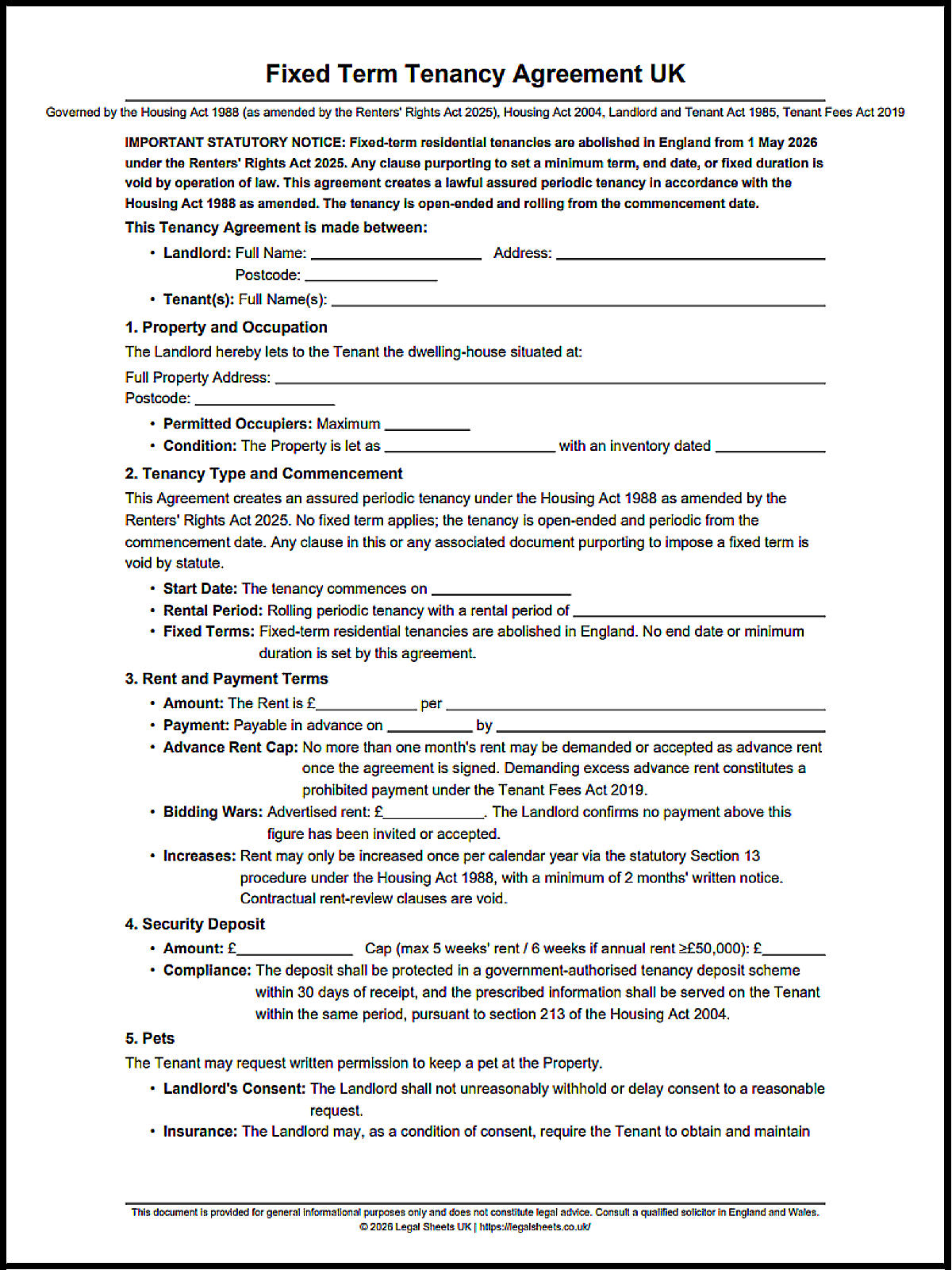
Fixed Term Tenancy Agreement Template (PDF, Word & Printable Formats)
Why Fixed-Term Clauses Require Careful Review Following the Renters’ Rights Reforms
Many fixed-term agreements currently in circulation were drafted for a legal environment that no longer exists in the same form. The greatest risk is often not the age of the document itself but the assumption that every clause remains suitable for modern tenancy management and possession planning.
Landlords frequently discover compliance issues only when a dispute reaches an advanced stage and the agreement is examined alongside current statutory requirements.
The Shift Away From New Fixed-Term Residential Tenancies
The Renters’ Rights Act 2025 has fundamentally reshaped the private rented sector by abolishing all new fixed-term Assured Shorthold Tenancies (ASTs). Private residential tenancies now operate exclusively as open-ended periodic arrangements, rendering traditional 6 or 12-month fixed-term contracts legally obsolete for new lets.
For landlords accustomed to offering a 6 month tenancy agreement or a 12 month tenancy agreement, this represents a substantial operational change.
When reviewing tenancy documentation, it is important to distinguish between:
- Historic fixed-term arrangements that remain relevant
- Transitional tenancy situations
- New tenancy arrangements subject to the updated framework
Confusion between these categories often leads to incorrect assumptions about renewal procedures and possession options.
Common Misunderstandings About Existing Fixed Term Tenancy Agreement
A frequent misconception is that older agreements automatically become ineffective because tenancy legislation has changed.
In reality, disputes usually require examination of the specific tenancy, the agreement used, the compliance history, and the actions taken by both parties.
Other misunderstandings commonly include:
- Assuming historic agreements become invalid automatically
- Confusing contractual obligations with possession rights
- Misunderstanding how earlier renewal arrangements operate
These errors can create serious procedural problems when a landlord attempts to rely on assumptions rather than documented evidence.
Where Landlords Continue to Face Risk
Older agreements often contain wording that was drafted for procedures that have since changed.
Particular concerns frequently arise from:
- Outdated clauses
- Non-compliant possession wording
- Reliance on superseded procedures
The practical problem is that a clause can appear legally persuasive while offering little value during enforcement. Courts focus on the current legal position and the available evidence rather than the confidence with which a clause was drafted many years earlier.
The Clauses That Usually Determine Whether a Fixed Rental Agreement Prevents Future Disputes
Most tenancy disputes originate from ordinary day-to-day issues rather than unusual legal questions.
Rent payments, occupancy arrangements, property use, inspections, and condition reports account for a large proportion of disagreements that later escalate into formal claims.
Rent and Payment Provisions
Rent clauses are often the first provisions examined when arrears arise.
A fixed tenancy agreement should address:
- Rent due dates
- Payment methods
- Arrears consequences
- Interest provisions
Many landlords encounter difficulties proving arrears where payment arrangements changed informally during the tenancy. If the agreement is unclear about how and when rent should be paid, evidential problems can develop long before court proceedings begin.
Clear payment provisions make it easier to establish whether a breach occurred and when it first arose.
Occupancy and Household Composition Rules
Household composition frequently changes during longer occupation periods.
For that reason, agreements commonly address:
- Permitted occupiers
- Additional residents
- Lodger restrictions
- Subletting controls
Disputes often emerge when family members, partners, or additional occupants move into the property without any formal discussion or shared living arrangements. Months later, neither party can easily establish what was authorised and what was prohibited.
The absence of clear occupancy provisions often turns a straightforward disagreement into a fact-sensitive evidential dispute.
Property Use Restrictions
Property use clauses become highly relevant when occupation differs from the original expectations, including business use considerations.
Common restrictions address:
- Business use
- Pets
- Smoking
- Alterations
Landlords frequently discover potential issues only after neighbours complain, alterations have been completed, or property damage has occurred.
A carefully drafted clause provides a clear benchmark against which conduct can be assessed. Without that benchmark, enforcement becomes significantly more difficult.
Access and Inspection Arrangements
Access provisions often receive little attention until maintenance issues emerge.
Typical clauses address:
- Notice requirements
- Emergency access
- Inspection schedules
Many disputes arise because one party believes access requests were unreasonable while the other believes cooperation was withheld.
Clearly documented procedures reduce uncertainty and create useful evidence if disagreements later reach court.
Inventory and Condition Recording
Deposit disputes frequently succeed or fail on the quality of condition evidence available.
Useful records commonly include:
- Check-in evidence
- Photographic records
- Damage disputes documentation
Where no reliable inventory exists, parties are often left relying on memory rather than objective proof. This places both landlords and tenants in a weaker evidential position.
Experienced property managers routinely regard inventories as one of the most valuable documents associated with any tenancy because they often become central evidence long after occupation has ended.
Clauses That Cannot Override Statutory Tenant Rights
One of the most common drafting errors is attempting to create contractual obligations that conflict with statutory rights and responsibilities.
Even where both parties sign the agreement, certain obligations remain governed by legislation and cannot simply be reassigned through drafting.
Repair Obligations That Remain the Landlord’s Responsibility
Under the Landlord and Tenant Act 1985, landlords remain responsible for specific repair obligations.
These responsibilities include:
- Structure and exterior
- Water installations
- Electrical systems
- Sanitation facilities
Attempts to transfer these statutory responsibilities to the tenant through contractual wording are unlikely to withstand scrutiny if a dispute arises.
Disrepair allegations remain one of the most common issues raised in possession-related proceedings, particularly where tenants argue that maintenance obligations were ignored.
Terms Commonly Found to Be Unenforceable
Certain provisions repeatedly create difficulties because they conflict with legal requirements or attempt to impose obligations beyond what the law permits.
Examples include:
- Repair-transfer clauses
- Excessive penalties
- Unlawful charges
- Disproportionate restrictions
The practical reality is that an unenforceable clause may sit unnoticed within an agreement for years before becoming relevant during a dispute. At that point, the existence of the clause offers little protection if it conflicts with statutory requirements.
Consumer Rights Challenges Against Tenancy Terms
The Consumer Rights Act 2015 permits scrutiny of tenancy terms where fairness concerns arise.
Challenges often focus on:
- Fairness assessments
- Transparency requirements
- Consequences of unfair terms
Landlords sometimes assume that a signed agreement guarantees enforceability. Courts take a different approach. The central question is usually whether the clause itself is fair, transparent, and legally effective.
Where a term is found to be unfair, the fact that it was included in the fixed rental agreement may provide little assistance when enforcement is attempted.
Deposit Handling Failures That Cause More Claims Than the Agreement Itself
Many landlords assume the tenancy agreement is the most important document in the file. In practice, deposit compliance failures often create greater legal exposure than defects in the agreement itself.
A perfectly drafted fixed tenancy agreement cannot repair the consequences of failing to protect a deposit correctly. County Court claims relating to deposits frequently arise because procedural requirements were missed during the first month of the tenancy rather than because the agreement contained defective wording.
Deposit Protection Deadlines
Under the Housing Act 2004, tenancy deposits must be protected within 30 days using an approved government-authorised scheme.
Key requirements include:
- Compliance with the 30-day deadline
- Use of an approved protection scheme
- Accurate registration of deposit details
Many landlords incorrectly assume that late protection resolves the issue. In reality, once the deadline has been missed, legal exposure may already exist.
Administrative oversight is not usually treated as a valid excuse. Courts generally focus on whether the statutory requirement was met rather than why it was missed.
Prescribed Information Errors
Protecting the deposit is only part of the compliance process.
The required Prescribed Information must also be provided correctly.
Common failures include:
- Missing information
- Incomplete notices
- Service failures
Property owners sometimes possess evidence that the deposit was protected but cannot demonstrate that the required information was properly provided to the tenant. This creates difficulties when possession proceedings or compensation claims later arise.
Financial Consequences of Non-Compliance
Deposit failures frequently produce consequences that landlords do not anticipate at the start of the tenancy.
Potential outcomes include:
- Court penalties
- Possession difficulties
- Tenant compensation claims
The verified legal framework provides for financial penalties of between one and three times the deposit value where compliance failures occur. In addition, certain possession routes become significantly more difficult where deposit obligations were not satisfied correctly.
The financial impact of a deposit mistake can therefore exceed the value of the deposit itself.
Evidence Landlords Should Retain
Many compliance disputes are not caused by failure to act but by failure to prove that action was taken.
Useful records include:
- Scheme registration records
- Service confirmations
- Tenant acknowledgements
Judges frequently examine documentary evidence rather than recollections. A landlord who can produce clear records of registration and service is typically in a far stronger position than one relying on verbal explanations years later.
Documents That Must Accompany the Agreement Before Occupation Begins
A tenancy file should never consist solely of a signed agreement.
Several mandatory documents are expected to accompany the occupation process. Missing documentation often becomes relevant only when enforcement action is contemplated, by which time the omission may already have weakened the landlord’s position.
Written Statement of Terms
Under Section 16D of the Housing Act 1988 (as amended by the Renters’ Rights Act 2025), providing a mandatory Written Statement of Terms is a strict compliance prerequisite. Failure to serve this document precisely as prescribed can result in significant financial penalties and impede the landlord’s ability to demonstrate compliance to the Private Rented Sector Ombudsman.
Failure to do so can expose landlords to enforcement action.
In practice, record-keeping is just as important as provision. A landlord who cannot demonstrate when the statement was supplied may face evidential challenges similar to those encountered in deposit disputes.
Gas Safety Record
A valid gas safety record must be provided before occupation and maintained thereafter.
The verified legal framework identifies failure to provide this document as a criminal offence under the applicable gas safety regulations.
Operationally, landlords often discover the significance of gas safety documentation when possession proceedings are contemplated. Missing records frequently attract close scrutiny because they relate directly to tenant safety and statutory compliance.
Energy Performance Certificate (EPC)
A valid EPC must be supplied to the tenant.
The verified legal framework further notes that properties generally require a minimum rating of E and that failure to provide the certificate can expose landlords to regulatory consequences.
Many compliance reviews reveal that landlords obtained an EPC but retained poor evidence regarding service. Once again, proving delivery is often just as important as obtaining the document itself.
How to Rent Guide
The current government-issued How to Rent guide forms part of the required tenancy documentation.
A recurring practical problem arises where landlords possess an outdated version or cannot establish when the guide was supplied.
When disputes reach court, evidential gaps concerning service frequently become more significant than parties initially expect.
Why Missing Documents Frequently Damage Possession Claims
Possession proceedings increasingly depend upon documentary evidence.
The most common problems include:
- Missing compliance records
- Inability to prove service
- Incomplete tenancy files
- Lost acknowledgements
Judges regularly examine whether mandatory documents were supplied and whether service can be proven. Landlords who maintain organised records generally encounter fewer procedural difficulties than those attempting to reconstruct events years later.
The Difference Between a 6 Month Tenancy Agreement and a 12 Month Tenancy Agreement in Practice
The distinction between a 6 month tenancy agreement and a 12 month tenancy agreement is often viewed as a simple difference in duration. In reality, the practical consequences can be much broader.
Property management strategies, occupation expectations, and financial risks frequently change depending on the intended duration.
Occupation Stability Considerations
Longer occupation periods often create greater certainty regarding occupancy.
A 12 month tenancy agreement may provide parties with a stronger expectation of continuity, while shorter arrangements have historically allowed earlier reassessment of the tenancy relationship.
However, stability can create both benefits and challenges. A problem tenant remains in occupation for longer, but a reliable tenant may reduce management costs and vacancy risks.
Rent Review Timing Implications
Rent review planning often differs depending on the intended tenancy duration.
A shorter fixed period may historically have allowed rent discussions to arise sooner, whereas longer occupation arrangements may delay opportunities to reconsider pricing structures.
Many landlords focus heavily on the initial rent figure while giving insufficient attention to how future reviews may operate in practice.
Property Management Considerations
Property management demands frequently vary according to tenancy duration.
Issues commonly include:
- Inspection scheduling
- Maintenance planning
- Budget forecasting
- Occupancy expectations
Longer occupation often requires greater attention to ongoing maintenance because wear and tear naturally accumulates over time.
Early Departure Risks
Early departures create operational difficulties regardless of the original term length.
Potential issues include:
- Unexpected void periods
- Advertising costs
- Reletting expenses
- Recovery disputes
Many disagreements arise not because a tenant leaves, but because neither party properly understood the financial consequences of leaving before the contractual arrangement was expected to end.
Which Arrangement Creates Greater Operational Flexibility
There is rarely a universally correct answer.
A shorter arrangement may offer earlier opportunities to reassess occupation arrangements, while a longer arrangement may reduce turnover and administrative burden.
The appropriate approach often depends on the property, the parties involved, and the landlord’s wider management objectives rather than any inherent legal advantage associated with a particular duration.
Break Clauses and Early Exit Provisions That Frequently Lead to Litigation
Break clauses are among the most heavily disputed provisions in many tenancy agreements.
A clause intended to create flexibility can quickly become a source of conflict if the conditions for exercising the right are unclear.
How Break Clauses Are Commonly Drafted
Most break clauses attempt to specify:
- When termination can occur
- Which party may exercise the clause
- Required notice periods
- Procedural conditions
The drafting challenge is balancing certainty with flexibility. Ambiguous wording often creates disputes about whether the clause was validly exercised.
Notice Requirements Within Break Clauses
Notice requirements are frequently the focal point of litigation.
Disputes commonly concern:
- Timing
- Method of service
- Proof of delivery
- Compliance with contractual procedures
A party may genuinely believe notice was served correctly while lacking sufficient evidence to prove it.
Conditions That Can Invalidate Early Termination Attempts
Break rights are often conditional.
Problems arise where one party fails to satisfy procedural requirements before attempting termination.
Common issues include:
- Incorrect notice method
- Failure to comply with contractual conditions
- Missing deadlines
- Insufficient evidence of service
Even minor procedural defects can undermine an attempted early termination.
Tenant Departure Before Contractual Expiry
Not every early departure involves a valid break clause.
Tenants occasionally leave before the anticipated end of the arrangement, creating disputes regarding ongoing obligations and financial liability.
The practical question frequently becomes whether the departure was authorised, accepted, or otherwise addressed through subsequent conduct.
Recovering Losses Following Early Vacation
When occupation ends unexpectedly, financial consequences often follow.
Potential areas of dispute include:
- Lost rent
- Reletting periods
- Property condition issues
- Outstanding obligations
Successful recovery efforts typically depend upon the quality of the tenancy records, the wording of the agreement, and the evidence available to support the claim.