
Free Printable Lodger Agreement Template (PDF Download)
Taking in a lodger often starts as an informal arrangement between people sharing the same home, but many disputes emerge later because the paperwork never properly recorded that the landlord remained in residence. A Lodger Agreement should reflect the reality of a resident landlord arrangement, as occupation rights in England are treated differently from those granted under a tenancy, and confusion over that distinction can create serious difficulties when notice is given or the arrangement comes to an end.
County Court disputes occasionally turn on whether the occupier was genuinely a lodger or whether the circumstances pointed towards a different form of occupation altogether, particularly where unsuitable tenancy documents were copied from the internet. The Protection from Eviction Act 1977 remains relevant in this area, but practical problems are more often caused by poor drafting than by the legislation itself.
The wording, occupancy details, notice provisions, and household rules included in the document matter far more than many resident landlords realise, which is why carefully prepared template wording and completion guidance are worth reviewing before the arrangement begins.
Affiliate Disclosure: We may earn a commission from purchases made through affiliate links on this page, at no extra cost to you.
Lodger Agreement Template (PDF, Word & Printable Formats)
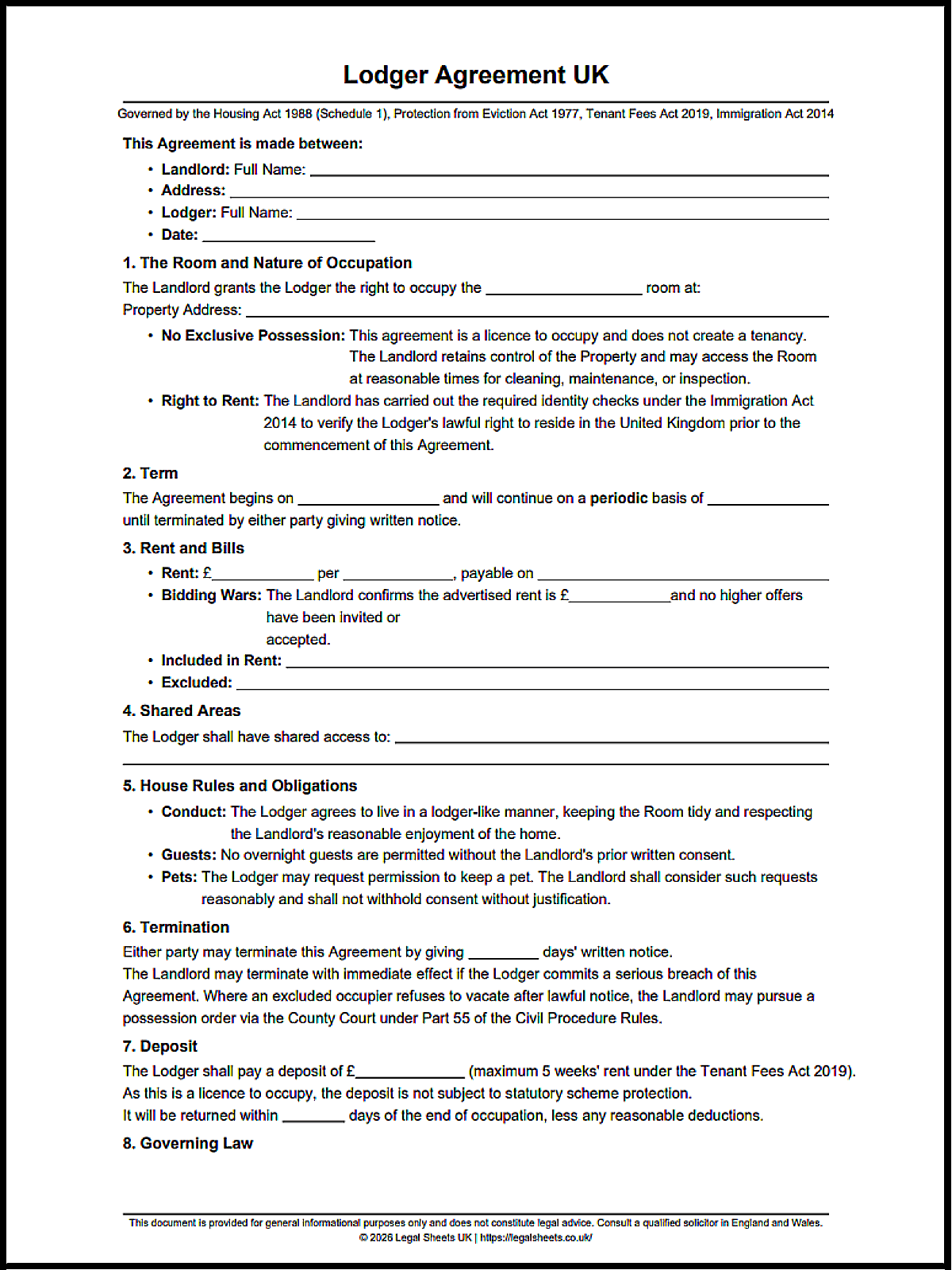
Customised Do-it-yourself Lodger Agreement
The Single Legal Distinction That Determines Whether This Is a Lodger Agreement or a Tenancy
The most significant legal issue in any lodger arrangement is whether the occupier genuinely holds a licence to occupy or whether the arrangement has crossed into tenancy territory.
Under common law principles established by the case of Street v Mountford [1985], legal status depends on the substance of the arrangement rather than the title printed at the top of the document.
Why Exclusive Possession Creates Risk
Many resident landlords unintentionally create problems by granting too much control over accommodation.
Factors that attract attention include:
- Control of accommodation
- Access rights retained by the landlord
- Shared living arrangements
- Common areas versus private rooms
A genuine lodger arrangement usually involves continued sharing of living accommodation and retained access rights consistent with a resident landlord arrangement.
The risk arises when the occupier effectively controls a separate living space and the landlord’s access becomes largely theoretical. In those circumstances, the practical operation of the arrangement may conflict with the wording of the agreement.
How Courts Look Beyond the Label on the Document
County Court possession disputes regularly focus on evidence rather than labels.
Courts commonly examine:
- Actual occupation arrangements
- Day-to-day conduct of the parties
- Shared facilities evidence
- Practical reality versus contractual wording
A homeowner may produce a signed lodger agreement template, yet still encounter difficulties if the occupier can demonstrate that the arrangement operated differently in reality.
Evidence such as household routines, use of facilities, retained access rights, and occupation patterns often carries considerable weight.
Consequences of Accidentally Creating a Tenancy
Misclassification can dramatically alter a landlord’s position.
Potential consequences include:
- Housing Act 1988 protections becoming relevant
- More complex possession procedures
- Additional compliance responsibilities
- Increased restrictions on recovering possession
The most expensive disputes often begin with a landlord assuming they have a lodger arrangement when the facts point elsewhere. By the time possession becomes necessary, correcting that mistake can be difficult and costly.
Before Moving a Lodger In: Decisions That Should Be Agreed First
Many disagreements blamed on legal drafting actually originate from conversations that never happened before occupation began.
The agreement works best when practical expectations have already been discussed and recorded.
Occupation Arrangements
Shared living becomes difficult when boundaries are unclear.
Issues worth agreeing in advance include:
- Private room boundaries
- Shared facilities
- Guests and overnight visitors
- Storage areas
Disputes often arise not because the agreement is defective but because each party assumed different rules applied.
For example, a lodger may view a spare cupboard as allocated storage, while the homeowner regards it as communal household space.
Financial Arrangements
Money disagreements remain one of the most common causes of conflict.
The agreement should clearly address:
- Weekly or monthly payments
- Utility contributions
- Deposit arrangements
- Included household services
Where payment arrangements are informal, proving what was agreed can become difficult if arrears develop or deductions are later disputed.
Maintaining payment records throughout the occupation frequently proves more valuable than lengthy contractual wording.
Household Expectations
A shared home operates differently from a conventional tenancy.
Areas commonly covered include:
- Cleaning responsibilities
- Noise expectations
- Security arrangements
- Use of communal spaces
Resident landlords often discover that behavioural expectations create more tension than rent issues. Recording these expectations from the outset reduces the likelihood of repeated disputes over day-to-day living arrangements.
Clauses That Carry the Most Practical Importance During the Occupation
Certain clauses attract attention only when a problem occurs. By that stage, weaknesses in the agreement can become expensive.
The following provisions deserve particular care when completing a lodger agreement uk document.
Occupation Licence and Excluded Occupier Status
The agreement should expressly identify the arrangement as a licence to occupy and confirm the lodger’s status as an excluded occupier.
This distinction aligns with the operation of the Protection from Eviction Act 1977 in resident landlord arrangements.
Failing to address the point does not automatically change the legal reality, but it can create unnecessary arguments if possession later becomes disputed.
Payment Terms and Late Payment Procedures
Payment provisions should answer practical questions before they arise.
Common examples include:
- Payment dates
- Accepted payment methods
- Consequences of late payment
- Treatment of recurring arrears
Many County Court debt claims succeed or fail based on the quality of payment records rather than the sophistication of the contract wording.
Access Rights Retained by the Resident Landlord
Access clauses are central to preserving the nature of a lodger arrangement.
The agreement should accurately reflect:
- Shared occupation of the property
- The landlord’s continuing presence
- Access arrangements consistent with shared living
- Use of communal areas
Problems emerge when the document grants rights that are inconsistent with the way the property is actually occupied.
House Rules and Shared Living Standards
House rules often receive little attention during signing but become highly relevant later.
Typical areas include:
- Visitors
- Noise
- Smoking
- Cleaning expectations
- Security practices
A short, practical set of rules usually works better than extensive restrictions that neither party intends to follow.
Property Damage and Repair Responsibilities
Shared occupation can make responsibility difficult to establish.
The agreement should identify:
- Reporting procedures
- Expectations regarding care of furnishings
- Responsibility for damage caused by the lodger
- Procedures for raising maintenance concerns
Good record-keeping at the start and end of occupation frequently prevents arguments over damage claims.
Notice Requirements for Ending the Arrangement
The agreement should explain how notice will be given and recorded.
Under the verified legal position, excluded occupiers are generally entitled to reasonable notice. Although legislation does not prescribe a specific period in this context, written notice creates a valuable evidential record if possession later becomes contested.
Many possession disputes are less about the notice itself and more about proving that notice was actually given.
Deposit Handling and Return Conditions
Unlike deposits for Assured Periodic Tenancies under the Renters’ Rights Act 2025, lodger deposits remain entirely outside the scope of statutory government-backed protection schemes. Because the lodger is an ‘excluded occupier,’ no legal obligation exists to register these funds; however, best practice remains to hold them in a separate account to avoid commingling.
That does not eliminate disputes.
The agreement should explain:
- Circumstances permitting deductions
- Evidence requirements
- Return procedures
- Outstanding payment adjustments
The strongest protection for both parties is usually a detailed inventory, supported by photographs and retained alongside the signed agreement.
Common Drafting Mistakes That Cause Lodger Agreements to Fail in Practice
Most problems with a lodger agreement are not caused by missing signatures or formatting errors. They arise because the wording does not match the way the property is actually occupied. When a dispute reaches the County Court, inconsistencies between the document and reality can become highly significant.
Wording That Suggests Exclusive Possession
One of the most common mistakes is using language copied from a tenancy agreement.
Phrases that imply the occupier has complete control over accommodation can undermine the intended licence arrangement. Even where the parties genuinely intended a lodger arrangement, wording that resembles a tenancy may create unnecessary arguments later.
A court will not determine legal status solely from the title of the document. The practical rights granted under the agreement remain highly relevant.
Giving the Lodger Sole Control of Facilities
Difficulties often arise where the agreement states that particular facilities are for the lodger’s sole use while the resident landlord rarely enters or uses those areas.
The more control granted to the occupier, the greater the risk that the arrangement begins to resemble something other than a traditional resident landlord and lodger relationship.
This issue commonly appears where converted lofts, annexes, or separate living spaces are involved.
Using Assured Shorthold Tenancy Clauses in a Lodger Contract
Many online templates recycle wording designed for tenancies.
Clauses dealing with tenancy-specific rights and obligations can create confusion when inserted into a lodger contract. The document should reflect the actual legal structure being used rather than copying provisions from unrelated residential agreements.
A landlord who relies on unsuitable wording may discover that the agreement answers the wrong questions while failing to address the issues that matter in shared accommodation.
Contradictory Access Provisions
Some agreements state that the landlord retains access rights while other clauses effectively grant complete privacy and control.
Contradictory drafting creates uncertainty.
If possession proceedings later become necessary, the court may examine whether the landlord genuinely exercised the rights claimed in the agreement or whether they existed only on paper.
Consistency across all occupation clauses is often more important than lengthy legal wording.
Unclear Notice Arrangements
Notice disputes are surprisingly common.
Agreements sometimes refer to notice without explaining:
- How notice should be served
- Whether written notice is expected
- When notice takes effect
- How receipt can be proven
Although reasonable notice is generally required for excluded occupiers, uncertainty about service frequently becomes the real source of disagreement.
Penalty Clauses That May Be Unenforceable
Some landlords attempt to discourage breaches through financial penalties.
Examples include disproportionate charges for minor rule breaches, excessive administration fees, or automatic deductions that bear little relation to actual loss.
Under the Consumer Rights Act 2015, terms should remain transparent and should not create a significant imbalance between the parties. Where a clause appears punitive rather than compensatory, enforcement can become problematic.
Safety, Documentation and Information the Resident Landlord Should Not Ignore
Many resident landlords focus heavily on rent collection and notice clauses while overlooking documentation requirements that can create greater risk.
The strongest agreements are supported by proper records throughout the occupation.
Gas Safety Record Requirements
Where gas appliances are present, annual inspection and record-keeping obligations apply under the Gas Safety (Installation and Use) Regulations 1998.
Official legislation can be reviewed at:
Gas Safety (Installation and Use) Regulations 1998
Failure to comply is not simply an administrative oversight. The verified legal position confirms that failing to provide the current Landlord Gas Safety Record is a criminal offence.
For many resident landlords, this becomes one of the most significant compliance obligations connected with taking in a lodger.
Providing Current Safety Documentation
Documentation should not be treated as something gathered only when a dispute arises.
Good practice includes retaining:
- Current gas safety records
- Signed agreement copies
- Payment records
- Occupation correspondence
Landlords frequently underestimate how valuable these documents become if the occupier later challenges events or alleges different arrangements existed.
EPC Position for Rooms in an Owner-Occupied Home
Energy Performance Certificate requirements often cause confusion because landlords are familiar with obligations affecting other residential lettings.
Under the verified legal facts provided, a room let within an owner-occupied home is generally exempt from requiring an EPC where the resident landlord continues living at the property.
This is one of several areas where assumptions drawn from tenancy arrangements can lead people in the wrong direction.
Right to Rent Exemptions for Resident Landlords
Another common misunderstanding concerns immigration checks.
While private landlords under the new 2026 regime face rigorous compliance, resident landlords remain exempt from the Immigration Act 2014 ‘Right to Rent’ check requirements. You are not legally obligated to verify the immigration status of an individual sharing your primary residence.
Many landlords mistakenly believe the same compliance obligations apply to every form of residential occupation. Lodger arrangements operate differently in this respect.
Keeping Evidence of Occupation Status
When disputes arise, evidence often matters more than legal arguments.
Useful records include:
- Signed agreements
- Evidence of shared facilities
- Communication records
- Household arrangements
- Notice documentation
Where occupation status later becomes disputed, these records may help demonstrate how the arrangement actually operated on a day-to-day basis.
UK Legal Requirements Affecting a Lodger Agreement
Legal Requirements
| Topic / Issue | England Legal Rule | Governing Law |
|---|---|---|
| Legal Status | Licence to occupy (excluded occupier) | Common Law (Street v Mountford) |
| Eviction | Reasonable notice; no court order required | Protection from Eviction Act 1977 |
| Gas Safety | Mandatory annual inspection & record provision | Gas Safety (Installation and Use) Regs 1998 |
| Deposit | No statutory protection requirement | Exempt from Housing Act 2004 |
| Fair Terms | Contract terms must be fair and transparent | Consumer Rights Act 2015 |
Practical Legal Impact
Many landlords assume that signing a lodger agreement form sample automatically determines legal status. The legal reality is more complicated.
The common law position established in Street v Mountford [1985] means that exclusive possession remains one of the most significant factors when assessing whether an arrangement operates as a licence or a tenancy.
Information about the case can be found through official legal resources:
Street v Mountford legal materials
The practical effect of excluded occupier status is often seen when occupation ends and possession proceedings begin. Reasonable notice generally remains necessary, but the procedural position differs significantly from arrangements governed by tenancy legislation.
The Protection from Eviction Act 1977 remains particularly relevant when possession issues arise.
Official legislation is available at:
Protection from Eviction Act 1977
Consumer fairness requirements should not be overlooked. Clauses drafted to punish rather than compensate can create enforcement difficulties if a dispute reaches court.
Another recurring issue involves safety documentation. Gas safety obligations are not optional administrative tasks. Courts and regulators generally view failures in this area far more seriously than minor drafting defects within the agreement itself.
Perhaps the most expensive mistake is misclassifying the arrangement. A landlord who assumes a lodger arrangement exists may later face possession complications if the factual occupation pattern suggests otherwise.
Ending the Arrangement Without Creating Possession Problems
Many disputes begin only after the relationship has already broken down following notice disputes.
The challenge is rarely the decision to end the arrangement. The challenge is creating a clear record of what happened before possession becomes disputed.
What Usually Counts as Reasonable Notice
The verified legal framework confirms that excluded occupiers are generally entitled to reasonable notice.
No fixed statutory period is provided within the supplied legal facts. As a result, disputes often focus on whether the notice given was reasonable in the circumstances rather than whether a particular number of days was met.
Clear communication at the outset of the arrangement reduces uncertainty later.
Why Written Notice Is Still the Safer Option
Although written notice may not always be legally mandatory, it is often the strongest evidential option available.
A written notice can help establish:
- When notice was given
- What date occupation was expected to end
- The wording used
- Whether disputes emerged afterwards
In possession disputes, proving service frequently becomes as important as proving entitlement.
Evidence to Keep After Serving Notice
Landlords often assume that once notice has been served, the matter is finished.
In reality, record retention becomes even more important.
Useful evidence includes:
- Copies of the notice
- Delivery records
- Emails and messages
- Notes of discussions
- Payment records following service
Where a dispute later reaches court, contemporaneous records usually carry greater weight than recollections months later.
When a Lodger Refuses to Leave
Most lodger arrangements end without formal proceedings.
Difficulties arise where the occupier disputes the notice, challenges their status, or simply refuses to vacate.
At that stage, the focus often shifts from the wording of the agreement to evidence demonstrating that the arrangement genuinely operated as a resident landlord licence arrangement.
When County Court Proceedings Become Necessary
If the occupier remains after the notice period expires, County Court proceedings may become necessary.
The verified legal facts identify a recurring procedural hurdle: proving the nature of the licence arrangement to the court.
Judges commonly examine practical occupation evidence, not merely the document title.
For that reason, landlords who maintain good records throughout the occupation generally place themselves in a stronger position than those who rely solely on a signed template.