
Sublease Agreement Template ( Free PDF & Word)
A Sublease Agreement is often searched for when a tenant needs someone else to occupy the property during a temporary move, but the biggest problem in practice is not the wording itself—it is failing to check whether the original tenancy permits subletting in the first place. In England, many occupation disputes begin when a head tenant grants a subtenancy without the consent required under the superior tenancy, leaving everyone involved uncertain about their position once the arrangement is challenged.
If the property is let under a tenancy governed by the Housing Act 1988, the relationship between the original tenancy and any subletting arrangement can become particularly significant if possession issues later reach the County Court. A carefully drafted Sublease Agreement should accurately reflect the existing tenancy terms, the permitted occupation rights and any conditions imposed by the landlord.
The template and accompanying guidance can be used to record those arrangements clearly before the subtenant moves in.
Sublease Agreement Template (PDF, Word & Printable Formats)
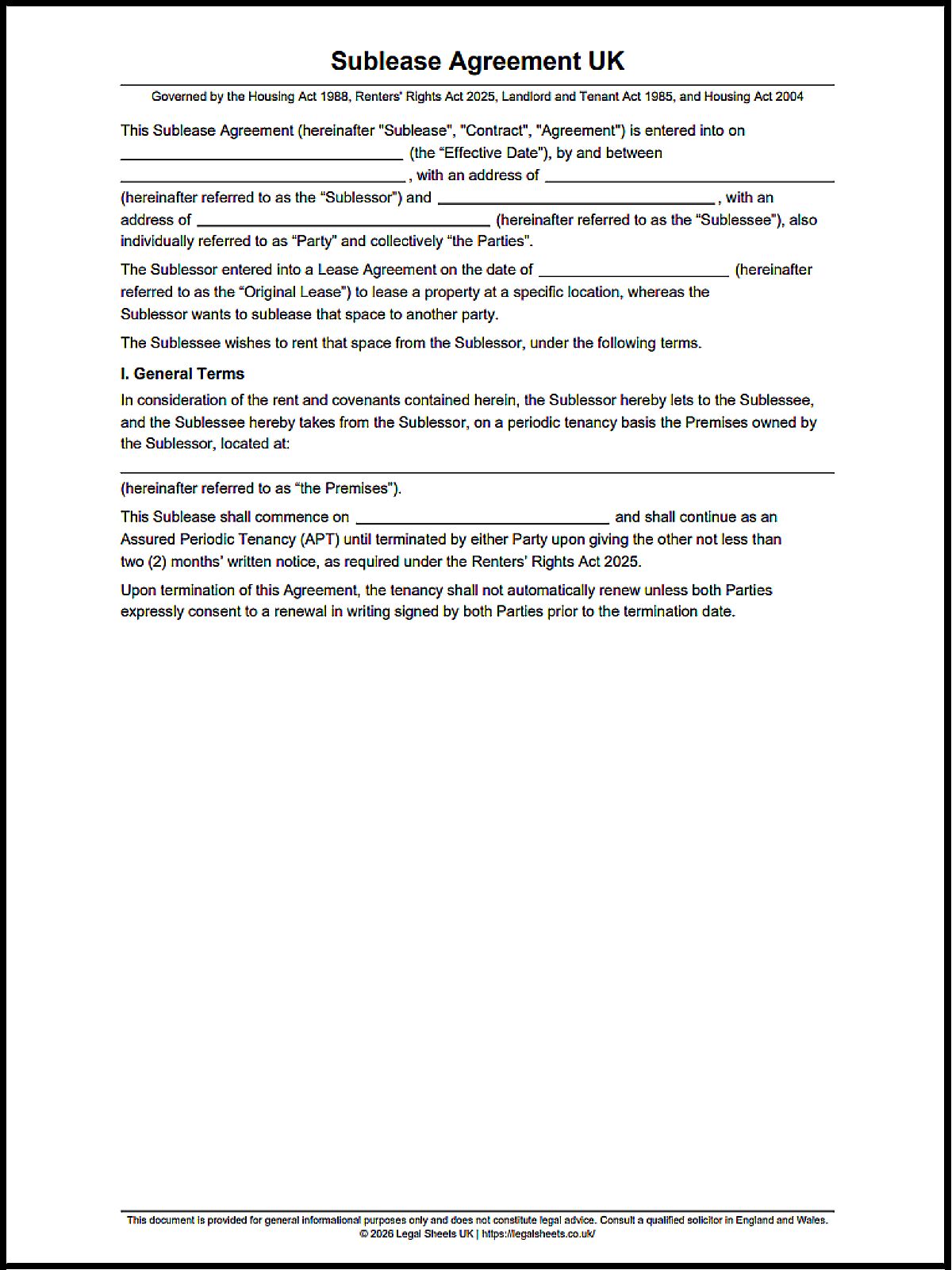
When a Sublease Agreement Is the Right Document to Use
Choosing the correct document at the outset often determines whether the arrangement remains manageable or develops into a costly dispute.
Situations Where a Tenant May Need to Sublet
A sublet agreement is commonly used when a tenant intends to remain bound by their existing tenancy but cannot occupy the property for a period of time.
Typical examples include:
- Temporary relocation for employment
- Study placements or educational commitments
- Extended travel periods
- Moving out before the tenancy term expires
- Replacing occupancy while retaining tenancy rights
- Covering ongoing rent liabilities during an absence
A frequent practical issue arises when tenants leave a property informally and allow a friend or colleague to move in without documentation. When rent arrears, damage, or deposit disputes emerge, there is often no written evidence showing who was responsible for what.
Situations Where a Sublease Agreement Should Not Be Used
A sublease template is not suitable for every occupancy arrangement.
It should generally not be used for:
- Assignment of the entire tenancy
- Lodger arrangements where the tenant remains resident
- Informal roommate arrangements without exclusive possession
- Holiday accommodation arrangements
- Short-term visitor occupation
- Situations where the head tenancy expressly prohibits subletting
One of the most common mistakes is using a sublease agreement where the superior tenancy forbids subletting altogether. The document may still create obligations between the tenant and subtenant, but the tenant may simultaneously breach the head tenancy.
How a Sublease Differs From Related Tenancy Documents
Although the documents appear similar, they produce different legal outcomes.
| Document | Primary Effect |
|---|---|
| Sublease Agreement | Creates a new tenancy beneath the existing tenancy |
| Assignment Agreement | Transfers the tenant’s interest to another person |
| Lodger Agreement | Occupier shares accommodation with resident landlord |
| Room Rental Agreement | Usually focuses on occupation of a room and shared facilities |
| Joint Tenancy Arrangement | Multiple tenants hold rights under the same tenancy |
Confusion between assignment and subletting frequently causes enforcement problems because liability to the superior landlord changes significantly depending on which arrangement is used.
Sublease Agreement Template (PDF, Word & Printable Formats)
The value of a well-drafted sublease contract lies in documenting expectations before problems arise.
What the Template Is Designed to Achieve
The template is intended to:
- Create a contractual relationship between sublandlord and subtenant
- Define occupation rights
- Record rent obligations
- Allocate responsibility for deposits
- Clarify repair and reporting procedures
- Establish communication and notice requirements
When possession proceedings or rent recovery claims reach court, judges often place considerable weight on the written agreement rather than verbal discussions.
Available Formats
Most users prefer one of the following formats:
- Editable Word version
- Fillable digital version
- Printable version
- PDF format for record retention
The format matters less than ensuring the completed document accurately reflects the actual arrangement.
Who Should Use This Template
The document is commonly used by:
- Assured Periodic Tenants (following the nationwide abolition of fixed-term ASTs in May 2026) who have successfully obtained explicit, written consent to sublet from their superior landlord.
- Tenants temporarily relocating
- Occupiers replacing an existing resident during a tenancy term
- Tenants seeking to reduce exposure to ongoing rent obligations
Situations Requiring Additional Legal Advice
Additional advice may be prudent where the arrangement involves: Commercial premises under a business lease
- Long-term subleases
- Complex consent conditions
- HMO licensing concerns
- Multiple unrelated subtenants occupying separate rooms
These situations frequently introduce compliance requirements beyond a standard residential sublease.
The Approval Check That Should Happen Before Any Subletting Begins
Many subletting disputes could be avoided through a simple review of the head tenancy.
Reviewing the Head Tenancy for Subletting Restrictions
Before drafting any tenancy sublet agreement, examine provisions dealing with:
- Absolute prohibitions
- Qualified consent requirements
- Conditions attached to consent
- Notice obligations to the superior landlord
Under the verified legal framework, superior landlord consent is often governed by the tenancy covenant and common law principles.
Risks of Subletting Without Consent
Failure to obtain required consent can create significant consequences.
Potential outcomes include:
- Breach of the head tenancy
- Possession action against the tenant
- Risk of forfeiture proceedings
- Liability for resulting losses
A recurring misconception is that a landlord’s verbal approval is sufficient. Problems arise when consent later becomes disputed and no evidence exists.
Evidence of Consent to Retain
Useful records include:
- Written consent letters
- Email approvals
- Licence to sublet documents
- Conditions imposed by the superior landlord
Maintaining these records can become critical if the landlord later alleges an unauthorised subletting arrangement.
Building the Occupation Terms That Prevent Future Disputes
Most disputes involve practical occupancy issues rather than complex legal arguments.
Defining the Space Being Sublet
The agreement should identify precisely what is being occupied:
- Entire property
- Individual room
- Shared kitchens and bathrooms
- Parking spaces
- Storage areas
Vague descriptions often result in disagreements over access rights.
Rent Structure and Payment Arrangements
The agreement should clearly record:
- Rent amount
- Due dates
- Payment methods
- Late payment provisions
Rent disputes frequently arise because payment expectations were discussed verbally but never documented.
Deposit Arrangements
The document should address:
- Deposit amount
- Purpose of the deposit
- Permitted deductions
- Return procedures
Poorly drafted deposit clauses often become the focus of tribunal and court disputes.
Occupancy Rules and Day-to-Day Property Use
Practical house rules commonly cover:
- Visitors
- Noise levels
- Smoking
- Pets
- Shared-area responsibilities
The more occupants involved, the more valuable clear written expectations become.
Utilities, Council Tax and Household Costs
Responsibility should be allocated for:
- Utility bills
- Council Tax
- Internet services
- Shared household expenses
A simple apportionment method is usually easier to enforce than informal cost-sharing arrangements.
Clauses That Commonly Cause Problems in Subletting Arrangements
Certain provisions regularly attract scrutiny during disputes.
Repair Responsibilities That Cannot Be Contracted Away
Attempts to transfer all repair obligations to the subtenant often create difficulties.
Under Section 11 of the Landlord and Tenant Act 1985, statutory repair obligations cannot simply be excluded through drafting. Clauses attempting to avoid those duties may be ineffective.
Unfair Terms That May Be Unenforceable
Problems frequently arise where agreements contain:
- Excessive penalties
- Automatic forfeiture provisions
- Restrictions overriding statutory rights
- Disproportionate financial consequences
The Consumer Rights Act 2015 may render unfair terms unenforceable.
Access and Inspection Rights
The agreement should address:
- Notice requirements
- Emergency access
- Property inspections
- Inventory reviews
Disputes commonly arise where inspections occur without adequate notice.
Ending the Sublease Early
The document should clarify:
- Break clauses
- Surrender arrangements
- Notice requirements
- Financial consequences of early departure
Unclear termination provisions often become central issues in possession claims.
Compliance Documents That Must Accompany the Sublease
Many possession claims fail because compliance documents were never provided or cannot be proven to have been provided.
Gas Safety Documentation
The sublandlord must provide the current gas safety certificate at the start of the tenancy.
Under the modernised Renters’ Rights Act 2025 framework, failing to hand over this certificate actively sabotages your ability to serve a valid Section 8 possession notice, trapping sublandlords in non-compliant arrangements.
Energy Performance Certificate Requirements
A valid EPC must be supplied to the subtenant.
The EPC requirements can be reviewed through the official regulations available from GOV.UK and legislation sources, including the Energy Performance of Buildings regime.
Providing the Current How to Rent Guide
Where applicable, the most recent guide should be supplied before occupation begins.
Official guidance is available through the GOV.UK publication: How to Rent guide.
With Section 21 evictions now entirely erased from English law, neglecting to supply the required government guidance—alongside the newly mandated Written Statement of Terms—will instantly invalidate any attempt to reclaim the property using the remaining Section 8 eviction grounds.
GDPR and Personal Data Handling
A privacy notice should explain:
- What information is collected
- Why it is collected
- How long it is retained
- The subtenant’s rights
Failure to address personal data handling can create regulatory exposure under UK GDPR and the Data Protection Act 2018.
Deposit Protection Mistakes That Frequently Undermine Possession Claims
Deposit compliance remains one of the most heavily litigated areas of residential tenancy management.
When Deposit Protection Becomes Mandatory
Where a tenancy deposit is received in a qualifying residential arrangement, obligations arise under the Housing Act 2004.
The 30-Day Compliance Window
The sublandlord must:
- Protect the deposit within 30 days
- Serve prescribed information within 30 days
- Retain evidence of compliance
Many landlords correctly protect the deposit but overlook service of prescribed information.
Consequences of Non-Compliance
Potential consequences include:
- Financial penalties
- Increased court scrutiny
- Difficulties pursuing possession claims
Judges regularly examine documentary proof rather than accepting unsupported assertions of compliance.
Evidence Every Sublandlord Should Retain
Keep copies of:
- Deposit protection confirmation
- Prescribed information
- Service records
- Correspondence with the subtenant
Well-organised records frequently determine the outcome of enforcement proceedings.
Right to Rent Checks and Immigration Compliance
Sublandlords can acquire obligations that many tenants do not realise exist.
When Checks Must Be Carried Out
Under the Immigration Act 2014, checks should be completed before occupation begins.
In some circumstances, follow-up checks may also be necessary.
Acceptable Evidence
Evidence may include:
- Original documentation
- Approved digital verification methods
- Supporting identification records
Penalties for Non-Compliance
Failures can result in:
- Civil penalties
- Enforcement action
- Evidential difficulties during investigations
Record retention is often as important as conducting the check itself.
Signing, Execution and Registration Requirements
Execution errors can affect enforceability.
Who Must Sign the Agreement
The document should generally be signed by:
- The sublandlord
- The subtenant
- Witnesses where required
When a Deed May Be Required
According to the Law of Property (Miscellaneous Provisions) Act 1989, leases exceeding three years must be executed as deeds.
Longer-term arrangements therefore require additional attention to execution formalities.
Land Registry Considerations
Subleases exceeding seven years require registration with HM Land Registry.
Further information is available through HM Land Registry.
Failure to consider registration requirements can create significant practical issues later.
Service of Notices During the Sublease
Service clauses often receive little attention until litigation begins.
Why Service Clauses Matter
Notices may relate to:
- Rent arrears
- Breach allegations
- Termination rights
- Possession procedures
Drafting Reliable Service Provisions
Consider specifying:
- Postal service methods
- Email service provisions
- Delivery addresses
- Recorded delivery requirements
Common Evidence Failures in Court
Common problems include:
- Missing delivery records
- Incomplete notice files
- Unclear service clauses
Where service becomes disputed, the party relying on the notice often faces evidential difficulties.
What Courts and Tribunals Commonly Examine When a Sublease Dispute Arises
The strongest legal argument frequently fails if the supporting evidence is missing.
County Court Issues
County Courts commonly deal with:
- Possession claims
- Rent arrears claims
- Contract breaches
- Damages disputes
First-tier Tribunal Matters
The First-tier Tribunal (Property Chamber) may consider:
- Deposit disputes
- Rent-related issues
- Property-related applications
Documents That Often Decide the Outcome
Key evidence commonly includes:
- Signed agreements
- Inventories
- Deposit records
- Compliance certificates
- Service documentation
In practice, missing paperwork is often more damaging than a weak legal argument.
UK Legal Facts and Compliance Overview
Legal Requirements
| Topic / Issue | England Legal Rule | Governing Law |
|---|---|---|
| Execution (Deeds) | Any lease or sublease arrangement granted for a term exceeding 3 years must be formally executed as a deed. | Law of Property (Miscellaneous Provisions) Act 1989 |
| Superior Consent | Subletting strictly requires the head landlord’s consent; under recent reforms, landlords cannot unreasonably refuse a written request to sublet. | Landlord and Tenant Act 1927 / Common Law |
| Deposit Protection | Subtenant deposits must be placed in an approved scheme within 30 days, capped at 5 weeks’ rent (for standard rentals). | Housing Act 2004 & Tenant Fees Act 2019 |
| Right to Rent | Sublandlords inherit the strict legal duty to verify the immigration status of their subtenants prior to move-in. | Immigration Act 2014 |
| Capacity | Parties must have legal capacity and authority to sublet | Common Law |
| Gas Safety | A valid Gas Safety Certificate must be provided to the subtenant before they occupy the property. | Gas Safety (Installation and Use) Regulations 1998 |
| EPC | Valid EPC must be provided | Energy Performance of Buildings (England and Wales) Regulations 2012 |
| How to Rent Guide | Latest guide must be supplied where applicable | Assured Shorthold Tenancy Notices and Prescribed Requirements (England) Regulations 2015 |
| GDPR | Privacy notice required for personal data processing | UK GDPR & Data Protection Act 2018 |
| Registration | Subleases exceeding 7 years require registration | HM Land Registry requirements |
Practical Legal Impact
Most sublease disputes do not arise because the parties misunderstood the rent. They arise because compliance obligations were overlooked.
Failure to obtain consent can place the tenant in breach of the head tenancy and underlying tenancy agreement. Deposit protection failures regularly lead to penalties and possession difficulties. Missing compliance paperwork completely derails any attempt to regain possession through the revised Section 8 grounds of the heavily amended Housing Act 1988. Now that rolling Assured Periodic Tenancies are the default, judges will strike out eviction claims at the first hurdle if deposit protection, gas safety, or written-statement rules were ignored at move-in. Courts and tribunals routinely focus on documentary evidence, particularly proof of service, deposit records, consent documentation, and signed agreements.
Frequently Asked Questions
Can a sublease remain enforceable if the superior landlord never gave consent?
Potentially yes between the sublandlord and subtenant, but failure to obtain required consent may still place the tenant in breach of the head tenancy and expose them to enforcement action by the superior landlord.
What happens if a subtenant pays a deposit but the deposit is not protected within 30 days?
The sublandlord may face financial penalties and encounter difficulties when pursuing possession-related remedies. Compliance under the Housing Act 2004 should be treated as a priority.
Can a sublandlord rely on a possession notice if the How to Rent guide or gas safety certificate was never provided?
No. In our post-Section 21 landscape, strict adherence to compliance is non-negotiable. Failing to serve mandatory documents—including the Gas Safety record, valid EPC, and the new statutory Written Statement of Terms—directly paralyses a sublandlord’s ability to use the heavily scrutinised Section 8 eviction courts.
Does a sublease need to be registered if it lasts more than seven years?
Yes. Subleases exceeding seven years generally require registration with HM Land Registry.
What evidence is most commonly missing when sublandlords lose possession or rent recovery claims?
Commonly missing records include proof of deposit compliance, evidence of service of statutory documents, written consent to sublet, signed inventories, and reliable proof that notices were delivered. Courts frequently scrutinise these documents before considering broader arguments about liability or possession.