
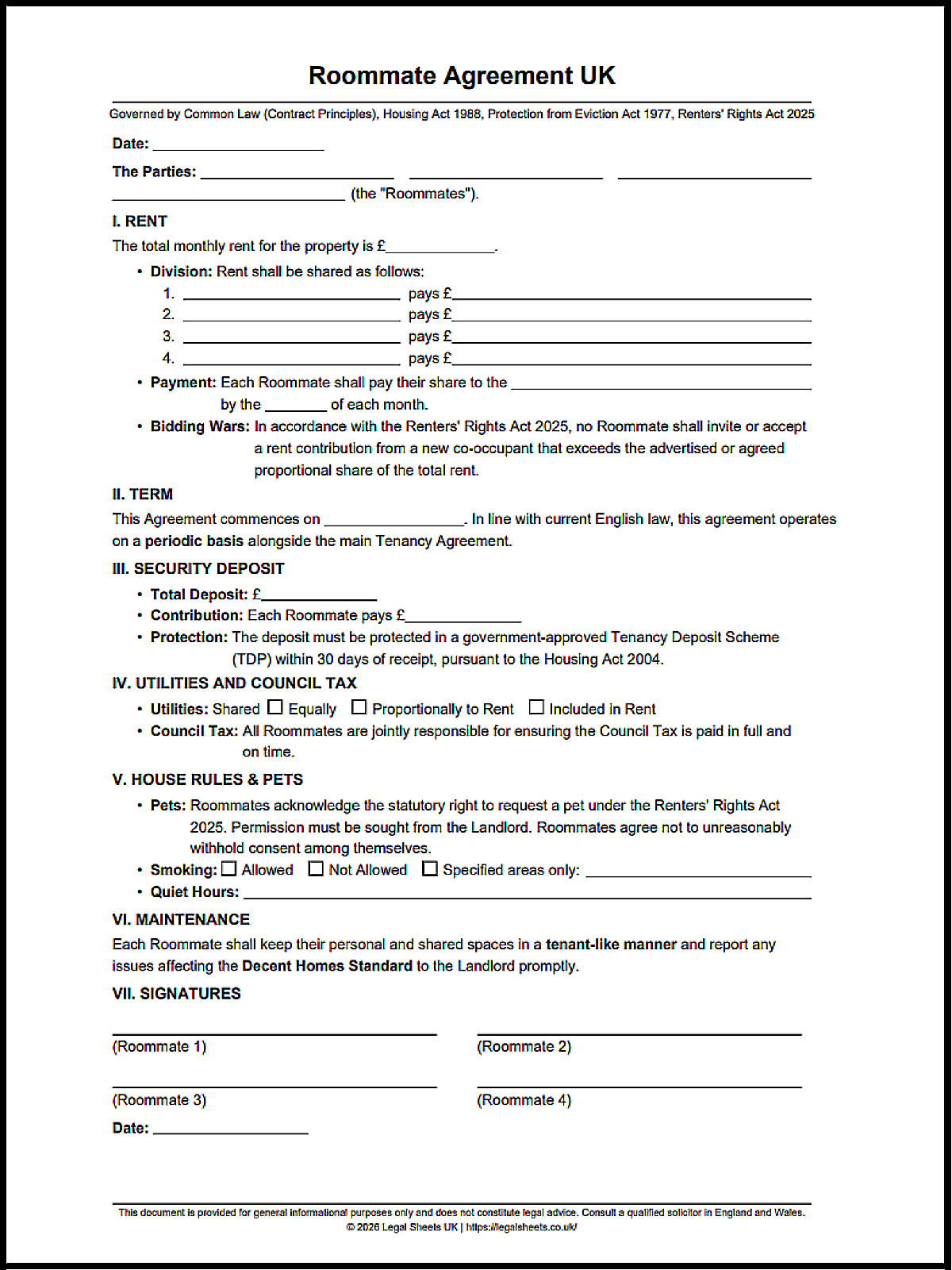
Roommate Agreement Template – Free PDF
A Roommate Agreement is often searched for when a new occupier is moving into a shared house and everyone assumes that a few messages in a group chat are enough to record what has been agreed. In practice, many disputes arise because nobody clearly identified whether the arrangement involved joint tenants, a subtenant, or a lodger, leaving arguments over rent contributions, bills, deposits, and notice periods once relationships deteriorate.
English housing law treats different shared living setups entirely differently. The landscape has grown drastically more complex since the Renters’ Rights Act 2025 came into force on 1 May 2026. With fixed-term Assured Shorthold Tenancies (ASTs) now abolished and replaced by open-ended Assured Periodic Tenancies, establishing whether your arrangement falls under the heavily modified Housing Act 1988 or operates as a simple common-law licence is an absolute necessity. County Court claims involving shared accommodation regularly turn on what was actually agreed between the occupants rather than what they later believed had been agreed.
The template and accompanying guidance here are designed to record those arrangements clearly before misunderstandings become expensive to untangle.
Table of Contents
ToggleRoommate Agreement Template (PDF, Word & Printable Formats)
The First Legal Question: Is the Occupant a Lodger, Licensee or Tenant?
Many disputes stem from misunderstanding legal status rather than disagreement over house rules.
Why Legal Status Changes Everything
The classification of an occupier can affect:
- Occupation rights.
- Notice expectations.
- Possession procedures.
- Deposit treatment.
- Security of tenure considerations.
Following the Renters’ Rights Act 2025 reforms to the Housing Act 1988, the dividing line between a tenancy and a licence to occupy carries massive legal weight. Genuine tenants now hold indefinite Assured Periodic Tenancies and are entirely shielded from ‘no-fault’ Section 21 evictions, whereas lodgers and licensees lack statutory security of tenure and can be asked to leave with reasonable notice An agreement labelled “roommate agreement” does not automatically determine legal status.
Warning Signs That a “Roommate” May Actually Be a Tenant
Potential indicators include:
- Exclusive possession of a room.
- Absence of a resident owner.
- Significant independence over accommodation.
- Long-term occupation arrangements.
Courts generally examine the reality of occupation rather than the title of the document.
Common Classification Mistakes That Lead to Disputes
Recurring errors include:
- Treating a tenancy as a licence.
- Assuming all shared accommodation creates lodger status.
- Using inappropriate notice procedures.
- Misunderstanding possession rights.
One of the most expensive mistakes occurs when parties assume an occupier can be removed informally, only to discover that statutory housing protections may apply.
Clauses That Matter Most in Shared Living Arrangements
The strongest roommate agreements focus on practical points that regularly generate disputes.
Rent Contributions and Payment Responsibility
The agreement should clearly identify:
- Individual payment shares.
- Due dates.
- Accepted payment methods.
- Responsibility for missed payments.
Vague wording often becomes problematic when one occupant leaves and remaining housemates seek reimbursement.
Utility Bills and Household Expenses
Common provisions address:
- Electricity.
- Gas.
- Water.
- Broadband.
- Streaming subscriptions.
- Shared household purchases.
Where calculations are unclear, recovering contributions later can become difficult.
Cleaning, Maintenance and Everyday Responsibilities
Typical provisions include:
- Cleaning rotas.
- Standards for shared areas.
- Waste disposal responsibilities.
- Repair reporting procedures.
These clauses may seem minor at the start of occupancy but frequently become major sources of tension.
Visitors, Partners and Overnight Guests
Agreements commonly address:
- Frequency of overnight stays.
- Additional contribution expectations.
- Security concerns.
- Housemate consent requirements.
The issue is often not the guest themselves but increased utility costs and reduced access to shared space.
Noise, Behaviour and Use of Shared Areas
Many households build in clear ground rules covering: Quiet hours and noise levels. Smoking expectations. Pet permissions (bearing in mind that under the new 2026 rules, private landlords cannot unreasonably block a tenant’s request to keep a pet, though live-in head tenants taking on lodgers retain more discretion). Home-working routines.
The more objective the wording, the easier it is to rely on if disagreements emerge.
Drafting Notice Provisions That Actually Work in Practice
Move-out disputes frequently cause more conflict than move-in arrangements.
Why Most Shared-Housing Disputes Start at Move-Out Stage
Common problems include:
- Sudden departures.
- Outstanding utility liabilities.
- Deposit disagreements.
- Difficulties finding replacement occupiers.
Without a notice provision, expectations often differ dramatically between occupants.
Choosing a Realistic Notice Period
How you draft your notice period depends entirely on the occupier’s true legal status. For authentic lodgers, notice periods can flexibly match the rent cycle (like a weekly or monthly arrangement). However, if your housemate legally qualifies as a sub-tenant, the Renters’ Rights Act 2025 strictly mandates a two-month written notice period from the tenant to end the agreement, overriding any shorter timeframe you might have drafted.
How Notice Should Be Served
The agreement should specify:
- Written notice requirements.
- Email procedures.
- Postal service options.
- Evidence retention methods.
Disputes often focus on whether notice was actually given rather than whether it was justified.
Money Risks That Frequently End Up in the County Court
Most roommate disputes eventually become debt disputes.
Shared Bills That One Occupant Stops Paying
Typical difficulties include:
- Limited evidence.
- Contribution calculation disputes.
- Incomplete payment records.
When claims reach the County Court, documentation often determines the outcome.
Damage to Shared Property
The agreement should address:
- Allocation of responsibility.
- Inventory evidence.
- Repair costs.
Without records, identifying who caused damage can be difficult.
Recovering Outstanding Contributions
Recovery generally progresses through stages:
- Informal discussions.
- Letter before action.
- County Court money claim.
The process can be lengthy and expensive compared with resolving the issue early through clear written terms.
House Rules That Courts Are More Likely to Respect
Not every clause carries equal weight.
Rules That Support Practical Enforcement
Courts are generally more interested in provisions dealing with:
- Cost-sharing arrangements.
- Property use expectations.
- Occupancy limits.
- Communication obligations.
These terms can usually be linked to measurable consequences.
Terms That May Be Difficult or Impossible to Enforce
Problems commonly arise with:
- Financial penalties.
- Excessive restrictions.
- Vague behavioural standards.
- One-sided obligations.
Under common law penalty principles, contractual fines for breaking house rules are often problematic.
Consumer Rights Considerations
The Consumer Rights Act 2015 may affect contractual fairness.
Useful drafting principles include:
- Clear wording.
- Transparent obligations.
- Balanced responsibilities.
- Defined financial consequences.
Where terms appear unfair, a court may decline to enforce them while leaving the remainder of the agreement intact.
Handling Deposits in Lodger and Shared Occupancy Arrangements
Deposits often generate more disputes than rent itself.
When Statutory Deposit Protection Does Not Apply
Where an occupier is genuinely a lodger sharing accommodation with a resident owner, statutory tenancy deposit protection requirements generally do not apply under the exclusions recognised by the Housing Act 2004.
Good Practice for Deposit Records
Useful evidence includes:
- Written receipts.
- Property condition records.
- Move-in photographs.
- Written explanations for deductions.
The strongest position is usually the party with the best documentation.
Common Deposit Disputes
Recurring disagreements involve:
- Cleaning costs.
- Alleged damage.
- Missing items.
- Final utility adjustments.
Many disputes arise because expectations regarding deductions were never documented at the outset.
Personal Data and Privacy Issues Often Overlooked by Housemates
Shared housing arrangements increasingly involve personal data processing.
When a Lead Tenant or Landlord Becomes a Data Controller
This may occur when collecting:
- Identification documents.
- Contact details.
- Banking information.
The responsibility exists regardless of whether the arrangement is informal.
GDPR Responsibilities in Shared Housing Administration
Where personal information is collected, compliance with UK GDPR principles and the Data Protection Act 2018 becomes relevant.
Practical responsibilities include:
- Transparency regarding data use.
- Appropriate security measures.
- Reasonable retention practices.
- Restricted access to personal information.
Avoiding ICO-Related Complaints
Common mistakes include:
- Collecting excessive information.
- Storing documents insecurely.
- Sharing personal information without justification.
Most complaints arise from poor handling practices rather than deliberate misconduct.
Common Drafting Errors That Undermine a Roommate Agreement
The agreement is only as effective as its drafting.
Relying on Verbal Promises
Although oral agreements can be legally binding under common law, evidential difficulties frequently arise.
Typical problems include:
- Different recollections.
- Missing records.
- Disputed obligations.
Leaving Key Financial Terms Undefined
Recurring drafting failures involve:
- Utility calculations.
- Rent apportionment methods.
- Shared purchase contributions.
Unclear wording often creates more disputes than having no clause at all.
Copying Tenancy Clauses Into a Shared-Housing Agreement
Many online templates import tenancy language without considering the actual arrangement.
This can create:
- Occupation-status confusion.
- Unexpected legal consequences.
- Possession difficulties.
Failing to Update the Agreement When Occupants Change
A document drafted for one household may become inaccurate after occupants leave or join.
Consequences include:
- Uncertain liability.
- Payment disputes.
- Enforcement complications.
If a Dispute Arises: How the Agreement Is Used as Evidence
The document’s value becomes most obvious when a dispute reaches court.
What a County Court Will Usually Examine
The court commonly reviews:
- Written terms.
- Payment records.
- Communications between occupants.
- Conduct after the agreement was made.
The focus is often on evidence rather than competing opinions.
Evidence That Strengthens a Claim
Useful evidence includes:
- Signed agreements.
- Bank transfer records.
- Utility invoices.
- Email correspondence.
Parties who maintain organised records are generally in a stronger position.
Typical Outcomes in Shared-Housing Disputes
Common outcomes include:
- Recovery of unpaid contributions.
- Debt judgments.
- Negotiated settlements.
- Cost-related decisions.
Many claims settle once the documentary evidence is disclosed.
UK Legal Facts and Compliance Considerations
Legal Requirements
| Topic / Issue | England Legal Rule | Governing Law |
|---|---|---|
| Capacity to Contract | Individuals must generally be 18 or older to enter a binding tenancy or roommate agreement in England. | Family Law Reform Act 1969 |
| Execution | Oral agreements may be legally binding but are difficult to prove | Common Law |
| Deposit Handling | Statutory deposit protection is mandatory for tenants but excludes true lodgers sharing amenities with a resident landlord. | Housing Act 2004 & Tenant Fees Act 2019 |
| Unfair Terms | Heavily penalising financial clauses or aggressively one-sided obligations are legally void and unenforceable. | Consumer Rights Act 2015 |
| Data Protection | Anyone acting as a ‘data controller’ (including lead tenants collecting ID or bank details) must process data securely and transparently. | UK GDPR and Data Protection Act 2018 |
| Occupation Status | Distinction between tenancy and licence affects legal rights and possession procedures | Housing Act 1988 |
For further reference, see the Housing Act 1988, Consumer Rights Act 2015, Data Protection Act 2018, and guidance from the courts and tribunals service.
Practical Legal Impact
Written agreements frequently reduce evidential disputes that arise from verbal arrangements. Occupation status can significantly affect possession rights and notice expectations. Unfair clauses may be disregarded while the remainder of the agreement survives. Poor handling of personal information can attract regulatory scrutiny, and incorrect assumptions about lodger status can create possession and eviction risks that become far more expensive than the original dispute.
Frequently Asked Questions
Can a roommate agreement be enforced if everyone originally agreed verbally?
Potentially, yes. Under common law, oral agreements can be legally binding. The difficulty is proving what was agreed. A written document usually provides stronger evidence if a dispute reaches the County Court.
What happens if a housemate stops paying their share of utilities but remains in the property?
The dispute generally becomes a contractual debt issue. Recovery often depends on evidence showing the person agreed to contribute and failed to do so.
Can a clause require a housemate to pay a financial penalty for breaking house rules?
Such clauses may be difficult to enforce. Contractual penalty provisions are commonly challenged, particularly where the amount bears little relation to any genuine loss suffered.
Does a roommate agreement protect me if the occupier later argues they are actually a tenant?
Not necessarily. Judges will always look at the factual reality of the living situation—such as whether the person has a lock on their door and exclusive use of a room—rather than the label slapped on the contract. If a court decides your ‘roommate’ is actually a sub-tenant, they instantly acquire the formidable protections of the Renters’ Rights Act 2025, completely immunising them from arbitrary eviction regardless of what your paperwork says.
What evidence is most useful if a shared-housing dispute reaches the County Court?
Signed agreements, payment records, utility statements, written notices, and email correspondence are typically among the most persuasive forms of evidence. Consistent documentation often carries greater weight than conflicting recollections of verbal discussions.
Author
-

Ankur is the founder and editorial reviewer at LegalSheets. He researches, writes, and reviews legal content, ensuring every template and guide is clear, accurate, and based on current UK laws and official government guidance. His focus is on making legal documents easier for individuals and businesses to understand and use.
