
Fixed Term Contract UK [PDF & Fillable Template]
A Fixed Term Contract is often prepared when an employer needs someone for a defined project, a period of maternity cover, or a role tied to temporary business demand, yet many disputes arise after the contract reaches its end rather than when it is signed. A common misconception is that employment automatically stops on the expiry date, but under the Employment Rights Act 1996 the non-renewal of a fixed-term arrangement is treated as a dismissal, which can bring Employment Tribunal scrutiny if the process has been handled poorly. In practice, employers frequently encounter difficulties where renewal decisions are left until the last moment, permanent vacancies are not communicated, or the employee continues working beyond the stated end date.
The Fixed-term Employees (Prevention of Less Favourable Treatment) Regulations 2002 also impose obligations that are often overlooked when temporary staff are treated differently from comparable permanent employees. Whether the objective is to recruit for a short-term project, record a temporary employment arrangement correctly, or manage the end of employment with greater certainty, the template and guidance that follow are designed around the issues that most commonly create problems in real workplace situations.
Fixed Term Contract Template (PDF, Word & Printable Formats)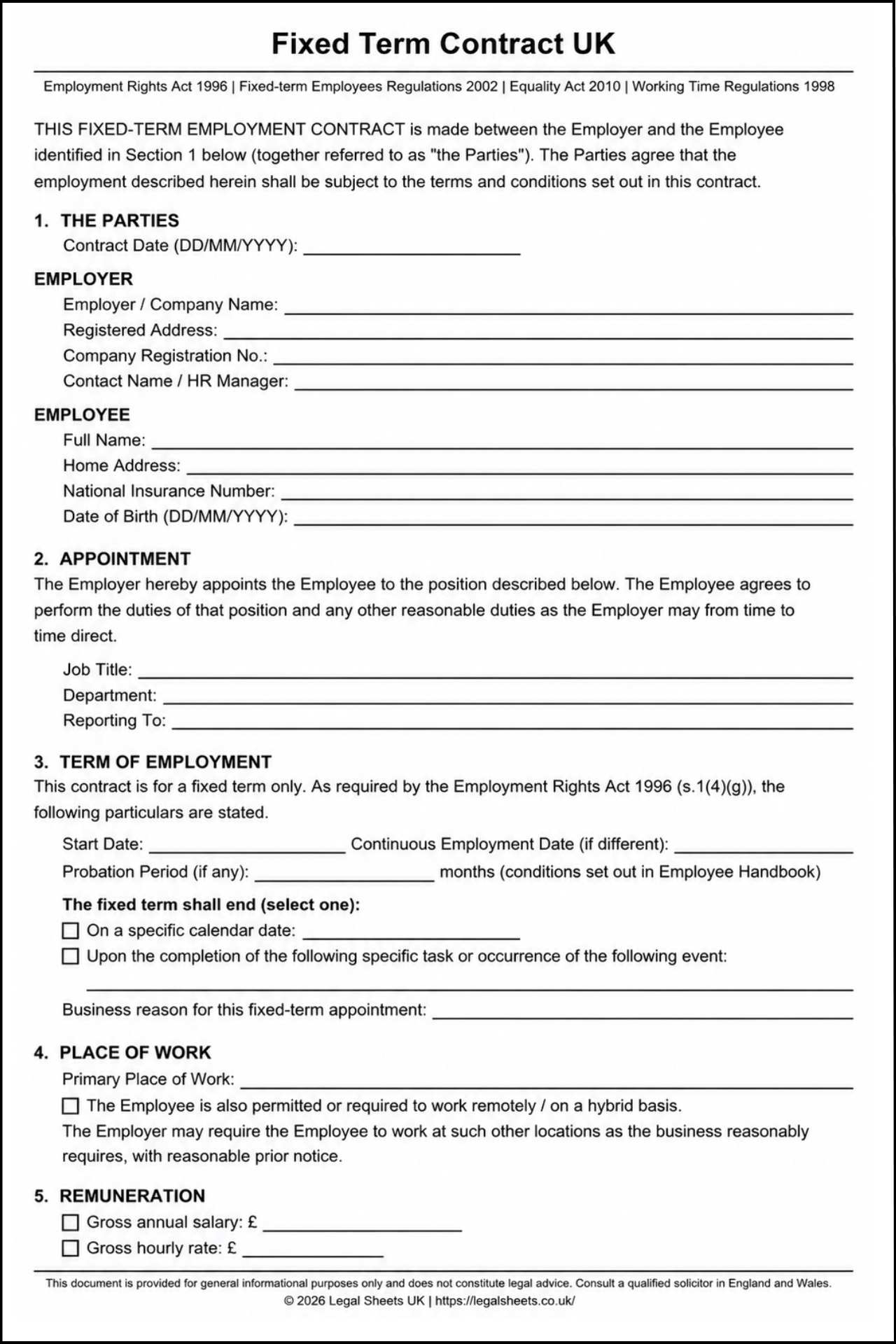
Fixed Term Contract Template: When This Document Is the Right Choice
A fixed term contract is usually appropriate where there is a genuine business reason for limiting the duration of employment.
Typical examples include:
- Project-based recruitment with a defined completion date
- Seasonal workforce requirements
- Temporary increases in workload
- Maternity cover positions
- Long-term sickness cover
- Time-limited funding arrangements
In practice, employers often create problems by using a fixed term contract repeatedly for an ongoing role that has no genuine end point. Over time, this can create permanency risks and trigger additional employment rights.
What the Template Typically Includes
A properly drafted fixed term employee contract generally contains:
- Employment commencement date
- Fixed expiry date or project completion trigger
- Job title and duties
- Salary and payment provisions
- Holiday entitlement
- Pension arrangements
- Notice provisions
- Early termination rights
- Confidentiality obligations
- Employment rights disclosures
One clause frequently scrutinised during disputes is the termination trigger. Vague wording such as “until further notice” undermines the purpose of a fixed-term arrangement and can create uncertainty regarding employment status.
Situations Where Additional Legal Advice May Be Needed
Professional advice may be appropriate where:
- Multiple contract renewals have occurred
- Senior executives are involved
- Significant commission or bonus arrangements exist for sales staff.
- The contract may end during maternity leave
- Early termination negotiations are underway
High-value disputes concerning early termination are often pursued through the County Court or High Court where breach of contract claims exceed Employment Tribunal limits.
Why Employers Commonly Use Fixed-Term Contracts
Temporary recruitment is often driven by operational necessity rather than workforce preference.
Covering Temporary Business Needs
Many organisations experience periods where additional staff are required for a limited duration.
Examples include:
- Christmas retail demand
- Tourism and hospitality peaks
- Temporary production increases
- Grant-funded positions
A fixed term arrangement allows the employer to align staffing levels with predictable business requirements.
Project-Specific Recruitment
Project work frequently requires specialist employees for a defined period.
Examples include:
- IT implementation projects
- Construction programmes
- Business transformation initiatives
- Research assignments for consultants
In these circumstances, linking termination to project completion often provides greater certainty than relying solely on a calendar date.
Employee Replacement Arrangements
Fixed-term recruitment is commonly used where an existing employee is expected to return.
Examples include:
- Maternity leave cover
- Long-term sickness absence
- Career break cover
- Secondment replacement
The contract should clearly identify the event that triggers termination, such as the return of the substantive employee.
Drafting Decisions That Have the Greatest Legal Impact
Many disputes involving fixed-term employment arise because of drafting decisions made at the start of the relationship.
Choosing the Correct Termination Trigger
Under the Employment Rights Act 1996, employers must clearly state the expected end date or the specific event that will end the employment relationship.
Common examples include:
- A fixed calendar date
- Completion of a project
- Expiry of funding
- Return of another employee
Where the trigger is unclear, disputes often arise regarding whether the contract actually ended.
Defining the Employment Duration Properly
The duration clause should identify:
- Start date
- End date where applicable
- Event-based termination trigger
- Renewal arrangements
Failure to identify these points accurately can result in uncertainty regarding employment status.
Avoiding Ambiguous Renewal Language
Renewal provisions should not create an expectation of continued employment.
Employers commonly include wording that: Renewal is discretionary subject to written confirmation.
- Further employment is not guaranteed
- Renewals require written confirmation
This reduces the likelihood of disputes concerning future employment expectations.
The Early Termination Clause That Employers Often Miss
One of the most expensive drafting mistakes involves omission of an early termination clause.
Why This Clause Matters
Business requirements change.
Projects may end early.
Funding may disappear.
Workloads may reduce unexpectedly.
Without an express right to terminate before expiry, employers can face significant financial exposure.
Risks of Omitting an Early Termination Provision
Under English common law principles, terminating a fixed-term employee before the contractual end date without an early termination clause may constitute wrongful dismissal.
The practical consequence can be severe.
An employer dismissing an employee three months into a twelve-month contract could potentially face liability for the remaining nine months of salary and benefits.
This is one reason experienced HR teams pay close attention to termination wording before issuing contracts.
Fixed-Term Employees and Equal Treatment Obligations
A recurring misconception is that temporary employees can receive reduced benefits because their employment is not permanent.
Areas Where Less Favourable Treatment Creates Risk
The Fixed-term Employees (Prevention of Less Favourable Treatment) Regulations 2002 prohibit less favourable treatment unless it can be objectively justified.
Areas commonly scrutinised include:
- Salary levels
- Bonus eligibility
- Training opportunities
- Workplace benefits
- Pension participation
Objective Justification Requirements
Employers seeking different treatment must be able to demonstrate legitimate justification.
Tribunals generally examine:
- Business reasons
- Evidence supporting the distinction
- Proportionality of the decision
Unsupported assumptions regarding temporary workers rarely survive scrutiny.
Managing Renewals Without Creating Unintended Permanency
Many employers focus heavily on the initial contract and pay less attention to renewal management.
That is often where problems begin.
Successive Contract Renewals
Each renewal should be documented carefully.
- HR departments commonly review: Continuous service and employee records
- Duration of previous contracts
- Future staffing requirements
- Business justification for continuation
Poor record keeping frequently complicates later disputes.
The Four-Year Conversion Risk
According to Regulation 8 of the Fixed-term Employees Regulations 2002, successive fixed-term contracts lasting four continuous years may automatically become permanent unless continued fixed-term status can be objectively justified.
Employers often underestimate this rule.
Simply issuing another fixed-term contract does not necessarily prevent permanent status from arising.
What Happens When Employees Continue Working After Expiry
Allowing employment to continue after the expiry date without formal renewal creates significant risk for zero-hours arrangements.
Under common law principles, the employee may become a permanent employee through an implied contract.
Once this occurs, standard notice and dismissal considerations apply.
Non-Renewal Is Legally a Dismissal: HR Process Considerations
Perhaps the most misunderstood aspect of fixed-term employment is that expiry does not create an automatic clean break.
Why Contract Expiry Is Not a Simple Administrative Event
Under Section 95 of the Employment Rights Act 1996, non-renewal constitutes a dismissal.
Employers therefore need to consider:
- The reason for non-renewal
- Procedural fairness
- Consultation requirements
The Employment Rights Act 2025 radically alters expiry risk. By reducing the qualifying period for ordinary unfair dismissal from two years to six months (effective January 2027) and abolishing the compensation cap, employers can no longer rely on the expiry of a standard 12-month fixed-term contract to avoid unfair dismissal scrutiny. The non-renewal must follow a full, procedurally fair dismissal process.
Practical Steps Before Non-Renewal
Before allowing a contract to expire, employers commonly:
- Review operational requirements
- Assess available permanent vacancies
- Hold consultation discussions
- Document decision-making
- Confirm outcomes in writing
Skipping these steps frequently increases tribunal risk during grievance procedures.
Tribunal Risks Following Expiry
Employment Tribunals regularly examine:
- Whether a fair reason existed
- Whether fair procedures were followed
- Whether alternative employment was considered
An employer relying solely on the expiry date may face avoidable litigation.
Redundancy Issues Affecting Fixed-Term Employees
Expiry and redundancy often overlap.
When Expiry May Amount to Redundancy
A fixed-term contract ending because the need for employees has reduced may constitute redundancy.
Examples include:
- Project completion
- Withdrawal of funding
- Workforce reductions
Statutory Redundancy Entitlements
Under Section 135 of the Employment Rights Act 1996, employees with at least two years of service may qualify for statutory redundancy pay where the expiry is attributable to redundancy.
Employers occasionally overlook this obligation when a contract reaches its end date.
Invalid Redundancy Waiver Clauses
Historically, employers sometimes attempted to exclude redundancy rights through contractual waivers.
Under Section 203 of the Employment Rights Act 1996, it is impossible to contract out of statutory employment rights. Any clause attempting to force a fixed-term employee to waive their right to statutory redundancy pay or unfair dismissal protection upon expiry is entirely void and legally meaningless
Maternity Leave and Fixed-Term Contracts
Maternity-related expiry situations require particular care.
Expiry During Maternity Leave
If a fixed-term contract expires due to redundancy while an employee is pregnant, on maternity leave, or within 18 months of childbirth, the Protection from Redundancy (Pregnancy and Family Leave) Act 2023 strictly applies. The employer is legally obligated to offer them any suitable alternative permanent vacancy ahead of all other candidates, rather than requiring them to interview for it.
Common Employer Mistakes
Common failures include: Ignoring available vacancies during internal recruitment.
- Running standard recruitment processes
- Treating maternity leave as irrelevant to renewal decisions
These errors frequently generate tribunal claims.
Potential Consequences
Consequences can include:
- Automatic unfair dismissal findings
- Discrimination claims
- Significant compensation awards
These disputes often become considerably more expensive than the employment relationship itself.
Required Employment Particulars and Mandatory Disclosures
The first day of employment is often where compliance obligations begin.
Section 1 Written Statement Requirements
Under Section 1 of the Employment Rights Act 1996, employers are strictly required to provide a Statement of Written Particulars on or before Day 1 of employment. For fixed-term staff, this must explicitly define the expected end date or the precise operational event (e.g., return of a specific employee or project sign-off) that will automatically trigger the contract’s expiry.
Consequences of Incomplete Written Particulars
Failure to provide accurate particulars may result in:
- Employment Tribunal awards
- Contractual uncertainty
- Disputes regarding employment status
In practice, inaccurate documentation often weakens the employer’s position during litigation.
Informing Employees About Permanent Vacancies
Employers must notify fixed-term employees of available permanent opportunities.
This obligation exists to ensure equal access to permanent employment.
Ignoring vacancy notifications may expose the employer to claims alleging less favourable treatment.
Signing, Storage and Administration
Administrative details rarely attract attention until a dispute arises.
Execution Requirements
No special execution formalities apply.
Electronic signatures are generally valid under common law principles and are widely used across employment documentation for remote workers.
No Government Filing Requirement
A fixed-term contract remains a private employment agreement.
There is no requirement to file the document with Companies House or any government department.
Related Employer Obligations
Employers must still complete:
- HMRC PAYE registration
- National Insurance administration
- Workplace pension enrolment
Fixed-term workers cannot be excluded from pension participation simply because their employment is temporary.
UK Legal Facts and Compliance Overview
Legal Requirements Table
| Topic / Issue | England Legal Rule | Governing Law |
|---|---|---|
| Less Favourable Treatment | It is unlawful to offer fixed-term staff worse terms (e.g., pro-rata bonuses, training, pensions) than comparable permanent staff unless rigorously “objectively justified”. | Fixed-term Employees (Prevention of Less Favourable Treatment) Regulations 2002 |
| Automatic Permanency (4-Year Rule) | If a fixed-term employee is continually renewed and accrues 4 years of continuous service, the contract automatically converts to a permanent contract by law. | Fixed-term Employees Regulations 2002 (Reg 8) |
| Expiry Constitutes Dismissal | If a contract expires due to redundancy within 18 months of childbirth, the employee holds an absolute statutory right to be offered any suitable alternative permanent vacancy. | Employment Rights Act 1996 (Section 95) |
| Right to Written Terms | A Section 1 Statement must be provided on or before Day 1, expressly defining the termination date or precise trigger event, otherwise tribunals can award 2–4 weeks’ capped pay. | Employment Rights Act 1996 (Section 1) |
| Statutory Redundancy Pay | Eligible employees may receive redundancy pay on expiry | Employment Rights Act 1996 (Section 135) |
| Execution Formalities | A Section 1 Statement must be provided on or before Day 1, expressly defining the termination date or precise trigger event, otherwise tribunals can award 2–4 weeks’ capped pay. | Common Law |
Practical Legal Impact
These rules influence far more than contract drafting.
Most Employment Tribunal disputes arise from:
- Poor renewal management
- Incorrect assumptions about contract expiry
- Failure to consider redundancy rights
- Unequal treatment of temporary staff
Employers who monitor contract durations, maintain proper records, and follow fair procedures are generally better positioned if disputes arise.
Common Mistakes That Lead to Employment Tribunal Claims
Drafting Mistakes
Recurring drafting failures include:
- Missing early termination clauses
- Unclear expiry wording
- Inadequate written particulars
These issues frequently weaken an employer’s defence during litigation.
HR Process Failures
Common procedural mistakes include:
- Treating expiry as automatic termination
- Skipping consultation discussions
- Ignoring available vacancies
Tribunals often focus heavily on these practical failures.
Compliance Oversights
Other recurring problems include:
- Unequal benefit arrangements
- Incorrect redundancy decisions
- Inadequate employment records
Many claims originate from administrative oversights rather than deliberate misconduct.
Frequently Asked Questions
Can a fixed-term contract be ended before the agreed end date?
Yes. However, employers should ensure the contract contains an express early termination clause. Without one, early dismissal may trigger wrongful dismissal claims and substantial financial liability.
Does a fixed-term employee become permanent after four years?
Potentially. Under Regulation 8 of the Fixed-term Employees Regulations 2002, successive fixed-term contracts reaching four continuous years may convert into permanent employment unless objective justification exists.
Can an employer simply allow a fixed-term contract to expire?
No. Under Section 95 of the Employment Rights Act 1996, expiry constitutes dismissal. Employers should consider both the reason for non-renewal and the procedure followed.
Are fixed-term employees entitled to bonuses and benefits?
Generally yes. Excluding temporary employees from benefits available to comparable permanent staff may amount to unlawful less favourable treatment unless objectively justified.
What happens if a fixed-term contract expires during maternity leave?
If the expiry amounts to redundancy, the Protection from Redundancy (Pregnancy and Family Leave) Act 2023 grants the employee absolute priority for any suitable alternative vacancy over other candidates. Failing to automatically offer an available role results in an automatically unfair dismissal and exposes the employer to uncapped discrimination damages.