
Free Independent Contractor Agreement [Printable PDF Formats]
A rushed Independent Contractor Agreement often causes problems not because it is unsigned or incomplete, but because the written terms bear little resemblance to how the working relationship actually operates. In England, Employment Tribunals and HM Revenue & Customs regularly look beyond the label attached to an agreement and examine issues such as control, personal service, and substitution when questions about employment status arise.
Where a company is entering the arrangement, execution requirements under the Companies Act 2006 should also be considered to avoid arguments about authority or validity later on. Businesses, consultants, and freelancers usually reach this stage when a project is ready to begin and there is a need to record payment arrangements, ownership of work, confidentiality obligations, and the contractor’s independent status with greater precision.
The template and accompanying guidance that follow are designed to document those commercial terms in a way that reflects how the engagement is intended to operate in practice.
Independent Contractor Agreement Template (PDF, Word & Printable Formats)
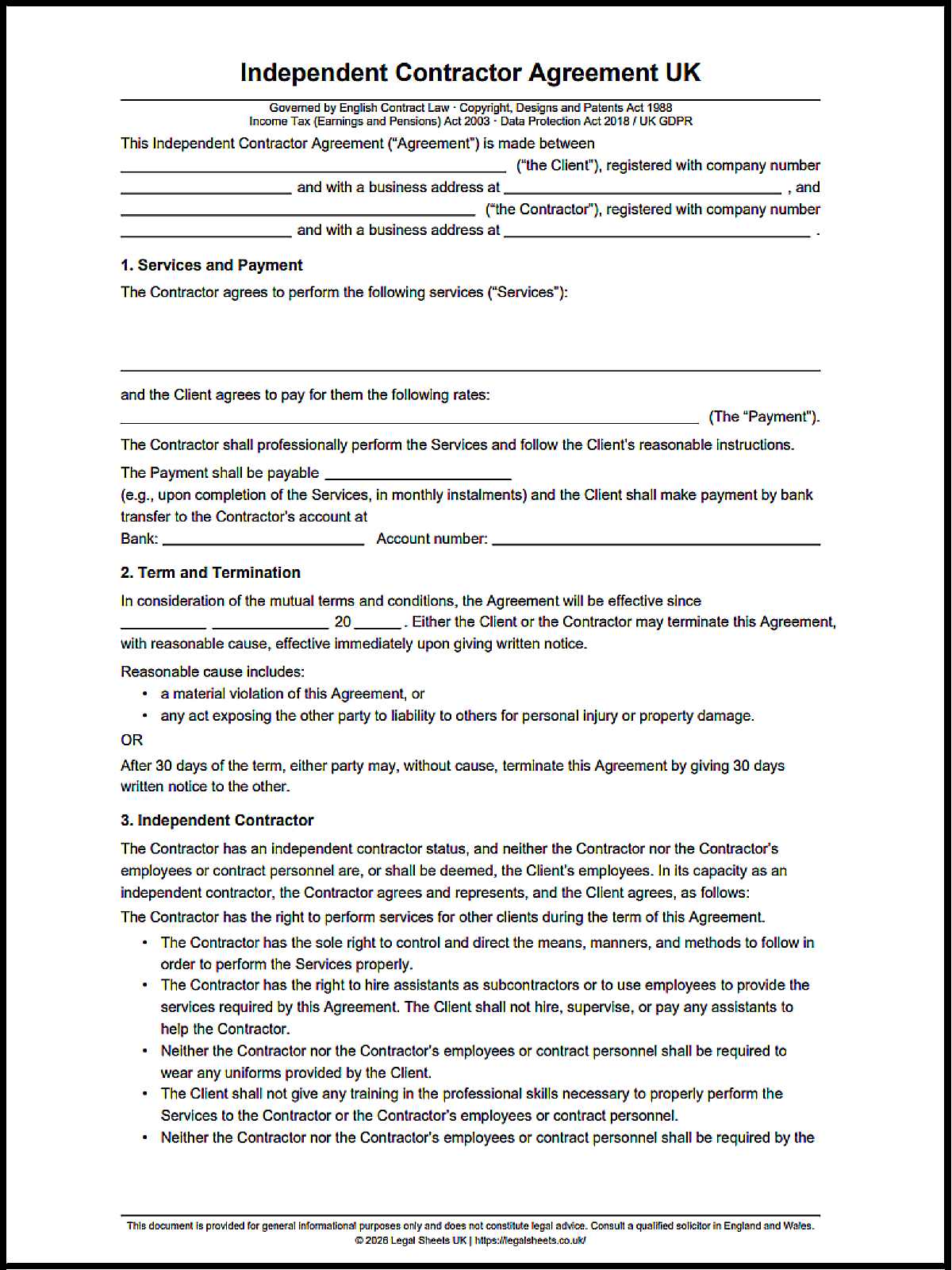
Before Drafting the Agreement: The Commercial Relationship You Are Actually Creating
The most expensive contractor disputes often begin long before the contract is signed.
Businesses frequently focus on drafting details while overlooking the practical relationship they intend to operate. A carefully prepared self-employed contract cannot compensate for working practices that resemble employment.
Is the Individual Truly Self-Employed?
The starting point is not the document. It is the reality of the engagement.
Degree of Operational Control
Independent contractors generally exercise substantial control over how services are performed. Excessive supervision can create difficulties if status is later challenged.
Ability to Work for Multiple Clients
Contractors commonly operate businesses of their own and may serve multiple clients simultaneously through distribution networks.
Freedom Over Working Methods
A client may specify deliverables and service standards without necessarily controlling every aspect of performance.
Financial Risk Assumed by the Contractor
Self-employed individuals often bear commercial risk, including responsibility for correcting defective work or managing business expenses.
Provision of Equipment and Resources
Contractors frequently use their own equipment, systems, and resources when delivering services.
Warning Signs That the Arrangement Resembles Employment
Several warning signs regularly appear in status disputes.
Fixed Working Hours
Requiring contractors to work identical schedules to employees can create evidential difficulties.
Line-Management Structures
A contractor who reports through employee management chains may appear less independent in practice.
Mandatory Attendance Requirements
Permanent attendance obligations can undermine claims of operational independence.
Exclusive Service Obligations
Preventing contractors from working elsewhere may weaken arguments that they operate independent businesses.
Integration into Internal Teams
The more a contractor becomes embedded within normal employee structures, the greater the risk that contractual labels lose significance.
Why Contract Labels Alone Do Not Protect the Business
One of the most common misconceptions is that calling someone a contractor automatically makes them one.
Pursuant to Section 230 of the Employment Rights Act 1996, employment status questions depend heavily upon the substance of the relationship. Courts and tribunals examine what actually happened during the engagement rather than relying exclusively on contractual wording.
This reality became particularly significant following the Supreme Court decision in Uber BV v Aslam, where practical working arrangements received greater attention than contractual descriptions.
Where a business drafts a freelance agreement describing complete independence but then imposes employee-style controls, the written contract may carry limited persuasive value during a dispute.
Structuring the Engagement to Support Genuine Contractor Status
Drafting and operational behaviour should reinforce one another.
Scope of Services vs Job Description
Many templates accidentally read like employment contracts.
Project-Based Deliverables
Independent contractor agreements usually perform best when focused on outcomes and deliverables.
Outcome-Focused Drafting
Clients often achieve better protection by defining what must be delivered rather than prescribing every step of the process.
Avoiding Employee-Style Responsibilities
Descriptions resembling permanent job roles can create ambiguity regarding status.
The Role of a Genuine Right of Substitution
The substitution clause frequently attracts attention during status reviews.
How Substitution Clauses Operate
A substitution clause allows the contractor to provide another suitably qualified individual to perform the services.
Practical Use of Substitutes
The clause carries greater weight when the right is genuinely capable of being exercised in practice.
Common Drafting Failures
Some templates include substitution language but impose so many conditions that the right becomes largely theoretical.
Operational Conduct That Undermines Substitution Rights
Under the Employment Rights Act 1996 framework and supporting case law, a substitution provision that exists only on paper may offer little protection. If every proposed substitute is routinely rejected without legitimate contractual grounds, tribunals may question whether the right was ever genuine.
Managing Control Without Creating Employment Indicators
Businesses still need oversight. The challenge is exercising it appropriately.
Service Standards Versus Managerial Control
Clients can specify standards and deliverables without necessarily directing every aspect of performance.
Deliverable Oversight
Monitoring progress against agreed milestones generally creates fewer difficulties than supervising daily working methods.
Reporting Requirements
Commercial reporting obligations are common, but excessive managerial oversight can blur distinctions between contractor and employee relationships.
Independence Safeguards
Practical independence should be visible in both the contract and daily operations.
Exclusivity Clauses and Their Hidden Risks
Exclusivity provisions often appear attractive from a commercial perspective but can create unintended consequences.
Restrictions on Other Clients
Preventing contractors from serving alternative clients may undermine indicators of self-employment.
Commercial Justification Considerations
Where restrictions are genuinely necessary, they should correspond to a clear commercial objective.
Status Implications
Broad exclusivity obligations may become relevant evidence if status is later challenged.
Payment Structures That Reduce Commercial Disputes
Many contractor disputes have little to do with legal theory. They arise because nobody clearly documented how payment would work.
Well-defined charging structures often prevent disagreements that would otherwise escalate into County Court claims for unpaid invoices.
Defining Fees and Charging Models
Different projects require different pricing models.
Fixed-Price Projects
Suitable where deliverables can be clearly defined at the outset.
Milestone Payments
Often used for longer projects where work is delivered in stages.
Day-Rate Arrangements
Common for consultancy and specialist professional services.
Retainer engagements with commission arrangements
Useful where ongoing availability forms part of the commercial arrangement.
Invoicing Procedures
Payment provisions deserve greater attention than they typically receive.
Submission Requirements
The agreement should clearly identify how invoices are submitted and what information they must contain.
Payment Deadlines
Unclear payment timelines frequently become a source of avoidable disputes.
VAT Considerations
Where applicable, invoicing provisions should accommodate VAT requirements and supporting documentation.
Supporting Documentation
Clients often require evidence that contractual milestones or deliverables have been completed before payment is authorised.
Handling Additional Work Requests
Scope creep remains one of the most common commercial problems in contractor engagements.
Variation Procedures
Additional work should be documented before performance begins.
Scope Expansion Controls
Clear boundaries reduce disagreements about whether work falls within the original fee structure.
Change Approval Mechanisms
Approval processes create evidence if payment disputes later arise.
Late Payment Scenarios
Even productive commercial relationships can deteriorate when invoices remain unpaid.
Interest Provisions
The agreement may address how overdue sums are treated.
Recovery Costs
Businesses often underestimate the expense of recovering relatively modest unpaid invoices.
Escalation Procedures
A structured escalation process frequently resolves payment disagreements before formal litigation becomes necessary.
Intellectual Property: The Clause Businesses Most Commonly Get Wrong
Few contractor disputes create more commercial damage than intellectual property ownership disputes. Businesses often assume that paying for work automatically gives them ownership of the underlying rights. Under English law, that assumption can become expensive.
A contractor may produce software, designs, written content, training materials, databases, marketing assets, or technical documentation that later becomes central to the client’s business operations. Ownership questions frequently emerge during investment reviews, acquisitions, licensing negotiations, or disputes rather than during the project itself.
Why Payment Alone Does Not Transfer Ownership
Many clients believe that once an invoice has been paid, ownership automatically passes to them.
In practice, payment and ownership are separate legal issues. A business may have paid in full for deliverables yet still lack ownership of the underlying intellectual property rights.
This misunderstanding commonly remains hidden until a commercial transaction exposes the problem.
Contractor-Owned Rights by Default
Pursuant to Sections 11 and 90(3) of the Copyright, Designs and Patents Act 1988, intellectual property created by an independent contractor generally belongs to the contractor unless ownership is properly assigned.
This position often surprises businesses that regularly engage freelancers and consultants.
Drafting a Valid Written Assignment
An intellectual property assignment clause is often one of the most valuable provisions within the entire agreement.
Section 90(3) of the Copyright, Designs and Patents Act 1988 requires copyright assignments to be made in writing and signed by or on behalf of the assignor.
Businesses frequently rely on purchase orders, emails, or invoices that were never intended to transfer ownership. These documents may provide far less protection than expected.
For the legislation, see Copyright, Designs and Patents Act 1988.
Future Intellectual Property and Deliverables
Many projects evolve after work begins.
Additional software modules, design revisions, content updates, and new deliverables often emerge during the engagement. If ownership provisions only address the original scope, uncertainty may arise regarding later work products.
Software, Content, Designs and Creative Work
Ownership disputes are particularly common where contractors create:
- Software and source code
- Website content
- Marketing campaigns
- Graphic designs
- Training materials
- Digital products
- Databases
Where ownership cannot be demonstrated clearly, commercial exploitation of those assets may become more difficult.
Consequences of Omitting an Express Assignment Clause
The absence of a written assignment can create substantial uncertainty.
Licensing Disputes
The client may only possess limited rights to use the work rather than outright ownership.
Competitor Reuse Risks
The contractor may remain free to reuse similar materials elsewhere, including for competing businesses.
Commercial ownership uncertainty during shareholder transactions
Investors, purchasers, and commercial partners frequently examine intellectual property ownership during due diligence exercises. Missing assignments often become a significant concern.
Data Protection Responsibilities When Contractors Access Personal Data
Data protection obligations frequently receive less attention than payment terms or termination clauses despite creating significant regulatory exposure.
The issue commonly arises where contractors access customer information, employee records, subscriber databases, or other personal data while performing services.
Identifying Whether the Contractor Is Acting as a Processor
The practical question is whether the contractor processes personal data on behalf of the client.
Where the contractor acts as a processor, specific contractual obligations become relevant under UK GDPR and the Data Protection Act 2018.
Mandatory Article 28 Contract Terms
Article 28(3) UK GDPR requires processor arrangements to include specific written provisions.
Where applicable, the agreement should address:
- Processing instructions
- Confidentiality obligations
- Security requirements
- Assistance with data subject rights
- Audit rights
- Compliance monitoring
According to the Verified Legal Facts, omission of mandatory processor provisions can result in statutory non-compliance and increased regulatory exposure.
For official guidance, see the Information Commissioner’s Office (ICO).
Security and Confidentiality Requirements
Businesses often provide contractors with access to systems containing commercially sensitive information.
The agreement should identify:
- Security expectations
- Access controls
- Confidentiality standards
- Information handling requirements
Many disputes arise because security obligations were assumed rather than documented.
Audit Rights and Compliance Monitoring
A client may remain legally exposed even where processing activities have been outsourced.
Audit provisions can provide visibility into compliance practices and assist with regulatory investigations if concerns arise.
Data Breach Reporting Obligations
Speed frequently determines the seriousness of a data incident.
The agreement should establish reporting procedures, notification timelines, and information-sharing requirements following a breach.
Delayed notification can significantly increase both regulatory and commercial consequences.
When a Separate Data Processing Agreement May Be Needed
Some contractor relationships involve extensive processing activities that justify a dedicated data processing agreement.
Separate documentation often provides greater operational detail than can reasonably be accommodated within the primary contractor agreement.
IR35 and Off-Payroll Working Issues That Affect Contractor Agreements
IR35 concerns often dominate discussions regarding contractor engagements, particularly where Personal Service Companies are involved.
However, contractual wording alone rarely determines the outcome of a status assessment.
Determining Whether the Rules Apply
The starting point is understanding the structure of the engagement and whether the relevant off-payroll working provisions apply.
Not every contractor relationship falls within the same tax framework.
Medium and Large Client Responsibilities
Chapter 10 of the Income Tax (Earnings and Pensions) Act 2003 places specific obligations upon medium and large client organisations engaging contractors through intermediaries.
Businesses frequently underestimate the procedural requirements attached to these engagements through agency intermediaries.
Status Determination Statements (SDS)
A Status Determination Statement is more than an administrative exercise.
According to Chapter 10 ITEPA 2003, qualifying clients must assess status and provide a Status Determination Statement before payments are made.
The statement should communicate both the decision reached and the reasoning supporting that decision.
For the legislation, see Income Tax (Earnings and Pensions) Act 2003.
Inside IR35 vs Outside IR35 Engagements
The tax consequences differ depending upon the determination reached.
Many disputes arise because businesses focus heavily on preferred outcomes while paying insufficient attention to the practical reality of the working relationship.
Why Contract Wording Alone Cannot Secure Outside IR35 Status
One of the most common drafting mistakes is assuming that favourable wording guarantees an outside IR35 position.
The Verified Legal Facts emphasise that substance matters. If contractual rights exist only on paper while operational practices indicate a different reality, the contractual language may provide limited protection.
The Practical Limits of Tax Indemnity Clauses
Many agreements contain indemnities requiring contractors to reimburse tax liabilities.
The practical difficulty often arises during enforcement.
Where the contractor operates through a Personal Service Company with limited assets or has ceased trading, the indemnity may offer little meaningful recovery despite appearing robust within the contract.
Restrictive Covenants Without Creating Unenforceable Restraints
Businesses understandably wish to protect customer relationships, confidential information, pricing structures, and proprietary knowledge.
The challenge is achieving protection without creating restrictions that are unlikely to survive scrutiny.
Legitimate Business Interests Worth Protecting
English courts generally focus on whether a restriction protects a genuine proprietary interest.
Restrictions imposed simply to prevent competition frequently encounter difficulties.
Non-Solicitation Clauses
Targeted restrictions preventing the solicitation of customers or suppliers are often easier to justify than broad non-compete obligations.
The narrower and more commercially focused the restriction, the greater its prospects of enforceability.
Confidential Information Protections
Strong confidentiality provisions often provide more practical protection than extensive non-compete clauses.
Many businesses underestimate the value of carefully drafted confidentiality obligations.
Non-Compete Restrictions
Non-compete provisions require particular care.
Businesses frequently draft restrictions covering excessive geographical areas, lengthy periods, or activities unrelated to legitimate commercial concerns.
Why Overly Broad Restrictions Commonly Fail
Under the English common law doctrine of restraint of trade, restrictions must be reasonable and proportionate.
The leading authority remains Nordenfelt v Maxim Nordenfelt Guns and Ammunition Co Ltd [1894].
According to the Verified Legal Facts, English courts commonly strike down restrictions that exceed what is reasonably necessary to protect legitimate business interests.
Termination Scenarios That Cause the Most Conflict
Many contractor relationships function smoothly until termination is discussed.
Disputes frequently emerge regarding final payments, incomplete work, ownership of deliverables, and alleged contractual breaches.
Ending the Engagement for Convenience
Commercial relationships sometimes end without fault.
Clear notice provisions can reduce uncertainty and provide both parties with sufficient time to manage the transition.
Immediate Termination Rights
Some circumstances justify immediate termination.
Examples may include serious confidentiality breaches, substantial contractual failures, or conduct fundamentally damaging the commercial relationship.
The triggering events should be clearly identified wherever possible.
Material Breach Procedures
Businesses sometimes terminate engagements without following their own contractual procedures.
A structured breach process often creates valuable evidence if litigation later follows.
Contractor Non-Performance
Repeated missed deadlines, defective deliverables, and persistent performance failures commonly lead to termination disputes.
The clearest agreements define measurable deliverables from the outset.
Client Non-Payment Issues
Not all termination disputes originate from the client.
Contractors regularly suspend performance or terminate engagements because invoices remain unpaid.
Where payment provisions lack clarity, both parties may genuinely disagree about what is owed.
Obligations That Continue After Termination
Certain obligations commonly survive termination, including:
- Confidentiality obligations
- Intellectual property provisions
- Data protection responsibilities
- Outstanding payment obligations
- Return of client property
- Dispute resolution clauses
Many businesses focus heavily on ending the engagement while overlooking obligations that continue long after the working relationship has ended.
Independent Contractor Agreement Clauses That Deserve Special Attention
Many contractor agreements fail not because a major clause was omitted, but because a critical provision was treated as standard boilerplate and never properly considered. During disputes, these clauses often determine whether the agreement delivers meaningful protection or simply creates a false sense of security.
Contractor Status Declaration
A contractor status declaration records the parties’ intention that the relationship is one of independent contracting rather than employment.
While useful, businesses should not assume this wording alone determines status. Pursuant to Section 230 of the Employment Rights Act 1996, tribunals assess the reality of the working relationship rather than relying solely upon contractual labels.
A declaration that conflicts with day-to-day working practices may provide limited protection during a status challenge.
Subcontracting and Delegation Rights
The agreement should clearly address whether services may be delegated and under what conditions.
Many disputes arise because clients expect personal performance while contractors assume they may use assistants, subcontractors, or substitutes.
Where substitution rights are intended to support self-employed status, operational conduct should remain consistent with the contractual wording.
Liability Caps and Exclusions
Liability provisions allocate commercial risk between the parties.
Without appropriate limitations, relatively modest projects can expose either party to disproportionate financial claims arising from delays, service failures, or contractual breaches.
The scope of any limitation should reflect the nature, value, and risk profile of the engagement.
Insurance Requirements
Insurance obligations are often overlooked until a claim arises.
Depending on the services provided, businesses may require evidence of:
- Professional indemnity insurance
- Public liability insurance
- Cyber-related insurance coverage
- Other specialist policies relevant to the engagement
Requesting evidence at the start of the relationship is generally more effective than attempting to verify cover after a dispute develops.
Confidentiality Provisions
Confidentiality obligations frequently provide stronger practical protection than aggressive restrictive covenants.
The clause should clearly identify:
- Protected information
- Permitted uses
- Disclosure exceptions
- Ongoing obligations following termination
Many businesses discover that confidential information is more valuable than any single deliverable produced during the project.
Notice Procedures
Commercial disputes often become procedural disputes.
Because there is no overarching statutory notice regime governing ordinary commercial service contracts, the agreement should specify:
- Permitted methods of service
- Service addresses
- Email notification requirements
- When notices are deemed received
Poor notice provisions frequently create avoidable arguments regarding termination and breach notifications.
Dispute Resolution Framework
Most agreements receive little attention until a disagreement occurs.
A clear dispute resolution clause can reduce uncertainty by identifying how disputes will be handled and where proceedings may be brought if informal discussions fail.
Entire Agreement Clause
Businesses regularly negotiate important commercial points through meetings, telephone calls, and email exchanges.
An entire agreement clause attempts to reduce later arguments about whether undocumented promises form part of the contractual relationship.
Significant commercial commitments should always appear in the final written agreement rather than being left within correspondence.
Common Reasons Independent Contractor Agreements Fail During Disputes
Most contractor disputes follow familiar patterns. The same drafting mistakes appear repeatedly across different industries and engagement types.
The “Sham Contract” Problem
This remains one of the most significant risks.
A business may use a professionally drafted independent contractor agreement while managing the individual exactly like a permanent member of staff.
According to the Verified Legal Facts, English courts and tribunals focus heavily on operational reality. If the contract describes independence but the practical relationship resembles employment, the written document may be treated as a sham.
The consequences can include worker or employee status findings and substantial financial liabilities.
Substitution Rights That Exist Only on Paper
Many agreements contain substitution clauses that nobody genuinely intends to use.
Where every proposed substitute is rejected in practice, tribunals may question whether the right was ever real.
Operational conduct frequently carries more weight than theoretical contractual rights.
Missing Intellectual Property Assignments
Businesses often discover ownership problems long after a project has ended.
Without a valid written assignment, the contractor may retain ownership of valuable intellectual property despite having received payment for creating it.
Poorly Defined Deliverables
Vague descriptions of services create uncertainty regarding performance obligations.
Disputes commonly arise regarding:
- Whether work was completed
- Whether additional fees are payable
- Whether deadlines were missed
- Whether termination was justified
Specific deliverables generally create fewer disputes than broad descriptions of responsibilities.
Ambiguous Payment Terms
Many County Court claims involving contractors arise from basic payment disagreements.
Unclear invoicing procedures, uncertain payment dates, and poorly defined milestones frequently become the source of avoidable litigation.
Unclear Termination Mechanisms
Termination clauses often appear straightforward until they need to be used.
Where notice periods, breach procedures, or post-termination obligations are unclear, disagreements can escalate quickly.
Overreaching Restrictive Covenants
Businesses sometimes draft restrictions designed to eliminate all competitive risk.
According to the Verified Legal Facts, overly broad restrictions are vulnerable under the English restraint of trade doctrine and may be struck down entirely.
UK Legal Requirements Affecting Independent Contractor Agreements
Legal Requirements Table
| Topic / Issue | England Legal Rule | Governing Law |
|---|---|---|
| Employment Status | Contractor status is assessed according to the reality of the relationship rather than contractual labels | Employment Rights Act 1996, Section 230 |
| Right of Substitution | Genuine substitution rights support self-employed status assessments | Employment Rights Act 1996 and supporting case law |
| IR35 Status Determination | Medium and large clients must issue a Status Determination Statement before payment | Chapter 10, Income Tax (Earnings and Pensions) Act 2003 |
| Intellectual Property Assignment | Contractor-created intellectual property remains with the contractor unless assigned in writing | Section 11, Copyright, Designs and Patents Act 1988 |
| Data Processing Terms | Written processor provisions are required where personal data is processed on behalf of the client | Article 28 UK GDPR; Data Protection Act 2018 |
| Contract Execution | Commercial contracts generally rely on consideration, although certain provisions may require deed execution where consideration is absent | Common Law Principles; Section 1, Law of Property (Miscellaneous Provisions) Act 1989 |
Practical Legal Impact
These legal requirements influence both drafting and enforcement.
Status disputes frequently focus on evidence of actual working practices rather than contractual language. A business that imposes employee-style controls may face significant difficulties defending contractor status regardless of the wording contained within the agreement.
Failure to provide a Status Determination Statement where required can transfer substantial tax liabilities to the client organisation.
Missing intellectual property assignments frequently create ownership disputes during acquisitions, investment reviews, licensing negotiations, and commercial disagreements.
Data processing failures create a different type of exposure. Regulatory scrutiny from the Information Commissioner’s Office may examine both operational conduct and contractual compliance.
For statutory references, see:
- Employment Rights Act 1996
- Income Tax (Earnings and Pensions) Act 2003
- Copyright, Designs and Patents Act 1988
Signing, Record-Keeping and Operational Implementation
A signed agreement is only the starting point. Many successful claims arise because parties ignored the contract after execution.
Execution Requirements
According to the Verified Legal Facts, standard commercial service contracts generally rely upon common law contractual principles and consideration.
However, where a key provision lacks reciprocal value, execution as a deed may be necessary.
Execution requirements should be considered before signature rather than during a dispute.
Electronic Signatures and Practical Considerations
Electronic execution is widely used throughout commercial contracting.
Businesses should retain executed copies together with all supporting schedules, statements of work, and amendments.
A missing schedule can create as much uncertainty as a missing contract.
Retaining Supporting Evidence
The strongest evidence often exists outside the agreement itself.
Businesses should retain:
- Signed agreements
- Statements of work
- Change requests
- Invoices
- Payment records
- Project correspondence
- Status determination documentation where applicable
These materials frequently become central evidence during litigation or tribunal proceedings.
Aligning Daily Working Practices With Contract Terms
Many arrangements fail at this stage.
A contract that emphasises independence becomes difficult to defend if managers impose fixed schedules, direct supervision, and employee-style controls.
Consistency between contractual terms and operational behaviour remains one of the most effective methods of reducing status-related risks.
Updating Agreements During Long-Term Engagements
Long-term engagements rarely remain static.
Additional responsibilities, revised deliverables, changing payment arrangements, and expanded project scopes should be documented rather than assumed.
Unrecorded changes often create evidential difficulties years later.
Frequently Asked Questions
Can a contractor still be treated as an employee even if they signed an Independent Contractor Agreement?
Yes. Pursuant to Section 230 of the Employment Rights Act 1996, courts and tribunals assess the actual working relationship. Contractual labels alone do not determine status.
See the Employment Rights Act 1996.
What happens if an Independent Contractor Agreement does not contain an intellectual property assignment clause?
The contractor will generally retain ownership of intellectual property they create unless ownership is properly transferred through a written assignment meeting the requirements of the Copyright, Designs and Patents Act 1988.
This can significantly restrict a client’s ability to control or commercialise the work.
Does every contractor engagement require an IR35 status assessment?
No, The obligation primarily affects medium and large client organisations engaging contractors through intermediaries under Chapter 10 of ITEPA 2003.
Status considerations nevertheless remain relevant whenever contractor relationships are structured.
Can a client refuse every proposed substitute despite having a substitution clause?
Consistently rejecting substitutes without legitimate contractual justification may undermine the authenticity of the substitution right.
Tribunals often examine how rights operate in practice rather than how they appear on paper.
Are post-termination non-compete clauses automatically enforceable against contractors?
No, Restrictions must be reasonable and designed to protect legitimate business interests. Overly broad restrictions face a significant risk of being declared unenforceable under the restraint of trade doctrine.
An Independent Contractor Agreement works most effectively when contractual wording, commercial objectives, and day-to-day working practices all support the same business model. Most disputes emerge when one of those elements says something different from the other two.