
Free Printable Section 8 Notice [Template & PDF Download]
Many landlords start searching for a Section 8 Notice only after a tenancy problem has already escalated, often because rent arrears are growing or complaints about a tenant’s conduct can no longer be ignored. Under the Housing Act 1988, a Section 8 Notice is only effective when the correct possession grounds are selected and the statutory notice requirements are followed, yet procedural mistakes at this stage remain one of the most common reasons possession cases stall.
County Courts in England regularly see claims delayed because the wrong Schedule 2 ground was used or the notice served did not match the legal requirements for the alleged breach. When that happens, the possession process frequently has to begin again, adding further cost and delay for the landlord.
The template and guidance that follow are designed to help you prepare a Section 8 Notice that reflects the circumstances of the tenancy and the procedural requirements expected by the court.
Section 8 Notice Template (PDF, Word & Printable Formats)
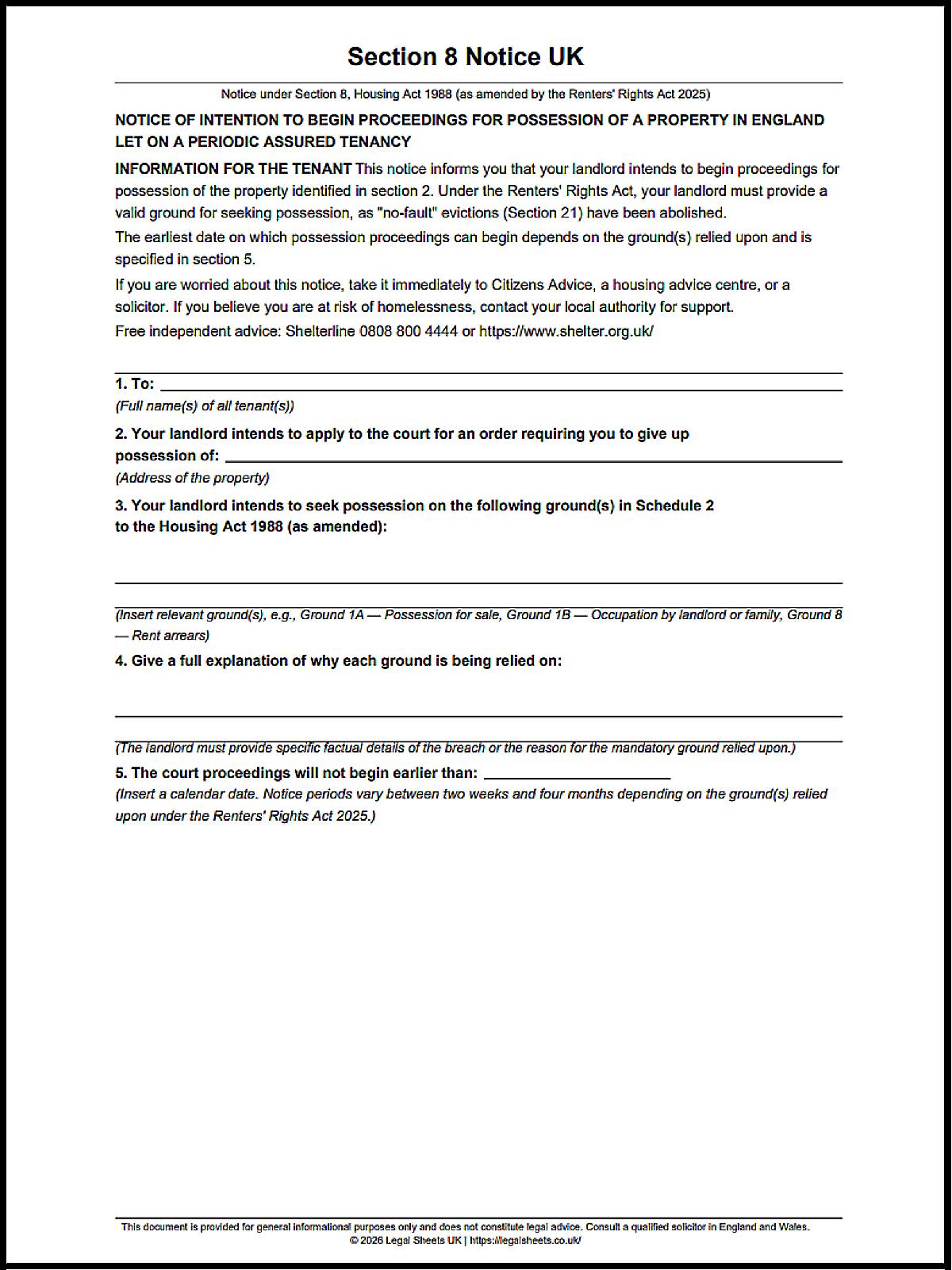
Before Serving a Section 8 Notice: The Checks That Prevent Expensive Mistakes
Confirm the Tenancy Type Qualifies
A common mistake is assuming every residential tenancy can be addressed through a Section 8 notice.
The statutory framework described by Section 8 of the Housing Act 1988 applies to Assured Periodic Tenancies. Before preparing the notice, landlords should confirm that the tenancy falls within the possession regime being relied upon.
Court proceedings can be delayed significantly if the wrong possession route is selected at the outset.
Verify Deposit Compliance First
Deposit compliance is frequently raised by tenants once court proceedings begin.
Under Section 213 of the Housing Act 2004 and the reforms reflected within the Renters’ Rights Act 2025 framework, landlords are prohibited from relying upon possession grounds unless the tenancy deposit was protected within a government-approved scheme and the prescribed information requirements were satisfied before the Section 8 notice is issued.
Many landlords focus on the possession ground itself and only review deposit records after proceedings start. By that stage, the issue may already undermine the claim.
Check Whether Transitional Renters’ Rights Requirements Apply
Some tenancies have moved through multiple legislative stages over time.
Where a legacy tenancy automatically converted into an Assured Periodic Tenancy, transitional requirements may apply. According to the verified statutory framework, landlords must have successfully served the required government information sheet explaining the new renter rights structure.
While failing to serve this mandatory document by the 31 May 2026 deadline exposes the landlord to severe local authority civil penalties of up to £7,000, it does not act as an automatic statutory bar to serving a Section 8 notice or initiating court proceedings.
This issue often emerges unexpectedly during possession litigation because landlords assume historic tenancy paperwork remains sufficient after legislative reform.
Ensure No Breathing Space Moratorium Is Active
Rent arrears possession claims require careful checking before service.
If a tenant enters an official Breathing Space arrangement, restrictions apply to the landlord’s ability to serve a Section 8 notice or advance possession proceedings based upon rent arrears grounds.
A standard Breathing Space may pause enforcement activity for up to 60 days. Mental Health Crisis Breathing Space protections may remain active throughout treatment and for an additional period afterwards.
Proceeding during a protected period can derail possession plans and create avoidable litigation costs.
Choosing the Correct Possession Ground Matters More Than the Notice Itself
Rent Arrears Grounds (Grounds 8, 10 and 11)
Many landlords assume rent arrears automatically justify possession.
The reality is more complicated.
Ground 8 now requires a minimum threshold of three months’ unpaid rent where rent is payable monthly, or thirteen weeks where rent is payable weekly or fortnightly. The threshold must exist both when the notice is served and when the court hearing takes place.
Because of this dual requirement, landlords often combine Grounds 8, 10 and 11 where appropriate.
The strongest possession files usually contain:
- A clear rent ledger
- Payment history records
- Bank statement evidence
- A chronological arrears calculation
Judges routinely examine whether arrears calculations are accurate before considering the mandatory consequences of Ground 8.
Selling the Property (Ground 1A)
Ground 1A allows possession where the landlord intends to sell.
However, this ground cannot be used during the first twelve months of a new tenancy.
Landlords frequently underestimate the evidential scrutiny attached to sale-based possession grounds. If possession is obtained and the property is subsequently re-let or marketed inconsistently with the stated intention, significant consequences may follow.
The post-possession conduct of the landlord can therefore become relevant long after the tenant has left the property.
Landlord or Family Occupation (Ground 1)
Ground 1 applies where occupation by the landlord or a family member is intended after tenancy termination.
As with Ground 1A, statutory restrictions prevent reliance on the ground during the first twelve months of a new tenancy.
County Court judges commonly focus on whether the occupation intention is genuine and supported by evidence. Weak preparation often becomes apparent during the hearing rather than at the notice stage.
Common Ground Selection Errors
Recurring mistakes include:
- Using outdated statutory wording
- Relying on obsolete possession grounds
- Assuming mandatory grounds require little evidence
- Selecting grounds before gathering supporting documentation
- Basing claims on facts that cannot be properly evidenced
Most possession failures are procedural rather than strategic. Choosing the correct ground and proving it are often more significant than drafting the notice itself.
Completing Form 3A Without Invalidating the Notice
Why Form 3A Is Mandatory
The prescribed form requirement has become one of the most significant compliance issues in possession proceedings.
Under the current statutory framework, private landlords must use Form 3A.
Using a historic Form 3, creating a self-drafted notice, or relying on an outdated template creates a serious invalidation risk. Courts may dismiss possession proceedings entirely if the prescribed form requirement has not been satisfied.
For many landlords, this becomes an expensive lesson because the defect cannot usually be repaired retrospectively.
Question 4.2: Reproducing the Ground Exactly
Question 4.2 requires careful attention.
The statutory ground relied upon must be reproduced using the required legal wording. Summarising, paraphrasing or inserting older versions of possession grounds creates unnecessary litigation risk.
Following the 2025 reforms, many historic template libraries became unreliable because they contained wording that no longer matched the current statutory position.
Judges examine possession notices closely where wording discrepancies appear.
Question 4.3: Providing Proper Particulars
The particulars section is where many notices become vulnerable.
Simply stating that rent is owed or that possession is required rarely provides enough detail.
Instead, the explanation should identify:
- The relevant possession ground
- The factual basis relied upon
- Dates and payment history where relevant
- A clear explanation connecting the facts to the ground
In arrears cases, a chronological rent schedule often provides far stronger evidence than a brief narrative statement.
Information That Should Match Supporting Evidence
The notice should align with:
- Rent records
- Payment ledgers
- Correspondence records
- Tenancy documents
- Service records
Inconsistencies between the notice and supporting evidence frequently become cross-examination points during possession hearings.
The Notice Period Calculation Errors That Frequently Collapse Possession Claims
Four-Week Notice Periods
Many possession claims encounter difficulty because the landlord focuses on the arrears themselves and overlooks the notice calculation.
Under the current statutory framework, Grounds 8, 10 and 11 require a minimum four-week notice period. The date entered on Form 3A must give the tenant the full statutory period before court proceedings can begin.
County Court judges routinely examine notice dates before considering the merits of the claim. If the notice period is short by even a single day, the possession claim may fail regardless of the level of arrears.
Four-Month Notice Periods
Grounds 1 and 1A operate on a significantly longer timeline.
Where possession is sought because the landlord intends to occupy the property or sell it, the minimum notice period is four months.
This often affects property sale planning. Landlords sometimes assume they can market a property quickly after deciding to sell, only to discover that the statutory notice period substantially delays the possession timetable.
The notice period should therefore be factored into any intended sale or occupation schedule from the outset.
The Postal Service “Two-Day Rule”
Service calculations create some of the most avoidable possession failures.
Where a notice is served by post, service is generally deemed to occur on the second day after posting. If that second day falls on a weekend or bank holiday, service moves to the next business day.
This seemingly small administrative detail frequently affects the date entered on Form 3A.
For example, a landlord may calculate a four-week notice period from the posting date rather than the deemed service date. The result is a notice that expires too early and becomes vulnerable to challenge.
When a Single Incorrect Date Invalidates Everything
The expiry date is not a technical formality.
A notice that gives less than the statutory minimum period is defective. The court cannot simply amend the date after proceedings have been issued.
In practice, landlords faced with a defective date often have to:
- Prepare a new notice
- Serve it again
- Wait through a fresh notice period
- Restart possession proceedings
The resulting delay can add months to the overall possession process.
Serving a Section 8 Notice and Proving It Was Received
Following the Service Clause in the Tenancy Agreement
The tenancy agreement should always be reviewed before service takes place.
Many agreements contain service provisions that specify how notices may be delivered. Those provisions often work alongside common law principles governing service.
Problems commonly arise when a landlord serves the notice using a method that differs from the contractual procedure without considering the consequences.
The stronger approach is to follow the agreement carefully and retain evidence showing exactly how service occurred.
Personal Delivery
Personal delivery remains one of the clearest methods of service.
Where the notice is handed directly to the tenant, disputes regarding delivery are often easier to address than disputes involving post or electronic communication.
Landlords relying upon personal delivery should retain:
- A written record of the delivery
- The date and time of service
- Details of the person who served the notice
- Any witness evidence available
Possession hearings frequently involve arguments about whether the notice was ever received, making contemporaneous records particularly valuable.
Postal Service
Postal service remains widely used because it creates a clear audit trail.
Common methods include:
- First-class post
- Recorded delivery
Proof of posting should always be retained.
A surprising number of possession claims encounter difficulty because landlords remember posting the notice but cannot produce evidence demonstrating when it was sent.
Without reliable service evidence, disputes can quickly shift away from the possession ground and onto whether valid notice was ever served.
Email Service
Email service is not automatically valid.
Electronic service generally requires:
- An express clause within the tenancy agreement authorising email service
- A verified email address provided for that purpose
Landlords who simply email a notice because it appears convenient may later discover that service cannot be proven or was never contractually authorised.
Keeping copies of emails, delivery confirmations and related correspondence can become crucial if service is challenged.
Building an Evidence File Before Court
The most successful possession claims are usually prepared long before proceedings begin.
A practical evidence file commonly includes Copies of the notice and written references
- Service records
- Certificates of posting
- Witness statements
- Rent ledgers
- Communication logs
- Ground-specific supporting documents
By the time a hearing takes place, the court will expect evidence to be organised and readily understandable.
Messy records often create credibility problems that extend beyond the immediate dispute.
UK Legal Facts and Statutory Requirements
Legal Requirements
| Topic / Issue | England Legal Rule | Governing Law |
|---|---|---|
| Prescribed Notice Form | Private sector landlords must use the highly detailed Form 3A; the standard Form 3 is now reserved strictly for social housing providers. | Housing Act 1988 (as amended by the Renters’ Rights Act 2025) (as amended by the Renters’ Rights Act 2025) |
| Mandatory Arrears Threshold | Ground 8 claims require a minimum of 3 months’ rent arrears (or 13 weeks if paid weekly) both at the time of notice service and at the court hearing. | Schedule 2, Ground 8 of the Schedule 2, Ground 8 of the Housing Act 1988 |
| Prior Occupation Restriction | Grounds 1 and 1A unavailable during the first twelve months of a new tenancy | Schedule 2 Housing Act 1988 |
| Deposit Protection Sanctions | Claims under Grounds 8, 10, and 11 will be automatically struck out if the deposit was not protected or Prescribed Information was not served. | Section 215 of the Housing Act 2004 (via Section 26 Renters’ Rights Act 2025) |
| Notice Periods | Statutory minimum periods apply according to the ground relied upon | Housing Act 1988 Section 8(4A) |
| Possession Proceedings | Court possession claims follow possession procedure rules | CPR Part 55 |
For statutory reference, see the Housing Act 1988, the Housing Act 2004, and the Civil Procedure Rules Part 55.
Practical Legal Impact
These rules shape every stage of the possession process.
A landlord may have a strong substantive reason for possession, yet still lose valuable time if the prescribed form is incorrect, the deposit position is defective, or the notice period has been miscalculated.
County Court judges usually address procedural compliance before examining the possession ground itself. As a result, administrative failures often determine the outcome of possession proceedings before the underlying dispute is fully considered.
What Happens After the Notice Expires
When Court Proceedings Become Necessary
The expiry of a Section 8 notice does not automatically end the tenancy.
If the tenant remains in occupation after the notice period expires, possession normally requires a court order.
This distinction causes frequent misunderstanding. Some landlords assume the expiry date itself authorises recovery of possession. In reality, further legal steps are generally required.
County Court Possession Claims
Once the notice has expired, the landlord may commence possession proceedings.
The possession claim is issued through the County Court covering the area where the property is located.
Timing remains important. A Section 8 notice does not remain usable indefinitely. Under the current framework for Form 3A, a notice remains legally active for exactly 12 months from the date it was served on the tenant. If the landlord fails to issue a formal County Court claim within this one-year window, the notice expires permanently and the process must start over.
Why Every Contested Claim Now Leads to a Hearing
Following the abolition of Section 21 possession procedures for private landlords, the procedural landscape has changed significantly.
The accelerated possession route is no longer available for private landlord possession claims.
Every contested Section 8 claim therefore proceeds to a court hearing where evidence is actively examined.
This places greater emphasis on:
- Accurate notice drafting
- Proper service records
- Clear evidence files
- Ground-specific proof
A possession claim supported by weak documentation can struggle even where the underlying complaint is genuine.
Evidence Judges Commonly Examine
Judges commonly review:
- Rent ledgers
- Bank statements
- Service evidence
- Correspondence records
- Tenancy documents
- Ground-specific evidence
The practical reality is that clear, organised evidence often carries more weight than lengthy explanations.
Landlords who arrive with a concise chronology and reliable supporting documents and formal warning records usually place themselves in a stronger procedural position than those relying on fragmented records.
Courtroom Problems That Commonly Defeat Section 8 Possession Claims
The Universal Credit Arrears Trap
One of the most overlooked risks involves arrears linked solely to delays in the housing element of Universal Credit. Landlords sometimes calculate arrears on the assumption that every unpaid sum can be counted towards the Ground 8 threshold.
The Renters’ Rights Act 2025 strictly codifies this protection by amending Ground 8 of Schedule 2 to the Housing Act 1988. It mandates that any shortfall directly caused by an administrative processing delay or a systemic bottleneck in the tenant’s Universal Credit housing element must be mathematically deducted from the total arrears figure before checking the 3-month mandatory threshold.
The practical consequence can be significant.
A landlord may believe the mandatory three-month threshold has been reached, only for the court to conclude that the true qualifying arrears fall below the required level. Once that happens, a mandatory Ground 8 claim can fail despite substantial unpaid rent appearing on the ledger.
For this reason, arrears schedules should always identify the source of any outstanding balance rather than simply presenting a total figure.
Weak Rent Accounting Evidence
Possession claims frequently encounter difficulty because the rent records are inconsistent.
Common problems include:
- Missing payment entries
- Conflicting arrears calculations
- Unexplained adjustments
- Bank statements that do not match the rent ledger
- Multiple versions of the arrears schedule
Judges are often presented with competing accounts from landlords and tenants. Where the landlord’s own records contain contradictions, proving the possession ground becomes far more difficult.
In practice, a single-page chronological rent ledger often carries more value than hundreds of pages of unorganised financial documents.
Defective Particulars of Claim
A Section 8 notice must do more than identify a legal ground.
The tenant must understand precisely why that ground is being relied upon.
Problems commonly arise where landlords insert brief statements such as:
- “Rent arrears owed”
- “Property required back”
- “Ground applies”
The verified legal framework requires sufficient factual explanation to allow the tenant to understand the case being advanced.
Where particulars lack detail, the court may conclude that the notice failed to provide adequate information, creating difficulties for the possession claim that follows.
Deposit Compliance Challenges Raised by Tenants
Deposit compliance frequently emerges as a defence during possession proceedings.
A landlord may focus heavily on rent arrears, sale plans or occupation intentions, only to discover that the tenant is challenging compliance with deposit protection obligations.
Following the 2025 reforms, Section 26 of the Renters’ Rights Act 2025 amended Section 215 of the Housing Act 2004 to extend the deposit-protection gate across the entire Section 8 framework. If a landlord failed to protect the deposit within 30 days or misserved the Prescribed Information, the court is legally required to dismiss any arrears claim under Grounds 8, 10, or 11 outright.
Many possession disputes that initially appear straightforward ultimately become arguments about procedural compliance rather than possession itself.
Possession Order Granted — Why Eviction Still Does Not Happen Immediately
Possession Orders vs Physical Eviction
Obtaining a possession order is not the final step.
A possession order confirms the landlord’s legal entitlement to possession, but it does not automatically result in the tenant leaving the property.
This distinction is frequently misunderstood.
Some landlords assume that once the court grants possession, they may immediately recover the property themselves. The legal process does not operate in that way.
Applying for a Warrant of Possession
If the tenant remains in occupation after the possession order takes effect, enforcement action may become necessary.
The next stage is typically an application for a Warrant of Possession.
This authorises court enforcement procedures rather than private action by the landlord.
Delays often arise at this stage because enforcement capacity varies and appointments are not always available immediately after the order is obtained.
High Court Enforcement Options
In some circumstances, enforcement may be transferred to High Court Enforcement Officers.
Landlords often consider this route where speed is a significant concern.
However, obtaining possession remains a formal enforcement process governed by the court system. The possession order itself does not bypass the requirement for lawful enforcement.
The practical timeline therefore extends beyond the original notice period and beyond the court hearing itself.
The Criminal Risks of Self-Help Eviction
One of the most serious mistakes occurs when landlords attempt to remove tenants without lawful enforcement.
Examples include:
- Changing locks
- Preventing access to the property
- Disconnecting utilities
- Physically removing belongings
- Pressuring occupants to leave after notice expiry
The verified legal framework confirms that these actions can constitute criminal offences.
A Section 8 notice does not authorise self-help eviction.
Neither does a possession order without the appropriate enforcement process.
Where landlords bypass the court enforcement stage, they may expose themselves to substantial legal consequences that exceed the original possession dispute.
Situations Often Confused With a Section 8 Notice
Section 8 Notice vs Former Section 21 Procedure
Many landlords still compare Section 8 notices with the former Section 21 process.
The distinction is now particularly important because the Renters’ Rights Act 2025 abolished Section 21 no-fault evictions.
A Section 8 notice requires reliance upon specific statutory grounds. The possession claim is therefore built around proving those grounds rather than simply establishing entitlement to recover possession without fault-based justification.
This creates a more evidence-driven possession process.
Section 8 Notice vs Possession Claim
The notice and the court claim perform different functions.
The Section 8 notice:
- Starts the statutory process
- Identifies the possession ground
- Provides the required notice period
The possession claim:
- Begins court proceedings
- Places the dispute before a judge
- Requests a possession order
Confusing these stages often leads landlords to underestimate the amount of work required after the notice expires.
Section 8 Notice vs Bailiff Enforcement
A Section 8 notice and bailiff enforcement sit at opposite ends of the possession timeline.
The notice begins the process.
Bailiff enforcement occurs only after:
- Notice service
- Notice expiry
- Court proceedings
- Possession order
- Enforcement application
Each stage has its own procedural requirements and evidential expectations.
Section 8 Notice vs Informal Eviction Letters
Informal letters requesting that a tenant leave are sometimes mistaken for possession notices.
A letter may explain concerns or request cooperation, but it does not replace the statutory requirements attached to Form 3A.
Where possession is likely to become contested, reliance on informal correspondence instead of the prescribed notice can create substantial delay because the landlord may ultimately need to restart the process using the correct documentation.
Frequently Asked Questions
Can a Section 8 Notice fail if the rent arrears fall below the Ground 8 threshold before the hearing?
Yes. The verified statutory framework requires the Ground 8 threshold to be satisfied both when the notice is served and when the court hearing takes place. If the qualifying arrears fall below the required level before the hearing, the mandatory ground may no longer be available.
What happens if I use an old Section 8 notice template instead of Form 3A?
Using the wrong form creates a significant invalidation risk. The current framework requires private landlords to use Form 3A. Reliance on outdated forms, historic templates or self-drafted notices may result in possession proceedings being dismissed.
The current prescribed form can be found through the official GOV.UK housing forms resources.
Can I serve a Section 8 notice by email if the tenancy agreement is silent on email service?
The verified procedural framework states that email service is generally valid only where the tenancy agreement expressly authorises it and the tenant has provided a verified email address for that purpose.
Where the agreement is silent, landlords should proceed carefully and consider alternative service methods supported by the tenancy documentation and applicable service requirements.
Does protecting the deposit late fix the problem before serving a Section 8 notice?
The verified legal framework states that landlords are prohibited from relying on possession grounds unless deposit protection and prescribed information requirements were satisfied before the notice is issued.
Deposit compliance issues frequently become points of challenge during possession proceedings. The precise effect of late compliance will depend on the circumstances and should be assessed carefully before notice service.
Official information regarding deposit protection obligations is available through the government’s deposit protection rules guidance.
Can I issue a new Section 8 notice if my original notice contained the wrong expiry date?
In many cases, yes.
Where an incorrect expiry date results in a defective notice, landlords commonly serve a fresh Section 8 notice containing the correct information and restart the statutory process.
Because the court cannot generally repair a notice that provides less than the required statutory notice period, re-service is often the safest procedural solution once the error is identified.