
Last Will And Testament Template UK [PDF, Word & Fillable Form]
Problems with a Last Will and Testament in England often do not appear until after someone has died, when an executor discovers that a witness signed incorrectly, a later marriage has revoked the will, or a gift has been described too vaguely to administer. Under section 9 of the Wills Act 1837, strict witnessing requirements still apply, and Probate Registry delays frequently arise where families assume an unsigned amendment or handwritten note can alter a properly executed will.
A common issue seen in probate disputes is that an outdated will fails to reflect current family circumstances, leaving beneficiaries challenging its effect or questioning whether the document represents the deceased’s final intentions. When that happens, the costs and delays can extend well beyond the original estate administration process. The template, drafting guidance, and practical notes that follow focus on the provisions and execution formalities most likely to determine whether a Last Will and Testament can be relied upon when probate is required.
Last Will And Testament Template 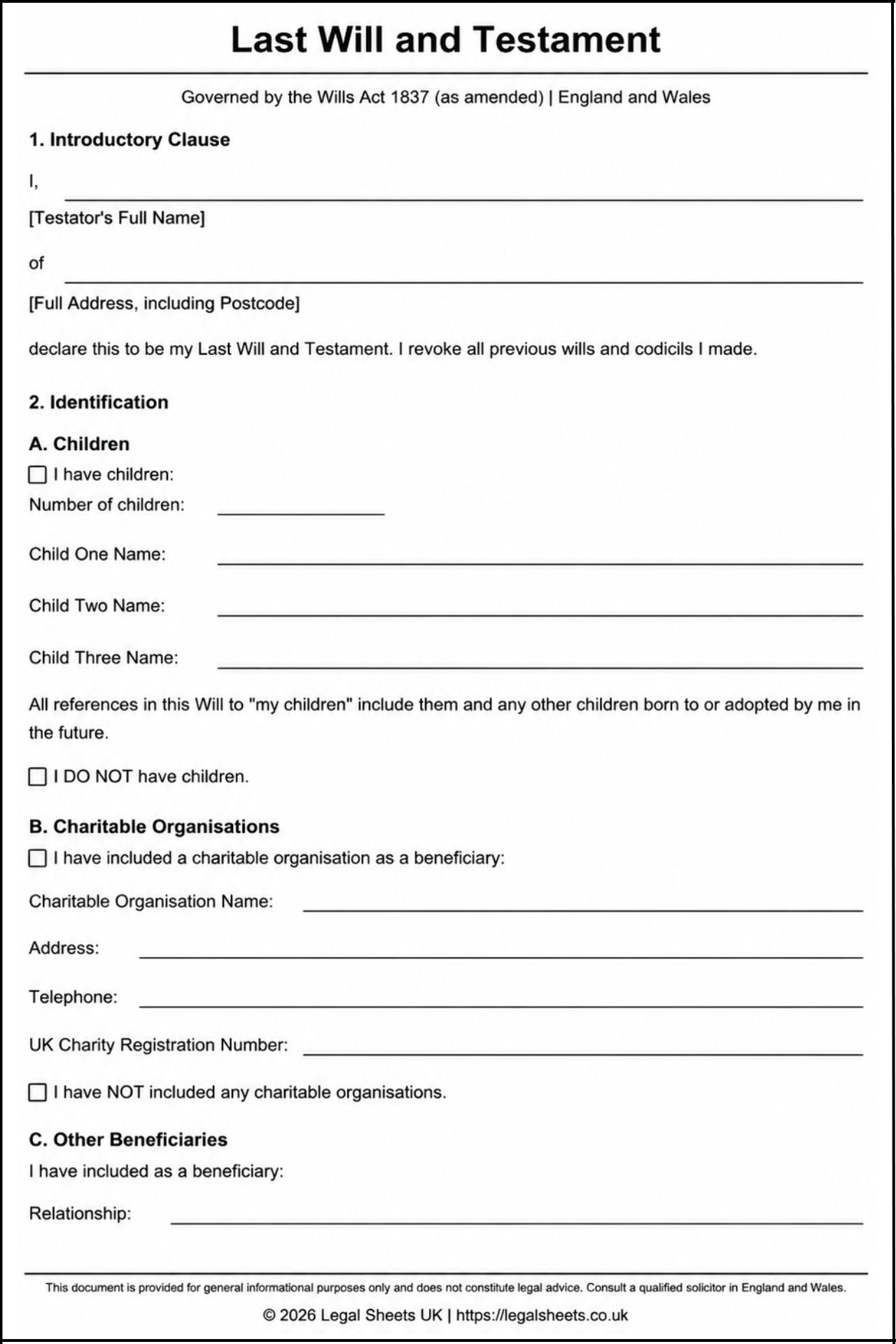
This template is suitable for many individuals who wish to create a straightforward legal will. It is commonly used by homeowners, parents, married couples, unmarried partners, and people who want greater control over how their estate is distributed.
A will becomes particularly valuable when there are specific gifts to be left, children who may require guardians, or family circumstances that do not fit traditional assumptions. Executors can also be appointed in advance, allowing trusted individuals to manage the estate administration process.
What This Will Template Covers
The template generally includes provisions dealing with executors, beneficiaries, gifts, guardianship appointments, and the distribution of the residuary estate. It also contains execution and witnessing sections necessary for legal validity.
One of the most important operational elements is the attestation clause. Although England does not require a prescribed will format, the absence of a proper attestation clause can create significant probate difficulties. Probate registries frequently scrutinise execution formalities when processing applications.
When This Template May Not Be Appropriate
A standard will template is not suitable for every estate. Complications often arise where the estate includes overseas property, substantial business interests, complex trust arrangements, or significant inheritance tax planning objectives.
In these situations, a generic will can unintentionally create ambiguity or fail to address practical administration issues. The result may be delays, increased costs, or litigation during probate.
Situations Where Legal Advice May Be Required
Certain circumstances regularly generate disputes even where a will appears valid on its face.
Examples include:
- Blended families
- Disinheritance of adult children
- Concerns about mental capacity
- Vulnerable beneficiaries
- Large estates
- Family business succession arrangements within partnerships
Where family members are likely to disagree with the proposed distribution, obtaining professional advice before execution often reduces the likelihood of challenges later from independent consultants.
Why Making a Will Early Prevents Costly Problems Later
Avoiding Intestacy Rules
Many people assume their assets will automatically pass according to their wishes if they die without a will. In reality, intestacy rules determine how the estate is distributed when no valid will exists.
This can produce outcomes that differ significantly from what the deceased intended. Unmarried partners are particularly vulnerable because assumptions about automatic inheritance frequently prove incorrect during estate administration.
Creating a will allows the testator to make personal decisions rather than relying on statutory default rules.
Deciding Who Controls Your Estate
The executor‘s role is often underestimated. Executors collect assets, settle liabilities, communicate with financial institutions, and oversee distribution of the estate including outstanding loans.
Without a valid appointment, administration can become more complicated. Selecting a reliable executor in advance allows the estate to be managed by someone familiar with the family’s circumstances and capable of handling administrative responsibilities.
Protecting Children and Dependants
Parents frequently focus on financial gifts while overlooking guardianship provisions.
A will allows parents to nominate guardians for minor children. Without clear instructions, difficult decisions may arise at an already stressful time. Guardianship appointments are therefore among the most important practical provisions contained within many wills.
Preventing Family Disputes
Probate litigation often begins with uncertainty rather than hostility.
Vague intentions, verbal promises, and inconsistent estate planning create opportunities for disagreement. A properly drafted will creates a written record of the testator’s wishes, reducing confusion and providing executors with a clear framework to follow.
Maintaining Control Over Specific Assets
Some individuals want particular assets to pass to specific beneficiaries. Family jewellery, heirlooms, collections, and sentimental possessions often become the subject of disagreement if they are not addressed clearly.
A will allows these gifts to be identified directly rather than leaving distribution decisions to executors or statutory rules.
Key Decisions to Make Before Completing a Will
Choosing Executors Who Can Realistically Act
Choosing an executor should involve more than selecting a close family member.
The role requires organisation, communication skills, and the willingness to deal with paperwork and financial institutions. In practice, disputes sometimes arise because an executor is unable or unwilling to perform their duties effectively.
Many people appoint substitute executors to address this risk.
Identifying Beneficiaries Clearly
Beneficiary descriptions should be precise.
Ambiguous wording can create uncertainty during probate, particularly where family members have similar names or where family circumstances change over time.
Clear identification reduces the risk of disputes and administrative complications.
Deciding How the Residuary Estate Will Be Distributed
After debts, taxes, and specific gifts have been dealt with, the remainder of the estate forms the residuary estate.
This clause often controls the largest portion of the estate. Errors within residuary provisions can create significant uncertainty and frequently become a focal point during probate disputes.
Appointing Guardians for Minor Children
Parents commonly view this as one of the most important sections of their will.
Guardians should be selected after careful consideration of their willingness, suitability, and ability to assume responsibility for children if required.
The Clauses That Matter Most in a Legally Effective Will
Revocation Clause
A revocation clause confirms that previous wills and testamentary documents are cancelled and replaced by the current will. Without clear revocation wording, confusion can arise if multiple versions of a will are discovered after death.
Executors frequently encounter situations where several signed documents exist, each containing different instructions. This creates uncertainty about which document reflects the deceased’s final intentions. A properly drafted revocation clause reduces the risk of competing documents causing delays during probate.
Appointment of Executors Clause
The executor clause identifies the individuals responsible for administering the estate. Their responsibilities typically include collecting assets, paying liabilities, applying for probate where necessary, and distributing the estate according to the will.
One common mistake is appointing someone solely because they are a close relative without considering whether they have the time, organisational skills, or willingness to perform the role. Probate administration can take many months and often involves extensive communication with banks, investment providers, insurers, and government agencies.
Many professionally drafted wills include substitute executors in case the primary appointment cannot act.
Guardian Appointment Clause
For parents of young children, this clause can be more important than the financial provisions within the will.
If both parents die while children are still minors, the guardian clause records who should assume responsibility for their care. Although courts always consider the welfare of the child, a properly drafted guardian appointment provides strong evidence of the parents’ wishes.
Disputes sometimes arise between family members when no guardian has been nominated. Clear appointments reduce uncertainty during difficult circumstances.
Specific Gifts Clause
Specific gifts deal with identifiable items or sums of money.
Examples include:
- Family jewellery
- Artwork
- Vehicles
- Collectables
- Fixed cash gifts
Problems commonly occur when the gifted item has already been sold or no longer exists at the time of death. Regular reviews help ensure these provisions remain accurate and practical.
Residuary Estate Clause
The residuary clause controls everything left after debts, taxes, expenses, and specific gifts have been dealt with.
In many estates, the residuary estate represents the largest portion of the overall value. Poorly drafted residuary clauses are a frequent source of litigation because they affect the ultimate distribution of substantial assets.
Executors often rely heavily on this clause when determining who receives the balance of the estate.
Simultaneous Death Provisions
Although rarely discussed, simultaneous death provisions can become important where family members die in the same incident or within a short period of one another.
These provisions help determine the order in which gifts should pass and reduce uncertainty during estate administration.
Attestation Clause
The attestation clause is one of the most important procedural elements within a will.
Although the Wills Act 1837 does not prescribe specific wording, the Non-Contentious Probate Rules 1987 effectively make a proper attestation clause essential for smooth probate administration.
The clause records that the testator signed the will in the presence of two witnesses and that the witnesses signed in the testator’s presence. If the clause is missing, the Probate Registry may require additional evidence before issuing a Grant of Probate.
In some cases, surviving witnesses may need to provide an Affidavit of Due Execution. If witnesses cannot be located, significant complications can arise.
Witnessing Requirements That Frequently Cause Probate Problems
Why Both Witnesses Must Be Present Together
One of the most misunderstood rules concerns the physical presence of witnesses.
Under Section 9 of the Wills Act 1837, the testator must sign or acknowledge their signature in the absolute, physical joint-presence of two independent witnesses. Crucially, the temporary pandemic-era legislation permitting video-witnessed wills formally expired in January 2024; remote, Zoom, or virtual witnessing is now strictly unlawful and will instantly void the document.
A surprisingly common mistake occurs when the testator signs with one witness present and then obtains a second signature later. Many people assume this is acceptable because two witnesses ultimately signed the document.
It is not.
Where the witnessing process is carried out separately, the entire will may be invalid.
Who Should Never Act as a Witness
Witnesses should be independent individuals who are not intended beneficiaries.
They should understand that their role is limited to witnessing execution rather than approving the contents of the will.
Using family members who may benefit from the estate frequently creates avoidable complications.
Beneficiary-Witness Mistakes and Their Consequences
Section 15 of the Wills Act 1837 contains a trap that catches many people.
Where a beneficiary acts as a witness, the will itself remains valid. However, the gift made to that witness becomes void.
The same risk applies to the witness’s spouse or civil partner.
This can completely undermine the testator’s intentions even though the remainder of the will remains enforceable.
Signing Errors That Can Invalidate the Entire Will
Probate disputes often focus on procedural failures rather than the contents of the document itself.
Examples include:
- Missing signatures
- Incorrect witnessing
- Witnesses not present together
- Unclear execution procedures
Courts and probate registries examine execution carefully because compliance with statutory formalities is fundamental to validity.
The Importance of Proper Attestation Wording
An attestation clause provides evidence that the will was executed correctly.
If the attestation clause is missing or defectively worded, the Probate Registry will flatly refuse the application under Rule 12 of the Non-Contentious Probate Rules 1987. The executors will be forced to track down the surviving witnesses and swear an ‘Affidavit of Due Execution’ to prove the signing formalities were properly followed This often causes delay, additional expense, and practical difficulties for executors.
Marriage, Civil Partnerships and Automatic Revocation Risks
How Marriage Can Cancel an Existing Will
Many people are surprised to discover that marriage can automatically revoke an existing will.
Under Sections 18 and 18B of the Wills Act 1837, a will is generally revoked when the testator marries or enters into a civil partnership.
This means a carefully drafted will can become ineffective immediately after the marriage takes place.
Using a Contemplation of Marriage Clause
There is an important exception.
A will may remain valid if it was specifically made in contemplation of marriage to a named individual and clearly states that it should not be revoked by that marriage.
The wording must identify the intended spouse or civil partner. Generic references are unlikely to achieve the intended result.
Risks Following Divorce or Dissolution
Changes in personal relationships should always trigger a review of estate planning arrangements.
Although many individuals focus on updating beneficiary provisions, executor appointments and guardianship clauses may also require reconsideration.
Failing to review a will following major life events often creates administrative complications later.
When an Existing Will Should Be Replaced
Common review points include:
- Marriage
- Civil partnership
- Divorce
- Birth of children
- Death of beneficiaries
- Significant changes in assets
A will should evolve alongside major changes in family and financial circumstances.
Testamentary Capacity and Validity Concerns
Understanding the Banks v Goodfellow Test
A valid will requires testamentary capacity.
The common law test established in Banks v Goodfellow remains the leading authority when assessing whether a person understood the nature and effect of making a will.
Capacity disputes are among the most common grounds for challenging testamentary documents.
Capacity Issues Commonly Raised During Probate
Concerns often arise where the deceased suffered from:
- Dementia
- Cognitive impairment
- Serious illness
- Mental health conditions
Family members may question whether the deceased fully understood the consequences of their decisions when the will was signed.
Additional Safeguards for Elderly or Vulnerable Testators
Where vulnerability exists, additional evidence can significantly strengthen the will’s defensibility.
Professional attendance notes and independent assessments often become important if the will is later challenged.
Many contentious probate disputes focus heavily on what evidence exists regarding the testator’s state of mind at the time of execution.
The Golden Rule and Medical Evidence
In practice, solicitors frequently follow the Golden Rule when preparing wills for elderly or vulnerable clients.
This involves obtaining medical evidence regarding capacity before execution.
Where disputes later arise, the absence of such evidence can become a significant issue. Challenges may lead to requests for attendance notes and supporting documentation, particularly where family members allege lack of capacity or undue influence.
Changes, Amendments and Updating an Existing Will
When a New Will Is Preferable to Amendments
Major changes are often best dealt with through a completely new will.
Creating a fresh document usually reduces ambiguity and avoids questions about which provisions remain effective.
Risks of Handwritten Alterations
Handwritten amendments frequently cause problems.
Under Section 21 of the Wills Act 1837, alterations made after execution must comply with appropriate formalities. Simply crossing out a name or changing a figure with a pen does not necessarily change the legal effect of the document.
If the original wording remains visible, it may continue to apply despite the attempted alteration.
Executing Amendments Correctly
Changes should be carried out using proper legal procedures.
Failure to do so may result in the amendment being ignored entirely, leaving the original wording in force.
Keeping Older Versions Under Control
Old wills regularly appear during probate investigations.
Where multiple versions exist, executors must determine which document represents the final valid will.
Destroying superseded versions and maintaining clear records can reduce uncertainty and minimise the risk of disputes.
Common Reasons Wills Are Challenged After Death
Allegations of Undue Influence
Not every challenge focuses on technical drafting errors. In many contentious probate disputes, family members claim that the deceased was pressured into making decisions they would not otherwise have made.
These allegations commonly arise where a beneficiary had substantial involvement in arranging the will, attending meetings, or communicating instructions on behalf of the testator. Suspicion often increases when a new will significantly changes earlier estate arrangements or unexpectedly excludes close relatives.
Undue influence claims can be difficult to prove, but they remain a common feature of probate litigation.
Claims of Lack of Capacity
Capacity disputes frequently arise when the deceased suffered from dementia, cognitive decline, or serious illness before signing the will.
Family members may argue that the testator did not fully understand the nature of the document, the extent of their assets, or the consequences of their decisions. Courts examine medical evidence, witness accounts, professional attendance notes, and surrounding circumstances when assessing these challenges.
Fraud and Forgery Allegations
Forgery allegations can result in lengthy and expensive litigation.
Challenges may involve disputed signatures, concerns about document alterations, or claims that the will presented for probate was never genuinely approved by the deceased. Executors facing these allegations often need to obtain handwriting evidence and supporting witness testimony.
Suspicious Circumstances Around Execution
Even where there is no direct allegation of fraud, unusual circumstances surrounding execution can attract scrutiny.
Examples include:
- Last-minute changes before death
- Isolated execution arrangements
- Missing witnesses
- Unusual beneficiary appointments
- Significant departures from earlier wills
Where concerns exist, courts may examine the surrounding evidence carefully before accepting the validity of the document.
Family Disputes Over Estate Distribution
Many probate disputes are driven by perceived unfairness rather than legal defects.
Adult children, former spouses, dependants, and other relatives may challenge distributions they believe are unreasonable. These disagreements often become more serious when communication during the deceased’s lifetime was limited or where expectations were created through verbal promises.
Inheritance Act Claims and Disinherited Family Members
Who Can Bring a Claim Against an Estate
A will can be valid yet still face legal challenges.
Under the Inheritance (Provision for Family and Dependants) Act 1975, certain individuals may seek reasonable financial provision from the estate. These claims do not necessarily attack the validity of the will itself. Instead, they focus on whether adequate provision has been made.
What Courts Consider Reasonable Financial Provision
The court considers the specific circumstances of each case.
The court applies two vastly different tests under the 1975 Act. Spouses and civil partners are judged on the ‘surviving spouse standard’, entitling them to a fair share of the marital assets regardless of financial need. Conversely, adult children and other dependents face the much harsher ‘maintenance standard’, meaning the court will only award them what is strictly necessary for their everyday living expenses
Risks of Excluding a Spouse or Civil Partner
Some testators assume complete freedom to exclude anyone they choose from their will.
In practice, disinheriting a spouse or civil partner creates significant litigation risk. Such claims can substantially alter how the estate is ultimately distributed.
Executors may face lengthy delays while disputes are resolved through negotiation or court proceedings.
Claims Involving Children and Dependants
Claims involving children, financially dependent individuals, and vulnerable family members frequently arise where the deceased assumed that a simple exclusion clause would prevent future disputes.
While the will may remain legally valid, the court has authority to consider whether additional provision should be made from the estate.
Probate Delays and Estate Administration Issues
When Probate Is Usually Required
Following death, the original will may need to be submitted to the Probate Registry alongside a probate application. The official probate application process is explained on the GOV.UK probate guidance.
Probate is commonly required where the estate contains land, property, investments, or financial assets exceeding institutional probate thresholds. Without the necessary authority, executors may be unable to access or transfer estate assets.
Caveats That Freeze Probate Applications
One of the most effective methods of delaying estate administration is the filing of a caveat.
By lodging a formal caveat with the Probate Registry for a nominal fee, a disgruntled party throws up an absolute legal blockade. This instantly freezes the issuance of the Grant of Probate for exactly six months. Because caveats can be continuously renewed, they are frequently used as a tactical weapon to completely halt estate administration during bitter family disputes
Families are often surprised by how quickly estate administration can come to a standstill once a caveat has been lodged.
Missing Original Wills
A missing original will can create significant problems.
You cannot easily obtain a Grant of Probate using a photocopy. Under English common law, if the original will was last kept in the testator’s possession but cannot be found after they die, the Probate Registry applies a strict legal presumption that the testator deliberately destroyed the document to revoke it (animo revocandi). Rebutting this presumption requires costly, complex sworn affidavits
Locating the original will is therefore a practical issue that should never be overlooked.
Executor Disputes
Executors do not always agree during business distribution.
Disagreements can arise regarding asset valuations, estate administration decisions, property sales, and the interpretation of will provisions. Where relationships break down, administration costs often increase and beneficiaries may experience substantial delays.
Probate Registry Concerns About Execution
The Probate Registry regularly reviews execution formalities.
Missing attestation clauses, unclear witness information, and procedural irregularities can trigger requests for additional evidence. Executors may need to obtain statements from surviving witnesses before probate can proceed.
These delays often occur years after execution, when witnesses may be difficult to locate.
Storing a Will Safely and Ensuring It Can Be Found
Home Storage Risks
Many wills are stored at home, but this creates obvious risks.
Documents can be lost, damaged, destroyed, or overlooked entirely. Executors may spend considerable time searching for the original will after death, particularly where family members are unsure where important documents were kept.
Solicitor Storage Arrangements
Professional storage arrangements often provide greater security through legal service providers.
Solicitors commonly retain original wills and maintain records identifying their location. This can simplify the process of locating the document when probate becomes necessary for family businesses.
Private Will Registration Services
Although registration is not legally required, some individuals choose to record the existence and storage location of their will with private registration services.
These arrangements do not affect validity but may assist executors when attempting to locate the document after death.
Informing Executors About the Will’s Location
Even the most carefully drafted will is of limited value if nobody knows where it is stored.
Executors should understand where the original document is located and how it can be accessed when required.
UK Legal Requirements Affecting a Last Will And Testament
Legal Requirements Table
| Topic / Issue | Precise English Legal Rule | Governing Statute / Administrative Regulation |
| Execution Formalities | A will must be in writing, signed by the testator, and fully executed in the joint, physical presence of two independent witnesses. | Wills Act 1837 (Section 9) |
| Beneficiary-Witness Trap | If a beneficiary (or their spouse/civil partner) acts as a witness, the will itself survives, but their specific inheritance is completely voided. | Wills Act 1837 (Section 15) |
| Revocation by Marriage | Entering into a marriage or civil partnership automatically revokes an existing will, unless the document explicitly names the intended spouse in a contemplation clause. | Wills Act 1837 (Sections 18 & 18B) |
| Attestation Clause | Wills lacking a formal attestation clause verifying proper execution will be rejected by the Probate Registry until an Affidavit of Due Execution is sworn. | Non-Contentious Probate Rules 1987 (Rule 12) |
| Unexecuted Alterations | Handwritten amendments or cross-outs made after the will is signed are legally ignored unless they are formally re-signed and re-witnessed. | Wills Act 1837 (Section 21) |
| Dependant Provision Claims | Spouses, cohabitees, and financial dependents can sue the estate for “reasonable financial provision” if they are unfairly disinherited. | Inheritance (Provision for Family and Dependants) Act 1975 |
Practical Legal Impact
Execution formalities remain one of the most important aspects of will validity. Many probate disputes do not arise because of poor drafting but because witnessing requirements were not followed correctly.
Missing attestation clauses can delay probate and require additional evidence from witnesses. Beneficiary-witness mistakes can unexpectedly void gifts, while marriage can revoke an otherwise valid will entirely.
Dependants may still bring claims against the estate even when the will itself is valid. Capacity concerns, particularly involving elderly or vulnerable testators, continue to be one of the most heavily litigated areas of contentious probate.
For these reasons, careful execution, regular review, and proper storage are often just as important as the wording contained within the will itself.
Documents Commonly Used Alongside a Will
Lasting Power of Attorney
A Lasting Power of Attorney operates during a person’s lifetime and allows trusted individuals to make decisions if capacity is lost. It serves a very different purpose from a will, which only takes effect after death.
Letter of Wishes
A Letter of Wishes can provide additional guidance to executors without forming part of the legally binding will itself.
Trust Documents
Some estates require separate trust arrangements to manage assets for beneficiaries or address specific family circumstances.
Funeral Wishes Statement
Funeral wishes are commonly recorded separately to provide guidance regarding burial, cremation, and related arrangements.
Probate Application Documents
Where probate is required, executors may need supporting documentation alongside the original will to complete the administration process.
Frequently Asked Questions
Is a Will Valid if One Witness Signed at a Different Time From the Other Witness?
No. Under Section 9 of the Wills Act 1837, both witnesses must be physically present at the same time when the testator signs or acknowledges their signature. Separate witnessing can invalidate the entire will.
What Happens if a Beneficiary Witnesses My Will?
The will may remain valid, but any gift made to that witness can become void under Section 15 of the Wills Act 1837. The same rule generally applies to the witness’s spouse or civil partner.
Does Getting Married Automatically Cancel an Existing Will?
In most cases, yes. Marriage or civil partnership generally revokes an existing will unless it was specifically made in contemplation of that particular marriage or civil partnership.
Can a Child or Dependant Challenge a Will After Death?
Yes. Certain individuals may bring claims under the Inheritance (Provision for Family and Dependants) Act 1975 if they believe reasonable financial provision has not been made.
What Happens if the Original Signed Will Cannot Be Located?
Missing originals often create serious probate difficulties. Executors may need to provide additional evidence, and disputes can arise regarding whether the will was revoked before death.