
Prenuptial Agreement Template UK – PDF & Word Format
Many couples start looking for a Prenuptial Agreement when there are family assets, a business, or children from an earlier relationship to think about long before the wedding day. In England, the agreement carries far more weight if it’s prepared carefully rather than treated as a last-minute formality, because the Family Court still exercises its discretion under section 25 of the Matrimonial Causes Act 1973 when deciding financial arrangements after divorce.
A recurring problem in practice is an agreement signed without proper financial disclosure or independent legal advice, leaving one party arguing that it should carry little weight when the court reviews the circumstances. The template and accompanying wording here are designed around the approach taken by the English courts, with practical guidance on completing and signing the agreement in a way that reflects current legal practice.
Prenuptial Agreement Template (PDF, Word & Printable Formats)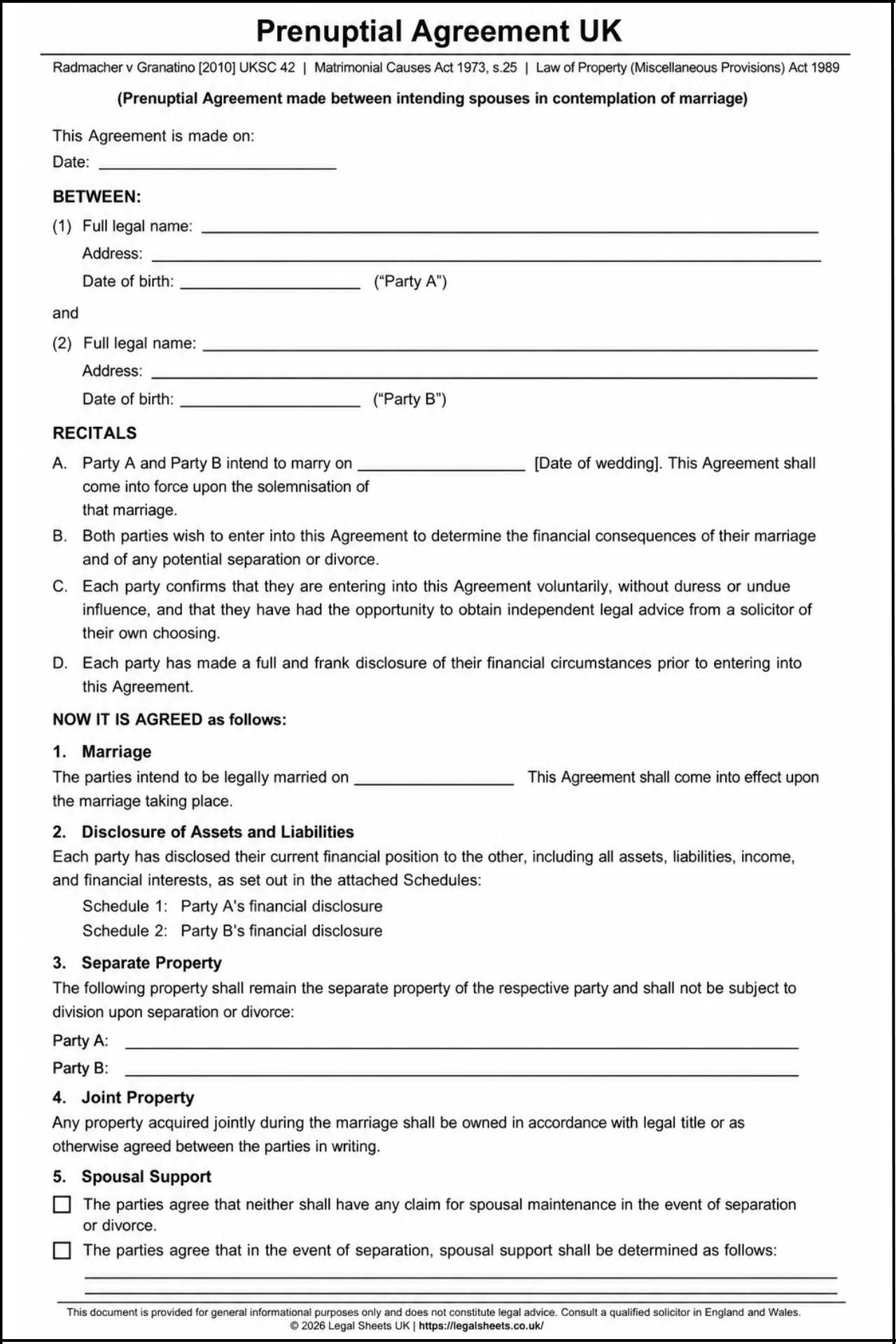
Situations Where a Prenuptial Agreement Is Commonly Used
Protecting Property Owned Before Marriage
Many people enter marriage already owning a house, investment property or valuable personal assets. Without clear documentation, disputes may later arise over whether those assets should remain separate or form part of the overall financial settlement. A properly prepared premarital agreement allows each person’s existing property to be clearly identified before the marriage begins.
Safeguarding Family Businesses
Business owners frequently use a prenup agreement to reduce uncertainty if the marriage later breaks down under consultancy arrangements. Even where one spouse established the business long before the relationship, questions may arise regarding future growth in value or indirect contributions during the marriage. Recording intentions early can make later discussions considerably clearer.
Preserving Inheritance and Gifts
Parents and grandparents sometimes transfer significant wealth through inheritance or lifetime gifts. A Prenuptial Agreement can record how inherited assets are intended to be treated, although the Family Court will always consider fairness when determining financial remedies.
Managing Existing Debts
Marriage does not automatically transfer responsibility for personal debts. Nevertheless, financial disputes frequently become more complicated when liabilities are not identified before marriage. Listing loans, credit facilities and other obligations creates a more accurate financial picture before the agreement is signed.
Supporting Second Marriages
Second marriages often involve more complex financial arrangements than first marriages. Existing property ownership, maintenance obligations and children from earlier relationships commonly require additional planning before marriage.
Providing Financial Certainty Before Marriage
Rather than waiting until problems arise years later, many couples prefer to discuss financial expectations while the relationship is positive. Recording those intentions before marriage often leads to clearer expectations throughout the relationship.
How Prenuptial Agreements Are Treated Under English Law
Matrimonial Causes Act 1973 and Section 25
Under English law, prenuptial agreements are not strictly legally binding contracts that automatically oust the jurisdiction of the court. Under Section 25 of the Matrimonial Causes Act 1973, the Family Court retains absolute statutory discretion over financial settlements on divorce. However, following the landmark Radmacher v Granatino Supreme Court ruling, the court will give ‘decisive weight’ to the agreement unless it creates a fundamentally unfair outcome or fails to meet a party’s basic needs.
The Impact of Radmacher v Granatino [2010]
The legal approach changed significantly following the Supreme Court decision in Radmacher v Granatino. The court confirmed that considerable weight may be given to a prenuptial agreement where it was entered into freely, with a full appreciation of its implications, provided it would not be unfair to hold the parties to its terms.
Why the Family Court Retains Discretion
Every marriage develops differently. Circumstances that seemed entirely reasonable before the wedding may become unsuitable after many years, particularly where children are born or one spouse gives up employment to care for the family. For that reason, English courts retain discretion to examine whether applying the agreement remains fair at the time of divorce.
Why Fairness Always Remains Central
Fairness is often the deciding factor. An agreement attempting to leave one spouse without adequate financial provision after a lengthy marriage may receive little weight, regardless of how carefully it was drafted. The court will examine the overall outcome rather than focusing solely on the wording.
What Can Be Included in a Prenuptial Agreement
Property Owned Before Marriage
Existing homes, investment properties and other valuable assets can be listed together with ownership details and intended treatment during any future financial settlement.
Savings and Investments
Savings accounts, investment portfolios, shares and other financial holdings are commonly disclosed to provide a complete picture of each person’s financial position before marriage.
Business Interests
Company shares, partnerships and ownership interests may be identified together with any agreed arrangements concerning future ownership.
Pension Arrangements
Pensions frequently represent one of the largest financial assets accumulated before marriage. Recording existing pension interests assists both parties in understanding their overall financial positions.
Future Inheritances
Although future inheritances cannot always be predicted, many couples record their intentions regarding inherited wealth should it later be received.
Debts and Financial Responsibilities
Loans, mortgages, personal borrowing and other liabilities should be disclosed to avoid later allegations that important financial information was withheld before signing.
Jointly Acquired Property
Many couples distinguish between property owned before marriage and assets purchased together afterwards. Recording this distinction can assist if future financial issues arise.
Review Arrangements
Including a review clause acknowledges that financial circumstances may change over time. Periodic reviews following significant life events, such as the birth of children or substantial changes in wealth, may help demonstrate that the agreement continued to reflect the couple’s intentions.
Matters That Cannot Be Controlled by a Prenuptial Agreement
Child Maintenance
Parents cannot remove their legal responsibilities towards their children through a marriage agreement. Financial obligations relating to children remain subject to the applicable legal framework.
Children’s Living Arrangements
Future arrangements concerning where children live or how parental responsibility is exercised cannot be predetermined by a Prenuptial Agreement.
Parenting Responsibilities
Parental responsibilities are always considered separately from financial arrangements between spouses.
Financial Orders Required by the Court
The Family Court retains authority to make financial orders during divorce proceedings where appropriate. A Prenuptial Agreement cannot prevent the court from exercising its statutory powers.
Essential Legal Requirements Before Signing
Full Financial Disclosure
One of the most common reasons agreements receive reduced weight is incomplete financial disclosure. Both parties should exchange full and frank information regarding assets, liabilities, income and financial commitments before signing. Without complete disclosure, it becomes difficult to demonstrate that each person fully understood the financial implications of the agreement.
Independent Legal Advice
To satisfy theRadmacher requirement that both parties possessed a ‘full appreciation’ of the rights they were waiving, obtaining Independent Legal Advice (ILA) from separate, qualified English family law solicitors is practically compulsory. The final agreement must include appended certificates signed by each solicitor confirming the legal implications were fully explained.
Voluntary Agreement
The agreement should always be entered into voluntarily. Pressure shortly before the wedding may later result in allegations of duress or undue influence, reducing the significance the court gives to the document.
Execution as a Deed
Because a Prenuptial Agreement may lack contractual consideration, it is generally executed as a deed. This requires each signature to be witnessed independently in accordance with the Law of Property (Miscellaneous Provisions) Act 1989.
Independent Witness Requirements
Each signature should be witnessed by an independent adult who is physically present during execution. Proper witnessing strengthens the evidence that the agreement was signed correctly.
Why Signing at Least 28 Days Before the Wedding Is Recommended
To defeat claims of duress or undue pressure, it is standard legal practice—mirroring the Law Commission’s guidance and the Ministry of Justice’s June 2026 ‘qualifying nuptial agreement’ consultation proposals—that a prenuptial agreement must be finalized and signed no less than 28 days before the wedding ceremony. Signing closer to the date severely compromises the agreement’s enforceability.
Information Needed Before Preparing the Agreement
Preparing the document is considerably easier when financial information has already been gathered. Couples commonly collect:
- Full names and personal details
- Details of existing property ownership
- Bank accounts and investments
- Business ownership information
- Pension details
- Outstanding loans and liabilities under loan agreements
- Expected inheritances where appropriate
- Supporting financial documents
Accurate disclosure supports the principle established in Radmacher that each person should have a full appreciation of the agreement’s implications before signing.
Step-by-Step Process for Completing a Prenuptial Agreement
Gather Financial Information
Prepare a complete record of assets, liabilities, income and financial commitments before drafting begins.
Exchange Financial Disclosure
Both individuals should exchange complete financial information to allow informed discussions about the proposed terms.
Negotiate the Terms
The agreement should reflect genuine discussion rather than unilateral drafting. Financial expectations are usually easier to address before the wedding than after marital difficulties develop.
Obtain Independent Legal Advice
Each person should consult their own qualified family law solicitor before signing.
Finalise the Draft
Once disclosure has been completed and advice obtained, the wording can be reviewed and agreed.
Execute the Agreement as a Deed
Signatures should be witnessed correctly so the document is executed as a deed.
Store the Signed Agreement Safely
After execution, each person should retain an original signed copy together with supporting disclosure schedules and certificates of independent legal advice. These documents may become important evidence if the agreement is ever considered during future Family Court proceedings.
Common Clauses Included in a Prenuptial Agreement
Every prenuptial agreement should reflect the couple’s financial circumstances rather than relying on generic wording. Well-drafted clauses identify assets clearly, explain how they should be treated if the marriage ends, and anticipate future changes that could affect the fairness of the agreement. While the Family Court retains discretion during financial remedy proceedings, carefully considered clauses supported by full financial disclosure and independent legal advice are generally given greater weight.
Separate Property Clause
This clause identifies assets that each person owned before the marriage and confirms the intention that those assets should remain separate if the relationship later breaks down. Typical examples include property, savings, investments, businesses and valuable personal possessions acquired before the wedding. Clear identification reduces uncertainty if questions later arise about ownership.
Matrimonial Property Clause
Many couples distinguish between property brought into the marriage and assets acquired together afterwards. This clause explains how jointly accumulated assets may be treated, recognising that contributions often change over the course of a marriage.
Debt Responsibility Clause
Existing personal debts should be identified together with responsibility for repayment. Mortgages, personal loans, credit card balances and business liabilities are commonly included. Recording financial obligations before marriage makes it easier to demonstrate that both individuals fully understood each other’s financial position before signing.
Business Protection Clause
Where one person owns a company, partnership or professional practice, this clause records how that interest should be treated during any future financial settlement. Business owners often wish to minimise uncertainty regarding ownership and control if the marriage later ends.
Inheritance Protection Clause
Inherited assets are frequently treated differently from wealth accumulated during the marriage. This clause records the parties’ intentions regarding existing or future inheritances while recognising that the court may still consider fairness under the circumstances existing at the time of divorce.
Pension Provision Clause
Pensions often represent one of the largest financial assets accumulated before marriage. Including pension arrangements allows both individuals to understand the overall financial position and acknowledge existing retirement savings before entering into marriage.
Confidentiality Clause
Some couples prefer to keep the contents of their marriage agreement confidential. A confidentiality clause can record that financial information and the agreement itself should not be disclosed unnecessarily, subject to legal requirements if the document is later considered by the Family Court.
Review Clause
Financial circumstances rarely remain unchanged throughout a marriage. A review clause allows the agreement to be reconsidered after significant events such as the birth of a child, major business growth, receipt of an inheritance or a substantial change in financial circumstances. Agreements that remain unchanged for decades despite significant life events may receive less weight if they no longer produce a fair outcome.
Severability Clause
If one provision later becomes ineffective or is given little weight by the court, a severability clause records that the remaining parts of the agreement should continue wherever possible.
Governing Law Clause
This clause confirms that the agreement has been prepared according to the law applicable in England and reflects the legal principles governing financial remedies following divorce.
Common Drafting Mistakes That Can Reduce the Weight of a Prenuptial Agreement
Many challenges arise because of the way a prenuptial agreement was prepared rather than the wording itself. In Family Court proceedings, judges frequently examine the circumstances surrounding execution as closely as the document’s contents.
Signing Too Close to the Wedding
Presenting the final agreement only a few days before the ceremony creates a significant risk that one person may later argue they signed under pressure. Although there is no statutory deadline, agreements signed at least 28 days before the wedding are generally less vulnerable to allegations of duress.
Incomplete Financial Disclosure
Failing to disclose all assets, liabilities, income or investments may seriously undermine the agreement. Material non-disclosure prevents the other person from fully appreciating the financial implications of the arrangement and can result in the agreement carrying little or no weight during divorce proceedings.
Using the Same Solicitor
Independent legal advice is intended to demonstrate that each individual understood the legal consequences of signing the agreement. Separate solicitors reduce the likelihood of later arguments that advice was inadequate or influenced by conflicting interests.
Failing to Execute the Agreement as a Deed
A prenuptial agreement should generally be executed as a deed, requiring each signature to be witnessed independently. Incorrect execution may weaken the evidential value of the document if it is later scrutinised by the Family Court.
Including Unfair Financial Terms
Under Section 25 of the Matrimonial Causes Act 1973, an agreement that attempts to leave the financially weaker spouse destitute or fails to provide for their basic housing and income needs will be struck down as unfair. The Family Court will ruthlessly override the prenup’s strict terms to ensure the fundamental ‘needs’ of the weaker spouse and any children are met.
Ignoring Future Children
Children frequently change financial priorities. Agreements that fail to acknowledge the possibility of future children may become less appropriate as family circumstances develop.
Never Reviewing the Agreement
A document signed many years before divorce may no longer reflect reality. Reviewing the agreement after major life events demonstrates that it continued to represent the parties’ intentions as their circumstances evolved.
What Happens If the Agreement Is Challenged During Divorce
A Prenuptial Agreement does not automatically determine the outcome of financial remedy proceedings. Instead, it becomes one factor considered by the Family Court alongside the wider circumstances of the marriage.
How the Family Court Assesses the Agreement
Because prenuptial agreements cannot be enforced via standard breach-of-contract claims in the civil courts, a spouse wishing to enforce the prenup during divorce must apply for a ‘Notice to Show Cause’ within Financial Remedy Proceedings. The Family Court judge will then demand the challenging spouse prove why they should not be strictly held to the terms they signed, applying theRadmacher fairness test.
Factors the Court Considers
Relevant considerations include full financial disclosure, independent legal advice, voluntary execution, fairness of the outcome, changes in financial circumstances and the needs of any children.
Circumstances That May Reduce Its Weight
The agreement may receive less weight where there was material non-disclosure, inadequate legal advice, pressure before the wedding or significant changes in circumstances that make the original terms unfair.
When the Court Is More Likely to Uphold It
The agreement is generally more persuasive where it was prepared well before the wedding, executed correctly as a deed, supported by full disclosure, accompanied by separate legal advice and reviewed following major life changes.
Reviewing and Updating a Prenuptial Agreement
Regular reviews demonstrate that the agreement continues to reflect the couple’s intentions rather than becoming outdated.
After the Birth of a Child
The arrival of children may alter financial priorities, housing needs and long-term planning.
Significant Changes in Wealth
Substantial increases or decreases in personal wealth may justify updating financial arrangements.
Business Expansion of family companies
Growth in the value of a business may require revised provisions concerning ownership and future financial expectations.
Receiving a Large Inheritance
A significant inheritance may justify reviewing how inherited assets should be treated.
Long Marriages
As marriages continue over many years, circumstances often change considerably from those existing before the wedding.
Moving to Another Jurisdiction
If the couple later relocate, local legal advice may be appropriate because different jurisdictions may treat prenuptial agreements differently.
Prenuptial Agreement vs Similar Legal Documents
Prenuptial Agreement vs Postnuptial Agreement
A prenuptial agreement is signed before marriage, whereas a postnuptial agreement is entered into after the wedding. Both address financial arrangements, but the timing differs.
Prenuptial Agreement vs Cohabitation Agreement
A cohabitation agreement is intended for couples who live together without marrying, while a prenuptial agreement is prepared in anticipation of marriage.
Prenuptial Agreement vs Separation Agreement
A separation agreement is created after a relationship has broken down to address existing issues. A prenuptial agreement is preventative and prepared before marriage.
Prenuptial Agreement vs Declaration of Trust
A declaration of trust records beneficial ownership of specific property, whereas a prenuptial agreement addresses wider financial arrangements that may arise during marriage and divorce.
UK Legal Requirements
Legal Requirements Table
| Topic / Issue | Precise English Legal Rule | Governing Statute / Precedent |
| Legal Status & Discretion | Prenuptial agreements are not strictly binding; the Family Court retains absolute statutory discretion over financial distribution but gives agreements decisive weight if fair. | Matrimonial Causes Act 1973 (Section 25) / Radmacher v Granatino [2010] UKSC 42 |
| Execution Formalities | As prenups lack contractual “consideration,” they must be executed strictly as a deed, requiring the physical presence of independent witnesses for each signature. | Law of Property (Miscellaneous Provisions) Act 1989 (Section 1) |
| Financial Disclosure | Both parties must provide full, frank, and material disclosure of all assets, liabilities, and income prior to execution. Material concealment vitiates the agreement. | Radmacher v Granatino [2010] UKSC 42 |
| Independent Legal Advice | Both parties must receive independent legal advice from separate qualified solicitors to ensure a “full appreciation” of the agreement’s implications. | Common Law |
| Child Provision Limits | Spouses cannot lawfully contract out of their financial obligations to provide for the housing, maintenance, and basic needs of any children of the family. | Matrimonial Causes Act 1973 / Children Act 1989 |
| Timing (Cooling-off Period) | To avoid fatal claims of undue pressure, the agreement must be signed no less than 28 days before the wedding ceremony. | Common Law |
Practical Legal Impact
A prenuptial agreement remains a private document and does not need to be registered with any government authority when signed. It usually comes before the Family Court only if divorce proceedings lead to a financial remedy application. At that stage, the court examines not only the wording of the agreement but also how it was prepared, whether proper disclosure was given, whether each person received independent legal advice and whether enforcing the agreement remains fair in light of current circumstances. Careful preparation and periodic review generally place the agreement in a stronger position than documents completed hastily or without appropriate safeguards.
Frequently Asked Questions
Is a Prenuptial Agreement legally binding in England?
No. It is not automatically legally binding, but the Family Court may give it significant weight if it was entered into freely, with full appreciation of its implications, and it would be fair to uphold its terms.
How far in advance of the wedding should a Prenuptial Agreement be signed?
Although there is no statutory deadline, best practice is to sign the agreement at least 28 days before the wedding to reduce the likelihood of later claims of pressure or duress.
Can a judge refuse to follow a Prenuptial Agreement?
Yes. The Family Court retains discretion under Section 25 of the Matrimonial Causes Act 1973 and may depart from the agreement if enforcing it would be unfair.
Do both people need separate solicitors?
Separate independent legal advice is strongly recommended because it demonstrates that each person understood the legal consequences of signing the agreement.
Can a Prenuptial Agreement protect future inheritances?
It can record the parties’ intentions regarding future inheritances, although the court will still consider fairness when deciding financial remedies.
What happens if one person hides assets before signing?
Material non-disclosure can significantly reduce the weight given to the agreement because the other person cannot be said to have fully appreciated its financial implications.
Can the agreement be changed after marriage?
Yes. Couples may review their financial arrangements after marriage and, where appropriate, enter into a postnuptial agreement reflecting their updated circumstances.
Is the agreement registered with any government authority?
No. A prenuptial agreement is a private document and is not filed with HM Land Registry, Companies House or another government body when executed.