
Grievance Letter UK – Free PDF & Editable Template
A Grievance Letter is often written after informal conversations have failed, when an employee needs to place their concerns on record before workplace relationships deteriorate further. One of the most common problems is sending a complaint that describes frustration rather than clearly identifying the events being challenged, making it harder for the employer to investigate under the ACAS Code of Practice on Disciplinary and Grievance Procedures.
If the dispute later reaches an Employment Tribunal in England, the grievance correspondence frequently becomes part of the evidence considered when reviewing how the matter was handled by everyone involved. The template and example wording that follow are intended to help you present your concerns clearly, request an appropriate outcome and prepare a grievance letter that reflects the circumstances of your workplace complaint.
Grievance Letter Template (PDF, Word & Printable Formats)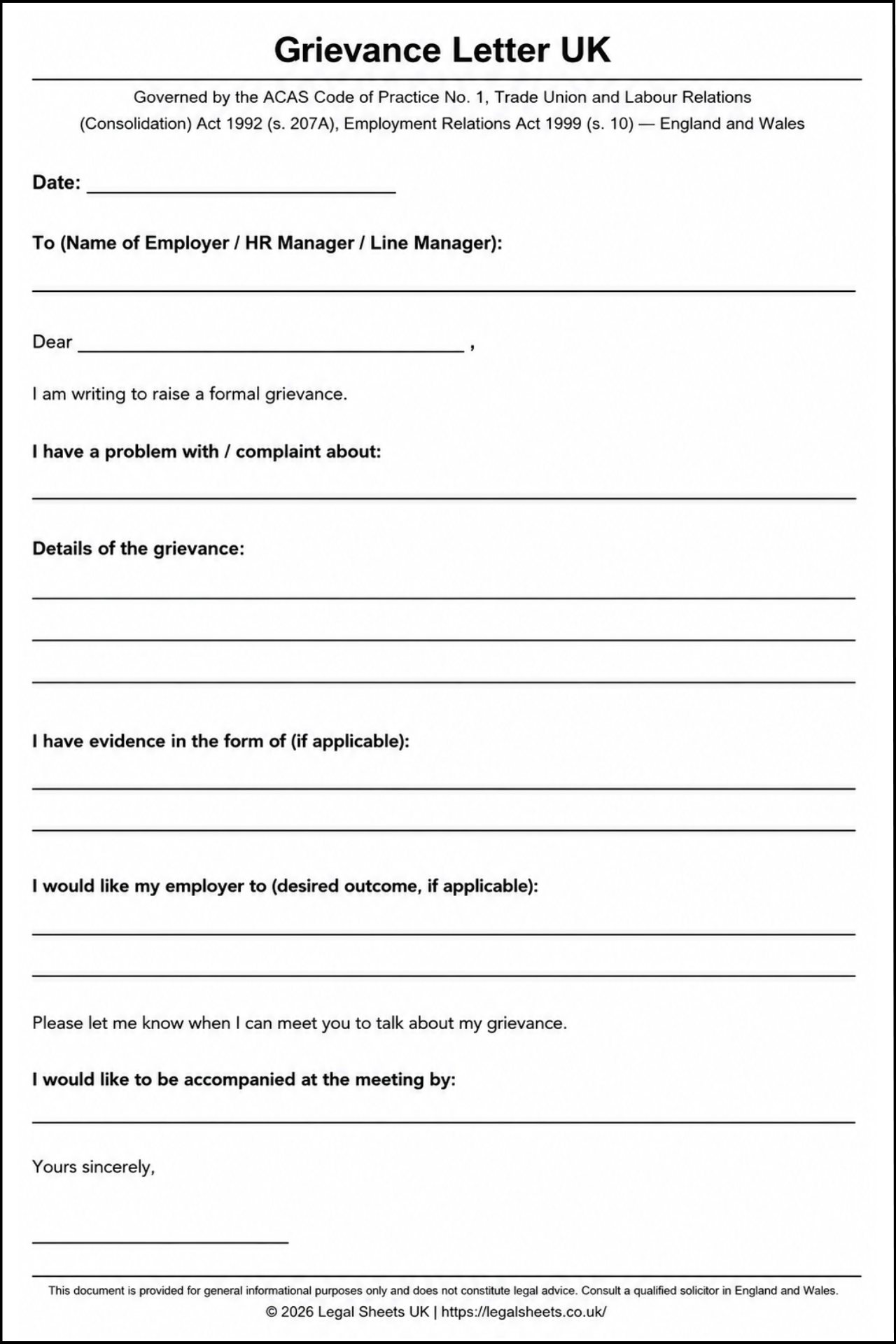
Before Sending a Grievance Letter: The Decisions That Can Affect a Future Tribunal Claim
Many employees focus on writing the letter itself and overlook the decisions that should be made before it is sent. Those early decisions often have a greater impact on future disputes than the wording used in the document.
Is the Issue a Grievance or Something Else?
Not every workplace concern should be dealt with through a formal grievance procedure.
Employees frequently confuse:
- Informal workplace concerns
- Disciplinary issues
- Performance management disputes
- Whistleblowing disclosures
- Discrimination complaints
- Formal grievances
The distinction matters because different procedures may apply.
For example, a concern about wider wrongdoing affecting the organisation may potentially engage whistleblowing protections, whereas a complaint about personal treatment by a manager may remain a standard grievance issue.
Understanding the nature of the complaint before drafting the letter reduces the risk of using the wrong process.
When Delaying the Complaint Can Damage Your Position
One of the most common mistakes is waiting too long before raising a formal grievance.
Where an employee believes there has been a serious breach of trust, severe bullying, unlawful treatment, or another significant workplace issue, continuing to work for an extended period without formally raising concerns can create difficulties later.
The verified legal facts identify the doctrine of affirmation of contract as a significant risk. Employees who delay for months while continuing to work normally may later struggle to argue that the employer’s conduct was so serious that it justified resignation.
Timing frequently becomes an important issue in tribunal proceedings. A grievance raised promptly is often viewed differently from one raised only after a relationship has completely broken down.
Gathering Evidence Before Writing
Before preparing the grievance letter, employees should gather any available evidence.
Examples include:
- Emails
- Internal messages
- Meeting notes from workplace consultants
- Witness details
- Diary entries
- Performance records
- Copies of relevant policies
- A timeline of events
A grievance stating that management has behaved unfairly may be difficult to investigate. A grievance that identifies the date, location, participants, and surrounding circumstances of a particular incident gives the employer something concrete to investigate.
Drafting a Grievance Letter That Employers Can Properly Investigate
“Employers can only investigate what they understand through HR services.
Many weak grievances fail because the complaint is too vague for anyone to assess properly.
Identifying the Events Being Complained About
A grievance should clearly explain:
- What happened
- When it happened
- Who was involved
- Who witnessed the incident
- Why the conduct is being challenged
The purpose is not to write a lengthy statement covering every workplace frustration. The objective is to identify the specific matters requiring investigation.
Where multiple incidents are involved, presenting them in chronological order often makes the grievance easier to follow and investigate.
Why Vague Complaints Often Fail
A common drafting mistake is relying on broad statements such as:
- “My manager bullies me.”
- “The workplace is toxic.”
- “Management treats me unfairly.”
Although these statements express dissatisfaction, they provide little information that can be tested, verified, or investigated.
Tribunal disputes frequently reveal that the original grievance lacked sufficient detail for the employer to understand the complaint properly. The more precise the allegations, the more difficult it becomes for an employer to argue that it was unaware of the issue.
Explaining the Workplace Impact
The grievance should explain the effect the conduct has had on the employee.
Examples may include:
- Damage to working relationships
- Stress and anxiety
- Reduced confidence in management
- Performance difficulties
- Concerns about workplace safety
- Loss of trust and confidence
This information provides context and assists the employer in understanding the seriousness of the complaint.
Stating the Outcome You Want
Employees often forget to explain what resolution they are seeking.
Possible requests may include:
- A formal investigation
- Mediation
- Workplace adjustments
- Management intervention
- Training measures
- Policy changes
- Resolution of a contractual dispute
An employer can investigate a complaint more effectively when it understands what the employee considers an acceptable outcome.
Special Considerations for Discrimination and Harassment Complaints
Discrimination and harassment grievances require additional care because they often involve facts that later become central to Employment Tribunal proceedings.
Putting the Employer on Notice
One of the most damaging mistakes is failing to explain why conduct is discriminatory.
The verified legal facts identify situations where employees complain about bullying but do not mention that the conduct relates to a protected characteristic under the Equality Act 2010.
Where relevant, the grievance should identify:
- The protected characteristic involved
- Why the conduct is discriminatory
- The individuals responsible
- Any pattern of repeated behaviour
Employers cannot investigate allegations they have not been told about.
Victimisation Risks After Raising Concerns
Employees who submit grievances alleging discrimination or harassment have legal protection against victimisation.
In practice, concerns often arise where an employee experiences:
- Demotion
- Exclusion from opportunities
- Unfavourable work allocation
- Disciplinary action
- Negative treatment following the complaint
The grievance letter frequently becomes the document used to establish when the employer first became aware of the allegation.
Sexual Harassment Complaints
Under the Worker Protection (Amendment of Equality Act 2010) Act 2023, along with the recent third-party harassment expansions under the Employment Rights Act 2025, employers are bound by an absolute statutory duty to take proactive, preventative measures against workplace harassment. A formal sexual harassment grievance automatically triggers this regulatory framework, forcing the employer to demonstrate active compliance and risk mitigation to avoid severe financial penalties
When a Grievance May Also Be Protected Whistleblowing
Not every grievance is a whistleblowing disclosure, but some grievances contain information that may engage whistleblowing protections.
Complaints That May Qualify as Protected Disclosures
According to the verified legal facts, protection may arise where information relates to:
- Criminal offences
- Health and safety dangers
- Breaches of legal obligations
Employees sometimes raise these concerns through a grievance because they are unsure which procedure should be used by independent contractors.
Personal Complaint vs Public Interest Disclosure
This distinction regularly causes confusion.
A complaint focused solely on personal treatment may remain a standard grievance.
A complaint identifying broader wrongdoing that affects others may potentially engage whistleblowing protections.
The way concerns are described can therefore become significant.
Common Whistleblowing Mistakes
Recurring drafting errors include:
- Presenting systemic wrongdoing as a personal dispute
- Omitting factual information
- Failing to explain wider consequences
- Making allegations without supporting detail
The verified legal facts indicate that simply making a complaint is not necessarily enough to qualify as a protected disclosure.
What Should Happen After the Grievance Is Submitted
Submitting the grievance letter is usually the beginning of a formal process rather than the end of it.
Acknowledgement and Investigation
Where a formal grievance is raised in writing, employers are generally expected to investigate the complaint and consider appropriate action.
The quality of the investigation often becomes a central issue if the dispute later escalates.
The Formal Grievance Meeting
The grievance meeting allows the employee to explain concerns directly and answer questions arising from the investigation.
Important facts frequently emerge during the meeting that were not included in the original letter.
Right to Be Accompanied
Workers have a statutory right to be accompanied at a formal grievance hearing by:
- A trade union representative
- A workplace colleague
Employees should consider in advance who they would like to accompany them if a hearing is arranged.
Receiving the Outcome
The outcome should explain:
- Findings reached
- Actions taken
- Any recommendations
- Next procedural steps
Detailed outcomes often reduce misunderstandings and future disputes.
Appealing the Decision
An appeal may be appropriate where:
- Relevant evidence was overlooked
- The investigation was inadequate
- New evidence becomes available
- The conclusions appear unreasonable
The appeal stage provides an opportunity to challenge the original decision internally before resignation.
Common Employer Failures That Strengthen Tribunal Claims
Many workplace disputes become tribunal claims because of how the grievance was handled rather than because the grievance was submitted.
Ignoring the Grievance
The verified legal facts identify employer inaction as a significant risk.
Failing to acknowledge, investigate, or address a grievance can create substantial problems and may influence how later claims are viewed.
Treating the Complaint as a Personal Conflict
Some employers dismiss grievances as personality clashes without examining the allegations properly.
This approach can be particularly problematic where the complaint involves discrimination, harassment, or potential whistleblowing concerns.
Retaliating Against the Employee
Employees sometimes report negative treatment after raising concerns.
Examples include:
- Reduced responsibilities
- Exclusion from opportunities
- Unfavourable management decisions
- Disciplinary action
When retaliation is alleged, the grievance letter often becomes the starting point for analysing the timeline.
Forcing a Premature Resignation
Employment relationships occasionally deteriorate rapidly after a grievance is submitted.
Tribunals commonly examine whether the employer had a genuine opportunity to investigate and resolve the issue before the employee resigned.
Serving and Preserving a Grievance Letter Properly
Following Internal Procedures
Employees should review any internal grievance policy before sending the letter.
The policy may specify:
- The correct recipient
- HR reporting procedures
- Internal submission methods
Failure to follow internal procedures can create unnecessary complications.
Creating an Evidence Trail
A clear record should be maintained.
Useful evidence includes:
- Email confirmations for remote workers.
- Submission receipts
- Read receipts
- Copies of correspondence
A missing paper trail often creates avoidable disputes about whether the grievance was ever received.
Why Record-Keeping Matters
The grievance letter frequently becomes the central document in later proceedings.
It may establish:
- What concerns were raised
- When they were raised
- What the employer knew
- How the employer responded
Accurate records strengthen both the investigation process and any later assessment of events.
Grievance Letter vs Other Workplace Documents
Grievance Letter vs Informal Complaint
An informal complaint seeks resolution without activating formal procedures.
A grievance letter creates a formal record and generally triggers a structured process.
Grievance Letter vs Whistleblowing Report
A grievance normally concerns an employee’s own workplace issue.
A whistleblowing report is usually focused on wider wrongdoing that may affect others.
Grievance Letter vs Resignation Letter
A resignation letter ends employment.
A grievance letter seeks to resolve a workplace problem while employment continues.
The distinction can become particularly important where constructive dismissal issues arise.
Grievance Letter vs Appeal Against Disciplinary Action
A disciplinary appeal challenges a disciplinary outcome.
A grievance challenges workplace treatment, conduct, or conditions.
Although the factual background may overlap, the documents serve different purposes.
UK Legal Facts and Compliance Requirements
Legal Requirements Table
| Topic / Issue | Precise English Legal Rule | Governing Statute / Regulation |
| Procedural Framework | Written grievances must be systematically resolved via a formal meeting, a documented decision, and an explicit right of appeal. | Trade Union and Labour Relations (Consolidation) Act 1992 (Section 207A) / Acas Code of Practice |
| Right to Be Accompanied | Workers hold a strict statutory right to be accompanied at any formal grievance hearing by a fellow worker or a certified trade union official. | Employment Relations Act 1999 (Section 10) |
| Whistleblowing Disclosures | Complaints containing factual information regarding illegal acts or health and safety breaches gain uncapped statutory protection if made in the public interest. | Employment Rights Act 1996 (Part IVA) |
| Protection from Victimisation | Retaliating against an employee (e.g., demotion, isolation) because they submitted a grievance alleging discrimination is strictly illegal. | Equality Act 2010 (Section 27) |
| Sexual Harassment Duty | Grievances involving sexual or third-party harassment trigger an active statutory assessment of the employer’s proactive preventative systems. | Worker Protection Act 2023 / Equality Act 2010 / Employment Rights Act 2025 |
| Electronic Service & Format | Formal grievances must be submitted in writing to engage the Acas Code; digital delivery via email or HR portal is valid under common law. | Acas Code of Practice / Common Law |
Practical Legal Impact
A grievance letter is often far more significant than employees realise.
The verified legal facts indicate that failing to raise concerns in writing may affect compensation where a dispute later reaches the Employment Tribunal. The written grievance also establishes exactly when the employer became aware of the complaint.
For discrimination, harassment, whistleblowing, and constructive dismissal disputes, the grievance letter often becomes the document that anchors the entire timeline of events.
Grievance Letter Checklist Before Sending
Content Checklist
- Specific incidents identified
- Dates included
- Individuals identified
- Evidence referenced
- Workplace impact explained
- Desired outcome stated
Procedural Checklist
- Correct recipient identified
- Internal policy reviewed
- Evidence preserved
- Submission method recorded
- Copies retained
Frequently Asked Questions
Can I bring a constructive dismissal claim if I never submitted a formal grievance letter before resigning?
Yes, but you face severe financial penalties. Under Section 207A of the Trade Union and Labour Relations (Consolidation) Act 1992, if an employee resigns without raising a formal written grievance first, the Employment Tribunal has the statutory authority to slash any resulting compensation award by up to 25% for an unreasonable failure to follow the Acas Code of Practice.
What happens if my employer ignores my grievance and refuses to arrange a meeting?
According to the verified legal facts, ignoring a formal grievance may create significant legal risk for the employer. Failure to investigate or address a complaint can become an important issue if the dispute later reaches the Employment Tribunal.
Will a grievance letter automatically qualify as protected whistleblowing if it mentions unlawful conduct?
No. To secure the absolute statutory protections of Part IVA of the Employment Rights Act 1996, the grievance letter must pass the strict ‘Chesterton’ statutory test. It must convey specific factual information—not just vague allegations—disclosing a breach of a legal obligation, and the employee must reasonably believe the disclosure is made in the public interest, rather than merely airing a private contractual dispute.
Can my employer argue they were unaware of discrimination if my grievance letter did not identify the protected characteristic involved?
Potentially. The verified legal facts specifically identify this as a common problem. If the discriminatory element is not clearly identified, the employer may later argue that it was never put on notice of a discrimination complaint.
Does calling a grievance letter “Without Prejudice” prevent it from being used as evidence in an Employment Tribunal?
No. Under English common law, slap-on ‘Without Prejudice’ labels are legally meaningless on a standard grievance. The rule only protects communications where an active legal dispute already exists and the document contains a genuine, good-faith attempt to negotiate a settlement. A tribunal will instantly admit a standard grievance letter into evidence, and the employer remains legally obligated to investigate it fully.