
Warning Letter to Employee UK (PDF, Word & Printable Formats)
A Warning Letter to Employee often becomes necessary after an employer has concluded that informal discussions are no longer resolving misconduct or performance concerns, but many workplace disputes begin because the formal procedure leading to the warning was rushed rather than because of the wording itself. Employers frequently discover the significance of a properly prepared Warning Letter to Employee only when an Employment Tribunal examines whether the investigation, disciplinary hearing, and opportunity to respond met the standards expected under the Employment Rights Act 1996 and the Acas Code of Practice.
In practice, a warning issued without those procedural steps can become difficult to rely upon if further disciplinary action later results in dismissal, even where the underlying concern was genuine. A well-prepared warning letter should record the disciplinary decision clearly, explain what improvement is expected, state how long the warning will remain active, and confirm the employee’s right of appeal. The template and guidance that follow are intended for employers who need to document that decision consistently while reflecting recognised disciplinary practice in England.
Table of Contents
ToggleWarning Letter to Employee Template (PDF, Word & Printable Formats)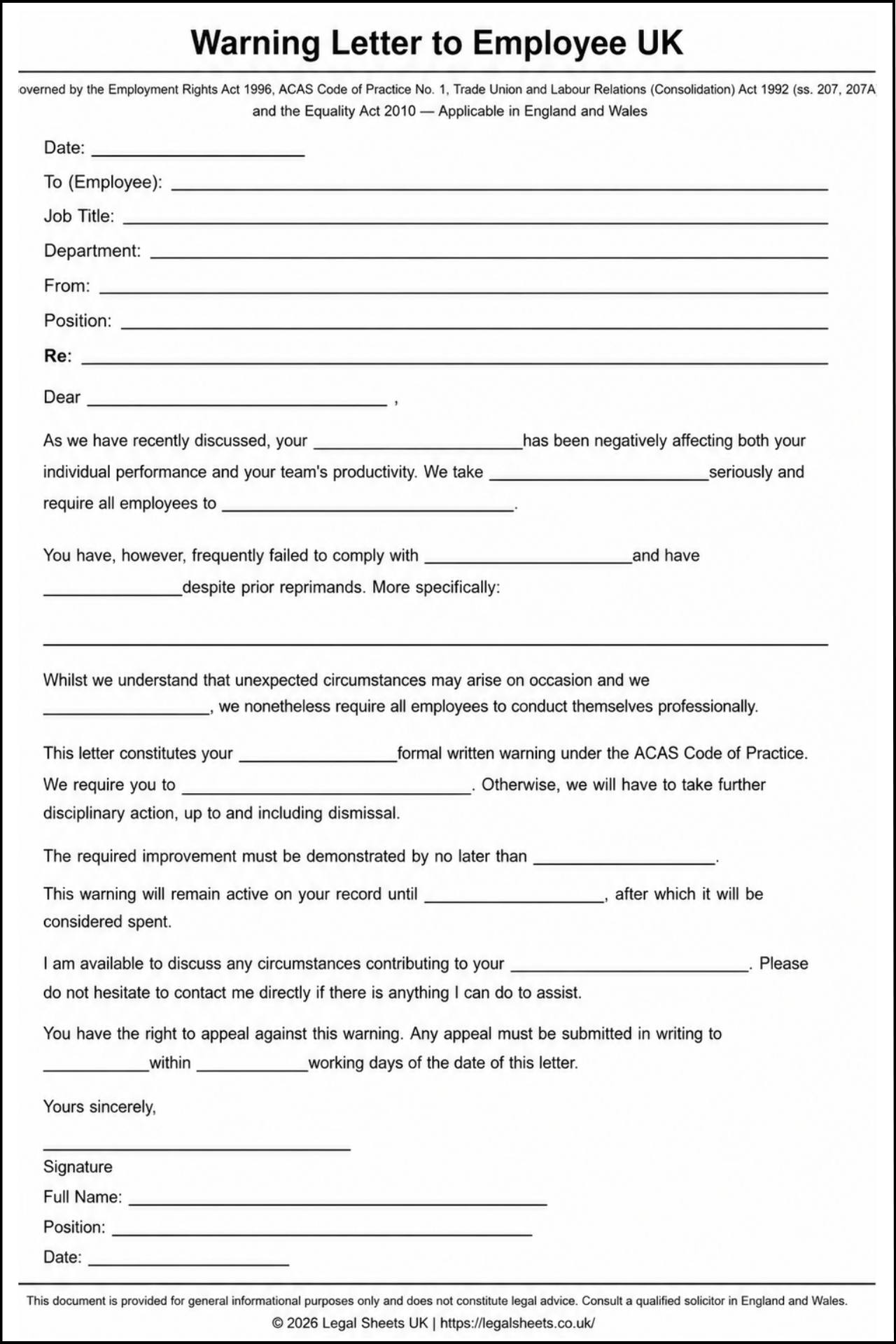
Not every workplace concern requires formal disciplinary action. However, repeated or sufficiently serious issues often progress beyond informal discussions. Employers usually reach this stage after concluding that previous management action has not achieved the required improvement.
Conduct-Related Issues
Conduct issues frequently involve behaviour that breaches workplace standards rather than an employee’s ability to perform their role.
Examples include:
- Repeated lateness.
- Unauthorised absence.
- Insubordination.
- Failure to follow workplace procedures.
- Breaches of company policies.
A single minor incident will not necessarily justify a written warning. Employers should consider the surrounding circumstances, previous conduct, and whether a less formal response remains appropriate.
Performance-Related Concerns
Performance warnings focus on the employee’s work rather than misconduct.
Typical examples include:
- Failure to achieve agreed targets.
- Persistent mistakes affecting work quality.
- Missed deadlines.
- Lack of improvement after previous management discussions.
One of the most common procedural mistakes is issuing a warning that simply tells an employee to “improve performance” without explaining what improvement actually looks like. Employment Tribunals frequently examine whether expectations were sufficiently clear for the employee to understand what was required.
Attendance and Behaviour Problems
Attendance concerns may justify a formal warning where patterns continue despite earlier discussions.
Common examples include:
- Persistent absenteeism.
- Repeated unauthorised lateness.
- Misuse of company property.
- Unprofessional behaviour affecting colleagues or customers.
Employers should distinguish between disciplinary attendance issues and absences connected with other workplace procedures before deciding which process applies.
Different Types of Employee Warning Letters
Not every workplace issue should be addressed using the same type of warning letter. The level of warning should reflect the seriousness of the conduct or performance concern, the employee’s disciplinary history, and whether previous management action has already taken place. Applying the wrong level of warning can create procedural difficulties if the employer later relies on it during dismissal proceedings.
First Written Warning
A first written warning is normally used where informal discussions have failed to resolve the issue or where the misconduct is serious enough to justify formal action without reaching the threshold for a final warning.
Typical situations include:
- Repeated lateness despite previous conversations.
- Failure to follow workplace procedures.
- Minor misconduct.
- Performance concerns following informal coaching.
The letter should explain what improvement is expected, how long the warning will remain active, and the consequences if the required standards are not achieved. Giving vague instructions simply leaves room for disagreement later about whether the employee actually improved.
Final Written Warning
A final written warning is reserved for more serious situations.
It may be appropriate where:
- A previous written warning remains active.
- The employee has failed to improve.
- The misconduct is sufficiently serious to justify bypassing a first warning without amounting to gross misconduct.
Employers should exercise caution before issuing a final warning for a relatively minor first offence. The verified legal facts explain that Employment Tribunals assess whether disciplinary decisions fall within the employer’s reasonable response, and a disproportionate warning may later undermine a dismissal based upon it.
Performance Warning Letter
Performance warnings are intended to address capability concerns rather than misconduct.
They commonly relate to:
- Missed performance targets.
- Declining productivity.
- Poor work quality.
- Failure to meet agreed objectives.
A recurring problem in practice is the use of vague wording such as “your performance must improve.” Effective warning letters instead identify measurable objectives, realistic review periods, and the standard expected before the next assessment.
Conduct Warning Letter
Conduct warnings deal with behavioural issues rather than work quality.
Examples include:
- Failure to follow management instructions.
- Inappropriate workplace behaviour.
- Breaches of health and safety procedures.
- Failure to comply with internal policies.
The letter should identify the incident clearly and explain why the conduct breached workplace expectations without relying on general criticism or unsupported conclusions.
Attendance Warning Letter
Attendance warnings usually arise where attendance problems continue despite previous discussions.
Examples include:
- Persistent lateness.
- Unauthorised absence.
- Unacceptable attendance patterns.
- Failure to follow absence reporting procedures.
Employers should distinguish disciplinary attendance issues from situations that require different HR procedures before issuing a warning letter.
Delivering the Warning Letter Correctly
Preparing a well-written warning letter is only part of the process. Employers should also consider how it is delivered and whether they can later demonstrate that the employee received it. A warning cannot fulfil its purpose if the employee was never properly informed of the decision.
Hand Delivery During the Outcome Meeting
The most common method is to hand the warning letter to the employee during the disciplinary outcome meeting.
This approach allows the manager to:
- Explain the decision.
- Discuss the required improvements.
- Confirm the warning period.
- Explain the appeal process.
- Answer procedural questions.
Providing the letter immediately after communicating the outcome also creates a clear timeline for HR records.
Email Delivery
Many employers issue warning letters electronically after the outcome meeting.
Where email is used, it should be sent to an address the employee regularly uses for work or another agreed address. Employers should retain evidence showing when the email was sent and, where possible, that it was received.
Electronic delivery is generally acceptable provided the employer can later demonstrate that the employee was notified of the warning.
Recorded or Tracked Post
If the employee is absent from work or cannot attend the outcome meeting, recorded or tracked post may be appropriate.
This method creates evidence of delivery and is particularly useful where disciplinary decisions may later become disputed.
Employers should also keep copies of the correspondence and delivery records within the employee’s personnel file.
Keeping Proof of Service
A warning letter has little evidential value if the employer cannot demonstrate that the employee received it.
Good HR practice includes retaining:
- A signed copy where available.
- Email transmission records.
- Postal tracking information.
- Notes of the outcome meeting.
- Copies of accompanying correspondence.
The verified legal facts state that employers should be able to prove receipt because a warning cannot take effect if the employee is unaware of it.
Managing Warning Letters After They Are Issued
Issuing the warning is not the end of the disciplinary process. What happens afterwards often determines whether the warning achieves its purpose or simply becomes evidence in future Employment Tribunal proceedings.
Recording the Warning on the Personnel File
The warning should be placed on the employee’s personnel file together with the documents supporting the disciplinary decision.
These records commonly include:
- Investigation documents.
- Hearing notes.
- Witness statements.
- Outcome correspondence.
- Appeal documentation where applicable.
Maintaining complete records creates a clear chronology if future disciplinary decisions are challenged.
Monitoring Improvement During the Active Period
Managers should actively monitor progress rather than waiting until the warning expires.
This often involves:
- Regular review meetings.
- Progress discussions.
- Objective performance measurements.
- Attendance monitoring where relevant.
Employees should understand whether they are meeting the expected standards throughout the warning period rather than discovering shortcomings only when further disciplinary action begins.
Reviewing Progress
Review meetings provide an opportunity to discuss improvements, identify any continuing concerns, and decide whether additional support is appropriate.
Where satisfactory improvement has been achieved, employers should acknowledge that progress rather than allowing the warning to become the only record of the employee’s performance.
Removing Expired Warnings
The verified legal facts explain that warning letters should specify how long they remain active.
Once that period expires, employers should avoid relying upon the expired warning during future disciplinary decisions. Continuing to treat expired warnings as active can create significant procedural difficulties if dismissal later occurs.
Handling Employee Appeals
Employees should have a genuine opportunity to challenge disciplinary decisions.
An appeal allows the organisation to:
- Review procedural concerns.
- Consider new evidence.
- Correct errors.
- Confirm or amend the disciplinary outcome.
Treating appeals seriously not only improves fairness but may also identify procedural problems before they become Employment Tribunal issues.
Common Errors That Can Make a Warning Procedurally Unfair
Many warning letters fail not because of their wording but because earlier procedural steps were ignored. Employment Tribunals regularly examine the entire disciplinary process rather than the warning letter in isolation.
Issuing a Warning Without Holding a Hearing
A common mistake is preparing a warning immediately after receiving a complaint without conducting a proper investigation or disciplinary hearing.
Issuing a ‘paper warning’ without conducting a formal investigation and disciplinary hearing directly breaches the Acas Code of Practice. Under English common law, if an employer later dismisses the employee by relying on this procedurally defective ‘totting-up’ warning, an Employment Tribunal will almost certainly rule the dismissal unfair under Section 98(4) of the Employment Rights Act 1996.
Refusing the Employee’s Right to Be Accompanied
Employees attending formal disciplinary hearings may request to be accompanied by a workplace colleague or trade union representative. Employers can find further guidance in the Acas disciplinary procedure guide.
Under Section 10 of the Employment Relations Act 1999, workers hold a strict statutory right to be accompanied by a certified trade union representative or fellow worker at any formal disciplinary hearing. Unreasonably refusing this request immediately exposes the employer to a standalone Employment Tribunal claim, yielding a penalty award of up to two weeks’ capped statutory pay, regardless of the warning’s ultimate fairness
Using Vague Improvement Requirements
General instructions such as “improve your attitude” or “perform better” rarely provide employees with meaningful guidance.
Instead, warning letters should describe:
- Specific objectives.
- Measurable standards.
- Review dates.
- Expected conduct.
Clear expectations make later disciplinary decisions much easier to justify.
Issuing a Disproportionate Warning
The seriousness of the warning should reflect the seriousness of the conduct.
Issuing a final written warning for an isolated minor incident may later appear unreasonable if relied upon during dismissal proceedings. Consistency across disciplinary decisions remains an important aspect of fair workplace management.
Relying on an Expired Warning
One of the most frequent procedural mistakes occurs months later rather than when the warning is issued.
Employers sometimes rely on warnings that have already expired when deciding to dismiss an employee.
Under strict English legal precedent (Diosynth Ltd v Thomson), an employer generally cannot use an expired warning as the principal tipping point to elevate a lesser offence into a dismissal. While an Employment Tribunal may occasionally consider a long history of expired warnings as background context, relying on an expired warning directly will almost certainly result in a finding of Unfair Dismissal
Failing to Explain the Appeal Process
Every warning letter should explain:
- The employee’s right to appeal.
- How an appeal should be submitted.
- The applicable timescale.
Omitting this information may create procedural defects that later influence the Employment Tribunal’s assessment of fairness.
How Warning Letters Fit Into the Wider Disciplinary Process
A warning letter is one stage within a wider disciplinary procedure rather than an isolated HR document. Understanding where it fits helps employers apply disciplinary action consistently and proportionately.
Informal Management Action
Many concerns are resolved through informal conversations, coaching, or management guidance before any formal disciplinary procedure begins.
These early discussions often prevent minor issues from escalating into formal action.
Formal Written Warning
Where informal management has not achieved the required improvement, or the misconduct justifies formal intervention, a written warning may become appropriate.
It documents the employer’s concerns and establishes clear expectations for future conduct or performance.
Final Written Warning
If the employee commits further misconduct or fails to improve while an active warning remains in place, a final written warning may follow where appropriate.
This stage should not be automatic. Employers should still assess the facts carefully before deciding whether further disciplinary action is justified.
Further Disciplinary Action
Continued misconduct or failure to meet required standards during the warning period may result in additional disciplinary proceedings.
Each new issue should still be investigated fairly before another sanction is imposed.
Dismissal as a Last Resort
Dismissal should normally represent the final stage of the disciplinary process rather than its starting point.
Employment Tribunals frequently examine whether earlier warning letters were procedurally fair before deciding whether a subsequent dismissal was fair under the Employment Rights Act 1996. A carefully prepared warning letter therefore becomes an important part of the employer’s overall disciplinary record rather than simply another HR document.
UK Legal Requirements for Employee Warning Letters
Legal Requirements Table
| Topic / Issue | Precise English Legal Rule | Governing Statute / Regulation |
| Procedural Fairness | Employers must conduct a reasonable investigation, hold a formal hearing, and offer a written right of appeal before issuing a formal warning. | Acas Code of Practice on Disciplinary and Grievance Procedures |
| Right to Be Accompanied | Workers hold a strict statutory right to be accompanied by a fellow worker or trade union representative at formal disciplinary hearings. | Employment Relations Act 1999 (Section 10) |
| Appeal Rights | The warning letter must explicitly offer an appeal and define the timeframe; failing to do so invites a 25% compensation uplift at an Employment Tribunal. | Acas Code of Practice on Disciplinary and Grievance Procedures |
| Duration of Warning | Warning letters must state how long they remain “live” (typically 6–12 months). Dismissals relying directly on an expired warning are generally deemed unfair. | Employment Rights Act 1996 (Section 98) |
| Data Retention | Expired disciplinary warnings constitute personal data and must not be retained or processed longer than strictly necessary for employment records. | Data Protection Act 2018 / UK GDPR |
| Service of Warning | There are no prescribed execution formalities, but employers must be able to prove the employee actually received the warning for it to be legally effective. | Common Law |
Practical Legal Impact
The legal value of a warning letter depends as much on the disciplinary procedure as on the wording of the document itself. Employment Tribunals regularly examine whether the employer investigated the allegation, allowed the employee to respond, respected the statutory right to be accompanied, and offered an appeal before deciding whether later disciplinary action was fair.
Ignoring the Acas Code may have significant financial consequences. Under Section 207A of the Trade Union and Labour Relations (Consolidation) Act 1992 (TULRCA), if an employer unreasonably breaches the Acas Code—for example, by skipping the formal hearing or failing to offer a written right of appeal—an Employment Tribunal holds the statutory power to uplift any subsequent compensation awarded to the employee by up to 25%. Likewise, relying on expired warnings or maintaining poor HR records can weaken an employer’s position if an unfair dismissal claim follows. Accurate record-keeping, proportionate decision-making, and consistent disciplinary procedures are therefore just as important as the warning letter itself.
Practical Tips for Employers Before Sending a Warning Letter
Use Objective Language
A warning letter should record facts rather than opinions.
Describe:
- What happened.
- When it happened.
- Which workplace standard was breached.
- The evidence considered.
Objective wording is easier to support if the decision is later challenged.
Avoid Emotional or Accusatory Wording
Personal criticism, frustration, or exaggerated language rarely improves the effectiveness of a warning letter.
Instead of making assumptions about an employee’s attitude or intentions, focus on observable conduct or measurable performance concerns.
Keep Supporting Evidence
Every warning letter should be supported by evidence gathered during the investigation.
This may include:
- Attendance records.
- Witness statements.
- Emails.
- Performance reports.
- Investigation notes.
- Minutes from the disciplinary hearing.
Maintaining a complete evidence file allows employers to explain how the disciplinary decision was reached.
Apply Workplace Policies Consistently
Employees frequently compare disciplinary outcomes with previous cases.
Applying workplace policies consistently reduces allegations that similar situations have been treated differently without justification.
Managers should therefore consider previous disciplinary decisions before determining the appropriate level of warning.
Follow Internal Disciplinary Procedures
Many organisations have disciplinary procedures that expand upon the minimum legal requirements.
Managers should follow those internal procedures carefully rather than relying solely on the warning letter template.
Consistency throughout the disciplinary process often carries more weight than lengthy or complicated wording within the warning itself.
Documents Often Used Alongside a Warning Letter
A warning letter is rarely issued on its own. Employers commonly prepare supporting documents throughout the disciplinary process, including:
- Disciplinary Invitation Letter.
- Investigation Outcome Letter.
- Suspension Letter where appropriate.
- Performance Improvement Plan (PIP).
- Disciplinary Hearing Outcome Letter.
- Appeal Outcome Letter.
Together, these documents create a complete record of the disciplinary procedure and help demonstrate how the employer reached its decision if the matter is later reviewed by an Employment Tribunal.
Frequently Asked Questions
Can an employer issue a warning letter without a disciplinary hearing?
Generally, a formal written warning should follow a fair disciplinary procedure that includes an investigation and a disciplinary hearing. The verified legal facts identify “paper warnings” issued without these procedural steps as a common reason why later disciplinary decisions are criticised by Employment Tribunals.
How long should a written warning remain on an employee’s record?
The warning letter should clearly state how long it will remain active. According to the verified legal facts, employers commonly specify a defined active period, after which the warning should no longer be relied upon as an active disciplinary sanction.
Can an employee appeal a written warning?
Yes. A formal warning letter should explain the employee’s right to appeal, identify who should hear the appeal, and specify the timeframe for submitting it. Failing to provide appeal information may create procedural defects if the disciplinary process is later reviewed.
Can an expired warning be used to justify dismissal later?
Generally, employers should not rely on warnings that have passed their stated expiry date. The verified legal facts explain that using expired warnings to justify dismissal can significantly weaken the employer’s position in an unfair dismissal claim.
What happens if an employer ignores the Acas disciplinary procedure?
Failure to follow the Acas Code may have serious consequences. In addition to undermining the fairness of disciplinary action, an Employment Tribunal may increase compensation by up to 25% where the employer has unreasonably failed to comply with the Code. Employers should therefore treat the disciplinary procedure with the same care as the warning letter itself.
HR Steps to Complete Before Issuing a Warning Letter
Many employers mistakenly believe the warning letter is the disciplinary process. In reality, it is usually the outcome of that process. Skipping the earlier stages creates procedural weaknesses that may later undermine reliance on the warning.
Carry Out a Fair Investigation
Before reaching any disciplinary decision, the employer should investigate the facts carefully.
This may include:
- Reviewing documents.
- Speaking with witnesses.
- Considering CCTV or electronic records where appropriate.
- Giving the employee an opportunity to explain events.
A rushed investigation often results in incomplete evidence, making later disciplinary decisions more difficult to defend.
Invite the Employee to a Disciplinary Hearing
Following the investigation, the employee should be invited to a disciplinary hearing with reasonable notice.
The hearing gives the employee an opportunity to understand the allegations, review the available information, and respond before any formal decision is reached.
Issuing a written warning without first holding an appropriate disciplinary hearing is identified in the verified legal facts as one of the most common procedural failures leading to Employment Tribunal criticism.
Respect the Employee’s Right to Be Accompanied
Where a formal disciplinary hearing takes place, eligible workers have a statutory right to be accompanied by either:
- A trade union representative.
- A workplace colleague.
Refusing this request may itself give rise to an Employment Tribunal claim, regardless of whether the warning is otherwise justified. Employers should therefore consider accompaniment requests carefully before proceeding.
Allow the Employee to Respond Before Making a Decision
The hearing should not become a meeting where the outcome has already been decided.
Employees should have a genuine opportunity to:
- Explain events.
- Challenge evidence.
- Provide mitigating circumstances.
- Respond to concerns raised during the investigation.
Allowing meaningful participation strengthens procedural fairness and produces better-informed disciplinary decisions.
Decide Whether a Written Warning Is Proportionate
Once all information has been considered, the employer must decide whether issuing a written warning is a proportionate response.
Relevant considerations often include:
- The seriousness of the conduct.
- Previous disciplinary history.
- Any mitigating circumstances.
- Consistency with earlier disciplinary decisions.
The verified legal facts highlight that issuing a final written warning for a very minor first offence may later be regarded as unreasonable if relied upon during dismissal proceedings.
Drafting a Warning Letter That Meets Good HR Practice
A warning letter should explain the employer’s decision clearly enough that the employee understands exactly why the warning has been issued and what is expected going forward. Ambiguous wording frequently creates unnecessary disputes months later when employers rely on the warning during subsequent disciplinary action.
Clearly Describe the Misconduct or Performance Concern
Set out the facts objectively.
Avoid emotional language, assumptions, or personal criticism. The letter should describe what occurred, when it happened, and why the conduct or performance fell below the expected standard.
Refer to the Evidence Considered
Briefly identify the evidence relied upon during the investigation and disciplinary hearing.
This may include witness statements, attendance records, work performance data, emails, or other relevant material considered before reaching the disciplinary decision.
Explain the Expected Standards Going Forward
The employee should understand exactly what improvement is required.
Rather than stating that standards must improve generally, explain the behaviour, attendance, or performance expected over the coming months using measurable expectations wherever possible.
Set Measurable Improvement Requirements
Clear targets reduce uncertainty.
For example, performance expectations should identify specific objectives, review periods, or attendance improvements instead of vague instructions to “perform better.”
Employment Tribunals regularly criticise warning letters that fail to explain what successful improvement actually looks like.
Specify How Long the Warning Will Remain Active
The verified legal facts indicate that warning letters should state how long they will remain active on the employee’s personnel record.
This avoids uncertainty later and reduces the risk of employers relying on expired warnings during future disciplinary decisions.
Explain the Consequences of Further Misconduct
The warning should explain what may happen if further misconduct or poor performance occurs during the active warning period.
Where appropriate, it should state that additional disciplinary action, including dismissal, may follow if the required improvements are not achieved.
Include the Employee’s Right of Appeal
Every formal warning letter should explain:
- The employee’s right to appeal.
- Who the appeal should be submitted to.
- The timeframe for lodging the appeal.
Omitting appeal information may create procedural defects that later become significant if disciplinary decisions are challenged before an Employment Tribunal.
Author
-

Ankur is the founder and editorial reviewer at LegalSheets. He researches, writes, and reviews legal content, ensuring every template and guide is clear, accurate, and based on current UK laws and official government guidance. His focus is on making legal documents easier for individuals and businesses to understand and use.
