
Partnership Agreement Template (Free PDF & Template)
Many searches for a Partnership Agreement begin after a disagreement about profits or decision-making rather than at the start of a new business. In England, where partners trade without clear written terms, the default rules in the Partnership Act 1890 can apply in ways that bear little resemblance to what the individuals believed they had agreed.
A recurring problem in partnership disputes before the Business and Property Courts is the absence of any workable clause dealing with partner exits, management authority, or ownership of business assets, leaving the court to interpret an incomplete arrangement. That situation can become particularly expensive when the business has already begun trading and money has changed hands.
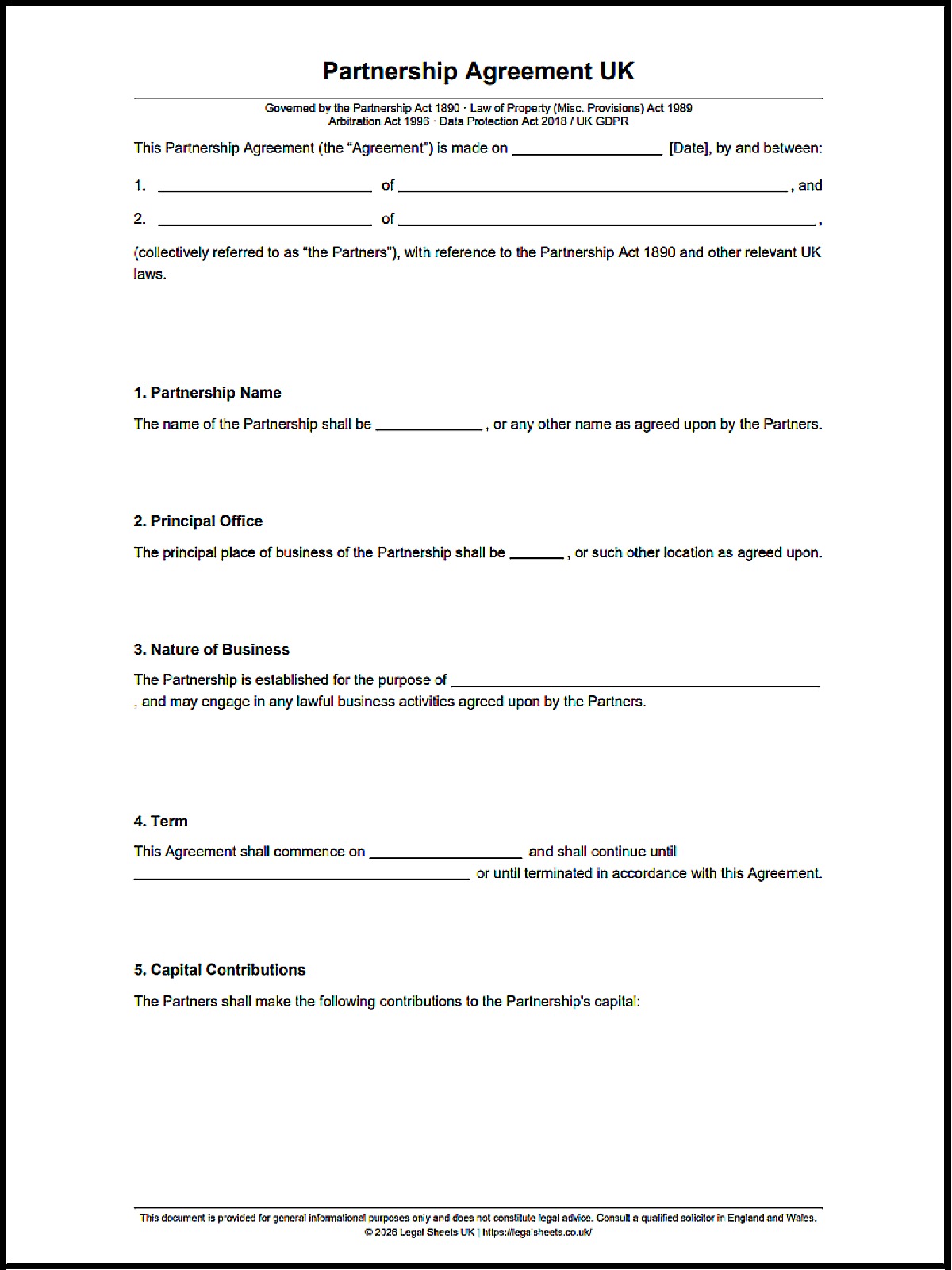
The wording and structure used in a properly prepared Partnership Agreement can establish from the outset how the relationship is intended to operate, and the template and drafting guidance that follow are designed to put those arrangements into clear written form.
Partnership Agreement Template (PDF, Word & Printable Formats)
Why Businesses Get Into Partnership Disputes Even Before Trading Begins
Most partnership disputes are not caused by dishonesty.
They usually begin because partners believe they have agreed on something when they have merely discussed it.
During the startup phase, attention is often focused on launching the business, attracting customers, securing premises, or generating revenue. Difficult conversations regarding ownership, liability, exit rights, and decision-making authority are postponed.
The disagreement therefore exists from the beginning but remains hidden until commercial pressure exposes it.
Verbal Agreements and Assumptions
Verbal arrangements often appear workable when the business is small.
Problems emerge when partners later remember discussions differently or when circumstances change.
Recurring areas of disagreement include:
- Different expectations regarding ownership percentages
- Unclear authority to enter contracts
- Confusion about responsibilities
- Different assumptions regarding profit entitlement
Because verbal arrangements rarely address every future scenario, they often become difficult to enforce once relationships deteriorate.
Different Expectations About Ownership Percentages
Ownership disputes frequently arise where contributions are unequal.
A partner contributing substantial capital may assume they have acquired a larger economic interest in the business. Another partner may believe that equal involvement in day-to-day operations justifies equal ownership.
Without written clarification, both positions can appear commercially reasonable.
The dispute often emerges only when profits become available for distribution.
Unclear Authority to Enter Contracts
Authority disputes commonly arise during periods of growth.
One partner may believe they have authority to negotiate contracts, appoint suppliers, or make purchasing decisions on behalf of the business. Other partners may disagree once the financial consequences become apparent.
Where authority limits are not clearly documented, disagreements can escalate rapidly and damage both internal relationships and external commercial arrangements.
Confusion Over Partner Responsibilities
Responsibilities often evolve informally during the early stages of trading.
As the business grows, partners may develop very different views regarding who is contributing the most value.
Disputes frequently arise concerning:
- Client management
- Sales activity
- Administrative work
- Financial management
- Supplier relationships
Without clearly defined responsibilities, perceptions of fairness can diverge significantly over time.
The Cost of Relying on Statutory Defaults
Many businesses assume that statutory rules will produce fair outcomes if disagreements arise.
The practical reality is that statutory defaults may not reflect the commercial arrangement the partners intended.
Equal Profit Sharing Regardless of Contribution
Pursuant to Section 24(1) of the Partnership Act 1890, partners are entitled to share equally in the capital and profits of the business unless an agreement provides otherwise.
This can create unexpected results where one partner contributed substantially more money, assets, equipment, or goodwill than the others.
Equal Responsibility for Losses
The same statutory provision also applies to losses.
Partners may therefore find themselves sharing liabilities equally despite contributing very different amounts to the business at the outset.
This often becomes contentious during periods of financial difficulty.
Joint Liability for Business Debts
Pursuant to Section 9 of the Partnership Act 1890, every partner is jointly liable for partnership debts and obligations incurred while they are a partner.
Many new business owners underestimate the significance of this exposure.
A partner may have had no direct involvement in a transaction yet still face personal liability arising from obligations incurred by the partnership.
Creditors commonly focus on recovery prospects rather than internal disputes regarding responsibility.
Common Issues That Trigger Early Conflict
Certain problems appear repeatedly in partnership disputes and often develop long before formal legal proceedings become necessary.
Unequal Capital Contributions
Financial contributions rarely remain a purely accounting issue.
Partners often associate their investment with expectations regarding influence, ownership, voting rights, or future returns.
When those expectations have not been documented properly, disagreement becomes increasingly likely.
Unclear Withdrawal Rights
A partner’s circumstances can change unexpectedly.
Without clear exit provisions, disagreements frequently arise regarding:
- Notice periods
- Financial settlements
- Buyout arrangements
- Ongoing liabilities
Questions that seem straightforward during formation can become highly contentious once someone actually wishes to leave.
Informal Decision-Making Arrangements
Informal decision-making may work during the early stages of trading.
As revenue, staffing levels, and contractual commitments increase, those arrangements often become inadequate. Businesses frequently discover that they never agreed which decisions require unanimous approval and which can be made individually.
Lack of Succession Planning
Many partnerships devote little attention to retirement, death, or bankruptcy during formation.
Yet these events regularly create the most disruptive disputes because no clear procedure exists for dealing with them.
Where continuity planning has been overlooked, the statutory position can produce consequences that none of the partners expected.
Structuring the Commercial Relationship Before Money Starts Moving
The easiest time to resolve potential disagreements is before significant trading begins.
Once revenue is being generated and financial interests have become entrenched, compromise becomes more difficult.
A partnership agreement allows the parties to establish expectations while commercial pressures remain relatively low.
Defining Each Partner’s Role
Clearly defined roles reduce operational confusion and create accountability.
Areas commonly addressed include:
Operational Responsibilities
Day-to-day responsibilities should be allocated clearly to avoid duplication, gaps in management, and later disputes regarding contribution levels.
Strategic Decision-Making Powers
Major commercial decisions often require different approval procedures from routine operational matters.
Client and Supplier Management
Allocating responsibility for key commercial relationships reduces conflicting instructions and protects business continuity.
Recording Capital Contributions
Contribution records become particularly important whenever ownership rights or financial entitlements are challenged.
Cash Contributions
Initial investment amounts should be recorded accurately and supported by appropriate financial records.
Equipment and Assets
Non-cash contributions frequently become the subject of valuation disputes if they were not properly documented at the outset.
Intellectual Property
Businesses built around branding, software, designs, or proprietary systems should identify ownership before those assets acquire significant value.
Existing Business Goodwill
Where an existing business is converted into a partnership structure, goodwill should be expressly addressed rather than left to assumption.
Setting Profit and Loss Allocation Rules
Profit-sharing provisions should reflect the actual commercial intentions of the partners.
Equal Sharing Arrangements
Equal sharing may be appropriate where partners contribute broadly equivalent value to the business.
Percentage-Based Distributions
Percentage allocations are often used where investment levels or commercial contributions differ significantly.
Performance-Linked Allocations
Some partnerships adopt formulas linked to revenue generation, client acquisition, or measurable performance indicators.
The drafting challenge is ensuring that the formula remains practical and understandable years later when the original negotiations are no longer fresh in the partners’ minds.
Authority Limits That Prevent Internal Conflict
Many partnership disputes arise because nobody established clear limits on what an individual partner can do without consulting the others.
Common provisions include:
Spending Thresholds
Borrowing Restrictions
Contract-Signing Authority
Banking Controls
These provisions often become critical when relationships begin to deteriorate. A partnership with clear authority limits can usually identify whether a partner acted within their powers. Without those limits, disputes frequently become more expensive and harder to resolve.
Clauses That Often Determine Whether the Partnership Survives a Crisis
Partnerships rarely fail because of routine trading activity.
More commonly, they face difficulty when an unexpected event occurs and the agreement contains no procedure for dealing with it.
The clauses addressing continuity, partner exits, expulsion rights, and dispute resolution often determine whether the business can continue operating during periods of serious disruption.
In many partnership disputes reaching the civil courts, the underlying problem is not that the partners disagree a crisis exists. The problem is that the agreement never specified what should happen once the crisis arrived.
Clauses That Often Determine Whether the Partnership Survives a Crisis
When partnerships encounter serious difficulties, the dispute is rarely caused by a single event. More often, the problem arises because the agreement contains no mechanism for dealing with that event.
Death, retirement, misconduct, insolvency, and business separation can all occur during the life of a successful partnership. The question is whether the agreement provides a workable procedure for responding when they do.
Continuity Provisions Following Death or Bankruptcy
Many partners assume the business will automatically continue if one partner dies or becomes bankrupt.
That assumption can be dangerous.
Pursuant to Section 33(1) of the Partnership Act 1890, a partnership may automatically dissolve upon the death or bankruptcy of a partner unless the agreement contains provisions that override the statutory default position.
Businesses often discover the practical consequences only after a major event has already occurred. Banking arrangements can be disrupted, ongoing contracts may become uncertain, and commercial relationships can suffer while the surviving partners attempt to resolve ownership and management issues.
Overriding Automatic Dissolution Risks
A continuity clause is often one of the most commercially valuable provisions in the entire agreement.
Without it, a profitable business may face disruption even though the remaining partners wish to continue trading.
Continuity provisions commonly establish:
- The intention for the business to continue
- The treatment of the departing partner’s interest
- Transitional management arrangements
- Valuation procedures
The absence of such provisions can leave the partners relying on statutory rules that were never designed around the specific needs of their business.
Business Continuity Planning
Effective continuity planning addresses operational concerns as well as legal issues.
Questions commonly include:
- Who controls the business immediately after the triggering event?
- How will clients and suppliers be informed?
- Who can access banking facilities?
- How will ongoing obligations be fulfilled?
Businesses that address these issues in advance are generally better positioned to maintain trading stability during periods of uncertainty.
Buyout Mechanisms
Buyout provisions establish how a departing partner’s interest will be valued and acquired using repayment terms.
Disputes frequently arise where the agreement identifies a buyout right but provides no valuation methodology.
The resulting disagreement often centres on whether value should be based on assets, profitability, goodwill, or another measurement entirely.
Clear valuation procedures reduce the likelihood of prolonged litigation and commercial disruption.
Partner Exit and Retirement Procedures
Few partnerships remain unchanged forever.
Retirement, relocation, career changes, and personal circumstances can all result in a partner wishing to leave the business through business separation.
Without a structured exit process, disagreements frequently arise over entitlement, timing, and financial settlement.
Notice Requirements
Exit provisions usually specify how much notice must be given before retirement or voluntary departure.
The objective is not merely administrative.
Adequate notice allows the partnership to:
- Reallocate responsibilities
- Protect client relationships
- Adjust financial planning
- Arrange succession
A sudden departure can place significant pressure on remaining partners, particularly in client-facing businesses.
Valuation Methodology
Many partnership disputes begin with agreement that a partner should leave but disagreement about the value of their interest.
A valuation mechanism should identify:
- The valuation basis
- The valuation date
- Whether goodwill is included
- How disputes regarding valuation will be resolved
The more detailed the methodology, the less scope exists for later disagreement.
Settlement of Partnership Accounts
Financial separation often involves more than a simple payment.
The partnership may need to address:
- Outstanding liabilities
- Unpaid drawings
- Profit entitlements
- Capital accounts
Failure to establish a structured settlement process can prolong disputes long after the departing partner has ceased active involvement in the business.
Expulsion Powers and Misconduct Provisions
One of the most misunderstood areas of partnership law concerns the removal of a partner.
Many business owners assume that a majority vote automatically allows an underperforming or disruptive partner to be removed.
That assumption is incorrect.
Pursuant to Section 25 of the Partnership Act 1890, a partner cannot be expelled by a majority unless an express contractual power exists within the partnership agreement.
Grounds for Removal
An expulsion clause should identify the circumstances in which removal may occur.
Examples may include:
- Serious misconduct
- Fraudulent behaviour
- Persistent breach of obligations
- Conduct causing substantial harm to the business
The grounds should be defined carefully because vague provisions often become difficult to enforce during disputes.
Voting Thresholds
Removal powers should identify the level of approval required before expulsion can occur.
Businesses commonly use specific voting thresholds to prevent arbitrary or abusive decision-making.
The objective is to balance business protection against fairness to the partner whose position is at risk.
Investigation Procedures
Removal decisions made without a fair process often become vulnerable to challenge.
Many agreements therefore establish procedures for:
- Notification of allegations
- Review of evidence
- Partner representations
- Formal decision-making
Even where misconduct appears obvious, procedural fairness can become significant if the dispute later reaches court.
Consequences of Omitting an Expulsion Clause
Failure to include an expulsion provision creates one of the most significant operational risks in a traditional partnership.
Without an express power of expulsion, the remaining partners may have no practical ability to remove a problematic partner while preserving the existing business structure.
In serious cases, dissolution of the partnership may become the only available solution.
This often surprises business owners who assumed a majority vote would be sufficient.
Restrictive Covenants After Departure
Partnership agreements frequently include restrictions designed to protect the business after a partner leaves.
These provisions commonly focus on preserving client relationships, confidential information, and commercial goodwill.
The challenge is ensuring that the restrictions remain enforceable.
Client Protection Measures
Businesses often invest substantial time and resources developing client relationships.
A departing partner may possess detailed knowledge regarding customers, pricing arrangements, and commercial opportunities.
Protective provisions are typically drafted to reduce the risk of immediate diversion of those relationships.
Non-Solicitation Obligations
Non-solicitation clauses generally focus on active attempts to attract clients, suppliers, or employees away from the business.
The scope of the restriction should reflect a legitimate commercial objective rather than an attempt to eliminate competition altogether.
Geographic Limitations
Geographic restrictions frequently attract scrutiny because they can affect an individual’s ability to continue working within their profession or industry.
The wider the geographic scope, the greater the risk that enforceability will become contentious.
Duration Restrictions
Time limits are equally significant.
A restriction lasting several months may be easier to justify than one extending for many years.
Businesses often create difficulties for themselves by selecting arbitrary durations without considering whether the restriction is genuinely necessary for client referrals.
Enforceability Concerns Under Restraint of Trade Principles
Under the common law doctrine of restraint of trade, restrictive covenants that are wider than reasonably necessary risk being struck down entirely.
Courts do not generally rewrite excessive restrictions to make them reasonable.
As a result, an overambitious clause can leave the partnership with no protection at all.
Businesses frequently discover this problem only after attempting to enforce the restriction against a former partner.
Ownership of Assets, Property and Partnership Resources
Asset ownership becomes particularly important when partners separate or when the business faces financial difficulty.
Many disputes arise because assets were used by the partnership without anyone clearly documenting who actually owned them.
Distinguishing Personal Assets From Partnership Property
The fact that an asset is used by the business does not automatically determine ownership.
Clear records should identify:
- Assets owned personally by partners
- Assets contributed to the partnership
- Assets acquired by the business
- Assets subject to financing arrangements
Ownership uncertainty often becomes expensive when dissolution or retirement occurs.
Ownership Records
Accurate records reduce the likelihood of disputes regarding entitlement and valuation.
Businesses frequently overlook documentation during formation and later struggle to reconstruct ownership history.
Asset Contribution Schedules
Schedules identifying contributed assets can provide valuable evidence if disagreements arise years later.
They also reduce uncertainty regarding repayment or return obligations when a partner departs.
Business-Use Assets
Equipment, vehicles, technology systems, and other operational assets are commonly used by the business while remaining personally owned by individual partners.
The agreement should clearly identify the intended arrangement.
When Property Clauses Require Additional Formalities
Property-related provisions require particular care because incorrect execution can affect enforceability.
Land Held by the Partnership
Where partnership arrangements involve land or real estate, additional legal considerations may arise.
Property ownership structures should be documented carefully to avoid uncertainty regarding beneficial ownership and partnership assets.
Property Transfers Into Partnership Ownership
Businesses sometimes contribute existing property to the partnership as part of their capital contribution through asset sales
The transfer process should be structured properly from the outset rather than relying on informal assumptions.
Legal Risks of Defective Execution
Property-related provisions may be vulnerable if the agreement has not been executed using the appropriate legal formalities.
Where deed execution is required but not used, specific provisions may become unenforceable.
Businesses often discover these defects only when enforcement is required, which is usually the worst possible time to identify them.
Intellectual Property and Business Branding
For many modern businesses, intellectual property may be more valuable than physical assets.
Ownership should be clarified before the business develops significant commercial value.
Ownership of Trademarks
Trademark ownership disputes frequently arise where branding was created by one partner before formation but used by the partnership after trading began.
Website and Digital Assets
Websites, domain names, social media accounts, and digital marketing assets often become central to the business.
The agreement should identify ownership and control arrangements clearly.
Client Databases
Client information may represent a significant commercial asset.
Ownership provisions can reduce disputes regarding access, use, and retention following a partner’s departure.
Business Name Compliance and Trading Identity Requirements
Choosing a trading name is often viewed as a branding decision. In practice, it can also create legal compliance obligations.
Partnerships that trade under a business name that is not simply the surnames of all partners must comply with statutory disclosure requirements contained in Part 41 of the Companies Act 2006.
Many small businesses overlook these obligations because the partnership agreement itself remains a private document. The compliance issue usually arises through external business communications rather than the agreement’s wording.
Using a Trading Name That Is Not the Partners’ Surnames
A partnership may operate successfully for years under a trading name without realising that additional disclosure obligations apply.
Where the business name differs from the surnames of all partners, statutory information must be disclosed through business communications and correspondence.
Failure to address these requirements can create unnecessary regulatory exposure even where the partnership agreement itself is valid.
Disclosure Obligations
The disclosure rules are intended to identify the individuals standing behind the business.
Customers, suppliers, creditors, and other third parties should be able to identify the partners operating the firm and locate an address for service if required.
Statutory Business Information Requirements
The statutory requirements apply to business communications rather than internal management documents.
Businesses should review their administrative procedures to ensure required information is included consistently across all relevant documentation.
Information That Must Appear on Business Documents
The Companies Act 2006 requires specific information to be disclosed when applicable.
Partner Names
The names of all partners must be disclosed in accordance with the statutory requirements.
Businesses commonly encounter problems where stationery templates, invoices, or correspondence systems have been created without considering disclosure obligations.
Address for Service
An address for service must also be provided.
The omission of this information can create compliance issues even where the business otherwise operates correctly.
Business Correspondence Requirements
The disclosure requirements extend to business correspondence and related documentation.
Businesses should ensure that administrative systems produce compliant documents consistently rather than relying on manual updates.
Consequences of Non-Compliance
Many owners assume disclosure failures are minor administrative oversights.
The consequences can be more significant.
Financial Penalties
Failure to comply with statutory disclosure requirements may expose the partners to financial penalties.
Because partnerships do not possess separate legal personality in the same way as a company, responsibility ultimately falls upon the partners themselves.
Enforcement Difficulties
The omission of required information can also create difficulties when attempting to enforce contractual rights.
In certain circumstances, the partnership may encounter obstacles when pursuing claims unless relief is granted by the court.
Operational Risks
Compliance failures often emerge at inconvenient moments, such as during litigation, debt recovery proceedings, or contractual disputes.
Addressing disclosure requirements at the outset is usually considerably easier than correcting problems retrospectively.
Execution Requirements: When a Simple Contract Is Not Enough
Many partnership agreements can be executed as ordinary contracts.
However, not every partnership arrangement qualifies for simple contract execution.
Businesses frequently focus on the commercial terms while overlooking the execution requirements necessary to make particular provisions enforceable.
Agreements Signed as Simple Contracts
Most routine partnership arrangements can be executed as standard contracts.
Where the agreement contains ordinary commercial provisions relating to management, profit sharing, contributions, and operational control, simple contract execution may be sufficient.
The critical issue is identifying whether the agreement contains provisions that require a higher level of formality.
Typical Partnership Arrangements
Many traditional trading businesses operate effectively using a standard contractual execution process.
Nevertheless, each agreement should be reviewed based on its specific contents rather than assumptions regarding the business structure.
Standard Execution Requirements
Even straightforward agreements should be executed carefully.
Common practical issues include:
- Missing signatures
- Incomplete schedules
- Incorrect dates
- Inconsistent versions of the document
These administrative mistakes can create evidential problems if a dispute later arises.
Situations Requiring Execution as a Deed
Certain provisions require greater formality.
Under Section 1 of the Law of Property (Miscellaneous Provisions) Act 1989, agreements containing powers of attorney or certain property-related arrangements may require execution as a deed.
Businesses often overlook this distinction because the majority of the agreement appears contractual in nature.
Powers of Attorney
Where partners grant authority to act on behalf of one another through powers of attorney, deed execution requirements may apply.
Failure to satisfy those requirements can affect enforceability.
Property-Related Provisions
Property ownership arrangements frequently create additional execution obligations.
Partnerships involving land or real estate should review execution requirements carefully before signing.
Land Transfer Arrangements
Land transfer provisions present particular risks because incorrect execution can undermine the intended legal effect of the arrangement.
The consequences often become apparent only when ownership rights are challenged.
Signing and Witnessing Mistakes That Create Enforceability Problems
Execution disputes rarely arise because parties intentionally ignored legal requirements.
More commonly, they occur because nobody realised additional formalities applied.
Missing Witness Signatures
Where witnessing is required, missing witness signatures can affect the validity of particular provisions.
Businesses frequently discover this issue only after attempting to rely upon the clause.
Incorrect Execution Methods
Using a simple contract when deed execution is required may render certain provisions ineffective.
The remainder of the agreement may survive while critical clauses fail.
Partial Invalidity Risks
One of the most problematic outcomes is partial invalidity.
Partners may assume the entire agreement is enforceable only to discover that the most commercially significant provisions cannot be relied upon because execution requirements were not satisfied properly.
Partnership Agreement Clauses Most Frequently Challenged in Court
Partnership disputes rarely concern every clause within the agreement.
Certain provisions repeatedly become the focus of litigation because they affect money, authority, and ownership.
Profit and Accounting Disputes
Financial disagreements remain among the most common causes of partnership litigation.
Questions often arise regarding entitlement, accounting treatment, and access to financial information.
Access to Financial Records
Partners frequently disagree about whether sufficient information has been disclosed regarding the firm’s finances.
A lack of transparency can rapidly erode trust and increase the likelihood of formal proceedings.
Undisclosed Transactions
Transactions undertaken without proper disclosure often become a source of conflict, particularly where they affect profitability or partnership assets.
Allocation Disagreements
Even where profits are substantial, disagreements regarding allocation methodology can create significant disputes.
This is particularly common where profit-sharing provisions are unclear or have been applied inconsistently.
Secret Profits and Fiduciary Duty Breaches
Partnership relationships rely heavily on trust.
Problems arise when one partner benefits personally from opportunities that should have belonged to the partnership.
Partner Disclosure Obligations
Transparency regarding financial interests and commercial opportunities is critical.
Failures in disclosure frequently trigger allegations of misconduct.
Remedies Available to Other Partners
One of the remedies commonly pursued is an action for an account under Section 28 of the Partnership Act 1890.
This procedure may require disclosure of profits, records, and financial information that has not been properly shared with the partnership.
In practice, these disputes can become expensive and time-consuming, particularly where records are incomplete.
Authority and Agency Disputes
Questions regarding authority frequently arise when a partner commits the business to obligations that others did not approve.
Unauthorised Contracts
A dispute may arise over whether a partner acted within their authority when entering into a transaction.
The answer often depends upon the wording of the agreement and the operational practices of the partnership.
Binding the Partnership to Liabilities
Authority disputes become particularly serious where substantial liabilities have been incurred.
The financial consequences can extend well beyond the individual responsible for the decision.
Partnership Property Disagreements
Ownership disputes often emerge during retirement, dissolution, or business separation.
Ownership Disputes
Questions regularly arise regarding whether assets belong to the partnership or to individual partners personally.
Asset Distribution Conflicts
Disagreements concerning valuation and distribution frequently become central issues when the partnership relationship ends.
Preventing Litigation Through Internal Dispute Procedures
Most partnerships would prefer to avoid court proceedings altogether.
The financial and commercial costs can be substantial even where a party ultimately succeeds.
Why Court Proceedings Can Destroy a Partnership
Partnership litigation often damages the business long before judgment is delivered.
Cost Exposure
Legal costs can place significant pressure on partnership finances.
Business Disruption
Management attention is frequently diverted away from clients, operations, and growth.
Public Disputes
Court proceedings may expose internal disagreements to public scrutiny, potentially affecting commercial relationships.
Building a Stepped ADR Process
Many experienced businesses include a structured dispute resolution process within the agreement.
The objective is to create opportunities for resolution before formal litigation becomes necessary.
Internal Negotiations
Direct discussions often resolve disagreements while preserving commercial relationships.
Mediation
An independent mediator may assist the parties in reaching a negotiated outcome.
Expert Determination
Technical or valuation disputes can sometimes be referred to an expert with relevant specialist knowledge.
Litigation as a Last Resort
Where alternative procedures fail, disputes may ultimately proceed through the civil courts.
Depending on the nature and value of the claim, proceedings may be heard in the County Court or, for more substantial partnership disputes, the High Court.
Notice Procedures Between Partners
Even straightforward administrative notices can create disputes if service requirements are unclear.
Service Methods
The agreement should specify how notices are to be delivered.
Proof of Delivery
Maintaining evidence of service can become important if a notice is later challenged.
Operational Record Keeping
Accurate records reduce uncertainty and support enforcement if disagreements arise.
Registration and Ongoing Administrative Requirements
A partnership agreement remains a private document, but the business itself still has administrative obligations.
Registering the Partnership for Tax Purposes
Unlike LLPs and companies, a general partnership agreement is not filed with Companies House.
However, tax registration obligations still apply.
According to the verified legal requirements, the partnership must register with HM Revenue & Customs using form SA400, and individual partners must register for Self Assessment. Registration must be completed by 5 October following the end of the tax year in which the partnership began trading.
For HMRC guidance, see business partnership registration requirements.
SA400 Requirements
The partnership registration process establishes the firm’s tax identity and reporting obligations.
Failure to complete registration promptly can create avoidable administrative difficulties.
Partner Self Assessment Registration
Each partner remains responsible for their own tax reporting obligations.
Businesses often focus on registering the partnership itself while overlooking individual registration requirements.
Financial and Record-Keeping Responsibilities
Good record keeping is often overlooked until a dispute arises.
At that point, missing records can become a serious evidential problem.
Partnership Accounts
Accurate accounts support transparency and reduce disputes regarding entitlement.
Tax Records
Maintaining proper tax records assists both compliance and internal financial management.
Profit Allocation Records
Documenting allocations consistently can prevent disagreements regarding historic distributions.
Operational Documents That Should Align With the Agreement
The partnership agreement should not exist in isolation.
Supporting operational documents should reflect the same commercial arrangements.
Banking Mandates
Banking authority should align with decision-making provisions contained within the agreement.
Share of Profits Schedules
Profit allocation records should match the agreed methodology.
Internal Resolutions
Significant decisions should be documented consistently to reduce uncertainty later.
UK Legal Facts About Partnership Agreements
| Topic / Issue | England Legal Rule | Governing Law |
|---|---|---|
| Financial Default Shares | Partners share profits, capital and losses equally unless agreed otherwise | Partnership Act 1890, s.24(1) |
| Liability for Firm Debts | Partners are jointly liable for partnership debts incurred while partners | Partnership Act 1890, s.9 |
| Expulsion Rights | No partner may be expelled without an express contractual power | Partnership Act 1890, s.25 |
| Automatic Dissolution | Death or bankruptcy of a partner may dissolve the partnership unless overridden | Partnership Act 1890, s.33(1) |
| Execution Formalities | Certain provisions require execution as a deed | Law of Property (Miscellaneous Provisions) Act 1989, s.1 |
| Business Name Disclosures | Trading names must comply with disclosure obligations | Companies Act 2006, Part 41 |
| Partnership Property | Property-related arrangements may trigger additional legal requirements | Law of Property Act 1925 |
| Tax Registration | Partnership must register with HMRC and partners must register for Self Assessment | Taxes Management Act 1970 |
The practical effect of these rules is that statutory defaults will often control the outcome whenever the agreement remains silent. Many of the most expensive partnership disputes arise not because the law is unclear, but because the partners never replaced the statutory position with bespoke contractual provisions.
Practical Legal Impact
Several recurring themes appear in partnership disputes:
- Statutory default rules apply automatically where the agreement is silent.
- Failure to include an expulsion mechanism can leave dissolution as the only realistic removal option.
- Missing continuity provisions can trigger unexpected dissolution following death or bankruptcy.
- Defective execution may invalidate property-related or attorney-related provisions.
- Business name disclosure failures can create compliance and enforcement difficulties.
- Joint liability can expose partners to obligations arising from partnership activities beyond their direct involvement.
FAQs
Can partners remove another partner if the agreement contains no expulsion clause?
Generally no. Pursuant to Section 25 of the Partnership Act 1890, partners cannot simply vote out another partner unless the agreement contains an express power permitting expulsion.
What happens if a partner dies and the agreement is silent?
Under Section 33(1) of the Partnership Act 1890, the partnership may automatically dissolve unless the agreement contains continuity provisions that override the statutory default position.
Is a partnership agreement legally required to be filed with Companies House?
No. A general partnership agreement is a private document and is not filed with Companies House.
Can a non-compete clause stop a former partner opening a competing business nearby?
Only where the restriction is reasonable in scope, duration, and commercial purpose. Restrictions that go further than necessary risk being unenforceable under restraint of trade principles.
Does every partnership agreement need to be signed as a deed?
No. However, agreements containing powers of attorney or certain property-related provisions may require execution as a deed to ensure enforceability.