
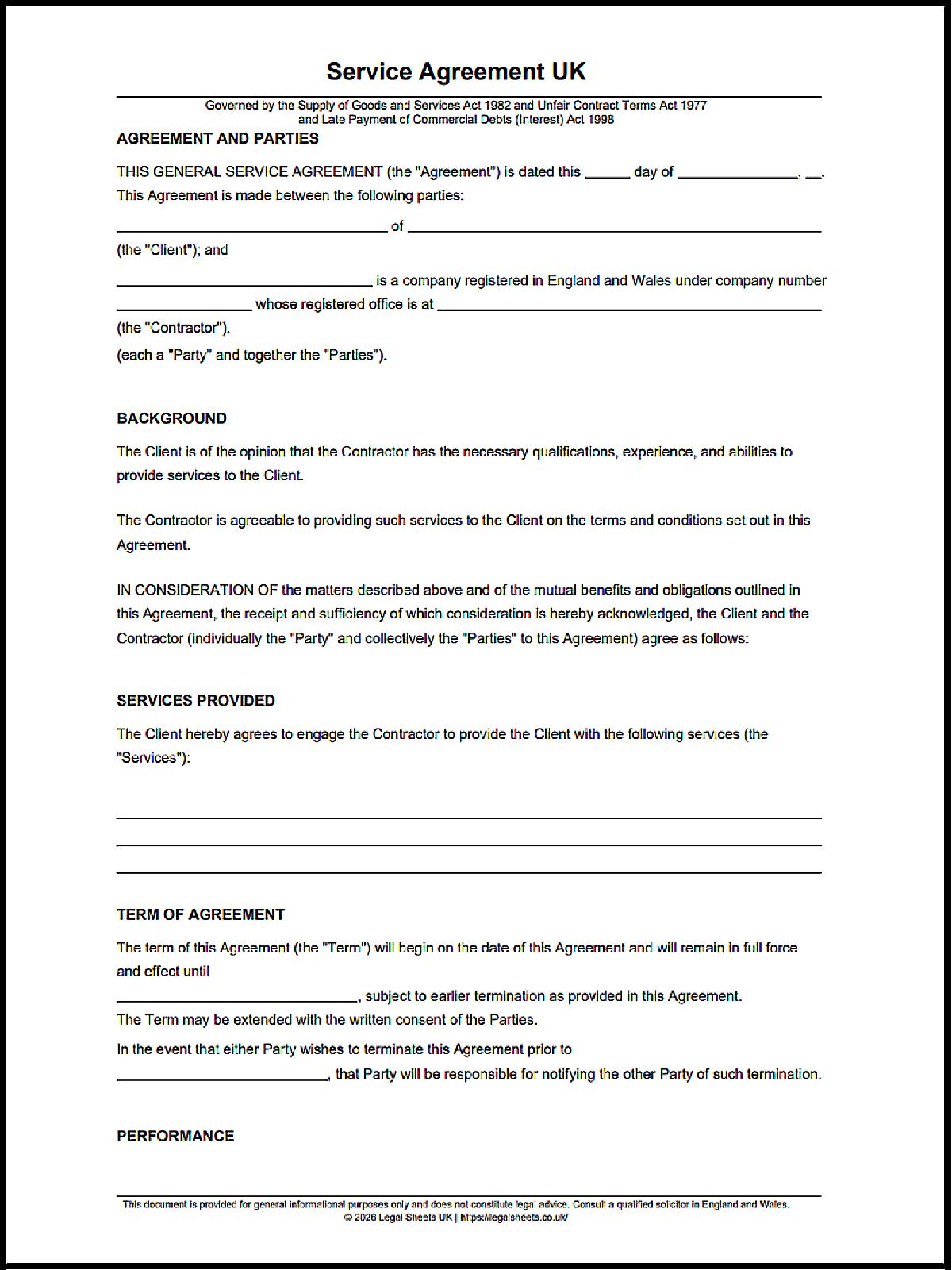
Free Service Agreement Template (PDF, Printable Formats)
A Service Agreement is often searched for only after a project has drifted away from what one side thought had been agreed, particularly when invoices remain unpaid or additional work has been requested without any clear variation process. In England, many County Court disputes involving service providers turn less on whether work was carried out and more on whether the agreement accurately described the services, payment triggers, and termination rights from the outset.
Where a company is contracting, authority to enter the arrangement can also become relevant under the Companies Act 2006 if the signatory’s position is later challenged. A well-drafted Service Agreement records the commercial understanding in a way that reflects how the relationship will actually operate day to day, rather than relying on informal emails or assumptions.
The wording and structure that follow are designed for that practical reality, whether you’re engaging a contractor, appointing a consultant, or supplying services to a client.
Table of Contents
ToggleService Agreement Template (PDF, Word & Printable Formats)
Before Drafting the Agreement: The Commercial Questions That Usually Cause Disputes Later
Many contractual disputes can be traced back to questions that were never properly discussed at the outset.
The drafting process should force both parties to identify expectations that might otherwise remain unstated.
Is the Provider Delivering Results or Simply Supplying Services?
One of the most common misunderstandings concerns the nature of the provider’s obligation.
Outcome-Based Engagements
Clients sometimes assume they are purchasing a specific result rather than professional effort. If a marketing consultant is engaged to increase sales, for example, the agreement should clarify whether the consultant guarantees outcomes or merely undertakes agreed activities.
Without that distinction, performance disputes become difficult to resolve.
Time-and-Materials Arrangements
Under a time-and-materials model, the provider is generally paid for work performed rather than a guaranteed outcome.
This structure offers flexibility but often creates concerns about budget control. Detailed reporting obligations and approval mechanisms can reduce disagreements over billable hours.
Retainer-Based Services
Retainer arrangements frequently generate disputes because clients expect unlimited availability while providers assume work will remain within defined boundaries.
A retainer should clearly state:
- Included services
- Response expectations
- Monthly limits
- Additional charges
Hybrid Service Models
Many commercial engagements combine elements of project work and ongoing support.
If the agreement fails to distinguish between the two, disputes often arise over whether certain activities fall within the fixed fee or attract additional charges.
What Exactly Is Included—and Excluded—from the Scope?
Scope disputes remain one of the most common causes of commercial litigation.
Scope Creep Risks
Scope creep usually develops gradually.
A client requests a minor adjustment. The provider accommodates it. Further requests follow. Eventually the parties disagree about whether additional work should be paid for.
By that stage, neither side may have retained clear records of what was originally agreed.
Change Request Procedures
A formal variation process creates discipline around project expansion.
Effective agreements require:
- Written requests
- Impact assessments
- Revised pricing where appropriate
- Formal approval before work begins
Without these controls, the parties often rely on conflicting recollections rather than documented decisions.
Additional Work Authorisation
Many providers lose recovery claims because employees or project managers approved extra work informally without proper authority.
The agreement should identify who may authorise changes and how approval must be communicated.
Out-of-Scope Charges
The document should explain how additional services will be priced.
Ambiguity in charging mechanisms frequently results in invoice disputes that could have been avoided through straightforward drafting.
Who Controls the Working Method?
The degree of operational control can have significant commercial consequences.
Independent Contractor Relationships
Where the provider operates as an independent business, excessive client control may create practical risks.
In some circumstances, HMRC may look beyond contractual labels and assess how the relationship functions in reality. If the provider is treated operationally like an employee, questions regarding employment status and off-payroll working obligations may arise.
Client Approval Rights
Clients commonly require approval rights for deliverables.
However, approval rights should not prevent the provider from exercising professional judgment in carrying out the services.
Poorly drafted approval provisions often create delays and uncertainty regarding project completion.
Operational Autonomy
Many successful service relationships depend on maintaining a clear distinction between oversight and control.
The client should be able to monitor performance without effectively managing the provider’s day-to-day activities.
Escalation Pathways
Disagreements frequently arise during delivery rather than at completion.
An escalation mechanism identifying decision-makers on both sides can resolve issues before positions become entrenched and legal costs begin accumulating.
Structuring the Commercial Relationship So Expectations Remain Enforceable
Commercial certainty is often more valuable than complex legal drafting.
The strongest agreements are usually those that define expectations in measurable terms.
Defining Services With Enough Precision to Avoid Ambiguity
Courts can enforce obligations only if they can identify what was promised.
Service Descriptions
Service descriptions should be specific enough that an independent observer could understand what work was expected.
Broad statements such as “provide consultancy services” rarely assist when a dispute develops.
Deliverable Specifications
Deliverables should identify:
- Outputs
- Format requirements
- Acceptance criteria
- Delivery dates
Where deliverables are unclear, payment disputes frequently follow.
Service Levels
Service level commitments become particularly important for ongoing service arrangements.
Examples include:
- Response times
- Resolution targets
- Availability commitments
- Reporting obligations
Objective measurements reduce arguments about whether performance was satisfactory.
Milestones and Completion Criteria
Many projects stall because nobody has defined what completion actually means.
Clear milestones allow both parties to assess progress and trigger payment events with greater certainty.
Managing Amendments Without Rewriting the Entire Agreement
Commercial relationships evolve. Contracts should anticipate change.
Variation Mechanisms
Variation clauses establish how contractual changes become effective.
They prevent parties from arguing later about whether informal discussions altered the agreement.
Written Approval Requirements
A requirement for written approval creates evidential certainty.
When disputes reach the County Court, documentary evidence often carries greater weight than conflicting witness recollections.
Pricing Adjustments
Additional work commonly requires revised pricing.
The agreement should establish how such adjustments will be calculated and approved.
Project Expansion Controls
Projects often expand beyond their original objectives.
Without formal controls, the provider may perform substantial additional work while struggling to recover payment for it later.
Dealing With Delays, Dependencies, and Client Cooperation
Many project failures are caused by client delay rather than provider delay.
Contracts should address this reality directly.
Client-Provided Information
Providers frequently depend upon information supplied by the client.
Where inaccurate or incomplete information causes delay, responsibility should be allocated clearly.
Access Requirements
Many services cannot be performed without access to systems, personnel, premises, or documentation.
The agreement should identify those dependencies and the consequences of restricted access.
Delay Attribution
Not every missed deadline reflects poor performance.
The contract should distinguish between delays caused by:
- The provider
- The client
- External events
Failure to allocate responsibility often creates avoidable disputes.
Consequences of Non-Cooperation
Clients occasionally fail to provide approvals, instructions, or information required for performance.
Without contractual provisions addressing non-cooperation, providers may face criticism for delays they did not cause.
Payment Clauses That Protect Cash Flow and Reduce Recovery Problems
Many service providers can tolerate operational challenges. Cash-flow disruption is often far more damaging.
A large percentage of County Court debt claims arise because payment provisions were drafted with insufficient precision.
Fixed Fees, Hourly Rates, Retainers, and Milestone Payments
Different pricing structures allocate risk differently.
Commercial Suitability of Each Structure
Fixed fees provide budget certainty but place greater delivery risk on the provider.
Hourly rates offer flexibility but require stronger record-keeping.
Retainers create predictable revenue but require careful definition of included services.
Milestone payments can balance risk where projects are delivered in stages.
Risk Allocation Differences
Pricing structures influence how commercial risk is distributed.
A poorly chosen payment model may create conflict even where service delivery itself is successful.
Budget Certainty Considerations
Clients often prioritise predictability, while providers seek protection against expanding workloads.
The payment structure should reflect those competing priorities.
Invoice Timelines and Approval Procedures
Many payment disputes involve process failures rather than genuine disagreements.
Submission Requirements
The agreement should specify:
- Invoice frequency
- Required supporting documents
- Submission methods
- Reference requirements
Administrative defects can delay payment unnecessarily.
Payment Triggers
The parties should define precisely when payment becomes due.
Common triggers include:
- Completion of milestones
- Acceptance of deliverables
- Monthly billing cycles
Unclear payment triggers often create avoidable arguments.
Disputed Invoice Procedures
Not every invoice dispute concerns the entire amount.
A structured dispute process can require undisputed sums to be paid while specific issues are investigated.
Late Payment Rights and Statutory Recovery Remedies
Business-to-business agreements often address overdue invoices expressly.
Under the Late Payment of Commercial Debts (Interest) Act 1998, statutory remedies may apply to qualifying overdue commercial debts. The availability of contractual remedies should therefore be considered carefully when drafting payment provisions.
Contractual Interest Provisions
Contractual interest clauses can encourage prompt payment and provide certainty regarding recovery calculations.
Statutory Interest Implications
Where contractual terms are silent or ineffective, statutory rights may become relevant depending on the circumstances of the debt.
Administrative Compensation Rights
Businesses often focus solely on interest while overlooking additional recovery mechanisms that may arise when invoices remain unpaid.
Alternative Substantial Remedies
Some agreements contain alternative remedies intended to replace statutory rights.
The drafting must be considered carefully because poorly drafted provisions frequently become a point of contention during recovery proceedings.
Preventing Payment Disputes Caused by Vague Deliverables
Many unpaid invoice disputes are really performance disputes in disguise.
Acceptance Criteria
Acceptance criteria provide objective measures for determining whether work has been completed.
Completion Evidence
Providers should maintain records demonstrating performance, including:
- Delivery confirmations
- Approval emails
- Project reports
- Meeting records
Such evidence often becomes decisive if litigation follows.
Sign-Off Procedures
Formal sign-off procedures create a clear endpoint for performance obligations.
Without sign-off mechanisms, parties frequently disagree about whether services were completed, creating unnecessary barriers to payment recovery.
Part 2 will continue with liability clauses, intellectual property ownership, data protection obligations, termination provisions, and commonly overlooked contractual clauses.
The Liability Provisions Courts Commonly Scrutinise
Liability clauses are often negotiated more aggressively than any other section of a Service Agreement. They determine who absorbs financial losses when something goes wrong and frequently become the first provisions examined when a dispute reaches the County Court or High Court.
Many businesses devote considerable attention to pricing and scope while relying on generic liability wording copied from previous contracts. That approach often creates problems because liability clauses are heavily dependent upon the nature of the services, the bargaining positions of the parties, and the risks associated with the engagement.
Liability Caps and Their Commercial Purpose
A liability cap establishes the maximum amount one party may be required to pay if it breaches the agreement.
Financial Exposure Management
Most service providers seek a cap because the contract value may be significantly lower than the potential losses a client could claim following an alleged breach.
For example, a consultancy project worth a few thousand pounds could theoretically be linked to a much larger business loss. Without a contractual limit, exposure may become commercially disproportionate.
Insurance Alignment
Liability caps are often linked to available insurance cover.
Where the cap bears no relationship to actual insurance arrangements, disputes frequently arise regarding whether the allocation of risk was commercially reasonable.
Risk Allocation Strategy
A liability cap is ultimately a risk-allocation tool.
The parties should consider:
- Contract value
- Nature of the services
- Likelihood of loss
- Available insurance
- Commercial bargaining strength
A cap that appears reasonable at the drafting stage is generally more likely to withstand scrutiny if later challenged.
Exclusions That May Be Unenforceable
Some exclusions are more vulnerable than others.
Businesses occasionally assume they can exclude virtually any liability through contractual wording. English law places limits on that assumption.
Negligence Limitations
The most heavily scrutinised exclusions often involve negligence.
Under the Unfair Contract Terms Act 1977 (UCTA), certain attempts to exclude liability may only be effective if they satisfy the statutory requirement of reasonableness.
Personal Injury and Death Exclusions
Liability for death or personal injury resulting from negligence cannot be excluded or restricted.
Attempting to do so creates immediate enforceability problems and may undermine confidence in the wider limitation clause.
For further statutory detail, see the Unfair Contract Terms Act 1977.
Reasonableness Assessments
Courts do not assess limitation clauses in isolation.
They often consider:
- Relative bargaining power
- Commercial sophistication
- Availability of alternatives
- Practical allocation of risk
A clause that appears heavily one-sided may attract closer scrutiny than a balanced commercial arrangement negotiated between experienced businesses.
Indemnities and When They Are Appropriate
Indemnities are frequently misunderstood.
Many parties treat them as standard boilerplate without considering the financial consequences they may create.
Third-Party Claims
Indemnities are commonly used where one party may face claims from third parties because of the other’s conduct.
The clause should identify:
- What claims are covered
- Notification procedures
- Defence rights
- Settlement authority
Ambiguity often produces secondary disputes about the indemnity itself.
Intellectual Property Infringement
Where a provider creates content, software, designs, or proprietary materials, intellectual property infringement claims may become a genuine commercial risk.
Specific indemnity wording is often used to allocate responsibility if third-party rights are alleged to have been infringed.
Data Protection Liabilities
Where personal data forms part of the service delivery process, the parties may wish to address responsibility for data protection failures.
However, indemnities should complement rather than replace properly drafted operational compliance obligations.
Why Aggressive Limitation Clauses Sometimes Backfire
Some organisations attempt to eliminate almost all contractual exposure.
That strategy does not always succeed.
UCTA Scrutiny
Excessively restrictive clauses are more likely to face challenges under UCTA where the legislation applies.
A limitation clause that appears commercially unreasonable may provide less protection than a carefully balanced alternative.
Bargaining Power Considerations
Courts often recognise the commercial reality of negotiated contracts between businesses.
However, significant inequality in bargaining power may become relevant when assessing disputed provisions.
Consequences of Invalid Provisions
When a limitation clause fails, the consequences can be severe.
Instead of relying on contractual restrictions, the service provider may find itself exposed to substantially broader common-law claims than originally anticipated.
Ownership of Work Product, Intellectual Property, and Business Assets
Ownership disputes often emerge only after the commercial relationship has ended.
At that stage, both parties may assume they own the same materials.
When the Client Should Own Deliverables
Certain projects are commissioned specifically so the client can acquire ownership of the resulting work.
Bespoke Work Products
Custom-developed materials are frequently intended to belong to the client upon completion.
Examples may include:
- Reports
- Designs
- Training materials
- Custom documentation
The agreement should state this clearly rather than relying on assumptions.
Commissioned Materials
Clients often expect ownership because they funded the work under a commissioned project.
However, payment alone does not automatically resolve ownership questions if the contract is silent.
Exclusive-Use Arrangements
Where exclusivity is commercially important, the document should explain precisely what rights the client receives following completion.
When the Service Provider Retains Rights
Not every element of a project is intended to transfer.
Many providers rely upon assets developed across multiple client engagements.
Pre-Existing Materials
Providers commonly incorporate pre-existing content, frameworks, methodologies, or resources into their services.
The agreement should distinguish these assets from newly created deliverables.
Methodologies
Many service businesses depend on proprietary methodologies that remain central to future projects.
Failure to reserve ownership can create uncertainty regarding future commercial use.
Templates and Proprietary Systems
Providers often continue using standard systems and templates across their client base.
The agreement should make clear whether the client receives ownership, a licence, or merely access rights.
Assignments, Licences, and Future Use Restrictions
Ownership can be transferred in different ways.
Transfer Structures
An assignment generally transfers ownership rights from one party to another.
The commercial intention should be reflected accurately in the drafting.
Licence Alternatives
A licence may be more appropriate where the provider intends to retain ownership while granting specified usage rights.
This approach often balances client needs with long-term commercial interests.
Commercial Exploitation Rights
Disputes frequently arise where neither party considered future use at the outset.
Questions commonly emerge regarding:
- Reuse
- Modification
- Commercial exploitation
- Distribution rights
The agreement should address these issues before they become contentious.
Execution Risks Where Intellectual Property Transfers Are Intended
Ownership provisions deserve particular attention where transfers are intended to be permanent.
Consideration Issues
The parties should ensure the contractual structure supports the intended transfer mechanism.
Defective drafting can create uncertainty regarding ownership long after services have been completed.
Deed Requirements
Certain transactions may justify execution as a deed rather than a simple contract.
Where a deed is used, additional execution formalities apply.
Long-Term Enforcement Implications
Ownership disputes often emerge years after project completion.
The quality of the original drafting frequently determines whether the dispute can be resolved quickly or escalates into expensive litigation.
Data Processing Obligations That Cannot Be Left to Generic Boilerplate
Data protection clauses are often overlooked until a compliance review, client audit, or regulatory issue exposes deficiencies.
Where personal data is processed as part of the services, generic wording may be inadequate.
Identifying When UK GDPR Clauses Become Mandatory
The critical question is whether one party processes personal data on behalf of the other.
Controller-to-Processor Relationships
A common example involves outsourced service providers handling customer, employee, or business-contact data for a client.
Where this occurs, specific contractual requirements may arise.
Outsourced Business Functions
Functions frequently associated with personal data processing include:
- Administrative support
- Customer management
- Marketing services
- Data analysis
- Technology support
The actual operational activities matter more than the label attached to the agreement.
Customer Data Handling
Businesses often underestimate the amount of personal data involved in service delivery.
Even relatively routine services may trigger data-processing obligations.
Information That Must Be Defined in the Agreement
Article 28 of UK GDPR requires specific matters to be addressed contractually where processor arrangements exist.
Further guidance can be found through the Information Commissioner’s Office (ICO).
Processing Purpose
The agreement should identify why personal data is being processed.
Vague descriptions create uncertainty regarding permissible use.
Processing Duration
The period during which data processing will occur should be clearly defined.
This becomes particularly important when the relationship ends.
Categories of Personal Data
The document should identify the types of personal data involved.
Overly broad descriptions frequently create compliance concerns during audits.
Categories of Data Subjects
The agreement should also identify whose data is being processed.
Examples may include customers, employees, suppliers, or business contacts.
Operational Responsibilities Between the Parties
Compliance failures rarely arise from the contract alone.
Operational practice is equally important.
Security Measures
The parties should identify expected security standards and responsibilities.
A contractual obligation with no operational implementation is unlikely to satisfy regulators.
Written Instructions
Processors generally require documented instructions regarding permitted processing activities.
Failure to maintain clear instructions can create evidential difficulties during investigations.
Data Subject Requests
The agreement should address how requests relating to personal data will be managed.
Without clear procedures, response delays become more likely.
Regulatory Cooperation
Where regulatory inquiries arise, cooperation obligations can become extremely important.
The absence of clear responsibilities may complicate investigations and increase compliance risks.
Termination Clauses Designed for Commercial Reality Rather Than Legal Theory
Many contracts are drafted with great optimism. Termination provisions recognise that commercial relationships sometimes fail.
A practical termination clause addresses what happens when cooperation breaks down rather than assuming performance will continue indefinitely.
Ending the Agreement for Convenience
Not every termination stems from wrongdoing.
Commercial priorities change.
Budgets are reduced.
Projects lose relevance.
Businesses restructure following shareholder changes
Notice Periods
Convenience termination provisions usually depend on notice periods.
The chosen period should reflect the practical needs of both parties.
A consultancy arrangement may require a different notice period from a long-term outsourced service contract.
Transition Obligations
The end of a contract is often operationally sensitive.
The parties may need to:
- Transfer information
- Complete outstanding work
- Assist with handovers
- Return assets
These obligations should be planned before termination occurs.
Commercial Impact
Termination rights affect negotiating leverage throughout the life of the agreement.
A right that appears reasonable initially may create operational difficulties if exercised unexpectedly.
Immediate Termination Events
Some situations justify immediate termination.
Material Breach
Material breach provisions are commonly relied upon when one party fundamentally fails to perform its obligations.
The agreement should provide enough detail to reduce uncertainty regarding what constitutes a material breach.
Insolvency Events
Businesses often seek the right to terminate if the other party experiences serious financial difficulties.
This reduces the risk of ongoing dependence upon an unstable supplier or customer.
Reputational Risks
Certain engagements may justify termination where continued association creates substantial reputational concerns.
Regulatory Failures
Regulatory non-compliance can have consequences extending far beyond the contract itself.
Termination rights may therefore be linked to serious compliance failures.
What Happens After Termination
Many disputes concern post-termination obligations rather than termination itself.
Outstanding Invoices
The agreement should address whether accrued payment obligations survive termination.
Return of Information
Businesses often overlook practical arrangements regarding the return or deletion of information.
This omission frequently causes conflict after the relationship ends.
Confidentiality Continuation
Confidentiality obligations commonly continue beyond termination.
The duration and scope of those obligations should be clear.
Ongoing Liability Provisions
Certain contractual provisions may survive termination because their purpose extends beyond the active service period.
The agreement should identify those provisions expressly.
Common Termination Notice Mistakes
Even a valid termination right can be undermined by procedural errors.
Wrong Recipient
Termination notices occasionally reach the wrong individual or department.
This can create disputes regarding effectiveness.
Incorrect Delivery Method
Many agreements specify how notices must be delivered.
Failure to follow those requirements often becomes a central issue in litigation.
Missed Contractual Deadlines
Termination rights sometimes depend on strict timing requirements.
Missing a contractual deadline may prevent reliance on an otherwise valid right to terminate.
Clauses Frequently Overlooked Until a Dispute Emerges
Many Service Agreements contain detailed provisions on pricing, scope, and liability but devote very little attention to administrative clauses. Ironically, these overlooked provisions often become decisive when a dispute develops.
Notices Clauses and Service Requirements
A party may have a valid claim, termination right, or breach notice, but that right can become difficult to enforce if contractual notice requirements are ignored.
Contractual Notice Procedures
The notices clause should identify:
- Permitted delivery methods
- Required addresses
- Named recipients (if applicable)
- When notice is deemed received
Many commercial disputes begin with arguments about whether a notice was validly served rather than the substance of the dispute itself.
Default Legal Service Rules
Where a contract is silent, common law principles may become relevant. If litigation follows, formal court documents must be served in accordance with Part 6 of the Civil Procedure Rules.
Further information regarding civil court procedures is available through the Civil Procedure Rules.
Evidence of Delivery
Businesses frequently overlook the need to retain evidence showing when and how notices were sent.
When termination rights, payment demands, or breach allegations are challenged, delivery evidence often becomes crucial.
Third-Party Rights and Unintended Enforcement Risks
Many organisations assume only the signatories can enforce a contract. That assumption is not always correct.
Affiliates
Corporate groups sometimes expect affiliated companies to benefit from contractual protections.
If the agreement is unclear, disputes may arise regarding who can enforce particular provisions.
Employees
Employees occasionally benefit indirectly from contractual arrangements, particularly where indemnities or protective provisions exist.
The parties should decide whether enforcement rights are intended.
Subcontractors
Service delivery frequently involves subcontractors who were never direct parties to the agreement.
Without careful drafting, uncertainty can arise regarding rights and protections available to those subcontractors.
Express Exclusions
Many commercial agreements expressly exclude third-party enforcement rights to avoid unexpected claims arising later.
Assignment Restrictions and Business Transfers
Businesses evolve over time.
Ownership structures change.
Operations are sold.
Receivables are assigned.
The agreement should anticipate those possibilities.
Transfer of Rights
The parties should determine whether contractual rights can be transferred without consent.
A client may be comfortable working with one provider but not with an unknown replacement.
Debt Assignments
Payment rights are sometimes assigned to third parties for financing, collection purposes, or loan security.
The agreement should address whether restrictions apply.
Consent Requirements
Consent mechanisms should be practical.
Overly restrictive provisions can create operational difficulties during legitimate business restructuring exercises.
Confidentiality Protections Beyond a Separate NDA
Many parties assume a standalone non-disclosure agreement removes the need for confidentiality provisions within the Service Agreement itself.
In practice, service-specific confidentiality obligations often remain necessary.
Commercial Information
Service providers may gain access to pricing models, business plans, supplier arrangements, or operational procedures.
The agreement should identify how such information must be handled.
Customer Information
Customer-related information frequently represents one of the most valuable commercial assets involved in the relationship.
Confidentiality provisions should reflect that reality.
Trade Secrets
Certain information may retain value long after the services have ended.
The parties should consider whether enhanced protection is appropriate for highly sensitive information.
Survival Obligations
Confidentiality obligations commonly continue after termination.
Failure to specify survival periods can create uncertainty regarding future obligations.
Signing the Agreement Correctly
Many businesses spend considerable time negotiating commercial terms yet devote little attention to execution requirements.
That becomes problematic when enforceability is later challenged.
Individual Signatories
Where individuals sign personally, the primary concern is usually authority and capacity.
Authority Considerations
The signatory should genuinely be the party assuming the obligations contained within the agreement.
Confusion regarding who contracted with whom can create significant enforcement problems.
Evidence of Capacity
Maintaining signed copies and supporting records reduces future disputes regarding authority and execution.
Corporate Execution Requirements
Businesses should ensure the person signing has authority to bind the company.
Authorised Signatories
Under Section 43(1)(b) of the Companies Act 2006, a simple contract may be executed by an authorised individual acting on behalf of the company.
Director Authority
Many organisations delegate contracting authority internally.
Failure to follow internal approval procedures can create practical difficulties even where external validity remains unaffected.
Company Secretary Involvement
Some organisations continue to involve company secretaries or additional officers as part of their governance procedures.
Additional Formalities for Deeds
Certain transactions may require or justify execution as a deed.
Witnessing Requirements
Where a deed is used, witnessing requirements become critical.
Improper witnessing can undermine the effectiveness of the execution process.
Delivery as a Deed
Execution alone is not always sufficient. The deed must also be delivered in accordance with the relevant legal requirements.
Consequences of Defective Execution
Execution defects often remain undiscovered until enforcement is attempted years later.
At that stage, correcting the problem may be impossible.
Operational Failures That Commonly Trigger Commercial Litigation
Many commercial disputes arise from operational conduct rather than legal drafting errors.
The agreement may be perfectly valid while day-to-day administration creates unnecessary conflict.
Scope Creep Without Formal Variations
Informal project expansion remains one of the most common sources of disagreement.
Informal Instructions
Employees frequently authorise additional work through meetings, telephone calls, or emails without considering contractual requirements.
The resulting expectations may differ significantly between the parties.
Email-Based Changes
Email exchanges often create uncertainty regarding whether a formal contractual variation occurred.
A variation procedure only has value if it is followed consistently.
Pricing Disputes
Additional work performed without clear pricing approval frequently leads to invoice challenges and recovery claims.
The Battle of the Forms Problem
Commercial parties often exchange multiple documents before work begins.
Competing Standard Terms
A supplier may rely on quotation terms while the customer relies on purchase-order conditions.
The parties sometimes discover the conflict only after a dispute arises.
Purchase Orders Versus Quotations
Different documents may contain contradictory provisions relating to liability, payment, or dispute resolution.
Those inconsistencies can significantly complicate litigation.
Last-Shot Rule Risks
Where competing terms exist, determining which terms ultimately govern the relationship can become a substantial issue in proceedings.
Failure to Follow Contractual Claim Procedures
Contracts frequently contain procedural requirements that parties overlook.
Notice Deadlines
Some rights depend upon compliance with strict notice periods.
Failure to meet those deadlines can prevent recovery altogether.
Indemnity Claims
Indemnities often require prompt notification and procedural compliance.
Businesses occasionally lose contractual protections simply because required processes were ignored.
Contractual Limitation Periods
Parties should understand any contractual restrictions affecting when claims may be brought.
Weak Documentation During Performance
Good records frequently determine the outcome of commercial disputes.
Missing Approvals
Projects often proceed without obtaining documented approvals required by the contract.
This creates evidential difficulties later.
Inadequate Records
Where performance records are poor, proving compliance becomes more expensive and uncertain.
Deliverable Disputes
Many litigation cases ultimately turn on whether work was completed as agreed.
Contemporaneous documentation is usually more persuasive than retrospective explanations.
Resolving Service Agreement Disputes Before Court Action Becomes Necessary
Litigation is rarely the most efficient solution for either party.
Commercial relationships often benefit from structured dispute-resolution procedures before formal proceedings are considered.
Internal Escalation and Commercial Resolution
Many disagreements can be resolved once senior decision-makers become involved.
Senior Management Review
Operational teams may become entrenched in disputes that management can resolve quickly through commercial compromise.
Contractual Escalation Routes
Formal escalation procedures can prevent minor disagreements from developing into expensive legal claims.
Mediation and Alternative Dispute Resolution
Courts increasingly expect parties to consider settlement opportunities before commencing litigation.
Commercial Settlement Opportunities
Mediation often allows the parties to preserve commercial relationships while addressing the underlying dispute.
Cost-Control Benefits
Even successful litigation can be expensive.
Early settlement frequently produces a more predictable commercial outcome.
Pre-Action Requirements Before Issuing Proceedings
Many businesses underestimate the procedural obligations that arise before a claim is filed.
Letter Before Action
A properly prepared Letter Before Action frequently encourages settlement before proceedings become necessary.
Evidence Preparation
Businesses should gather:
- The signed agreement
- Variations
- Correspondence
- Invoices
- Payment records
- Performance evidence
Weak preparation often weakens otherwise strong claims.
Settlement Engagement
Failure to engage constructively before litigation may have consequences when courts consider procedural conduct and costs.
Where Commercial Disputes Are Usually Heard
The value and complexity of the dispute often determine the forum.
County Court Claims
Most breach of contract and debt recovery disputes are heard in the County Court.
Claims under £10,000 are generally allocated to the Small Claims Track, where recovery of legal costs is heavily restricted.
Claims between £10,000 and £25,000 are generally allocated to the Fast Track.
Business and Property Courts
More substantial commercial disputes may require specialist judicial management.
Commercial Court Considerations
High-value and complex commercial litigation may be heard within the High Court, including the Commercial Court where appropriate.
UK Legal Facts and Compliance Framework
Legal Requirements
| Topic / Issue | England Legal Rule | Governing Law |
|---|---|---|
| Corporate Simple Contracts Execution | Can be executed by an authorised individual acting for the company | Section 43(1)(b), Companies Act 2006 |
| Corporate Deed Execution | Requires authorised signatories or a director plus independent witness and delivery as a deed | Sections 44 and 46, Companies Act 2006 |
| Exclusion of Negligence Liability | Liability for death or personal injury caused by negligence cannot be excluded; other exclusions must satisfy reasonableness requirements | Section 2, Unfair Contract Terms Act 1977 |
| Statutory Late Payment Remedies | Interest and compensation may apply to qualifying overdue commercial debts | Sections 1 and 4, Late Payment of Commercial Debts (Interest) Act 1998 |
| Third-Party Enforcement Rights | Third parties may enforce contractual rights in certain circumstances unless excluded | Section 1, Contracts (Rights of Third Parties) Act 1999 |
| Assignment of Legal Rights | Written assignment and notice requirements apply | Section 136, Law of Property Act 1925 |
| Data Processing Clauses | Mandatory contractual provisions apply where personal data is processed on behalf of another party | Article 28(3), UK GDPR |
| Corporate Trading Disclosures | Certain company identity information must appear on business documents | Companies (Trading Disclosures) Regulations 2008 |
| Registration of Corporate Charges | Certain charges require registration within prescribed time limits | Section 859A, Companies Act 2006 |
| Land Registration Requirements | Certain property-related transfers require registration | Land Registration Act 2002 |
Practical Legal Impact
These rules influence commercial drafting in ways that are often overlooked until enforcement becomes necessary.
Liability clauses must be drafted with statutory restrictions in mind. A provision attempting to exclude liability for death or personal injury caused by negligence will not achieve its intended result and may attract scrutiny of the wider limitation regime.
Data-processing provisions deserve particular attention. Where a service provider acts as a processor, omission of mandatory Article 28 terms creates regulatory exposure that extends beyond contractual risk. The ICO may investigate compliance failures irrespective of whether a dispute exists between the parties.
Execution requirements also matter. Businesses sometimes assume that obtaining a signature is enough. If a transaction requires deed execution and the necessary formalities are absent, enforceability problems may emerge years later when rights need to be exercised.
Similarly, registration obligations become relevant when agreements extend beyond pure service provision and involve security interests or property-related rights.
Frequently Asked Questions
Can a service agreement cap liability at a very low amount without risking unenforceability?
Possibly, but the lower the cap, the more likely it is to attract scrutiny if challenged. Courts may examine the commercial context, bargaining power, available insurance, and whether the limitation satisfies applicable reasonableness requirements under UCTA.
What happens if a company signs a service agreement using the wrong execution method for a deed?
The consequences depend on the nature of the defect and the transaction involved. Execution failures can create uncertainty regarding enforceability and may undermine rights the parties believed had been validly created.
Can a client rely on statutory late-payment interest if the agreement already contains its own interest clause?
Potentially, but the interaction between contractual remedies and statutory remedies requires careful consideration. The drafting should clearly address how overdue invoices will be treated and whether alternative contractual remedies are intended to apply.
Why do service providers lose disputes even when the work was completed?
The most common reasons are evidential rather than technical. Missing approvals, vague deliverables, inadequate records, informal scope changes, and failure to follow contractual procedures frequently undermine otherwise valid claims.
Can an affiliate, subcontractor, or employee enforce rights under a service agreement if they did not sign it?
In some circumstances, third parties may obtain enforcement rights under the Contracts (Rights of Third Parties) Act 1999 unless those rights are expressly excluded. Businesses that wish to prevent unintended enforcement should address the issue directly within the agreement.
Author
-

Ankur is the founder and editorial reviewer at LegalSheets. He researches, writes, and reviews legal content, ensuring every template and guide is clear, accurate, and based on current UK laws and official government guidance. His focus is on making legal documents easier for individuals and businesses to understand and use.
