
Maternity Leave Letter (Fillable PDF)
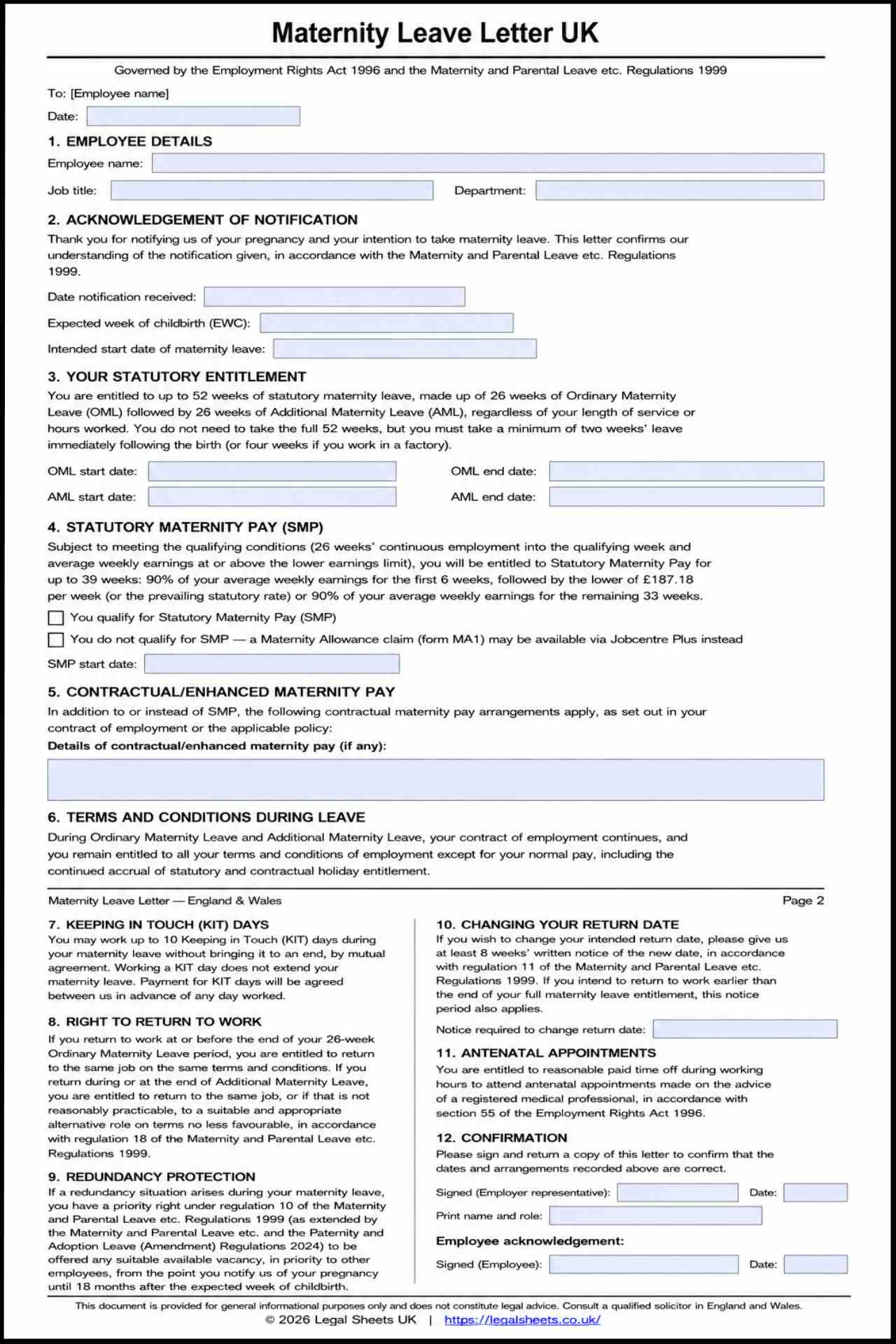
A Maternity Leave Letter is particularly useful when an employee needs to formally record maternity leave arrangements or an employer needs to confirm the dates following notification of pregnancy. The wording should accurately reflect the employee’s proposed start date and expected return date while keeping maternity leave separate from Statutory Maternity Pay, which has its own eligibility requirements.
Employees have employment rights during maternity leave, including rights relating to holiday accrual, pay rises and returning to work. The letter should therefore record the relevant dates and arrangements carefully, giving the employee and employer a clear written record to rely on during the leave period.
Table of Contents
ToggleMaternity Leave Letter Template (PDF, Word & Printable Formats)
Getting the Maternity Leave Notification Dates Right
The 15th-Week Notification Deadline
The employee must provide formal written notice of the pregnancy, expected week of childbirth and intended maternity leave start date no later than the end of the 15th week before the expected week of childbirth.
This means the letter should not simply say that the employee intends to take maternity leave at some point in the future. It should identify the information needed to establish the intended leave arrangements.
Missing information can create practical problems. Where the required particulars are not supplied within the applicable period without reasonable excuse, the employer may be able to postpone the start of maternity leave until the necessary notice has been provided.
Choosing the Intended Maternity Leave Start Date
The intended start date should be written as a specific calendar date rather than left open-ended.
Under Regulation 6 of the Maternity and Parental Leave etc. Regulations 1999, statutory maternity leave cannot begin earlier than the 11th week before the Expected Week of Childbirth (EWC). Furthermore, under Regulation 7, any pregnancy-related absence during the four weeks prior to the EWC automatically triggers the start of maternity leave, overriding any later date specified in the employee’s letter.
For HR purposes, the date written in the letter should therefore be clear enough to enter accurately into the employee’s records.
Changing the Maternity Leave Start Date
An employee who later wants to change the proposed start date needs to provide written notice within the applicable statutory period.
Under Regulation 4(3)–(4) of the 1999 Regulations, an employee wishing to alter their maternity start date must give at least 28 days’ written notice before the new date or the original date—whichever is earlier. This formal variation resets the operational timetable for HR and payroll.
A revised notification should clearly state the new proposed date rather than relying on an earlier letter. This reduces the risk of HR or payroll retaining conflicting dates.
What Must the Employee Put in the Letter?
Confirming the Pregnancy
The letter should explicitly confirm that the employee is pregnant.
This is one of the statutory facts identified in the supplied framework. The wording does not need to turn the notification into a lengthy medical statement. A straightforward confirmation is sufficient for the purpose of recording the notification.
The employee should also keep a copy of the notification and evidence of when it was sent or received.
Giving the Expected Week of Childbirth
The expected week of childbirth should be clearly recorded.
Under English statutory definitions, the Expected Week of Childbirth (EWC) is the specific calendar week, starting at midnight between Saturday and Sunday, in which childbirth is expected. Stating the exact EWC rather than an informal estimated due date is essential, as statutory notice deadlines and SMP calculation windows hinge directly on this date.
This date is particularly important because several statutory calculations depend upon it.
Stating the Intended Leave Start Date
The employee should state the exact calendar date on which they intend Ordinary Maternity Leave to begin.
A clear date allows the employer to calculate the relevant maternity leave period and respond appropriately. It also gives HR and payroll a specific date to record rather than having to interpret an informal statement about when the employee expects to stop working.
When Pregnancy-Related Illness Automatically Changes the Start Date
Absence During the Four Weeks Before the Expected Week of Childbirth
One of the more important practical complications arises where an employee becomes absent because of a pregnancy-related illness during the four weeks before the expected week of childbirth.
Under the supplied legal framework, maternity leave can begin automatically following such an absence, even where the original maternity letter gave a later planned start date.
For example, an employee may originally plan to work until a particular date but then be signed off with a pregnancy-related condition. The employer should not simply continue relying on the original letter. HR and payroll records may need to be updated to reflect the statutory trigger.
Why the Original Letter May No Longer Reflect the Actual Start Date
The date contained in the maternity letter is the employee’s intended start date. It does not necessarily remain the operative date if a statutory automatic trigger occurs.
The practical issue is record keeping. The employer should identify the date of the relevant pregnancy-related absence, determine the resulting maternity leave start date, and update the employee’s maternity and payroll records accordingly.
MAT B1, Statutory Maternity Pay and Maternity Leave Are Not the Same Thing
When the MAT B1 Certificate Is Needed
The MAT B1 certificate is relevant to Statutory Maternity Pay rather than being the document that creates the employee’s underlying maternity leave entitlement.
The supplied framework states that the employee must provide medical evidence of pregnancy and the due date for SMP purposes, with the MAT B1 certificate identified as the relevant evidence.
This distinction matters because an employee may have a statutory right to maternity leave even where there is a separate question about entitlement to SMP.
Maternity Leave vs Statutory Maternity Pay
Statutory maternity leave and Statutory Maternity Pay should be administered as separate questions.
Under Section 71 of the Employment Rights Act 1996, the right to take 52 weeks of maternity leave is a day-one statutory right with zero qualifying service requirement. Conversely, Statutory Maternity Pay (SMP) is governed separately by the Social Security Contributions and Benefits Act 1992 and requires 26 weeks of continuous service by the 15th week before the EWC, alongside meeting the Lower Earnings Limit
For an employer, this means an SMP eligibility decision should not simply be treated as a decision about whether the employee can take maternity leave.
What Happens If Statutory Maternity Pay Is Not Available?
Where an employer determines that the employee does not qualify for SMP under the stated eligibility requirements, the supplied framework identifies Form SMP1 as the relevant document.
The framework states that the employer should issue SMP1 within the specified period so that the employee can pursue Maternity Allowance through the Department for Work and Pensions where applicable.
The maternity leave notification should therefore remain separate from the payroll decision concerning SMP.
What the Employer Must Do After Receiving the Letter
The 28-Day Written Response
Receiving the employee’s maternity notification creates an important employer-side task.
The employer must respond in writing within 28 days and confirm the date on which the 52-week maternity leave period will end.
The response deadline should be calculated from the date the notification is received. This is why HR should record the receipt date rather than merely saving the letter without an administrative timestamp.
Creating a Reliable HR and Payroll Audit Trail
A practical maternity record should allow someone reviewing the file later to establish:
- When the notification was received.
- The expected week of childbirth.
- The intended maternity leave start date.
- The confirmed expected return date.
- Whether MAT B1 documentation was provided.
- The employer’s SMP decision.
- Any subsequent change to the maternity leave dates.
The supplied framework specifically identifies the date of receipt as triggering the employer’s 28-day response period.
What Happens If the Employer Misses the 28-Day Response Deadline?
The Early Return Consequence
The employer’s written response is not merely an administrative courtesy.
The supplied framework connects the employer’s 28-day response obligation with the employee’s ability to return early. Where the employer has failed to provide the required confirmation, this can affect the employer’s ability to postpone an early return where the employee has not given the usual eight weeks’ advance notice.
That makes the original notification date and the employer’s response date important pieces of the HR record.
Why the Employer’s Response Should Not Be Treated as Routine Administration
A missed response can have consequences later in the maternity process.
For that reason, the employer should treat the notification as a dated HR workflow: record receipt, calculate the 28-day deadline, prepare the written confirmation and retain evidence that the response was issued.
Protecting the Employee After Maternity Notification
Pregnancy and Maternity Discrimination
A maternity notification can also create significant discrimination risks for an employer.
The supplied framework identifies section 18 of the Equality Act 2010 as providing protection against pregnancy and maternity discrimination. It specifically identifies unfavourable treatment, performance management, demotion and redundancy selection as potential areas of concern.
The fact that a legitimate workplace issue exists does not mean the employer can ignore pregnancy and maternity protections when deciding how to address it.
Automatically Unfair Dismissal
The supplied legal facts also identify section 99 of the Employment Rights Act 1996 in connection with automatically unfair dismissal in maternity-related circumstances.
Where a workplace decision is being considered after maternity notification, the employer should maintain a clear record of the genuine reason for the decision and the process followed.
Enhanced Redundancy Protection
The supplied framework identifies enhanced statutory priority rights for suitable alternative vacancies in specified redundancy circumstances under the 2024 amendment regulations.
The protection extends through pregnancy and for the specified period following the expected week of childbirth.
This becomes particularly relevant where a redundancy exercise overlaps with an employee’s maternity notification.
Compulsory Maternity Leave: The First Weeks After Birth
The Two-Week Restriction
The maternity leave process does not simply end with the employee’s planned start date.
The supplied framework identifies compulsory maternity leave following childbirth and states that an employee should not return to work during the first two weeks following childbirth, with a four-week restriction identified for factory workers.
Employers therefore need to ensure that workplace and payroll systems do not inadvertently treat the employee as available for work during this protected period.
Payroll and Workplace Records
Once the actual childbirth date is known, HR should update the relevant records.
The employer should reconcile the actual date with the planned maternity timetable and ensure payroll and workplace systems reflect the compulsory leave period.
Common Maternity Leave Letter Mistakes
Missing One of the Required Notification Details
A letter that confirms pregnancy but omits the expected week of childbirth or intended leave start date may not contain all the information required by the statutory notification process.
The three core facts identified in the supplied framework are pregnancy, expected week of childbirth and intended leave start date.
Confusing the Due Date With the Expected Week of Childbirth
Using an unclear date can create avoidable administrative problems.
The expected week of childbirth should be recorded consistently with the relevant medical information, particularly because the statutory notification and leave calculations depend upon it.
Treating MAT B1 as a Requirement for Maternity Leave
MAT B1 should not be confused with the employee’s maternity leave notification.
The supplied framework places MAT B1 within the SMP evidence requirements.
Keeping the leave entitlement and SMP process separate prevents an employer from treating a payroll evidence issue as though it were a refusal of maternity leave.
Failing to Record the Employer’s 28-Day Response
The employer should not allow the written response deadline to disappear into ordinary HR administration.
The 28-day response should be tracked from the date the employee’s notification was received, with a copy of the response retained on the employee’s record.
Treating the Letter as a Trigger for Adverse Employment Action
A maternity notification can coincide with other workplace issues, but the employer must remain alert to pregnancy and maternity discrimination risks.
The supplied framework specifically identifies performance management, demotion and redundancy selection as areas where unfavourable treatment can create serious legal exposure.
How Should the Maternity Leave Letter Be Sent?
Acceptable Service Methods
The supplied framework identifies email with a delivery or read receipt, or a formal letter delivered to HR or line management, as accepted methods.
The practical objective is to establish when the employer received the notification.
Keeping Evidence of Receipt
The employee should retain:
- A copy of the maternity leave letter.
- The date it was sent.
- Email delivery or read confirmation where applicable.
- Any response from HR or management.
- Supporting documentation relevant to the maternity leave process.
For employers, the receipt date should be entered into the HR record because it affects the 28-day written response period.
What Happens After Maternity Leave Is Confirmed?
During Maternity Leave
HR should keep the maternity record accurate throughout the leave period.
Relevant payroll information should be maintained, and changes affecting SMP should be recorded where applicable. The employer should also retain the original notification and subsequent correspondence so that the maternity timeline can be reconstructed if a dispute later arises.
Returning Earlier Than Planned
An employee who wants to return earlier than originally planned must give the required written notice.
Under Regulation 11 of the 1999 Regulations, an employee seeking to return to work before the end of their full 52-week entitlement must give at least eight weeks’ advance written notice. If this notice is not given, and provided the employer met the initial 28-day response deadline, the employer may postpone the return date by up to eight weeks.
The employer’s original 28-day confirmation can therefore become relevant when dealing with an early return.
Returning at the End of the 52-Week Period
The employer should retain the confirmed end date of the statutory maternity leave period and ensure HR records are consistent.
The maternity leave end date should not be confused with separate arrangements that may apply after maternity leave. Any additional family-leave arrangements should be considered separately rather than being treated as part of the original maternity notification.
UK Legal Facts About Maternity Leave Letters
Legal Requirements Table
| Topic / Issue | Precise Legal Rule | Governing Statute / Administrative Regulation |
| Statutory Leave Entitlement | 52 weeks total (26 weeks Ordinary Maternity Leave + 26 weeks Additional Maternity Leave) as a Day-1 employment right. | Employment Rights Act 1996 (Sections 71–73) |
| Notification Deadline | Formal notice of pregnancy, EWC, and leave start date must be given by the end of the 15th week before the EWC. | The Maternity and Parental Leave etc. Regulations 1999 (SI 1999/3312, Reg 4) |
| Employer Written Confirmation | Employer must respond in writing within 28 days of receipt, stating the expected date of return upon completion of 52 weeks. | The Maternity and Parental Leave etc. Regulations 1999 (Reg 7(6)) |
| Automatic Leave Trigger | Pregnancy-related illness occurring in the 4 weeks prior to the EWC automatically starts statutory maternity leave. | The Maternity and Parental Leave etc. Regulations 1999 (Reg 7(1)) |
| Early Return Notice | Employee must give 8 weeks’ advance written notice to return before the full 52 weeks of maternity leave end. | The Maternity and Parental Leave etc. Regulations 1999 (Reg 11) |
| Compulsory Maternity Leave | Employment work is strictly barred for 2 weeks after birth (4 weeks for factory workers); breach is a criminal offence. | Employment Rights Act 1996 (Section 72) |
| SMP Medical Certification | Medical proof of pregnancy and due date (Form MAT B1) must be submitted to claim Statutory Maternity Pay. | Statutory Maternity Pay (General) Regulations 1986 (SI 1986/1960, Reg 23) |
| Redundancy Protection Window | Priority redeployment status for suitable alternative vacancies applies from pregnancy notification up to 18 months post-birth. | Maternity and Adoption Leave etc. (Amendment) Regulations 2024 (SI 2024/265) |
| Pregnancy Discrimination | Unfavourable treatment, detriment, or dismissal due to pregnancy or maternity leave is strictly unlawful. | Equality Act 2010 (Section 18) / ERA 1996 (Section 99) |
The statutory rules affect more than the wording of the letter itself. The notification dates determine the maternity leave timetable, while the employer’s 28-day response creates a separate HR obligation. Medical evidence should be handled through the SMP process, and pregnancy-related sickness can change the planned maternity start date.
Practical Legal Impact
The most important operational point is that the maternity notification should become part of a controlled HR process. A missed date, incomplete notification or unrecorded response can create problems later when calculating maternity leave, handling an early return or dealing with a pay dispute.
The same records can also become important if the employee alleges discrimination or detriment. The supplied framework identifies Employment Tribunal claims involving pregnancy or maternity discrimination, automatically unfair dismissal and unlawful deductions from wages.
Where Maternity Leave Disputes Are Resolved
Employment Tribunal Claims
The supplied framework identifies the Employment Tribunal as the forum for statutory employment disputes involving maternity leave management.
These can include:
- Unlawful detriment.
- Pregnancy or maternity discrimination.
- Automatically unfair dismissal.
- Unlawful deductions from wages.
- Disputes concerning SMP or enhanced contractual maternity pay.
Acas Early Conciliation is identified as a required step before an Employment Tribunal claim.
HMRC and Statutory Maternity Pay Disputes
SMP disputes are treated separately from the employee’s underlying maternity leave entitlement.
The supplied framework identifies the HMRC Statutory Payments Dispute Team as having administrative jurisdiction over disputes about SMP eligibility or calculation. Either party can apply for a formal statutory decision where the entitlement or calculation is disputed.
Maternity Leave Letter vs Related Employment Documents
Maternity Leave Letter vs Statutory Maternity Pay Notification
The maternity leave letter records the employee’s statutory maternity leave notification.
SMP involves separate eligibility, notice, calculation and medical-evidence requirements. The two processes can operate alongside each other but should not be treated as identical.
Maternity Leave Letter vs Pregnancy Announcement to Employer
A pregnancy announcement may be an informal workplace communication. A statutory maternity notification needs to contain the information identified by the applicable maternity leave rules.
For that reason, an employee should ensure that the formal notification records the expected week of childbirth and intended leave start date rather than relying solely on an earlier informal conversation.
Maternity Leave Letter vs Return-to-Work Letter
The maternity leave letter begins the maternity leave notification process. A return-to-work communication concerns a later stage.
An early return also has its own notice requirement, with the supplied framework identifying eight weeks’ advance written notice.
Keeping these documents separate makes the employment record easier to follow.
Frequently Asked Questions
Can an employee take maternity leave from the first day of employment?
Yes. Under the verified legal framework, statutory maternity leave is a Day-1 employment right, so there is no qualifying period of service for the 52-week maternity leave entitlement.
What happens if the maternity leave notification is submitted after the 15th week before the expected week of childbirth?
The supplied framework states that the employee must provide the required notification by the end of the 15th week before the expected week of childbirth. Where the required particulars are late without reasonable excuse, the employer may be able to postpone the start of maternity leave until the required notice has been satisfied.
Does an employee need a MAT B1 certificate to take maternity leave?
The verified framework distinguishes MAT B1 from the maternity leave notification. MAT B1 is identified as medical evidence for Statutory Maternity Pay purposes. The maternity leave notification itself concerns pregnancy, the expected week of childbirth and the intended leave start date.
Can pregnancy-related sickness automatically start maternity leave?
Yes, under the supplied framework, pregnancy-related absence during the four weeks before the expected week of childbirth can trigger maternity leave automatically, overriding the planned date stated in the original maternity letter.
What happens if the employer does not confirm the maternity leave dates within 28 days?
The employer loses the statutory power to postpone the employee’s return if she decides to come back before the full 52 weeks elapse without giving the standard eight weeks’ notice. The employer cannot enforce the early-return notice penalty if their own 28-day confirmation notice was omitted.
Author
-

Ankur is the founder and editorial reviewer at LegalSheets. He researches, writes, and reviews legal content, ensuring every template and guide is clear, accurate, and based on current UK laws and official government guidance. His focus is on making legal documents easier for individuals and businesses to understand and use.
