
Tenancy Agreement Template UK [Free Fillable, Printable PDF]
A Tenancy Agreement is often searched for at the point a property is about to be let, yet many disputes in England begin months later when a landlord tries to rely on wording that seemed adequate at the time but proves difficult to enforce in practice. Under the Housing Act 1988, the agreement frequently becomes a central piece of evidence if rent arrears develop or possession is sought through the County Court.
A recurring problem is the use of outdated clauses copied from older templates while deposit protection and prescribed information obligations have been handled separately or not documented clearly. When that happens, arguments can arise not only about unpaid rent but also about what was actually agreed between the landlord and tenant at the start of the tenancy. The template and guidance that follow are designed to help record the tenancy in clear, workable terms that reflect current UK practice.
Tenancy Agreement Template (PDF, Word & Printable Formats)
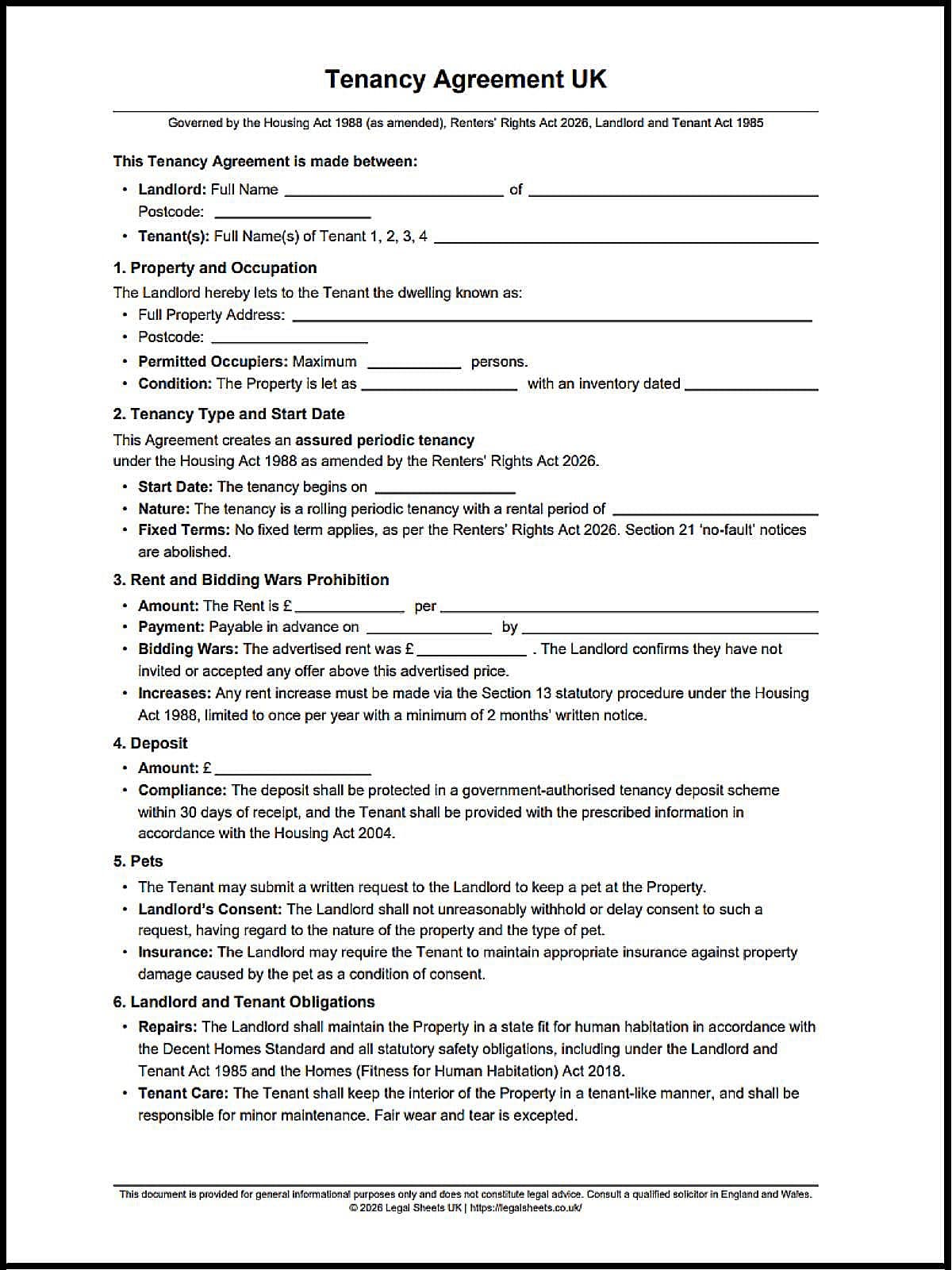
Why Many Older Tenancy Agreements No Longer Reflect Current Law
Abolition of AST Structures
One of the most common drafting mistakes today is using a tenancy agreement built around Assured Shorthold Tenancy terminology.
Many downloadable forms remain based on legal structures that no longer apply to new residential tenancies.
Transition to Assured Periodic Tenancies
Following the formal abolition of the Assured Shorthold Tenancy (AST) regime, all new private lettings in England automatically default to open-ended Assured Periodic Tenancies. Fixed-term clauses are legally obsolete; tenants possess an overriding statutory right to terminate the agreement at any point by serving a standard two-month written notice to quit.
As a result, agreements must be drafted with continuing occupation in mind rather than focusing on what happens when a fixed term expires.
Removal of Fixed-Term Tenancy Architecture
Clauses that assume a tenancy will automatically end on a specified date can create confusion and may conflict with the current statutory structure.
Landlords often discover these issues only when they later attempt to recover possession.
Consequences of Using Outdated Templates
The practical problem is not merely technical non-compliance.
An outdated agreement can undermine future possession proceedings, create disputes regarding rent increases, or contain provisions that courts simply disregard because they no longer have legal effect.
Clauses Commonly Copied From Old Agreements That Now Create Problems
Section 21 References
Many historic templates continue to refer to Section 21 procedures.
Those references no longer reflect the current possession framework and may mislead both landlords and tenants about how a tenancy can be brought to an end.
Landlord Break Clauses
Landlord break clauses intended to create a unilateral right to recover possession outside statutory grounds are particularly problematic.
A clause appearing in the agreement does not automatically make it enforceable.
Automatic Possession Wording
Provisions suggesting that possession automatically follows certain contractual breaches frequently create false expectations.
Possession claims remain subject to statutory requirements and court scrutiny.
Fixed Annual Rent Increase Clauses
Landlords sometimes copy clauses stating that rent rises by a fixed percentage every year.
Such wording can become a significant source of dispute because future rent increases must follow the statutory framework rather than a contractual escalation formula.
Blanket Pet Bans
Absolute “no pets under any circumstances” wording increasingly creates compliance concerns.
A modern agreement should recognise the tenant’s ability to request permission for a pet rather than attempting to exclude the possibility entirely.
Risks of Downloading Legacy Tenancy Agreement Forms
Unenforceable Clauses
Many online templates appear professionally drafted but contain provisions that are no longer effective.
A clause can look legally sophisticated while having no practical value during enforcement proceedings.
Regulatory Penalties
Certain compliance failures extend beyond contractual disputes and may expose landlords to enforcement action by local authorities.
This risk often arises where templates omit required information or encourage prohibited practices.
Possession Difficulties
Possession claims increasingly depend upon accurate documentation and procedural compliance.
Defective agreements frequently create evidential complications that delay proceedings.
Tenant Challenges and Complaints
Modern tenants are more likely to obtain advice from tenant organisations, ombudsman schemes, or professional representatives.
Documentation weaknesses that might once have gone unnoticed are now more likely to be challenged.
Before Drafting the Agreement: Decisions Landlords Must Make
Choosing the Rent Structure
Monthly Rent Cycles
Most residential tenancies operate on monthly payment cycles.
The chosen payment structure should align with how rent will actually be collected and administered throughout the tenancy.
Rent Due Dates
Ambiguity about due dates often creates avoidable arrears disputes.
The agreement should clearly identify when rent falls due and how payments are expected to be made.
Payment Methods
Landlords frequently prefer electronic payments because they create a clear evidential record.
Payment records often become important evidence where arrears claims later arise.
Handling Rent Arrears Provisions
Many agreements contain extensive arrears clauses, yet the practical value usually lies in clear payment records and accurate documentation rather than lengthy contractual wording.
Landlords who maintain organised records are generally in a stronger position if disputes progress to formal proceedings.
Deciding Whether a Deposit Will Be Taken
Deposit Amount Restrictions
The amount collected requires careful consideration before the tenancy begins.
The Tenant Fees Act 2019 restricts security deposits to five weeks’ rent where annual rent is below £50,000 and six weeks’ rent where annual rent is £50,000 or more.
Collecting more than the permitted amount creates prohibited payment issues rather than additional security.
Deposit Alternatives
Some landlords choose not to take a traditional deposit.
Where alternative arrangements are considered, the financial and evidential implications should be evaluated before occupation begins.
Deposit Registration Obligations
The compliance deadline arrives quickly.
A landlord who takes a deposit must protect it within an approved tenancy deposit scheme and provide prescribed information within 30 days of receipt.
Many disputes arise not because protection is forgotten entirely, but because one administrative step is completed while the other is overlooked.
Occupancy Arrangements That Need to Be Defined Early
Sole Tenants
A sole tenant arrangement creates a straightforward liability structure.
The agreement clearly identifies the individual responsible for rent and compliance with tenancy obligations.
Joint Tenants
Joint occupancies require greater attention at drafting stage.
Unclear arrangements frequently create disputes when one occupier leaves but others remain.
Permitted Occupiers
Not everyone living at a property is necessarily a tenant.
Identifying permitted occupiers at the outset reduces uncertainty later.
Children Living at the Property
Expected household composition should be recorded accurately from the beginning.
This reduces disagreements about authorised occupation and occupancy expectations.
Lodger Restrictions
Landlords often discover unauthorised sub-occupation arrangements only after neighbours complain or maintenance issues arise.
Clear drafting reduces uncertainty regarding whether additional occupants may move into the property.
Managing Pet Requests Under the New Legal Framework
Statutory Tenant Rights
Pet provisions have become one of the most frequently discussed areas of residential tenancy drafting.
A modern agreement should acknowledge that tenants may request permission to keep a pet.
Reasonable Refusal Considerations
Refusals should be approached carefully.
A landlord who assumes that a standard “no pets” clause ends the discussion may discover that the clause provides less protection than expected.
Insurance-Related Conditions
Following the recent amendments to the Tenant Fees Act 2019, pet insurance is now officially classified as a ‘permitted payment’. While landlords cannot unreasonably withhold consent for a pet, they can lawfully mandate that the tenant either maintains a comprehensive pet damage insurance policy or reimburses the landlord’s premium for equivalent coverage.
For many landlords, insurance conditions are likely to become more significant than outright prohibitions.
Clauses That Carry the Most Legal Risk in a Tenancy Contract
Most tenancy disputes do not arise because a tenancy agreement is completely missing. They arise because one or two clauses were drafted incorrectly, copied from an outdated template, or never reviewed against current legal requirements.
When a disagreement reaches the County Court, the Private Rented Sector Ombudsman, or a local authority enforcement team, attention often focuses on a small number of provisions that directly affect possession rights, rent collection, deposits, and statutory compliance.
Rent Increase Provisions
Rent increase clauses have become one of the highest-risk areas of tenancy drafting.
Many landlords continue to use wording stating that rent will increase automatically each year by a fixed percentage or by reference to inflation. Under the current framework, contractual rent review mechanisms of that type are ineffective.
The practical consequence is often discovered months later. A landlord believes rent has increased under the tenancy agreement, while the tenant continues paying the original amount. The resulting arrears calculation may be entirely incorrect because the purported increase never took legal effect.
A tenancy agreement should instead recognise that future rent increases must follow the statutory process rather than attempting to create an alternative contractual mechanism.
Deposit Clauses
Deposit clauses regularly become important long after the tenancy begins.
The wording should accurately reflect the deposit amount collected and operate consistently with statutory deposit protection obligations. Problems frequently arise when agreements contain generic deposit wording that does not match the amount actually received.
Where a deposit exceeds the statutory cap, the excess may be treated as a prohibited payment. That issue can create wider enforcement difficulties beyond the deposit itself.
Property Access and Inspection Rights
Landlords often assume ownership of the property automatically creates unrestricted access rights.
In practice, poorly drafted access provisions frequently lead to disputes. Tenants may object to repeated visits, while landlords may believe inspections are being unreasonably obstructed.
A sensible clause identifies inspection arrangements clearly without creating unrealistic expectations about unrestricted entry.
Repairs and Maintenance Responsibilities
Repair disputes commonly begin with uncertainty rather than outright disagreement.
The tenant may assume a landlord is already aware of a defect, while the landlord may not learn about the issue until substantial damage has occurred.
Effective drafting creates a clear reporting process and records who should be contacted when problems arise. This becomes particularly valuable if later allegations are made about delays or property deterioration.
Anti-Social Behaviour Provisions
Anti-social behaviour complaints often involve neighbouring occupiers, local authorities, managing agents, or police reports.
While tenancy agreements cannot create new statutory possession grounds, they can establish clear behavioural expectations and provide useful evidence if persistent complaints develop.
Landlords dealing with nuisance allegations frequently discover that written records become more valuable than lengthy contractual wording.
Utility and Council Tax Obligations
Responsibility for utility bills and council tax should never be left to assumption.
Even where the parties believe the arrangement is obvious, disputes regularly arise after tenancy commencement when utility accounts remain in the wrong name or payment responsibility becomes contested.
A few carefully drafted provisions often prevent significant administrative problems later.
Notice Service Clauses
Service provisions receive little attention at signing but become critically important when notices must be delivered.
Many disputes concern whether a notice was received rather than whether it was validly drafted. For that reason, service clauses should be clear, practical, and consistent with the parties’ actual communication methods.
Email Service Provisions
Electronic communication is now routine, but legal service requirements should not be assumed.
When Electronic Service Becomes Legally Effective
For email service to operate effectively, the tenancy agreement should expressly state that both parties accept service through designated email addresses.
Without clear contractual wording, arguments can arise about whether an emailed notice was properly served.
Designated Email Addresses
The agreement should identify the email addresses that may be used for service purposes.
This avoids later disputes where parties attempt to rely on alternative or outdated addresses.
Evidential Considerations
From a practical perspective, service disputes often become evidential disputes.
Maintaining delivery confirmations, copies of emails, and clear communication records can prove more valuable than extensive legal arguments if notice validity is later challenged.
Documents That Should Accompany the Tenancy Agreement
A tenancy agreement rarely operates in isolation.
Many landlord compliance failures occur because the agreement was signed correctly while associated statutory documents were overlooked. In enforcement proceedings, regulators and courts frequently examine the supporting documentation before considering broader tenancy issues.
Written Statement of Key Tenancy Terms
Pursuant to Section 16D of the Housing Act 1988, issuing a Written Statement of Terms is no longer an administrative formality but a strict statutory prerequisite. This mandatory disclosure must precisely outline rent parameters, the parties’ unique registration numbers on the newly established Private Rented Sector Database, pet consent protocols, and the statutory Section 13 rent review process.
Failure to provide accurate information can expose landlords to local authority enforcement action and financial penalties.
Gas Safety Certificate
The gas safety record is often one of the first documents requested when compliance questions arise.
Landlords should ensure the current certificate is provided before the tenant takes physical occupation of the property.
A surprising number of compliance disputes begin because a certificate existed but no reliable evidence showed that it had actually been served.
Energy Performance Certificate (EPC)
The EPC should be provided as part of the tenancy commencement process.
Failure to maintain compliance with energy performance requirements can create regulatory consequences that extend beyond the tenancy agreement itself.
Electrical Installation Condition Report (EICR)
Electrical safety documentation is increasingly scrutinised by local authorities.
Where an EICR is required, landlords should retain clear evidence showing both compliance and service of the report.
In practice, record-keeping failures often become just as problematic as missing documentation.
How to Rent Guide?
Landlords must provide the current version of the government’s “How to Rent” guide at the beginning of the tenancy.
Many landlords mistakenly treat this as an administrative formality. However, missing tenancy-start documentation frequently becomes relevant later when compliance histories are reviewed.
Deposit Prescribed Information
Protecting a deposit and serving prescribed information are separate obligations.
A common mistake is completing deposit registration while overlooking the prescribed information requirement. The result can be a compliance failure despite the landlord believing the deposit process was completed correctly.
Property Inventory and Condition Schedule
Inventories are not merely useful administrative records.
Most deposit disputes ultimately become evidential disputes about property condition at the beginning and end of occupation. A detailed inventory can significantly reduce disagreement over deductions.
Why Missing Documents Create Enforcement Problems Later
Compliance issues rarely remain hidden forever.
They typically emerge when a landlord seeks possession, a tenant raises a complaint, a deposit dispute develops, or a local authority begins an investigation.
At that point, reconstructing missing records months or years later can be extremely difficult. Landlords who maintain complete tenancy files generally encounter fewer procedural obstacles than those relying on memory or informal records.
Signing the Agreement and Starting the Tenancy
Many tenancy disputes can be traced back to the first few days of occupation. Administrative shortcuts taken at move-in often become expensive problems later.
When the Agreement Becomes Legally Binding
For periodic residential tenancies of this type, there is generally no requirement for execution as a deed.
The agreement becomes legally effective as a written contract once the necessary arrangements are completed and both parties have signed.
The practical focus should be accuracy and proper record retention rather than unnecessary execution formalities.
Signature Requirements
The parties should sign the final version of the agreement after all details have been completed.
Last-minute amendments made after signing frequently create evidential uncertainty if disputes later arise regarding the agreed terms.
Digital vs Physical Signatures
Both digital and physical signing methods are commonly used.
The more important issue is maintaining a complete record showing exactly what document was signed, when it was signed, and what supporting documents were provided at the same time.
Restrictions on Taking Rent Before Execution
The Renters’ Rights Act 2025 introduced important restrictions concerning rent in advance.
Landlords are prohibited from requesting, encouraging, or accepting more than one month’s rent in advance. No rent payment may be taken before the tenancy agreement has been fully executed.
Landlords accustomed to older industry practices should review their procedures carefully to avoid inadvertent non-compliance.
Moving-In Workflow Checklist
Before occupation begins, landlords should confirm that:
- The tenancy agreement has been signed.
- Required disclosures have been provided.
- Any deposit has been protected correctly.
- Prescribed information has been served where required.
- Safety documentation has been supplied.
- Property portal registration obligations have been completed.
- Records of service and compliance have been retained.
The most effective landlords often approach move-in as a compliance process rather than a paperwork exercise.
UK Legal Facts and Compliance Framework
A tenancy agreement is only one part of a landlord’s compliance obligations. Many disputes arise because landlords focus on the wording of the tenancy agreement template while overlooking statutory requirements that operate alongside it. Courts, tribunals, local authorities, and deposit schemes routinely examine compliance records when disputes arise.
| Topic / Issue | England Legal Rule | Governing Law |
|---|---|---|
| Tenancy Type & Structure | New residential tenancies operate as open-ended Assured Periodic Tenancies rather than ASTs. | Housing Act 1988 (as amended by the Renters’ Rights Act 2025) |
| Tenant Notice to Quit | Tenant may end the tenancy by giving at least 2 months’ written notice | Housing Act 1988 / Renters’ Rights Act 2025 |
| Deposit Cap | Maximum of 5 weeks’ rent where annual rent is below £50,000, or 6 weeks’ rent where annual rent is £50,000 or more | Tenant Fees Act 2019 |
| Deposit Protection | Deposit must be protected and Prescribed Information served within 30 days of receipt. | Housing Act 2004, Section 213 |
| Rent in Advance | More than one month’s rent in advance cannot be requested or accepted | Renters’ Rights Act 2025 |
| Written Statement of Terms | A mandatory written statement of key terms must be provided to the tenant. | Housing Act 1988, Section 16D |
| Address for Service | Landlord must provide an address in England or Wales for service; otherwise, rent is not legally due. | Landlord and Tenant Act 1987, Section 48 |
| Rent Increase Mechanism | All rent increases must strictly use the statutory Section 13 notice framework. | Section 13 notice framework |
| Safety Documentation | EPC, Gas Safety Certificate, and EICR obligations apply | Relevant safety regulations |
| Deposit Scheme Registration | Deposits must be protected in an authorised scheme within 30 days | Deposit protection rules |
| Property Portal Registration | Both the landlord and the property must be actively registered on the Private Rented Sector Database. | Renters’ Rights Act 2025 |
Practical Legal Impact
Many landlords assume compliance issues become relevant only when a dispute occurs. In reality, compliance failures often remain hidden until possession proceedings, deposit claims, or local authority investigations expose them.
For example, a tenancy agreement may appear professionally drafted, but failure to provide the required written statement of terms, protect the deposit within the required timeframe, or provide mandatory safety documentation can create significant procedural difficulties later.
County Courts frequently examine whether statutory requirements have been met when possession claims are pursued. Similarly, local authorities can investigate failures relating to tenancy documentation, prohibited payments, and registration obligations. The practical lesson is that a tenancy agreement works most effectively when it forms part of a wider compliance process rather than being treated as a standalone document.
Frequently Asked Questions
Can a tenancy agreement still include a fixed term if both parties want one?
New residential tenancies operate as open-ended Assured Periodic Tenancies. Using fixed-term language copied from older agreements may create confusion because the tenancy structure no longer depends on a predefined end date.
What happens if the landlord forgets to provide the Section 48 address for service?
The landlord must provide an address in England or Wales where notices can be served. Until that information is supplied, rent is not legally treated as due from the tenant.
Is a rent increase clause valid if the tenancy contract says rent rises automatically every year?
No. Contractual clauses providing for automatic annual rent increases are ineffective. Rent increases must follow the statutory Section 13 procedure rather than an internal rent review clause.
Can a landlord refuse every pet request by inserting a “no pets” clause?
A blanket prohibition on pets may not be enforceable. Tenants have a statutory right to request permission to keep a pet, and requests must be considered within the applicable legal framework.
Can possession proceedings be delayed because the deposit was not protected within 30 days?
Deposit compliance failures frequently create procedural difficulties. Landlords who fail to protect a deposit and complete the required steps within the statutory timeframe often face additional complications when disputes later arise.
Does a tenancy agreement remain enforceable if the How to Rent guide or safety certificates were not provided at the start of the tenancy?
The tenancy agreement itself may still exist as a contract between the parties, but failing to provide mandatory documents can create significant compliance issues. In practice, missing documentation is often examined closely during disputes, possession proceedings, and regulatory investigations, which is why landlords should provide all required documents at the start of the tenancy.