
Resignation Letter Template (PDF & Printable Formats)
Many employees search for a Resignation Letter only after accepting a new job offer or reaching the point where they need to leave quickly, yet the most common problem is not the decision to resign but getting the notice wording wrong. A resignation letter that fails to identify the correct leaving date or overlooks a contractual notice period can create disputes long after the employee has left, particularly where final salary, accrued holiday pay, or post-employment restrictions are involved.
Under the Employment Rights Act 1996, statutory notice rules may apply, but employment contracts often require longer notice periods that must be reflected accurately in the resignation itself. Employment Tribunal disputes regularly reveal that a brief resignation email sent in frustration created uncertainty about whether valid notice had actually been given and when employment ended. The template and example wording that follows is designed to communicate resignation clearly, record the intended final working date, and fit the practical realities of leaving employment in England.
Resignation Letter Template (PDF, Word & Printable Formats)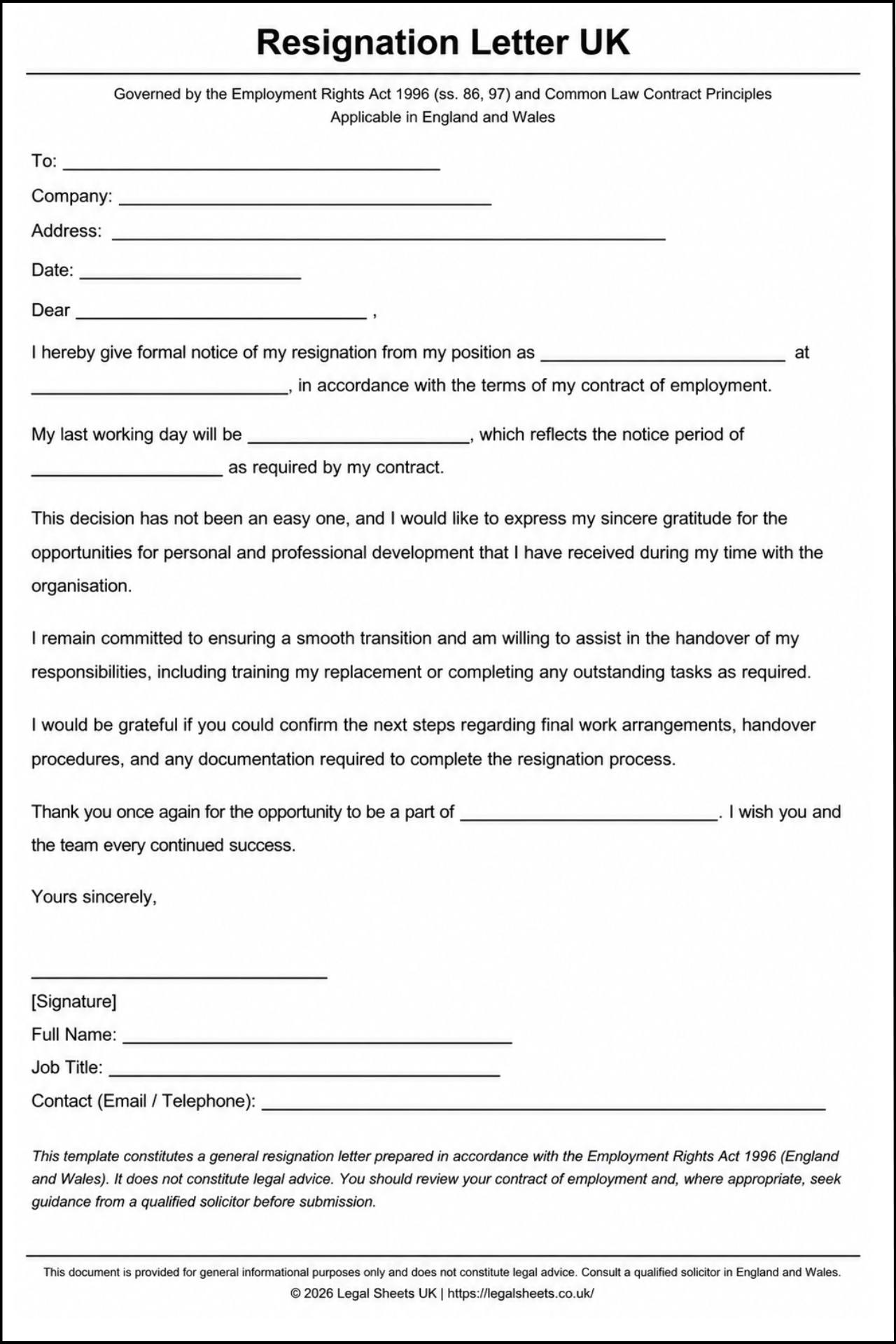
Before Writing Your Resignation Letter, Check These Three Employment Documents
Your Employment Contract
Many employees focus on drafting the resignation letter before checking their contract. In practice, the contract often determines the most important parts of the process.
Review:
- Notice requirements
- Delivery requirements
- Garden leave provisions
- Pay in Lieu of Notice (PILON) clauses
A common mistake occurs when an employee assumes statutory notice is sufficient despite agreeing to a longer contractual notice period.
Staff Handbook and Internal Policies
Employers frequently maintain procedures covering employee warnings, including:
- Notice submission
- Exit interviews
- Company property returns
- Handover requirements
Ignoring internal procedures may not invalidate a resignation, but it often creates unnecessary difficulties during the departure process.
Director Appointment Documents
Where an employee also serves as a statutory company director, resignation from employment and resignation from office as a director may involve separate considerations.
The employment relationship may end while directorship obligations continue unless appropriate steps are taken.
Choosing the Right Type of Resignation Letter
Standard Notice Resignation
This is the most common approach.
The employee provides contractual notice and continues working until the agreed departure date.
Employers generally prefer this approach because it permits a structured handover.
Short Resignation Letter
A short resignation letter focuses only on essential information.
Typical contents include:
- Notice of resignation
- Notice period
- Final working date
This format is often preferred where the employee wants a straightforward departure without extensive explanation.
Professional Resignation Letter
A professional resignation letter maintains a courteous tone while clearly communicating the employee’s decision.
Employees frequently underestimate the importance of preserving relationships for future references. A future reference request may be handled by the same individuals receiving the resignation letter today.
Resignation Email
Email has become increasingly common.
However, the employment contract may specify how notice must be delivered. If notice provisions require post or hand delivery, relying solely on email could create disputes unless the employer accepts the communication.
Immediate Resignation Letter
Immediate resignations often occur after workplace disagreements, stress, or the acceptance of a competing job offer following unresolved complaints.
The practical risk is that the employee may breach contractual notice obligations and expose themselves to claims for losses caused by their failure to work notice.
Constructive Dismissal Resignation
Sometimes the resignation itself forms part of a legal claim.
If an employer commits a fundamental, repudiatory breach of contract (such as withholding pay or severe harassment), the employee can legally resign with immediate effect. Crucially, under the Employment Rights Act 2025, employees now hold a ‘Day 1’ statutory right to claim constructive unfair dismissal, entirely removing the old two-year service requirement.
A recurring problem arises when employees wait too long before resigning. Continuing to work for months after the alleged breach can undermine a later constructive dismissal claim.
The Wording That Makes a Resignation Legally Effective
Statements That Clearly End Employment
The wording should leave no room for doubt.
Examples include:
- “I hereby resign from my position.”
- “Please accept this letter as notice of my resignation.”
Clear language reduces the risk of disputes about whether notice was actually given.
Identifying the Final Working Day
An effective resignation should identify either:
- The final working date; or
- The notice period being given
Many workplace disputes begin because neither party calculated the termination date in the same way.
Wording That Creates Problems
The following examples frequently cause uncertainty:
- “I am thinking about resigning.”
- “I might leave.”
- “I will resign if things do not improve.”
According to the verified legal facts, conditional wording does not constitute effective notice of termination. The employment relationship remains ongoing.
Why Resignation Letters Are Often Disputed
Disputes commonly involve:
- Final working dates
- Notice calculations
- Service methods
- Contradictory communications
- Employer responses after notice is received
The legal argument is often not whether the employee resigned, but when the resignation took effect.
Notice Periods and Final Working Dates
Statutory Minimum Notice Requirements
Under Section 86(2) of the Employment Rights Act 1996, employees with at least one month’s continuous employment must provide a minimum of one week’s notice.
When Contractual Notice Overrides the Statutory Minimum
Many contracts require:
- One month’s notice
- Three months’ notice
- Longer executive notice periods
Where a contractual notice provision exceeds the statutory minimum, the contractual requirement remains binding.
Calculating the Correct Leaving Date
Employees commonly make mistakes by:
- Counting notice incorrectly
- Using the wrong start date
- Assuming notice begins when drafted rather than when delivered
A miscalculated termination date can affect payroll, holiday accrual, and tribunal limitation periods.
Consequences of Leaving Early
Employers cannot force employees to continue working.
However, an employee who fails to work the required contractual notice period may be in breach of contract. According to the verified legal facts, employers may pursue civil claims for losses arising from the employee’s early departure.
Resignation Email vs Printed Letter: Does the Delivery Method Matter?
Following the Contractual Notices Clause
The first document to check is the employment contract.
It may specify:
- Email delivery
- Hand delivery
- Postal delivery
- Particular HR contacts
Failure to follow the contractual process can create avoidable disputes.
Proving the Employer Received Notice
Useful evidence includes:
- Email acknowledgements
- Read receipts
- Delivery confirmations
- Written responses from management
Avoiding Service Disputes
Practical steps include:
- Keeping copies of all communications
- Retaining delivery records
- Requesting written acknowledgement
These records often become important if the resignation date is later challenged.
Common Resignation Mistakes That Create Legal Problems
Walking Out Without Required Notice
Employees occasionally assume they can leave immediately.
Where the contract requires a longer notice period, doing so may amount to breach of contract and expose the employee to claims for resulting losses ending employment.
Resigning in Anger
One of the most heavily litigated workplace situations occurs when an employee resigns during an argument.
Under the English common law ‘heat of the moment’ doctrine, if an employer immediately accepts a resignation shouted during a stressful argument without allowing a 24-to-48-hour cooling-off period, the Employment Tribunal will invalidate the resignation. The tribunal treats the event as a unilateral dismissal by the employer, opening the door to an immediate unfair dismissal claim.
Delaying Resignation After Serious Workplace Misconduct
If an employee suffers a severe breach of contract but continues working and drawing a salary for months without formally working ‘under protest’, English common law deems them to have ‘affirmed’ the contract. This legally waives the employer’s breach and completely destroys the employee’s ability to claim constructive dismissal.
Assuming Notice Can Be Withdrawn Later
Employees sometimes believe they can change their mind.
The verified legal position is that a clear and unambiguous resignation cannot be withdrawn unilaterally. Employer consent is required.
Getting the Final Working Date Wrong
An incorrect date can create:
- Payroll disputes
- Holiday pay disagreements
- Reference issues
- Effective Date of Termination disputes
These issues frequently appear in tribunal proceedings.
When a Resignation Can Trigger Employment Tribunal Issues
Constructive Unfair Dismissal Claims
A resignation may form the basis of a constructive dismissal claim where it follows a fundamental employer breach.
The timing and wording of the resignation often become critical evidence.
Final Pay and Holiday Pay Disputes
Employers occasionally attempt to withhold money from final salary payments.
Employers frequently attempt to ‘fine’ departing staff by withholding final pay for unreturned laptops or failing to work their full notice. Under Section 13 of the Employment Rights Act 1996, this is an illegal deduction from wages unless the employment contract contains a highly specific, written deductions clause explicitly covering that exact scenario.
Disputes About the Effective Date of Termination
The Effective Date of Termination (EDT) frequently becomes contentious where:
- PILON arrangements exist
- Garden leave is imposed
- Notice periods are disputed
An incorrect EDT calculation can affect tribunal deadlines.
When the Employer’s Response Changes the Legal Position
If an employee submits four weeks’ notice and the employer angrily tells them to leave the building today without formally invoking a contractual Pay in Lieu of Notice (PILON) clause, the employer has legally dismissed the employee. This blunder transforms a voluntary resignation into a Wrongful Dismissal, which instantly voids any post-termination restrictive covenants (non-competes) the employer held over the departing staff member.
Special Considerations for Directors Who Resign
Employment Resignation vs Director Resignation
The two positions are legally distinct.
Resigning from employment does not necessarily remove an individual from office as a company director.
Companies House Filing Requirements
Where the employee is also a statutory director or consultant, Companies House records must be updated within 14 days of the resignation taking effect pursuant to Section 167 of the Companies Act 2006.
Continuing Duties After Resignation
Resignation does not automatically remove obligations concerning:
- Confidential information
- Company property
- Restrictive covenants
These issues often become relevant after employment ends.
UK Legal Facts and Compliance Considerations
Legal Requirements Table
| Topic / Issue | England Legal Rule | Governing Law |
|---|---|---|
| Statutory Minimum Notice | An employee with at least one month of continuous service must provide a statutory minimum of exactly one week’s notice. | Employment Rights Act 1996, Section 86(2) |
| Contractual Notice | If the employment contract mandates a notice period longer than the statutory minimum (e.g., 3 months), the employee is legally bound to provide it. | ACAS – Notice Periods |
| Execution Requirements | An oral resignation is legally binding at common law, but most contracts strictly mandate that notice must be served in writing to be valid. | ACAS – Resignation Guidance |
| Withdrawal of Resignation | Once clear and unambiguous notice of resignation is communicated, the employee cannot unilaterally withdraw it; mutual employer consent is strictly required. | Common Law |
| Constructive Dismissal Resignation | Employees resigning in response to a fundamental employer breach can resign without notice and claim constructive unfair dismissal from Day 1 of employment. | Employment Rights Act 1996, Section 95(1)(c) |
| Director Resignation Filing | If the resigning employee is also a registered statutory director, the company must file Form TM01 to update the public register within 14 days. | Companies Act 2006, Section 167 |
| Day 1 Constructive Dismissal Rights | Withholding final pay (e.g., for unreturned company property) is strictly illegal unless expressly authorised by a prior written contractual clause. | Employment Rights Act 2025 |
| Service Requirements | Notice method often governed by employment contract | Common Law |
Practical Legal Impact
These rules affect real workplace disputes far more often than employees expect.
A resignation may be perfectly genuine yet still trigger disagreements over notice, final pay, restrictive covenants, or tribunal deadlines. Employers frequently focus on service requirements and notice compliance. Employees are more likely to focus on leaving dates and salary payments.
The disputes themselves may be heard in different forums. According to the verified legal facts, statutory employment claims generally proceed through the Employment Tribunal, while employer claims for damages arising from notice breaches may proceed through the civil courts.
Practical Checklist Before Sending Your Resignation
Confirm Notice Requirements
- Review the employment contract
- Check contractual notice obligations
- Calculate the final working date
Prepare for Handover
- Identify outstanding projects
- Document ongoing work
- Arrange knowledge transfer where appropriate
Protect Important Evidence
- Retain copies of resignation communications
- Keep records of employer acknowledgements
- Preserve employment documents
Consider Future Employment Implications
- References
- Restrictive covenants
- Confidentiality obligations
- Director responsibilities where applicable
Frequently Asked Questions
Can I resign immediately if my contract requires three months’ notice?
You may resign immediately, but doing so may place you in breach of contract. According to the verified legal facts, employers may seek damages for losses caused by the failure to work the required notice period.
Is a resignation email legally valid if my contract says notice must be in writing?
Possibly, but the answer depends on the contractual notice provisions. If the contract requires a specific delivery method, using a different method may create disputes unless the employer accepts it.
Can I change my mind after submitting a resignation letter?
Not automatically. Under the verified legal position, a clear resignation cannot be withdrawn unilaterally and requires the employer’s agreement.
What happens if my employer tells me to leave immediately after I resign?
The legal consequences depend on how the employer responds and whether contractual provisions such as PILON apply. The verified facts identify circumstances where an employer’s reaction may alter the legal position and create dismissal-related consequences.
Can waiting too long to resign affect a constructive dismissal claim?
Yes. According to the verified legal facts, continuing to work for a prolonged period after an alleged fundamental breach may be treated as affirming the contract, which can undermine a constructive dismissal claim.