
Free Non Disclosure Agreement [Printable NDA Template]
A Non Disclosure Agreement is often searched for at the point where valuable business information is about to be shared and someone wants written protection in place before conversations progress any further. One of the most frequent problems in England is not the absence of an agreement, but poorly drafted confidentiality provisions that leave uncertainty about what information is actually protected, how long obligations continue, or when disclosure is permitted.
In practice, commercial disputes can become far more complicated when confidential material is exchanged during negotiations and the parties later disagree about whether restrictions applied, a point that regularly affects claims brought before the County Court or High Court. While confidentiality obligations are largely governed by English contract law rather than a prescribed statutory form, organizations must also consider UK GDPR and Data Protection Act 2018 requirements where personal data forms part of the information being shared.
The wording and structure of the agreement therefore matter considerably, making a carefully prepared template and completion guidance worth reviewing before any disclosure takes place.
Table of Contents
ToggleNon Disclosure Agreement Template (PDF, Word & Printable Formats)
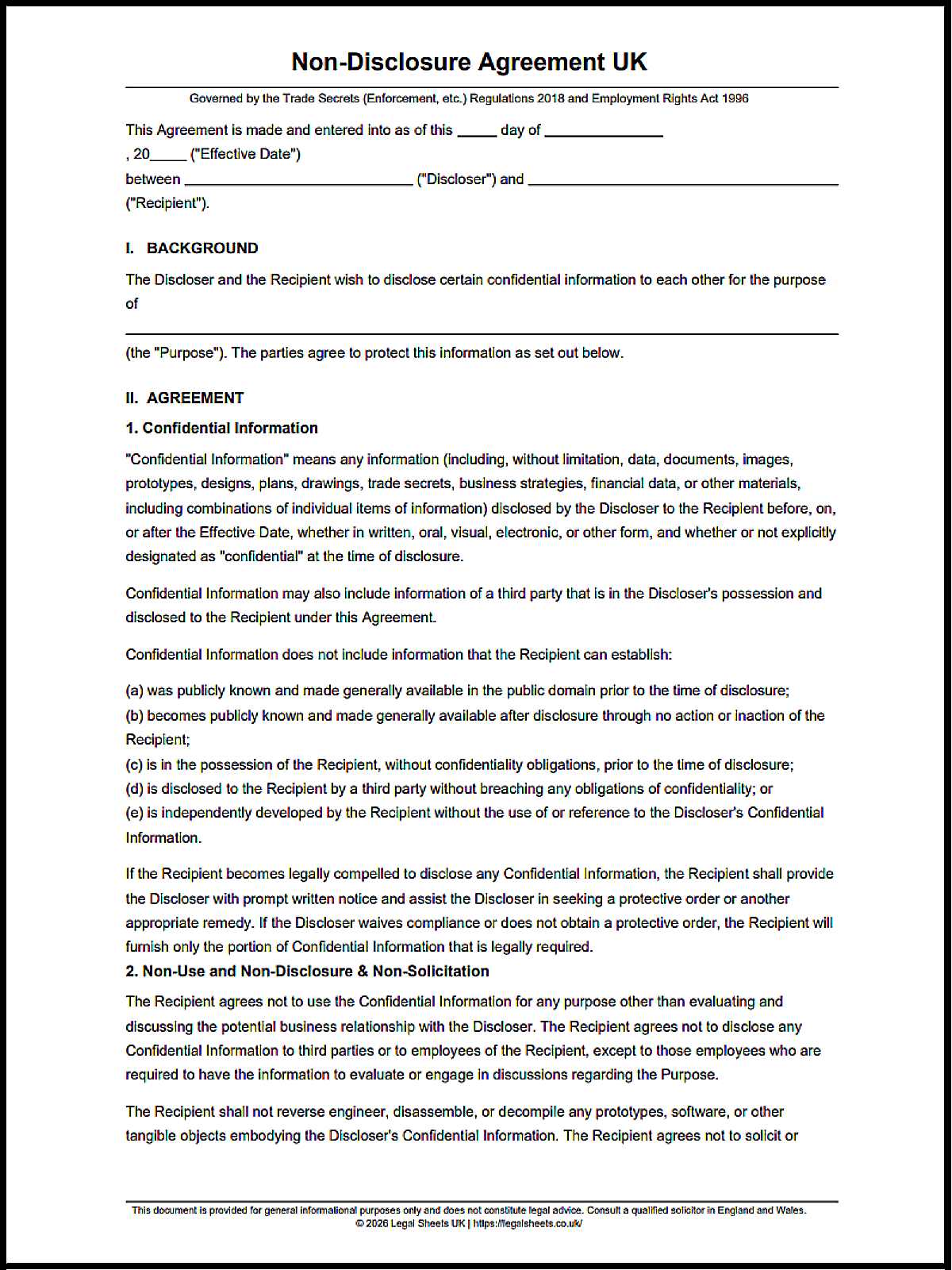
Get PDF | WORDNon Disclosure Agreement
The First Drafting Decision: Mutual NDA or One-Way Confidentiality Agreement?
Many enforcement problems start with selecting the wrong structure.
When a mutual NDA is usually appropriate
A mutual NDA is commonly used where both parties expect to exchange sensitive information, including:
- Joint commercial discussions
- Strategic partnerships
- Reciprocal due diligence
- Collaborative product development
Mutual arrangements often reduce negotiation friction because confidentiality obligations apply equally to both parties.
When a unilateral NDA is usually more appropriate
A one-way agreement is typically used where only one party is disclosing information.
Common examples include:
- Investor pitches
- Supplier evaluations
- Contractor engagements
- Employee access to confidential information
An employee NDA frequently falls into this category because the employer is usually the primary source of confidential information.
The consideration problem that frequently invalidates one-way agreements
A common drafting mistake is assuming a signature alone creates an enforceable obligation.
Under common law, a simple contract requires offer, acceptance, intention to create legal relations, and consideration. Where consideration is absent, businesses sometimes execute the NDA as a deed instead.
Issues commonly arise when:
- Mutual consideration has not been properly identified
- Nominal consideration is inadequately documented
- Deed execution requirements are overlooked
If execution is defective, the entire confidentiality arrangement may become vulnerable to challenge.
Defining Confidential Information Without Making the Agreement Unenforceable
The definition of confidential information often determines whether an NDA succeeds or fails.
Information that is commonly protected
Businesses typically seek protection for:
- Trade secrets
- Commercial strategies
- Financial information
- Customer data
- Technical specifications
- Product roadmaps
The stronger the connection between the information and genuine commercial value, the easier it becomes to justify confidentiality obligations.
Exclusions that courts typically expect to see
Most professionally drafted agreements exclude:
- Publicly available information
- Independently developed information
- Information already known to the recipient
- Lawfully obtained third-party information
Without these carve-outs, disputes frequently arise over whether information was truly confidential at all.
Why overbroad definitions create enforcement problems
Businesses sometimes attempt to classify every communication as confidential.
That approach can create practical difficulties because:
- Vague definitions create uncertainty
- Injunction applications become harder to support
- Interpretation disputes become more likely
- Overly broad restrictions can face restraint of trade arguments
Courts generally examine whether the information can be identified with sufficient precision rather than accepting broad labels at face value.
Clauses That Usually Determine Whether an NDA Works in Practice
The most litigated provisions are rarely the introductory clauses. The operational clauses are where disputes normally focus.
Permitted purpose provisions
A confidentiality obligation without a defined purpose often creates uncertainty.
Effective drafting normally addresses:
- Limiting use to specific business discussions
- Defining authorised activities
- Preventing secondary commercial use
Many breaches occur because information was used for an unauthorised purpose rather than publicly disclosed.
Access and internal disclosure controls
Confidentiality can quickly be undermined if information is circulated internally without restriction.
Common controls include:
- Need-to-know access
- Employee confidentiality obligations
- Contractor access restrictions
Businesses that cannot demonstrate internal controls often face difficulties proving the information retained its confidential status.
Return, deletion, and destruction requirements
These provisions commonly cover:
- Physical documents
- Electronic records
- Backup systems
- Certification of destruction
A recurring problem is assuming deletion has occurred when archived copies remain accessible.
Confidentiality duration and survival periods
Appropriate durations depend on the nature of the information.
Common approaches include:
- Fixed-term obligations
- Indefinite protection for trade secrets
- Commercially reasonable survival periods
The more sensitive the information, the stronger the argument for continuing protection.
Employee NDA Clauses That Receive Greater Legal Scrutiny
Employment-related confidentiality provisions often receive closer examination than purely commercial arrangements.
Confidentiality obligations during employment
Employers commonly require employees to protect internal business information while employed.
Problems usually emerge where confidentiality expectations have never been clearly documented or communicated.
Protection of business information after employment ends
Post-employment restrictions attract greater scrutiny because they affect former employees after the employment relationship has ended.
The focus generally shifts to whether the information genuinely remains confidential.
Distinguishing confidentiality from restrictive covenants
These concepts are frequently confused.
Confidentiality restrictions protect information.
Non-compete restrictions restrict competition.
Non-solicitation restrictions restrict business approaches to customers or staff.
Attempting to disguise restrictive covenants as confidentiality clauses can create enforcement difficulties.
Why employee NDAs cannot silence protected disclosures
Businesses occasionally attempt to draft confidentiality provisions too broadly.
Any provision seeking to prevent protected whistleblowing disclosures is vulnerable to challenge. Employees remain entitled to report wrongdoing, legal breaches, and relevant health and safety concerns.
Confidentiality Clauses That Regulators and Courts Commonly Reject
Certain provisions routinely create legal problems.
Attempts to prevent whistleblowing
Any restriction preventing protected disclosures may be ineffective under employment legislation.
Clauses restricting criminal reporting
Businesses cannot legitimately require individuals to conceal criminal conduct.
Provisions discouraging cooperation with regulators
Regulatory investigations often involve disclosure obligations that override private confidentiality expectations.
Excessive secrecy obligations that undermine public policy
Courts frequently examine whether confidentiality provisions have crossed the line from protecting legitimate commercial interests into suppressing matters that should properly be disclosed.
Trade Secrets, Commercial Know-How, and the Limits of Contractual Protection
An NDA is only one layer of protection.
Information that may qualify as a trade secret
Examples commonly include:
- Proprietary processes
- Technical formulas
- Confidential methodologies
- Valuable commercial know-how
Contractual protection versus statutory trade secret remedies
Certain trade secret protections may exist independently of the NDA itself through the Trade Secrets (Enforcement, etc.) Regulations 2018.
Preserving the quality of confidence before a dispute arises
Businesses often lose valuable claims because they treated sensitive information casually.
Practical measures include:
- Internal controls
- Marking confidential information
- Access restrictions
- Audit trails
A court is more likely to accept information as genuinely confidential where the business consistently treated it that way.
Execution Mistakes That Frequently Undermine Enforceability
Even well-drafted agreements can fail because of execution errors.
Signing as a simple contract
Simple contracts rely upon ordinary contractual principles, including consideration.
When execution as a deed may be required
Where consideration is absent, deed execution is often considered.
Witnessing requirements for deeds
Where deed execution is used, formalities become significantly more important.
Common signing errors in commercial environments
Recurring mistakes include:
- Missing signatures
- Incorrect execution blocks
- Authority issues
- Electronic execution concerns
Many enforcement disputes begin with parties discovering years later that execution was never completed correctly.
What Usually Happens After a Suspected Confidentiality Breach?
The first few days after a suspected breach often determine the outcome of any later claim.
Immediate containment actions
Typical responses include:
- Access suspension
- Evidence preservation
- Recovery requests
- Internal investigations
Delay frequently results in the loss of critical electronic evidence.
Assessing whether the information still retains confidentiality
If information has already entered the public domain, enforcement options may become significantly weaker.
Pre-action correspondence and breach notices
Most disputes begin with formal correspondence seeking explanations, undertakings, or remedial action.
Deciding between injunction proceedings and damages claims
Businesses often pursue injunctions where ongoing disclosure presents a continuing threat. Damages may be less attractive if the commercial harm is difficult to quantify.
Enforcement Realities: Why Most NDA Disputes Turn on Evidence Rather Than Wording
Many businesses overestimate the importance of drafting and underestimate the importance of evidence.
Evidence commonly relied upon
Common evidence includes:
- Email trails
- Access logs
- Shared files
- Meeting records
- Witness evidence
The party with the strongest evidential record frequently holds the stronger litigation position.
Challenges in proving financial loss
Loss caused by confidential information misuse can be difficult to calculate.
Commercial opportunities lost because of disclosure often involve complex valuation disputes.
Situations where injunctions are more valuable than damages
Where information remains confidential but is at risk of disclosure, stopping publication may be commercially more valuable than pursuing compensation afterwards.
When enforcement moves to the High Court rather than the County Court
High-value commercial disputes, complex injunction applications, and significant trade secret claims commonly proceed in the High Court.
NDAs and Personal Data — Where Confidentiality Obligations Meet UK GDPR
Confidential information and personal data are not always the same thing.
Confidential information versus personal data
A document may be confidential without containing personal data, and vice versa.
Data sharing risks often overlooked in commercial NDAs
Businesses frequently focus on confidentiality while overlooking separate data protection obligations.
Operational safeguards when confidential information contains personal data
Where personal data is involved, access controls, retention practices, and security measures become increasingly important.
Why an NDA does not replace data protection compliance
Where personal data is processed, separate obligations under the UK GDPR and Data Protection Act 2018 continue to apply regardless of what the NDA says.
Common Drafting Errors That Create Expensive Disputes
Catch-all definitions that are too broad
Overly broad definitions often create interpretation disputes rather than stronger protection.
Hidden restraint of trade provisions
Restrictions extending beyond genuine confidentiality concerns can attract scrutiny.
Unrealistic penalty clauses
Excessive financial penalties may prove difficult to enforce.
Undefined disclosure purposes
Unclear purposes create uncertainty about what uses are permitted.
Missing carve-outs for legally required disclosures
Failure to address lawful disclosure obligations frequently creates avoidable disputes.
Failing to address ownership of disclosed materials
Ownership disputes often arise when documents, data, or intellectual property are exchanged during negotiations.
UK Legal Facts and Compliance Framework
Legal Requirements
| Topic / Issue | England Legal Rule | Governing Law |
|---|---|---|
| Whistleblowing (Protected Disclosures) | Any provision preventing protected disclosures is void | Employment Rights Act 1996 (s.43J) |
| Execution Formalities (Deeds) | Required where consideration is absent; deed formalities apply | Law of Property (Miscellaneous Provisions) Act 1989 (s.1) |
| Execution Formalities (Simple Contracts) | Requires offer, acceptance, intention, and consideration | Common Law |
| Trade Secrets Protection | Statutory remedies available for unlawful use or disclosure | Trade Secrets (Enforcement, etc.) Regulations 2018 |
| Reporting Criminal Offences | Clauses restricting criminal reporting are void | Common Law Public Policy / Criminal Law Act 1967 |
| Employment Settlement Agreements | Independent legal advice required for valid statutory claim waivers | Employment Rights Act 1996 (s.203) / Equality Act 2010 (s.147) |
Practical Legal Impact
Businesses frequently assume that every confidentiality clause written into an agreement will be enforced exactly as drafted. In practice, courts focus on legitimacy, proportionality, and evidence.
Restrictions attempting to suppress whistleblowing disclosures can fail regardless of how carefully they are worded. Likewise, a one-way NDA executed without consideration may encounter enforceability challenges if deed formalities were required but not satisfied.
Useful official sources include the Employment Rights Act 1996, the Trade Secrets (Enforcement, etc.) Regulations 2018, and guidance available through GOV.UK.
Frequently Asked Questions
Can a Non Disclosure Agreement stop an employee from reporting wrongdoing or whistleblowing?
No. Restrictions preventing protected disclosures may be ineffective under the Employment Rights Act 1996. Confidentiality obligations cannot be used to suppress legitimate whistleblowing.
Is a one-way NDA enforceable if no payment or consideration is provided?
Not automatically. Where consideration is absent, businesses often consider execution as a deed. Failure to address the consideration issue can create enforceability risks.
Can a court refuse to enforce an NDA because the definition of confidential information is too broad?
Potentially. Overly broad definitions can create uncertainty, make injunction applications harder to support, and generate disputes about what information was genuinely protected.
What is usually more effective after a breach — an injunction or a claim for damages?
That depends on the objective. Where confidential information is still at risk of disclosure, an injunction may offer greater commercial value than compensation awarded after the damage has already occurred.
Does signing a confidentiality agreement automatically protect trade secrets if the information later becomes public?
Not necessarily. Once information enters the public domain, confidentiality arguments become significantly weaker. Businesses that maintain strong internal controls, access restrictions, and documented confidentiality practices generally place themselves in a stronger enforcement position.
Author
-

Ankur is the founder and editorial reviewer at LegalSheets. He researches, writes, and reviews legal content, ensuring every template and guide is clear, accurate, and based on current UK laws and official government guidance. His focus is on making legal documents easier for individuals and businesses to understand and use.
