
Free Section 21 Notice Template (PDF & Printable Formats)
A Section 21 Notice is often searched for when a landlord believes the tenancy is ending smoothly, only to discover that a missing certificate or deposit protection error can undermine the possession process months later. While Section 21 originated in the Housing Act 1988, subsequent legislation—specifically the Deregulation Act 2015—layered on strict statutory prerequisites. County Court judges will actively scrutinise whether these precise compliance hurdles were cleared before they will even consider granting a possession order.
In England, County Court claims are frequently delayed when landlords cannot prove that required tenancy documents were provided or that the tenancy deposit was handled correctly. These disputes rarely arise from the wording of the notice alone; they are usually caused by earlier administrative steps that were overlooked during the tenancy.
The template and guidance that follow are designed to help you prepare a Section 21 Notice that reflects current England requirements and the practical realities of possession proceedings.
Table of Contents
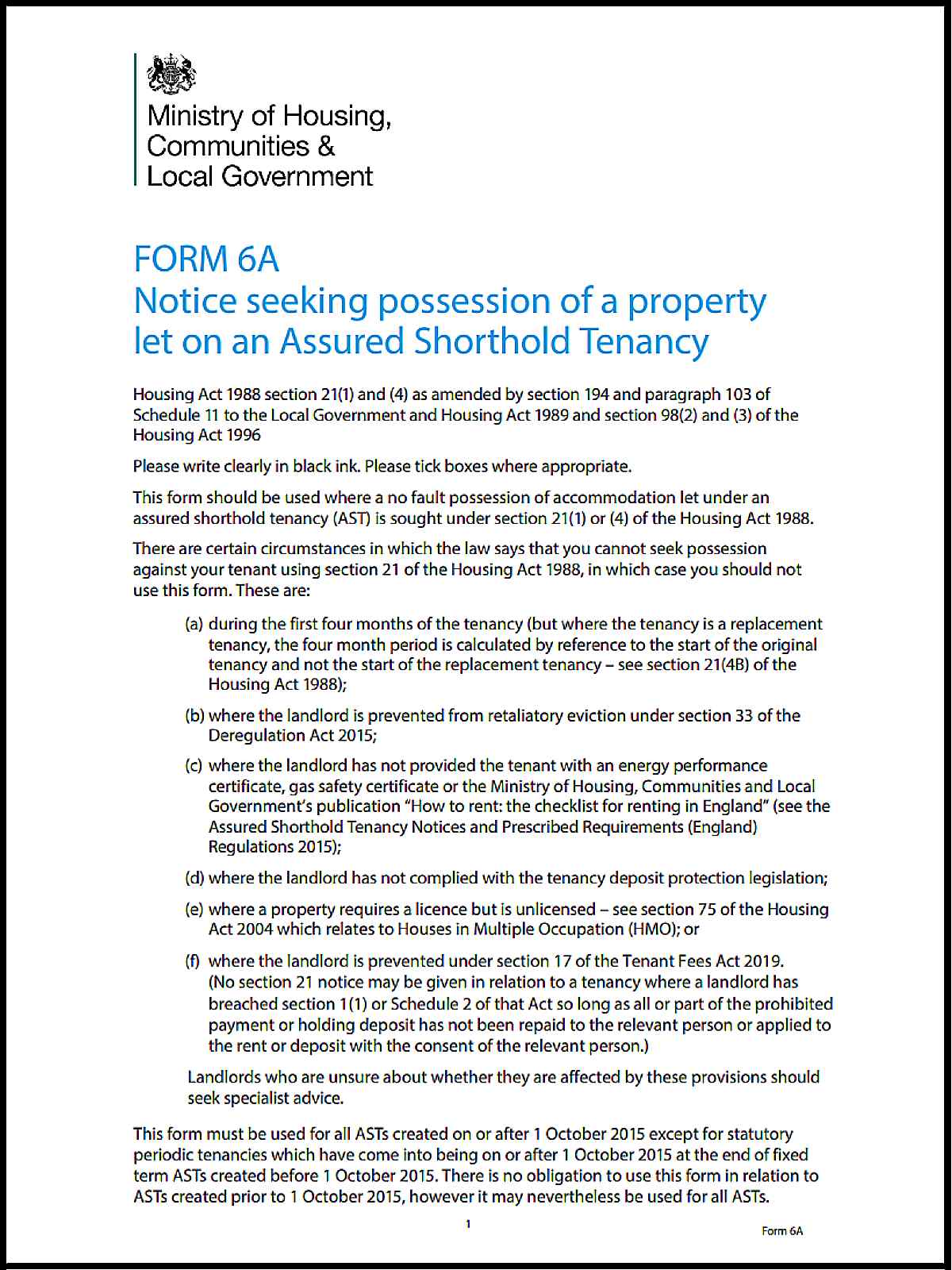
ToggleSection 21 Notice Template (PDF, Word & Printable Formats)
Why Most Searches for a Section 21 Notice Now Involve Expired Rights, Missed Deadlines, or Invalid Notices
The majority of current searches arise after a landlord discovers that the legal position has changed. Some are reviewing historic possession files. Others are trying to understand whether a notice served before abolition can still support court proceedings.
The most common misunderstanding is assuming that a Section 21 notice remains available simply because it was widely used for many years. Under the Renters’ Rights Act 2025, new notices cannot be served after 1 May 2026. That means many online templates, downloadable forms, and historic guidance materials no longer reflect the current position.
Another recurring issue involves landlords who served a notice before abolition but delayed taking further action. In many cases, attention turns to court deadlines, service evidence, and historic compliance records rather than the wording of the notice itself.
A distinction now exists between:
- Historic Section 21 notices served before abolition.
- Current possession procedures available after abolition.
Where a valid legacy notice exists, it may still be relevant within the transitional framework. Where no valid notice exists, landlords generally need to consider alternative possession routes rather than attempting to rely upon a discontinued process.
Section 21 Notice Template (PDF, Word & Printable Formats)
Can a Section 21 Notice Still Be Used in 2026?
The answer depends entirely on when the notice was served and whether the transitional rules continue to permit reliance upon it.
The 1 May 2026 Cut-Off
The most significant date is 1 May 2026.
Under the Renters’ Rights Act 2025, no new Section 21 notices can be legally served on or after that date. Any notice served after abolition is legally ineffective.
This creates a practical trap for landlords relying on outdated guidance or historic template libraries. A notice produced from an old section 21 form may look correct, but service after the abolition date renders it unusable.
The consequences extend far beyond a struck-out claim. Under the enforcement provisions of the Renters’ Rights Act 2025, local authorities possess expanded powers to issue civil penalties of up to £7,000 per tenancy against landlords who breach the new periodic tenancy rules or fail to issue mandatory statutory information.
The Transitional Window for Existing Notices
The abolition rules do not affect every historic notice equally.
A limited transitional framework applies to notices served on or before 30 April 2026. Those notices may continue to be relevant provided all applicable legal requirements were satisfied when the notice was served.
In practice, possession disputes involving legacy notices often become evidence disputes. Landlords must demonstrate not only that a notice existed, but also that the surrounding compliance obligations were satisfied.
This frequently leads to detailed scrutiny of:
- Deposit protection records.
- Disclosure documents.
- Service evidence.
- Historic tenancy paperwork.
Where records are incomplete, possession proceedings can become substantially more difficult even before the court considers the tenant’s position.
The 31 July 2026 Possession Claim Deadline
The transitional framework contains a hard procedural deadline.
Under Schedule 6 of the Renters’ Rights Act 2025, possession proceedings relying upon a valid Section 21 notice must be issued in the County Court on or before 31 July 2026.
Many landlords assume that a notice remains available indefinitely once served. That assumption can be costly. Missing the court deadline causes the notice to expire permanently.
Once the deadline passes, the notice ceases to provide a route to possession. The issue is not simply administrative; the right to rely on that particular notice is lost altogether.
As a result, landlords involved in transitional claims have focused heavily on court filing dates, particularly given the significant pressure currently affecting possession case processing.
The Compliance Checklist Judges Examine Before Looking at Possession
One of the most misunderstood aspects of Section 21 litigation is that judges often examine compliance history before considering possession itself.
A landlord may have a properly completed notice and still lose the claim because an earlier statutory obligation was overlooked years before.
Deposit Protection Requirements
Deposit protection remains one of the most common reasons possession claims encounter difficulty.
Under the Housing Act 2004, tenancy deposits were required to be protected within 30 days of receipt and accompanied by the prescribed information. More information can be found in the official Housing Act 2004.
In practice, disputes often arise where:
- Protection occurred late.
- Prescribed information cannot be proven.
- Records have been lost.
- Multiple tenancy renewals created documentary gaps.
For legacy Section 21 claims, failure to comply creates a significant obstacle. If a deposit was protected late or the Prescribed Information was missed, the statutory block is absolute. Under Section 214 of the Housing Act 2004, the landlord must refund the deposit in full (or with agreed deductions) before serving Form 6A; otherwise, the Section 21 notice is legally void.
Many possession claims reach court only for historic deposit records to become the central issue.
Gas Safety Records
Gas safety documentation frequently attracts detailed judicial scrutiny.
The relevant requirement was that tenants should have received the current gas safety certificate before occupation commenced, with subsequent certificates provided following later inspections.
A recurring practical problem is that landlords often retain the certificates themselves but cannot prove when they were actually provided to the tenant.
For possession proceedings relying on Section 21, historical failures concerning the original certificate can have serious consequences. Litigation teams commonly spend considerable time reconstructing service records from events that occurred years earlier.
Where evidence cannot be produced, a claim that initially appeared straightforward can become highly contested.
Energy Performance Certificate Requirements
An Energy Performance Certificate (EPC) forms another area where administrative shortcomings emerge during litigation.
While the mandate to commission an EPC falls under the Energy Performance of Buildings Regulations 2012, the absolute bar on serving a Section 21 notice without first providing that EPC to the tenant was strictly imposed by the Assured Shorthold Tenancy Notices and Prescribed Requirements (England) Regulations 2015.
In practice, landlords occasionally discover that an EPC exists but cannot demonstrate delivery. Others find that an outdated certificate remained on file while newer tenancy arrangements continued.
Where a valid EPC was omitted, the position could sometimes be corrected before service of Form 6A. Once litigation begins, however, judges frequently focus on the documentary trail rather than assumptions about what probably occurred.
The Correct How to Rent Guide
The “How to rent: the checklist for renting in England” booklet generated a substantial amount of litigation because compliance depended on providing the correct edition applicable to the tenancy.
Official guidance is available through How to rent: the checklist for renting in England.
A common problem was record retention. Landlords often retained evidence that a guide had been supplied but could not demonstrate which edition was delivered.
Tenant representatives reviewing possession claims regularly examine this issue because a seemingly minor administrative discrepancy can affect the validity of the notice.
The challenge is rarely the existence of the guide itself. The challenge is proving compliance years later when documents have changed, tenancies have renewed, and records have become fragmented.
Renters’ Rights Act Information Sheet Requirements
The transitional framework introduced an additional disclosure requirement for certain ongoing tenancy situations.
For any assured or assured shorthold tenancy created before 1 May 2026 that features wholly or partly written terms, landlords or their managing agents were legally required to serve the official ‘Renters’ Rights Act Information Sheet 2026’ on every named tenant no later than 31 May 2026.
For many landlords, this requirement arrived after the Section 21 notice had already been served. As a result, possession files now frequently contain a mixture of historic Housing Act documentation and newer transitional compliance records.
Property professionals conducting audits commonly review this information alongside deposit records, disclosure documents, service evidence, and agency records to assess whether a legacy possession claim remains capable of proceeding..
The practical reality is that judges rarely view a Section 21 notice in isolation. They examine the entire compliance history surrounding the tenancy. A missing document from years earlier can carry greater weight than the wording of the notice itself.
The Fastest Ways a Section 21 Notice Becomes Invalid
Many landlords assume that a possession claim succeeds or fails based on the notice itself. In reality, most unsuccessful Section 21 claims collapse because of compliance defects discovered long after the notice was served.
By the time a case reaches the County Court, tenant representatives and duty solicitors often focus on finding a single procedural failure. If one mandatory requirement is missing, the court may never reach the possession question.
Using the Wrong Form
For legacy Section 21 notices, the prescribed document was Form 6A.
Pursuant to Section 21(8) of the Housing Act 1988 and the Assured Tenancies and Agricultural Occupancies (Forms) (England) Regulations 2015, landlords were required to use the mandated statutory form.
A common mistake occurred where landlords downloaded outdated templates from old websites or reused historic forms from previous tenancies. Even where the content looked broadly similar, failure to use the correct prescribed form could result in the notice being treated as invalid.
In practice, judges frequently compare the notice used against the statutory requirements in force at the date of service rather than accepting substantial compliance arguments.
Attempting to Serve After Abolition
Since 1 May 2026, no new Section 21 notices can be legally served.
Some landlords only discover the abolition after searching for a section 21 eviction notice or section 21 notice PDF online. Unfortunately, completing a historic template does not preserve a legal route that no longer exists.
Any notice served after the abolition date is void.
The consequences extend beyond wasted time and legal costs. The Renters’ Rights Act 2025 allows local housing authorities to impose financial penalties of up to £7,000 for attempts to use the abolished procedure.
In practical terms, a landlord relying on post-abolition service starts from a position where the notice cannot support a possession claim at all.
Unreturned Prohibited Tenant Fees
Possession claims occasionally fail because of issues entirely unrelated to rent or occupation.
Under Section 17 of the Tenant Fees Act 2019, a Section 21 notice could not be validly served while a prohibited payment remained outstanding.
Examples commonly involved:
- Unlawful administration charges.
- Excessive holding deposits.
- Fees retained contrary to statutory restrictions.
What catches many landlords by surprise is that the underlying tenancy may have operated smoothly for years, yet a historic fee issue can still undermine reliance on a notice.
During possession proceedings, tenants and advisers routinely review agency records looking for unresolved payment breaches.
Retaliatory Eviction Restrictions
Retaliatory eviction challenges remain one of the most significant risks in possession litigation.
Where a local authority served an Improvement Notice or an Emergency Remedial Action notice regarding serious property hazards, a Section 21 notice became invalid if served within the relevant six-month restriction period.
These disputes rarely arise from paperwork alone. They typically emerge where repair complaints have been ongoing for months and communications between landlord and tenant are already strained.
In court, judges often examine the sequence of events carefully:
- When the tenant complained.
- Whether the local authority became involved.
- When enforcement action occurred.
- When the possession notice was served.
A notice that appears valid on its face can fail once the wider chronology is reviewed.
Administrative Errors Made Years Earlier
One of the most frustrating aspects of Section 21 litigation is that the decisive mistake may have occurred years before possession proceedings begin.
Examples include:
- Missing disclosure records.
- Lost compliance documents.
- Service evidence that no longer exists.
- Historic certification failures.
The accelerated possession route historically depended on documentary compliance. Consequently, seemingly minor administrative oversights can resurface during litigation long after the individuals involved have changed, the managing agent has been replaced, or records have been archived.
Many landlords discover this only after investing substantial time and money preparing a claim.
Serving a Legacy Section 21 Notice and Proving It Reached the Tenant
Service disputes remain common because possession proceedings require more than proof that a notice was created. The court must be satisfied that it was properly served.
A notice sitting in a file achieves nothing if the landlord cannot demonstrate how and when the tenant received it.
Service Methods Commonly Accepted
Service generally needed to follow the provisions contained within the tenancy agreement.
Commonly accepted methods included:
- Hand delivery to the property.
- First-class post.
- Email service where expressly authorised by the tenancy agreement and supported by a designated electronic address.
In practice, experienced landlords rarely rely on a single method. Multiple service methods were often used simultaneously to reduce the likelihood of later disputes.
The reason is simple: possession claims are expensive to restart if service cannot be proven.
Service Methods That Frequently Cause Disputes
Many service arguments arise because landlords use methods that feel convenient rather than methods authorised by the tenancy agreement.
Examples regularly challenged in court include:
- Informal messaging applications.
- Unauthorised email addresses.
- Verbal notifications.
- Messages sent to outdated contact details.
A landlord may believe a tenant clearly knew about the notice. The legal issue, however, is whether service occurred in accordance with the contractual and procedural requirements.
Knowledge of a notice and valid service are not necessarily the same thing.
Building an Evidence Trail
Successful possession claims typically include evidence extending beyond the notice itself.
Common supporting records include:
- Witness statements.
- Postal receipts.
- Tracking confirmations.
- Dated photographs of delivery.
- Internal service logs and service provider records.
Property professionals often treat service evidence as seriously as the notice because proving delivery can become a separate contested issue.
Where evidence is weak, tenants frequently challenge service as part of a broader defence strategy.
Using Form N215
Form N215 operates as the Certificate of Service used to demonstrate how documents were served.
For possession proceedings, it forms part of the evidential package submitted to the County Court.
The document does not create valid service by itself. Instead, it records the method used and supports the landlord’s evidence.
Where supporting proof is unavailable, a completed N215 may attract further judicial scrutiny rather than resolving the issue.
What Happens After the Notice Period Ends
Many landlords mistakenly assume that possession automatically follows once the notice period expires.
The notice itself does not end the tenancy and does not authorise removal of the tenant. Further court action is required.
Moving From Notice to Court Proceedings
Once the notice period expired, the landlord needed to commence formal possession proceedings in the County Court.
For legacy Section 21 claims, the notice normally became a central exhibit within the claim documentation.
Supporting materials often included:
- Deposit protection evidence.
- Disclosure records.
- Service documentation.
- Compliance certificates.
- Form N215 where applicable.
In 2026, timing has become particularly significant because transitional claims must be issued before the statutory deadline.
A landlord holding an otherwise valid notice gains no benefit if proceedings are not started in time.
The Accelerated Possession Procedure
Historically, Section 21 claims could use the accelerated possession process.
The attraction of this route was that a judge could determine the claim on paperwork alone without requiring a full hearing.
In practice, however, accelerated possession was only as strong as the documents supporting it.
Where evidence was incomplete, judges frequently required additional information or listed matters for further consideration.
As transitional claims approach the statutory deadline, courts are seeing increasing scrutiny of historic compliance records.
Why Claims Are Being Struck Out in 2026
A recurring theme in current litigation is that claims are failing because of historic administrative defects rather than active tenant misconduct.
Common reasons include:
- Missing compliance documents.
- Invalid notices.
- Inadequate service evidence.
- Historic disclosure failures.
- Deposit protection defects.
Tenant representatives understand that a successful challenge to one compliance requirement may dispose of the claim entirely.
As a result, judges are often required to review years of tenancy administration before reaching the possession question.
The Practical Timeline From Legacy Notice to Physical Eviction
The actual possession process extends well beyond service of the notice.
Even where a landlord succeeds at every stage, several procedural steps remain before physical recovery of the property.
Notice Stage
For valid legacy notices, the notice period was generally required to provide at least two calendar months.
Additionally, the notice could not expire before the end of the tenancy’s fixed term.
Many disputes originate here because landlords sometimes calculate dates incorrectly or rely on assumptions taken from outdated guidance.
A possession claim built on incorrect notice dates can encounter difficulties from the outset.
Court Stage
After the notice period ends, the matter moves to the County Court.
At this stage, judges typically examine:
- Notice validity.
- Compliance history.
- Disclosure records.
- Service evidence.
- Statutory requirements.
Possession proceedings frequently become document-heavy exercises. The landlord’s record-keeping practices over several years may prove more influential than events occurring immediately before the claim.
For transitional cases, the court must also be satisfied that proceedings were issued before the 31 July 2026 deadline.
Enforcement Stage
Obtaining a possession order does not necessarily mean the property is immediately recovered.
If the tenant remains in occupation beyond the date specified by the court, the landlord must apply for a Warrant of Possession.
County Court Bailiffs are then responsible for carrying out the eviction.
Across England, enforcement delays remain a practical concern. Bailiff availability frequently affects how quickly possession orders can be executed.
Consequently, even successful landlords may face additional waiting periods before physical possession is achieved.
Actions Landlords Must Never Take
Frustration with delays sometimes leads landlords to consider self-help measures.
That approach creates serious legal risk.
Landlords must not:
- Change locks while the tenant remains entitled to occupy.
- Exclude tenants from the property.
- Remove belongings without authority.
- Interfere with utilities in an attempt to force departure.
Such conduct can amount to unlawful eviction under the Protection from Eviction Act 1977.
The lawful route remains possession proceedings followed, where necessary, by enforcement through County Court Bailiffs. Attempting to bypass the process can create liabilities far more significant than the original possession dispute.
Section 21 Notice vs Section 8 Notice After the Renters’ Rights Act 2025
The distinction between Section 21 and Section 8 has become far more significant since the abolition of new Section 21 notices.
For many years, landlords often viewed Section 21 as the simpler possession route because it did not require proof of tenant fault. Following the Renters’ Rights Act 2025, that position has changed. Landlords who can no longer rely on a valid legacy Section 21 notice must consider alternative statutory grounds for possession.
Why the Distinction Matters More Than Ever
The removal of the no-fault possession route means landlords can no longer assume that possession can be obtained simply by serving a notice and waiting for the notice period to expire.
Where a legacy Section 21 notice is unavailable, expired, or invalid, possession generally depends upon statutory grounds that can be evidenced and defended in court.
In practice, this means landlords are spending more time gathering supporting evidence before commencing possession proceedings.
Situations Previously Covered by Section 21
Historically, Section 21 was commonly used where a landlord wanted possession at the end of a tenancy without alleging misconduct.
Typical examples included:
- Recovering possession at the end of a tenancy.
- Preparing a property for sale.
- Returning to occupy the property personally.
- Regaining control of a property after a fixed term expired.
The key feature was that the landlord did not need to establish tenant fault.
When Section 8 Has Become the Only Available Route
Where a Section 21 notice can no longer be relied upon, landlords may need to pursue possession using statutory grounds available under Section 8 procedures.
With the abolition of no-fault evictions, landlords must rely on the expanded Section 8 framework introduced by the Renters’ Rights Act 2025. This includes heavily revised mandatory grounds, such as Ground 1 (landlord or family moving in), Ground 1A (intention to sell the property), and the newly structured student HMO possession rules (Ground 4A), alongside established grounds like significant rent arrears.
A common mistake is assuming that an expired Section 21 notice can simply be revived or re-served. Since new Section 21 notices cannot be served after 1 May 2026, landlords must focus on the possession routes that remain legally available.
UK Legal Facts About Section 21 Notices
Legal Requirements
| Topic / Issue | England Legal Rule | Governing Law |
|---|---|---|
| Abolition & Issuance Ban | No new Section 21 notices can be legally served on or after 1 May 2026; existing fixed-term ASTs converted to periodic tenancies. | Renters’ Rights Act 2025 |
| Transitional Court Deadline | Possession proceedings relying on pre-abolition legacy Section 21 notices must be issued by 31 July 2026. | Renters’ Rights Act 2025 (Schedule 6) |
| Notice Period | Minimum two calendar months for legacy notices | Housing Act 1988 |
| Deposit Protection | Tenancy deposits must be protected within 30 days of receipt, and Prescribed Information served to tenants and relevant persons. | Housing Act 2004 (s.213) & s.214 |
| Form Requirement | Form 6A is the mandatory prescribed form for any legacy Section 21 notice served between October 2015 and 30 April 2026. | Assured Tenancies and Agricultural Occupancies (Forms) (England) Regulations 2015 |
| Gas Safety Compliance | A valid EPC must be physically or digitally given to the tenant free of charge before serving a Section 21 notice. | Assured Shorthold Tenancy Notices and Prescribed Requirements (England) Regulations 2015 |
| EPC Compliance | EPC must be provided before reliance on the notice | Energy Performance of Buildings (England and Wales) Regulations 2012 |
| How to Rent Guide | The correct edition of the government’s checklist must be provided at the start of the tenancy or at any statutory periodic renewal. | Housing Act 1988 (s.21B via Deregulation Act 2015) |
| Prohibited Fees | A Section 21 notice cannot be validly served if a prohibited fee or unlawful holding deposit remains unreturned. | Tenant Fees Act 2019 (s.17) |
| Retaliatory Eviction Restrictions | A Section 21 notice is invalid if served within 6 months of a local authority Improvement Notice or Emergency Remedial Action notice. | Deregulation Act 2015 (s.33) |
Practical Legal Impact
The table illustrates why possession disputes frequently focus on administration rather than occupation.
A technically correct notice may still fail because a separate compliance requirement was overlooked years earlier. County Court judges regularly review the entire tenancy history before considering possession.
The practical consequence is that landlords often spend more time proving compliance than arguing the merits of possession itself.
The abolition of new Section 21 notices has increased the significance of historic records. Missing paperwork that may have seemed unimportant at the time can now determine whether a legacy claim succeeds.
Many landlords also discover that online guidance published before 2026 no longer reflects the current legal position after tenancy termination. Reliance on outdated materials can result in wasted costs, procedural delays, and failed possession proceedings.
For statutory reference, landlords and advisers frequently review the official Housing Act 1988 alongside current government guidance on possession procedures.
Common Situations Where Landlords Discover a Section 21 Notice Cannot Be Used
Missing Deposit Protection Evidence
One of the most common discoveries occurs when possession proceedings are being prepared and evidence of deposit protection cannot be located.
The landlord may genuinely believe compliance occurred, but without supporting documentation, proving compliance becomes significantly harder.
Incorrect Form 6A Records
Historic files occasionally contain draft notices, incomplete notices, or notices prepared using the wrong version of Form 6A.
These issues often remain unnoticed until the tenant’s representative reviews the court bundle.
Historic Gas Safety Failures
Gas safety compliance regularly generates disputes because records may date back many years.
A landlord might possess current certificates but struggle to demonstrate that the required certificate was provided before the tenant originally occupied the property.
Missed July 2026 Court Deadline
Some landlords correctly served a legacy notice before abolition but failed to commence possession proceedings before 31 July 2026.
Under the transitional provisions, the notice expires permanently once that deadline is missed.
Unresolved Tenant Fee Breaches
Historic agency practices occasionally create problems long after a tenancy begins.
Where prohibited payments were taken and not returned, the validity of the notice can be affected.
Landlords often discover these issues only after conducting a detailed file review.
Retaliatory Eviction Challenges
Repair complaints and local authority involvement frequently create additional litigation risk.
A possession claim that appears straightforward can become highly contested once enforcement notices and property condition records are examined.
Frequently Asked Questions
Can a landlord legally serve a new Section 21 notice after 1 May 2026?
No.
Under the Renters’ Rights Act 2025, new Section 21 notices cannot be served on or after 1 May 2026. Any notice served after that date is legally void and may expose the landlord to financial penalties.
What happens if a valid Section 21 notice was served before abolition but court proceedings were not started by 31 July 2026?
The notice expires permanently.
Under the transitional provisions contained in Schedule 6 of the Renters’ Rights Act 2025, possession proceedings relying on a legacy notice had to be issued by 31 July 2026. Missing that deadline prevents further reliance on the notice.
Can a possession claim fail because the original gas safety certificate was not given before the tenant moved in?
Yes.
According to the verified compliance requirements applicable to legacy Section 21 notices, failure to provide the initial gas safety certificate before occupation can invalidate reliance on the notice. Courts routinely scrutinise historical compliance records when assessing possession claims.
Further statutory information is available through the Gas Safety (Installation and Use) Regulations 1998.
Is a Section 21 notice valid if the tenancy deposit was protected late or the Prescribed Information was never served?
Not automatically.
Under the Housing Act 2004, deposit protection and prescribed information requirements formed part of the compliance framework supporting Section 21 validity. Where protection obligations were not met within the required timeframe, the landlord generally needed to resolve the issue before serving Form 6A.
Official information regarding deposit obligations can be found within government guidance on Deposit protection rules.
Can a landlord rely on email service if the tenancy agreement does not specifically permit electronic service?
Generally, no.
The verified procedural requirements indicate that email service was only valid where the tenancy agreement expressly authorised electronic service and the tenant had provided a designated digital address for that purpose.
Where those requirements were absent, landlords typically needed to rely upon another permitted service method, such as hand delivery or first-class post, supported by appropriate evidence of service.
For legacy Section 21 claims, service disputes remain a common reason why possession proceedings encounter delays or fail altogether. A landlord may have a valid notice, but without proof of proper service, the court may refuse to rely upon it.
Author
-

Eva Gray is a content writer and editorial reviewer at LegalSheets, where she writes and fact-checks articles on UK law, contracts, and everyday legal matters. She holds both a First-class BA and an MPhil from the University of Cambridge, and has gained hands-on legal experience through internships at Stephenson Harwood, Linklaters, and O'Keefe's Solicitors. A member of the Cambridge Law Society, Eva combines academic rigour with practical legal insight to produce clear, accurate, and trustworthy content that helps readers navigate complex legal topics with confidence.
