Vehicle Bill Of Sale UK | Free PDF & Word
A Vehicle Bill Of Sale usually becomes important the moment someone questions who owns the vehicle or what was actually included in the sale. In England, private vehicle sales are shaped by the Sale of Goods Act 1979 and, where a trader sells to a consumer, the Consumer Rights Act 2015, yet many disputes start because the document omits the registration number, VIN, mileage, or the exact condition of the vehicle at handover.
County Court claims regularly expose these gaps when a buyer alleges the wrong vehicle was delivered or a seller disputes the agreed purchase price, leaving little reliable evidence beyond conflicting accounts. Whether you’re buying or selling a car, van, motorcycle or other road vehicle, the template and guidance that follow will help you record the transaction clearly and include the details commonly relied upon if ownership or the terms of the sale are later challenged.
Affiliate Disclosure: We may earn a commission from purchases made through affiliate links on this page, at no extra cost to you.
Table of Contents
ToggleVehicle Bill Of Sale Template (PDF, Word & Printable Formats)
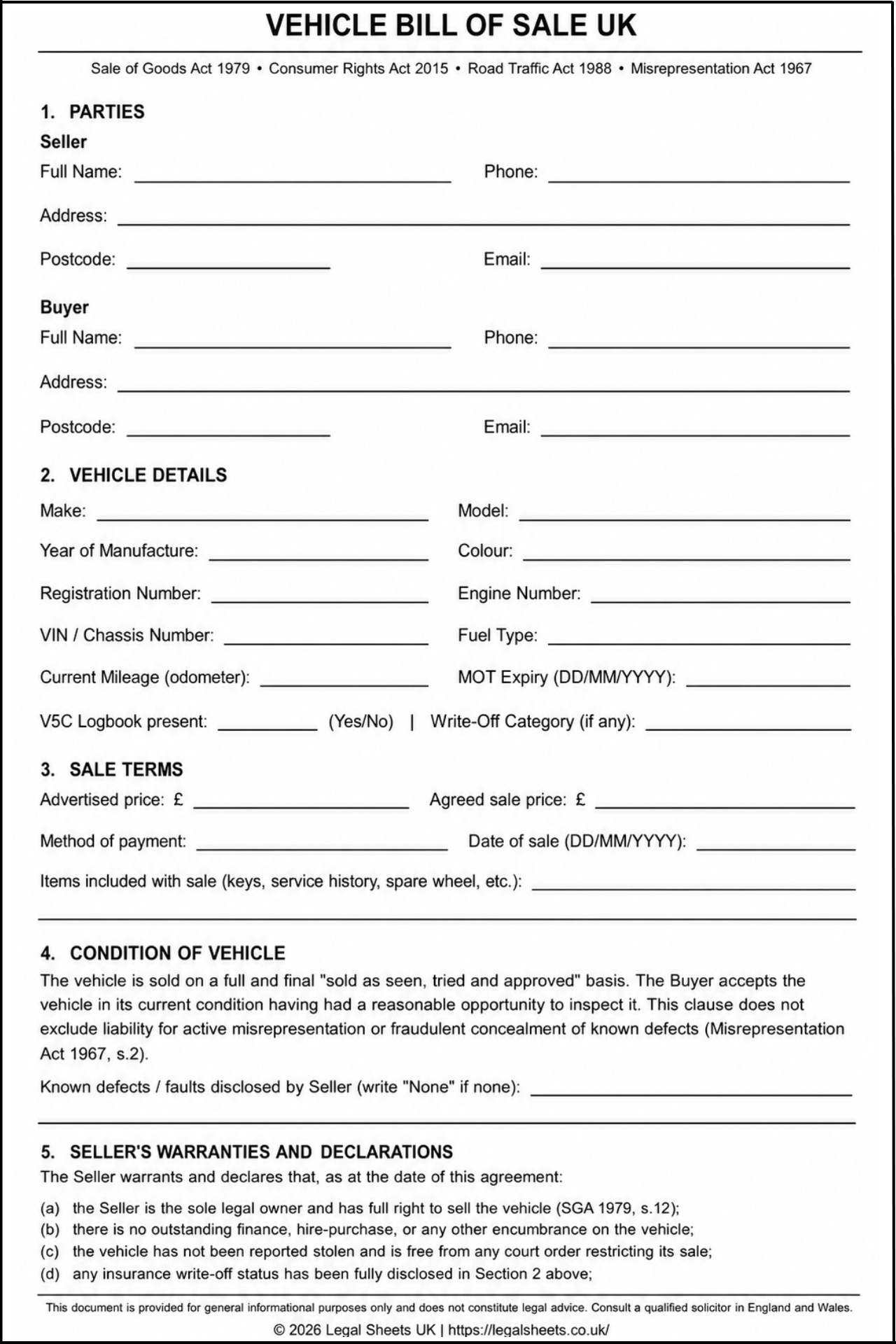
Customised Do-it-yourself Bill of Sale
When a Vehicle Bill Of Sale Is Used
Private Vehicle Sales
Private sales are the most common use for a Vehicle Bill Of Sale. Two individuals agree on the price, inspect the vehicle, exchange payment, and sign the document.
In these sales, the buyer normally accepts responsibility for checking the vehicle before purchase. Recording the exact condition described by the seller can become significant if a later dispute concerns alleged misrepresentation rather than ordinary wear and tear.
Dealer Sales
Motor dealers usually produce their own sales paperwork, but a Vehicle Bill Of Sale may still accompany the transaction as supporting evidence.
Unlike private sellers, dealers remain subject to statutory consumer protections. A dealer cannot remove a buyer’s legal rights simply by inserting phrases such as “Sold As Seen” or “No Refunds” into the paperwork.
Family Transfers
Vehicles frequently pass between parents, children, siblings, or other relatives. Even where no money changes hands, recording the transfer in writing reduces confusion over ownership later.
A written record can also prove useful if questions arise regarding insurance, taxation, or ownership after the transfer.
Gifts and Low-Value Transfers
People often assume that gifts require no documentation. In reality, disputes sometimes arise years later when ownership cannot easily be proved.
A simple Vehicle Bill Of Sale showing that the vehicle was transferred without payment provides clear evidence of the parties’ intentions.
Classic and Collectible Vehicles
Historic and collectible vehicles often appreciate in value over time. Buyers generally expect detailed paperwork confirming originality, mileage, accessories, and known history.
The more valuable the vehicle, the greater the benefit of accurately recording every detail of the transaction.
What Makes a Vehicle Bill Of Sale Different From Other Vehicle Documents
Many vehicle documents appear similar but serve completely different purposes. Using the wrong document often creates unnecessary confusion after the sale.
Bill Of Sale vs V5C Logbook
One of the most common misunderstandings involves the V5C registration certificate.
The Bill Of Sale records ownership between buyer and seller. The V5C records the registered keeper with the DVLA. These are separate functions.
Even after signing the Bill Of Sale, the seller must still notify the DVLA that the registered keeper has changed. Failing to do so may leave the previous keeper receiving speeding notices, parking penalties, or vehicle tax correspondence.
Bill Of Sale vs Vehicle Sale Agreement
A vehicle sale agreement usually contains broader contractual terms, including payment arrangements, delivery obligations, warranties, or conditions that must be satisfied before ownership transfers.
A Vehicle Bill Of Sale is generally more straightforward. It primarily records that ownership has passed and confirms the agreed consideration.
Bill Of Sale vs Receipt
A receipt simply proves payment.
A Vehicle Bill Of Sale records substantially more information, including the identities of the parties, vehicle description, sale date, and ownership declaration.
Bill Of Sale vs Purchase Invoice
Purchase invoices are generally issued by motor traders as part of their business records.
A Bill Of Sale is suitable for both business and private transactions and focuses on recording the transfer itself rather than accounting information.
Information Every Vehicle Bill Of Sale Should Contain
Small omissions often become major problems if the transaction is later challenged. A carefully completed document leaves very little room for disagreement.
Buyer and Seller Details
Record the full legal names and complete addresses of both parties.
Incomplete addresses frequently become an obstacle if legal proceedings are later required because court documents cannot easily be served on an unidentified seller.
Vehicle Identification Information
The document should accurately identify the vehicle by including:
- Registration number
- Vehicle Identification Number (VIN)
- Make
- Model
- Year
- Colour
Entering incorrect identification details may create uncertainty about which vehicle was actually sold.
Purchase Price and Payment Method
Record the agreed purchase price together with the payment method, whether cash, bank transfer, or another agreed method.
This reduces disputes where one party later alleges that payment was incomplete.
Odometer Reading
The mileage should be recorded exactly as displayed at the time of sale.
Mileage discrepancies frequently become the subject of later disputes, particularly where the vehicle’s value depends heavily upon its recorded usage.
Vehicle Condition
The condition statement should honestly reflect what both parties understood when completing the transaction.
If the seller writes statements such as “Full Service History,” “HPI Clear,” or “New Cambelt,” those statements may later become legally significant if they prove to be false.
Sale Date and Time
Recording both the date and time establishes precisely when responsibility for the vehicle changed hands.
This can become important if parking penalties, traffic offences, or insurance questions arise shortly after the sale.
Signatures
Although England does not impose a statutory requirement that a Vehicle Bill Of Sale must be signed or witnessed, written signatures provide valuable evidence of the agreement if the transaction is later disputed.
Each party should receive an identical signed copy immediately after completion.
Clauses That Matter Most in Practice
Many disputes arise not because the parties intended to deceive one another, but because important matters were never written down. Well-drafted clauses reduce uncertainty and provide a clearer record of what both parties agreed at the time of sale.
Ownership Declaration
This clause confirms that ownership of the vehicle passes from the seller to the buyer on the agreed sale.
A clear ownership statement removes uncertainty over whether the document was merely a receipt or an actual transfer of ownership.
Right to Sell
One of the most valuable protections is the seller’s confirmation that they have the legal right to sell the vehicle.
Where the seller lacks good title, disputes may arise if another person or finance company later claims ownership. Recording this declaration creates an important evidential record should litigation become necessary.
Vehicle Condition Statement
The condition clause should accurately describe the vehicle at the time of sale without exaggeration.
Private sellers often include wording confirming that the vehicle is sold in its existing condition. However, any specific factual statements written into the document should be capable of being supported if challenged later.
Existing Finance Disclosure
Outstanding finance is one of the most serious issues affecting used vehicle purchases.
If finance remains attached to the vehicle, failing to disclose it can result in expensive disputes that may ultimately involve recovery of the vehicle by the finance provider.
Included Accessories and Spare Items
Items such as spare keys, service books, locking wheel nuts, charging cables, manuals, roof racks, or personalised accessories should be listed individually.
This avoids later disagreements about what formed part of the agreed sale.
Payment Confirmation
A short confirmation acknowledging that payment has been received provides useful evidence if one party later alleges that money remains outstanding.
Where payment is made electronically, keeping the corresponding bank record alongside the Bill Of Sale creates an even stronger evidential package.
Entire Agreement Clause
An entire agreement clause records that the written document reflects the parties’ complete agreement.
Although it cannot eliminate every future dispute, it reduces arguments that additional verbal promises formed part of the sale.
Legal Requirements in England
The legal effect of a Vehicle Bill Of Sale depends on who is selling the vehicle and the circumstances of the transaction. While the document itself is a private agreement, several laws affect the rights of buyers and sellers.
Legal Requirements Table
| Topic / Issue | Precise English Legal Rule | Governing Statute / Administrative Regulation |
| Simple Private Sale (Receipt) | Purely written evidence of a C2C sale. Operates under the caveat emptor (buyer beware) principle, unless a written representation proves false. | Sale of Goods Act 1979 / Misrepresentation Act 1967 |
| “Sold as Seen” Prohibition | Motor traders are strictly prohibited from utilizing contractual clauses to exclude the statutory rights of satisfactory quality, fitness, or description. | Consumer Rights Act 2015 (Section 31) |
| Title of Financed Vehicles | A private buyer purchasing a financed motor vehicle in good faith without notice legally acquires good title, defeating repossession claims. | Hire-Purchase Act 1964 (Part III) |
| Logbook Loans (Security) | A security Bill of Sale must strictly match the prescribed schedule wording and be registered at the High Court within 7 days, otherwise it is entirely void. | Bills of Sale Act (1878) Amendment Act 1882 |
| DVLA Keepership Update | The seller has a strict administrative duty to notify the DVLA of the change of registered keeper immediately upon executing the sale. | Road Vehicles (Registration and Licensing) Regulations 2002 |
| Execution Formalities | A simple Vehicle Bill of Sale requires no statutory witnessing to pass title. A statutory security Bill of Sale must be independently witnessed. | Common Law / Bills of Sale Acts |
In practice, these rules determine how disputes are decided rather than how the document is completed. County Courts regularly examine the wording used in the Bill Of Sale alongside payment evidence, advertisements and correspondence when deciding ownership or misrepresentation claims.
Sale of Goods Act 1979 in Private Sales
Private vehicle sales operate differently from dealer sales.
The Sale of Goods Act 1979 implies that the seller has the legal right to sell the vehicle. However, buyers generally purchase under the principle of buyer beware. If a mechanical fault appears after purchase, the buyer will normally need to prove that the seller made a false statement rather than simply relying on the vehicle developing problems.
Consumer Rights Act 2015 for Dealer Sales
Motor traders owe greater legal obligations than private sellers.
Vehicles sold by businesses must be of satisfactory quality, fit for purpose and match their description. Under Section 31 of the Consumer Rights Act 2015, dealers are strictly prohibited from attempting to bypass their statutory duty to provide vehicles of satisfactory quality. Inserting clauses such as ‘Sold As Seen,’ ‘Trade Sale Only,’ or ‘No Refunds’ into a B2C Bill of Sale is completely legally void and directly exposes the dealership to enforcement action by Trading Standards.
Hire-Purchase Act 1964 and Outstanding Finance
Outstanding finance remains one of the biggest risks when buying a used vehicle.
Selling an encumbered vehicle normally constitutes a breach of title. However, under Part III of the Hire-Purchase Act 1964, a crucial statutory exception exists: if a private individual (not a motor trader) unknowingly purchases a vehicle in good faith without notice of an outstanding hire-purchase or conditional sale agreement, they legally acquire ‘good title,’ permanently defeating the finance company’s right to repossess it.
Misrepresentation Act 1967
Written statements matter.
If the seller records statements such as “HPI Clear,” “Full Service History,” or “New Cambelt” and those statements later prove false, the buyer may pursue a civil claim based upon misrepresentation.
DVLA Notification Requirements
The Bill Of Sale transfers evidence of ownership, but it does not update DVLA records.
Under the Road Vehicles (Registration and Licensing) Regulations 2002, the seller bears a strict statutory duty to notify the DVLA immediately of the change of registered keeper. Until this legal requirement is fulfilled, the seller remains statutorily liable for the vehicle’s vehicle excise duty (road tax), speeding fines, and parking penalties.
Completing the Vehicle Bill Of Sale Step by Step
Verify the Vehicle Identity
Confirm the registration number, VIN, make, model and other identifying details directly from the vehicle before completing the document.
Record Accurate Seller Information
Record complete names and addresses rather than initials or incomplete contact details. Incorrect information often creates enforcement difficulties if legal proceedings become necessary.
Describe the Vehicle Correctly
Avoid exaggerated descriptions.
Only record information that can be supported by service records or inspection evidence.
Confirm Payment
State the agreed purchase price together with the payment method and whether payment has been received in full.
Sign and Exchange Copies
Each party should sign and immediately retain an identical copy for future reference.
Notify DVLA
After the sale is completed, the seller should separately complete the required DVLA notification process regarding the change of registered keeper.
Common Mistakes That Cause Problems Later
Confusing Ownership With Registered Keepership
The Bill Of Sale records ownership.
The V5C records the registered keeper.
Confusing the two remains one of the most frequent errors following private vehicle sales.
Missing VIN or Registration Number
Incorrect vehicle identification may leave uncertainty over which vehicle the document actually covers.
Incorrect Mileage
Recording inaccurate mileage can trigger later allegations of misrepresentation.
Incomplete Seller Address
County Court claims often become difficult where buyers cannot locate the seller because only partial contact details were recorded.
False Statements About Service History
Statements regarding servicing, accident history or replacement parts should never be included unless accurate.
Ignoring Outstanding Vehicle Finance
Failing to investigate outstanding finance can expose both parties to significant ownership disputes.
Private Sales vs Dealer Sales
Buyer Beware in Private Sales
Private buyers should inspect the vehicle carefully before agreeing to purchase.
The law generally expects buyers to satisfy themselves regarding the vehicle’s condition unless the seller has made false representations.
Consumer Rights Against Motor Traders
Dealer purchases carry stronger statutory protections than private transactions.
Businesses remain responsible for complying with consumer legislation regardless of any wording inserted into the paperwork.
Why “Sold As Seen” Has Different Effects
A private seller may include wording reflecting the buyer’s inspection of the vehicle.
A motor trader cannot rely upon similar wording to remove statutory consumer rights.
Outstanding Finance and Ownership Risks
Logbook Loans
A standard Vehicle Bill of Sale must never be used to secure a cash loan where the original owner retains physical possession of the car. These ‘logbook loans’ are strictly governed by the Bills of Sale Act (1878) Amendment Act 1882; they must follow an exact prescribed statutory schedule and be registered at the High Court within 7 days, otherwise the lender’s security is entirely void in law.
Hire Purchase Agreements
Vehicles subject to hire purchase should be investigated carefully before purchase.
Conditional Sale Agreements
Outstanding conditional sale agreements may affect ownership if not properly resolved before sale.
HPI Checks
Although not legally compulsory, checking for outstanding finance before purchase is often one of the simplest ways to reduce future ownership disputes.
When a Buyer Can Lose the Vehicle
If ownership defects emerge, finance providers may assert competing rights depending upon the circumstances of the transaction and applicable statutory protection.
Vehicle Condition and Misrepresentation
Mechanical Faults
Mechanical failures alone do not automatically establish legal liability in private sales.
Accident History
Known accident damage should be described honestly.
Mileage Discrepancies
Mileage inaccuracies frequently become central evidence in County Court disputes.
Service Records
If service history is mentioned, supporting records should be available.
Written Statements That Create Liability
Even brief written descriptions may later become evidence if they are inaccurate.
Payment and Evidence
Cash Payments
Count cash carefully before signing the document.
Bank Transfers
Electronic payments produce useful supporting evidence alongside the Bill Of Sale.
Deposits
Any deposit should clearly state whether it forms part of the purchase price.
Receipts
Keep receipts together with the completed Bill Of Sale.
Supporting Documents
Useful documents include:
- V5C details
- Service records
- MOT history
- Finance clearance evidence
- Spare key receipts
After the Sale
Updating the DVLA
The seller should complete the DVLA notification immediately after the transaction.
Keeping Copies
Both parties should safely retain signed copies of the completed document.
Insurance Changes
Insurance arrangements should be updated once ownership changes.
Vehicle Tax
Responsibility for vehicle tax should be addressed separately from the Bill Of Sale.
Number Plate Issues
Any personalised registration arrangements should be completed before ownership transfers if necessary.
County Court Disputes Involving Vehicle Bills Of Sale
Ownership Disputes
County Courts regularly consider the completed Bill Of Sale when deciding ownership disagreements.
Payment Disputes
Payment records, bank statements and signed acknowledgements frequently become decisive evidence for commission payments.
Misrepresentation Claims
Claims often arise where written statements concerning the vehicle later prove inaccurate.
Small Claims Track
Lower-value disputes are commonly allocated to the Small Claims Track, while higher-value claims may proceed through the Fast Track.
Evidence That Courts Expect
Useful evidence includes:
- Signed Bill Of Sale
- Payment records
- Vehicle advertisements
- Messages between buyer and seller
- Service records
- Photographs taken at the time of sale
Situations Where a Standard Bill Of Sale May Not Be Appropriate
Business Fleet Sales
Fleet transactions often require more detailed contractual documentation for commercial fleets.
Vehicles Sold at Auction
Auction sales usually operate under their own contractual terms.
Exported Vehicles
Export sales frequently require additional customs and registration documentation.
Vehicles Subject to Court Orders
Vehicles affected by legal restrictions should not be transferred using a standard Bill Of Sale alone.
Security Over Vehicles
A simple Vehicle Bill Of Sale is not suitable for creating security over a vehicle where the owner retains possession.
FAQ
Does a Vehicle Bill Of Sale transfer ownership?
Yes. It records the transfer of ownership between buyer and seller, but it does not update the DVLA’s registered keeper records.
Is a Vehicle Bill Of Sale enough without the V5C?
No. The Bill Of Sale and the V5C serve different purposes. The seller must still notify the DVLA of the change of keeper.
Can I use a Bill Of Sale for a financed vehicle?
It can be used to record the sale, but outstanding finance may affect ownership rights and should be investigated before completion.
Is a witness required?
No. Under English common law, a witness is not statutorily required to validate a simple private Vehicle Bill of Sale. However, if the document is a statutory security Bill of Sale (such as a logbook loan governed by the 1882 Act), it must be executed as a deed and strictly attested by one or more credible, independent witnesses to be legally valid.
What happens if the seller gave a false address?
This can make County Court proceedings difficult because the buyer may be unable to formally serve legal documents on the seller, even where the underlying claim has merit.
Author
-

Ankur is the founder and editorial reviewer at LegalSheets. He researches, writes, and reviews legal content, ensuring every template and guide is clear, accurate, and based on current UK laws and official government guidance. His focus is on making legal documents easier for individuals and businesses to understand and use.
