
Bill of Sale Template | PDF & Fillable Form
Selling a vehicle or other valuable property without proper paperwork is where problems usually begin, and a Bill Of Sale is often the document people start looking for only after questions about ownership or payment arise. In England, the Sale of Goods Act 1979 and the Consumer Rights Act 2015 shape many sales involving goods, while the Bills of Sale Acts 1878 and 1882 still apply to certain security interests over personal chattels, making it important not to confuse a simple receipt with a document intended to create security.
County Court disputes regularly turn on missing details such as the purchase price, the date of transfer, or an inadequate description of the item, leaving one side struggling to prove what was actually agreed. Whether you’re selling a car, boat, trailer, equipment or other personal property, the template and completion guidance below are designed to record the transaction clearly and produce reliable evidence if ownership is later questioned.
Table of Contents
ToggleBill of Sale Template (PDF, Word & Printable Formats)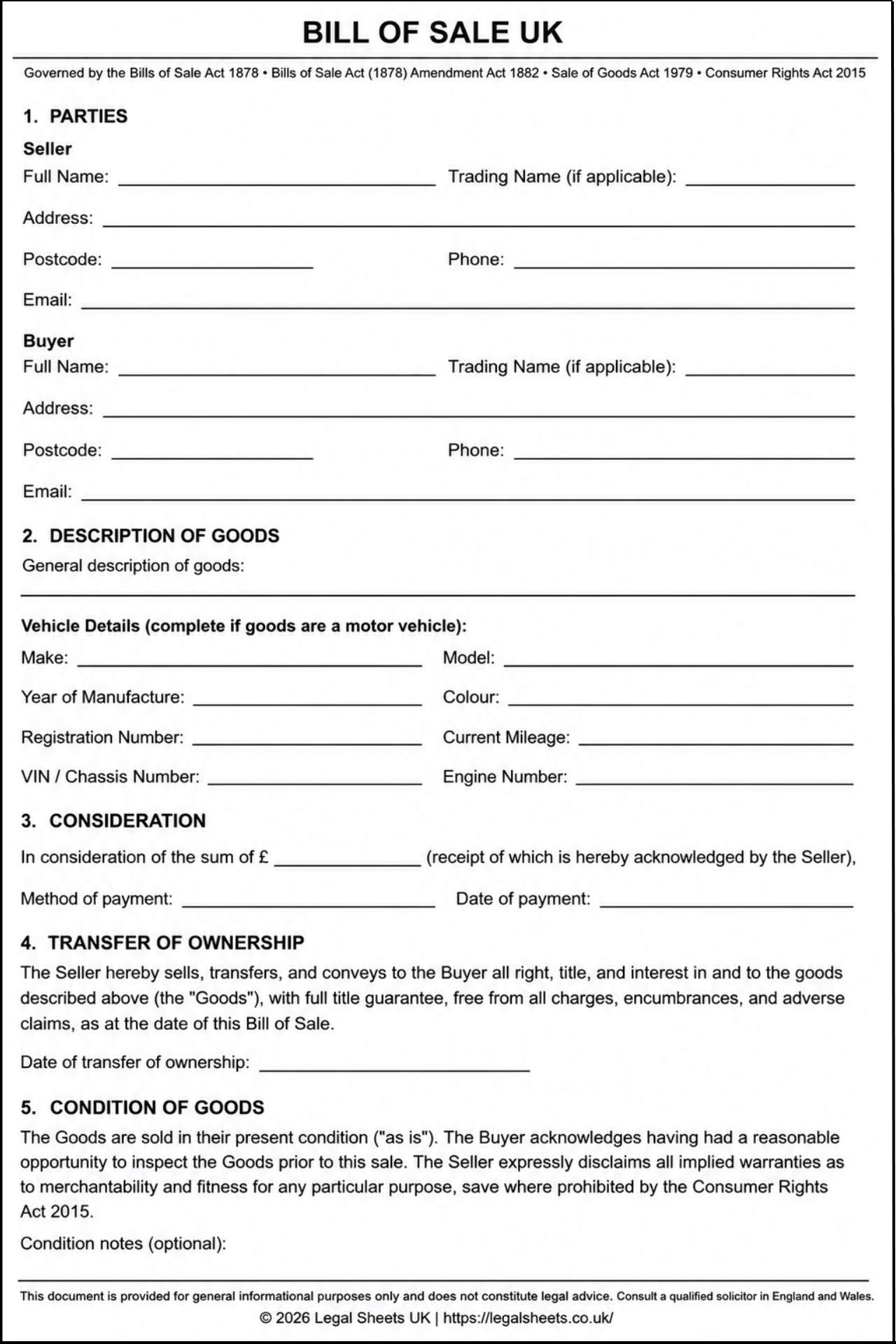
Situations Where a Different Legal Document May Be More Appropriate
Not every transaction should rely on a simple Bill of Sale.
Different documentation may be needed where:
- Goods are being sold under a finance agreement.
- The transaction forms part of a business acquisition.
- Ownership is transferred as security for a loan.
- Consumer protection legislation applies to a business selling to a customer.
- Hire purchase arrangements remain outstanding.
Using the wrong document can create avoidable legal problems if ownership or security rights are later disputed.
When a Bill of Sale Is the Right Document
Private Vehicle Sales
Private vehicle sales are among the most common situations where a Bill of Sale is used. It records exactly what vehicle was sold, the agreed price and the date ownership changed. While it provides useful evidence of the sale, it does not replace the requirement to update the vehicle registration separately.
Selling Personal Possessions
Items such as watches, artwork, antiques and expensive electronics are often sold privately. Recording the transaction in writing makes it easier to prove ownership transferred if questions arise later.
Business Asset Transfers
Businesses sometimes dispose of surplus equipment, office furniture or machinery through distributors. A Bill of Sale creates a clear record showing what assets were transferred and when the transfer occurred.
Farm Equipment and Machinery
Agricultural equipment often represents a significant financial investment. Recording serial numbers, identifying marks and the equipment’s condition reduces uncertainty if ownership is later challenged.
Boats, Trailers and Other Valuable Property
Larger personal assets benefit from detailed written records. Identifying numbers, purchase price and supporting documentation all help establish what was included in the transaction.
Transactions Where Proof of Ownership Transfer Is Important
Any sale involving valuable personal property should be documented carefully. A signed Bill of Sale can provide persuasive evidence if a disagreement reaches the County Court.
Understanding the Two Meanings of a Bill of Sale in England
Simple Bill of Sale for Everyday Sales
Most people use the term “Bill of Sale” to describe a receipt or written agreement confirming the sale of personal property. In England, these documents are generally governed by common law principles and the Sale of Goods Act 1979. They simply record the transaction and provide evidence that ownership has passed between buyer and seller.
Statutory Bill of Sale Used for Secured Lending
A statutory Bill of Sale is a completely different legal instrument. Instead of recording an ordinary sale, it transfers ownership of personal goods while allowing the original owner to retain possession, typically as security for borrowing. These arrangements are commonly associated with certain logbook loans and are subject to strict statutory requirements. Under Section 9 of the Bills of Sale Act (1878) Amendment Act 1882, any material deviation from the exact prescribed statutory wording in the schedule, omitting the annexed inventory, or failing to state the exact loan consideration renders the Bill of Sale completely and incurably void in law, reducing the lender to a mere unsecured creditor.
Why Confusing the Two Can Create Legal Problems
Many people assume every Bill of Sale follows the same legal rules. In reality, confusing an ordinary sale receipt with a statutory Bill of Sale may lead to significant consequences. A simple receipt cannot create security over goods, while a statutory Bill of Sale requires prescribed wording, registration and compliance with specific legal formalities. Using the wrong document may leave one party without the legal protection they expected.
When a Simple Bill of Sale Is Not Enough
Goods Subject to Finance Agreements
“Under Section 12 of the Sale of Goods Act 1979, selling encumbered goods generally means the seller cannot legally pass ‘good title.’ However, a crucial statutory exception exists under Part III of the Hire-Purchase Act 1964: if a private individual (not a motor trader) unknowingly purchases a motor vehicle in good faith that is subject to an undisclosed hire-purchase agreement, they do legally acquire good title, defeating the finance company’s right to repossess it. Buyers should always check whether outstanding finance exists before completing the purchase.
Logbook Loans
Logbook loans rely on statutory Bills of Sale rather than ordinary sale receipts. These arrangements must satisfy strict legal requirements, including prescribed wording and registration. Using a standard Bill of Sale instead will not create valid security over the vehicle.
Hire Purchase Vehicles
Vehicles purchased under hire purchase agreements require extra caution. Until ownership legally passes to the seller, they may not be entitled to sell the vehicle. A buyer who unknowingly purchases such a vehicle could face ownership disputes if the finance provider exercises its rights.
Security Over Personal Property
Where goods are being used as security for borrowing rather than being sold outright, a simple Bill of Sale is not the appropriate document. Special statutory requirements apply, and failing to meet them can make the security unenforceable.
Consumer Sales Involving Businesses
Businesses selling goods to consumers cannot rely on wording that attempts to remove statutory consumer rights through sales agents. Different legal obligations apply under the Consumer Rights Act 2015.
What Information Should a Bill of Sale Contain?
A properly completed Bill of Sale should include:
- Buyer information
- Seller information
- Full description of the item
- Vehicle registration number, VIN and mileage where applicable
- Serial numbers for valuable goods
- Purchase price
- Payment method
- Sale date
- Ownership declaration
- Description of the item’s condition
- Signatures of both parties
- Witness details if included
The more accurately the property is identified, the less likely ownership disputes will arise later.
Optional Clauses That May Be Added
“Sold as Seen” Clause
In private consumer-to-consumer sales, a ‘sold as seen’ clause is legally effective under the caveat emptor (buyer beware) principle of the Sale of Goods Act 1979. However, under Section 31 of the Consumer Rights Act 2015, if a business seller attempts to use a ‘sold as seen’ or ‘no refunds’ clause to bypass their statutory duties to provide goods of satisfactory quality, the clause is strictly legally void and unenforceable.
No Outstanding Finance Declaration
The seller may declare that no finance or security interest exists over the goods. While this provides reassurance, buyers should still carry out their own checks where appropriate.
Accessories Included in the Sale
Record any additional items included with the purchase, such as spare tyres, charging cables, trailers, manuals or specialist equipment.
Spare Keys and Documents Handed Over
For vehicles and machinery, list all keys, service records, logbooks and maintenance documents provided with the sale.
Payment Acknowledgement for commission sales
Include confirmation that payment has been received in full or clearly state any balance that remains outstanding.
How to Complete a Bill of Sale Correctly
Step 1 – Identify Both Parties
Record the full legal names and addresses of the buyer and seller exactly as they appear on official identification.
Step 2 – Describe the Property Accurately
Include every identifying feature available, especially registration numbers, VINs, serial numbers, model details and condition.
Step 3 – Record the Agreed Purchase Price
Write the exact purchase price together with the payment method and payment date if applicable.
Step 4 – Confirm the Item’s Condition
Describe the condition honestly. Misrepresenting faults can lead to disputes even if both parties signed the document.
Step 5 – Sign and Exchange Copies
Both parties should sign and retain identical copies immediately after completion.
Step 6 – Keep Supporting Records
Retain payment receipts, bank transfer confirmations, photographs and any communication relating to the sale.
Bills of Sale for Vehicle Transactions
Vehicle sales require careful record keeping. The Bill of Sale should include the registration number, VIN, mileage and a clear description of the vehicle.
Updating the DVLA remains a separate process. Completing a Bill of Sale alone does not update vehicle registration records.
Buyers should also check for outstanding finance before purchase because a written Bill of Sale cannot remove existing legal interests attached to the vehicle.
Bills of Sale for Personal Property
A Bill of Sale can also be used for:
- Electronics
- Furniture
- Jewellery
- Collectables
- Business equipment
- Agricultural machinery
For valuable goods, recording serial numbers and identifying marks provides stronger evidence if ownership is later questioned.
UK Legal Requirements
| Topic / Issue | Precise English Legal Rule | Governing Statute / Administrative Regulation |
| Simple Bill of Sale (Receipt) | Purely written evidence of a private sale. Operates under the caveat emptor (buyer beware) principle for C2C transactions. | Sale of Goods Act 1979 |
| “Sold as Seen” Clauses (B2C) | Businesses are strictly prohibited from utilizing contractual clauses to exclude statutory rights of satisfactory quality, fitness, or description. | Consumer Rights Act 2015 (Section 31) |
| Title of Financed Vehicles | A private buyer purchasing a financed motor vehicle in good faith without notice legally acquires good title, defeating repossession claims. | Hire-Purchase Act 1964 (Part III) |
| Statutory Security Form | A statutory security Bill of Sale must strictly match the prescribed schedule wording and include a chattels inventory, otherwise it is entirely void. | Bills of Sale Act (1878) Amendment Act 1882 (Section 9) |
| High Court Registration | Statutory Bills of Sale must be registered at the King’s Bench Division of the High Court within exactly 7 clear days of execution. | Bills of Sale Acts 1878 & 1882 |
| Statutory Witnessing | Absolute bills must be witnessed by an explaining solicitor. Security bills must be witnessed by an independent, credible third party. | Bills of Sale Act 1878 (Section 10) / Bills of Sale Act (1878) Amendment Act 1882 (Section 10) |
In practice, most private buyers will only need a simple Bill of Sale. Statutory Bills of Sale arise mainly in secured lending, where strict compliance failures can make the security entirely ineffective.
Registration Rules for Statutory Bills of Sale
A statutory Bill of Sale must be registered with the High Court within seven clear days of execution. Registration requires physically lodging the original document, a true copy, and a sworn affidavit at the King’s Bench Division of the High Court. The affidavit must formally attest to the exact date and time of execution, alongside the names, addresses, and occupations of the grantor and attesting witnesses. Failure to renew this registration every five years renders the statutory bill legally void against third parties.
Missing the registration deadline can have serious consequences, including loss of security rights or reduced protection against third parties.
Common Mistakes That Can Make a Bill of Sale Ineffective
- Using a simple Bill of Sale where a statutory document is required.
- Leaving out registration numbers or serial numbers.
- Selling goods without legal ownership.
- Assuming a “Sold as Seen” clause always prevents claims.
- Failing to disclose outstanding finance.
- Not keeping signed copies and payment records.
Many County Court disputes arise because basic information was omitted rather than because the parties disagreed about the price.
Practical Risks Buyers and Sellers Should Understand
Risks for buyers
- Purchasing goods with outstanding finance.
- Receiving inaccurate descriptions.
- Difficulty proving ownership if paperwork is incomplete.
Risks for private sellers
- Claims of misrepresentation if information was inaccurate.
- Disputes over payment or collection.
Risks for businesses
- Consumer Rights Act obligations cannot be excluded by contractual wording.
- Poor documentation may weaken the business’s position during disputes.
Risks involving financed vehicles
A Bill of Sale cannot remove finance already attached to a vehicle. Buyers should verify ownership before completing the purchase.
How Bill of Sale Disputes Are Usually Resolved
Most disputes involving ordinary Bills of Sale are handled by the County Court. Common issues include unpaid purchase prices, ownership disagreements and alleged misrepresentation.
Disputes involving statutory Bills of Sale may involve High Court registration issues or enforcement relating to secured lending. Where statutory requirements were not followed correctly, enforcement action can fail despite the parties believing the document was valid.
Best Practices Before Signing
- Verify the seller’s ownership.
- Check whether finance remains outstanding.
- Confirm each party’s identity.
- Inspect the goods carefully.
- Keep copies of payment evidence and supporting documents.
- Retain a signed copy of the Bill of Sale for future reference.
Frequently Asked Questions
Is a Bill of Sale legally binding in England?
Yes. A properly completed Bill of Sale can form legally persuasive evidence of a sale between the parties, provided it accurately records the agreed transaction.
Does a Bill of Sale transfer ownership of a vehicle automatically?
It records the transfer between the parties but does not replace the separate requirement to update vehicle registration records with the DVLA.
Can I use a Bill of Sale for goods with outstanding finance?
You should exercise caution. Outstanding finance may prevent the seller from transferring good legal title to the buyer.
Is a witness required for every Bill of Sale?
No. A witness is generally optional for a simple private Bill of Sale. However, a statutory absolute Bill of Sale must be witnessed by a qualified solicitor who formally explains its effect to the grantor (1878 Act), whereas a statutory security Bill of Sale must be attested by one or more credible, independent witnesses (1882 Act).
Can a business rely on a “Sold as Seen” clause when selling to consumers?
No. Consumer protection legislation prevents businesses from excluding statutory consumer rights through a “Sold as Seen” clause.
Author
-

Ankur is the founder and editorial reviewer at LegalSheets. He researches, writes, and reviews legal content, ensuring every template and guide is clear, accurate, and based on current UK laws and official government guidance. His focus is on making legal documents easier for individuals and businesses to understand and use.
