
Tenancy Surrender Agreement (PDF, Word & Fillable Formats)
A Tenancy Surrender Agreement is usually prepared when a landlord and tenant decide that ending the tenancy by agree.
ment is preferable to waiting for notice periods or possession proceedings. One of the most frequent problems in England is assuming that handing back the keys or exchanging messages automatically brings the tenancy to an end, only for disagreements about rent, deposits or liability to emerge later. Where the parties intend an express surrender, it is normally documented by deed and must be executed with the required formalities rather than relying on informal arrangements.
County Court disputes often turn on whether there was clear evidence that the tenancy had actually been surrendered, making accurate written records far more persuasive than conflicting recollections. The template and guidance that follow are designed to record the agreed surrender date, confirm the remaining obligations of each party and provide wording suitable for ending a tenancy by mutual agreement.
Table of Contents
ToggleTenancy Surrender Agreement Template (PDF, Word & Printable Formats)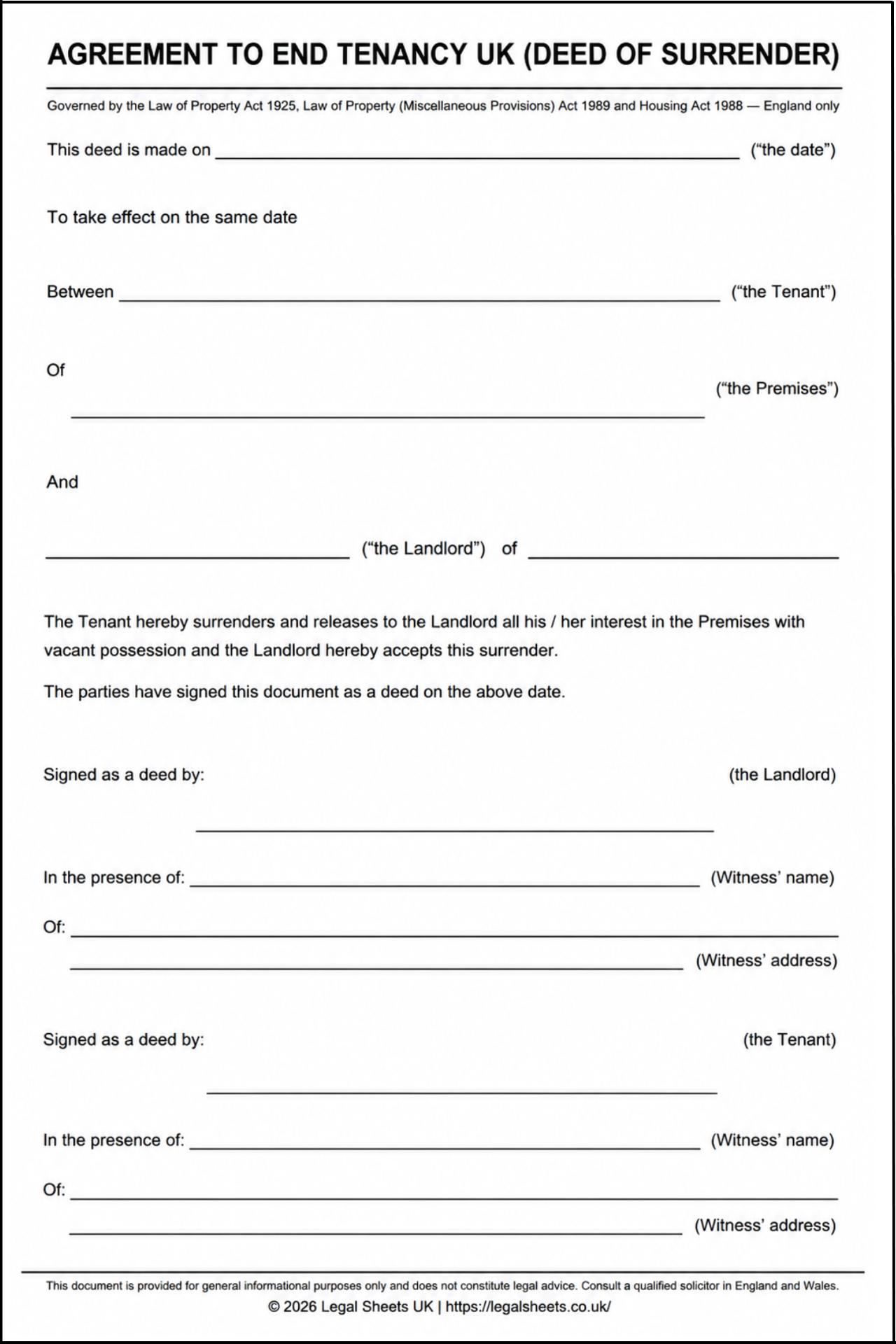
Clauses That Commonly Prevent Future Disputes
A Tenancy Surrender Agreement should do more than record the date the tenancy ends. It should also deal with the practical issues that often lead to disagreements after the tenant has moved out. Clear clauses reduce uncertainty and provide evidence of what both parties accepted when signing.
Release from future tenancy obligations
Once the surrender takes effect, the agreement should confirm that the tenancy has ended and identify which obligations continue, if any. This avoids later arguments over whether rent or other contractual duties still apply after the agreed surrender date.
Outstanding rent
If rent remains unpaid, the agreement should state the amount owed and how it will be settled. Leaving rent arrears unresolved often leads to disputes after the tenancy has ended.
Damage claims
Any known damage should be recorded before signing. If repairs are required, the agreement can explain whether the landlord will arrange the work and whether the cost will be deducted from the deposit or paid separately.
Deposit repayment
The agreement should explain how the tenancy deposit will be dealt with, including any agreed deductions and inventory records, and when the remaining balance will be returned. Recording this information helps avoid misunderstandings once the tenancy has ended.
Inventory confirmation
Referring to the original inventory allows both parties to compare the property’s condition at the start and end of the tenancy. This creates a more objective basis for assessing damage claims.
Final inspection
A joint inspection before handing over the property allows any issues to be identified immediately. It is often easier to resolve concerns while both parties are present than after possession has changed.
Keys and security devices
The agreement should confirm that all keys, access cards, alarm fobs, garage remotes and similar security items have been returned. Missing security devices may result in replacement costs.
Entire agreement clause
Including an entire agreement clause confirms that the written document contains the complete agreement between the parties. This reduces the possibility of either party later relying on alleged verbal promises.
Governing law
The agreement should confirm that it is governed by the law of England, ensuring that any dispute is considered under the correct legal framework.
Executing the Deed Correctly
Execution is one of the most important parts of a deed of surrender tenancy. Many disputes arise not because the parties disagreed, but because the document was signed incorrectly. A defective deed may not bring the tenancy to an end, even where both parties intended that result.
Why execution as a deed matters
Under Section 52 of the Law of Property Act 1925, an express surrender of a tenancy generally must be executed as a deed. If the document fails the statutory deed formalities, it defaults to a simple ‘agreement to surrender’ under Section 2 of the LPMPA 1989. This does not instantly terminate the tenancy; it merely creates a contractual promise to do so, forcing the landlord to seek a costly ‘specific performance’ court order if the tenant refuses to leave.
Required deed wording
Under Section 1 of the Law of Property (Miscellaneous Provisions) Act 1989, the document must clearly state that it is intended to operate as a deed. The execution wording should identify that each party signs as a deed rather than as an ordinary contract.
Omitting this wording can significantly affect enforceability if one party later refuses to complete the surrender.
Independent witness requirements
Each signature should be witnessed by an independent individual. The witness should not have a personal interest in the transaction and should be able to confirm that they actually observed the signing.
Physical presence of the witness
The witness should be physically present when the party signs the deed. Under Section 1(3) of the Law of Property (Miscellaneous Provisions) Act 1989, remote witnessing via Zoom or FaceTime is strictly prohibited. The witness must physically stand in the same room to observe the signing. Failing this strict physical presence requirement completely voids the deed, rendering it legally useless in the County Court.
Signing by all parties
Every landlord and every tenant who is required to participate should sign the deed. Missing signatures may leave the tenancy in force, particularly where a fixed-term joint tenancy is involved.
Keeping signed originals
Both parties should retain signed originals of the executed deed. If a dispute later reaches the County Court or a tenancy deposit adjudication, the signed document will usually be the primary evidence of the agreed surrender terms.
Special Rules for Joint Tenancies
Joint tenancies require particular care. During a fixed-term tenancy, all joint tenants must agree to the surrender and execute the deed. One tenant cannot unilaterally surrender the tenancy on behalf of the others.
Why every joint tenant must participate
Each joint tenant shares responsibility for the tenancy. Unless every joint tenant signs the deed, the surrender may not be legally effective.
What happens if one tenant refuses
Surrendering a fixed-term Assured Shorthold Tenancy requires absolute unanimity. If even one joint tenant refuses to sign the deed, the surrender fails entirely. The original tenancy remains fully active, and all tenants—even those who tried to leave—remain jointly and severally liable for the full rent.
Joint and several liability after failed surrender
Where an attempted surrender is ineffective, liability under the original tenancy usually continues until the tenancy ends lawfully.
Practical examples
A group of three students renting a property cannot end a fixed-term tenancy if only two sign the deed. The third tenant’s participation is normally required for the surrender to be effective.
Early Termination Payments and Tenant Fees
Where the tenant requests an early surrender, the landlord may recover certain costs, but there are strict legal limits.
When a landlord may recover costs
The payment should reflect genuine losses resulting from the early termination rather than operating as a financial penalty.
Actual financial loss
Under the Tenant Fees Act 2019, recoverable costs are generally limited to the landlord’s actual financial loss, such as rent lost before a replacement tenant moves in.
Reasonable re-letting expenses
Reasonable referencing or re-letting costs may also be recoverable where they directly result from the early surrender.
Charges that are prohibited
Flat administration penalties or arbitrary surrender fees that exceed actual loss may amount to prohibited payments.
Consequences of unlawful fees
Charging a flat ‘administration fee’ that exceeds your actual financial loss is an unlawful prohibited payment under the Tenant Fees Act 2019. Doing so triggers Trading Standards fines of up to £5,000 and completely blocks the landlord’s legal right to serve a Section 21 eviction notice until the unlawful fee is refunded.
Vacant Possession on the Agreed Date
Vacant possession involves more than simply moving out.
Returning possession
The tenant should leave the property so the landlord can take immediate control.
Returning keys
Keys should be returned on the agreed date unless another arrangement has been recorded.
Removing belongings
Furniture and personal possessions should normally be removed before the surrender takes effect.
Leaving occupiers behind
If another occupier remains in the property, the landlord may not receive genuine vacant possession.
Goods left in the property
Leaving substantial belongings behind can create additional legal and practical issues, including responsibilities relating to abandoned goods.
What Happens to the Tenancy Deposit
Deposit protection requirements
Following surrender, the deposit should be dealt with in accordance with the authorised tenancy deposit protection scheme.
Agreed deductions
Where deductions have been agreed within the deed, they should be applied consistently with the relevant deposit scheme requirements.
Returning the balance
The remaining deposit should be returned once legitimate deductions have been resolved.
Deposit scheme dispute resolution
If the parties disagree over deductions, the dispute may be referred to the alternative dispute resolution service provided by the relevant tenancy deposit scheme.
Common Drafting and Execution Mistakes
- Using an ordinary contract instead of a deed.
- Omitting required deed wording.
- Witnesses not being physically present.
- Leaving agreed terms outside the written document.
- Recording the wrong surrender date.
- Assuming that returning keys automatically ends the tenancy.
Each of these mistakes can delay possession, increase legal costs or create unnecessary County Court disputes.
If One Party Changes Their Mind
Tenant refuses to leave
Even with a flawlessly executed Deed of Surrender, a landlord cannot physically force a tenant out or change the locks. Bypassing the courts is a severe criminal offense under the Protection from Eviction Act 1977. The landlord must instead apply to the County Court for a formal Possession Order relying on the executed deed
Landlord refuses to accept surrender
Without mutual agreement, the tenancy generally continues unless another lawful method of termination applies, Section 8 Notice, such as a Section 21 Notice
Agreement versus deed consequences
A defective deed may operate only as an agreement to surrender, which can create additional enforcement difficulties if one party refuses to comply.
County Court implications
The court will examine whether the deed was executed correctly and whether the legal requirements were satisfied before relying on it.
Long Leases and Land Registry Requirements
When registration becomes necessary
Most residential ASTs do not require registration after surrender. However, leases originally granted for more than seven years are treated differently.
HM Land Registry forms
Where registration is required, the surrender may need to be lodged with HM Land Registry using the appropriate forms.
Closing the leasehold title
Registration enables the existing leasehold title to be closed following completion of the surrender.
Why most ASTs do not require registration
Most residential assured shorthold tenancies are private arrangements and do not require filing with HM Land Registry or the County Court.
UK Legal Facts
Legal Requirements Table
| Topic / Issue | Precise Legal Rule | Governing Statute / Regulation |
| Express Surrender | An immediate, express surrender of a tenancy must be executed formally as a deed to be legally effective. | Law of Property Act 1925, s.52 |
| Deed Execution & Witnessing | The document must declare itself a deed and be signed in the strict physical presence of an attesting witness. | Law of Property (Miscellaneous Provisions) Act 1989, s.1 |
| Agreement to Surrender | If not a deed, an agreement to surrender must be in writing, signed by both parties, and incorporate all agreed terms in one document. | Law of Property (Miscellaneous Provisions) Act 1989, s.2 |
| Early Termination Fees | Landlords can only charge for actual financial losses (e.g., lost rent) and reasonable re-letting costs. Arbitrary penalties are void. | Tenant Fees Act 2019, s.1 & Schedule 1 |
| Eviction Restrictions | A landlord cannot forcibly remove a tenant holding over after a surrender; they must obtain a County Court Possession Order. | Protection from Eviction Act 1977, s.1 |
| Fixed-Term Joint Tenancies | Unanimity is required. One joint tenant cannot unilaterally surrender a fixed-term joint tenancy on behalf of the others. | Common Law (Property Principles) |
| Deposit Reconciliation | Once the deed executes and possession is yielded, the tenancy deposit must be allocated as per the authorized scheme’s rules. | Housing Act 2004, ss.212–215 |
Practical Legal Impact
These legal requirements determine whether a surrender is legally effective. Improper execution may leave the tenancy in force, while prohibited fees can lead to enforcement action. County Courts closely examine execution formalities when possession claims arise, and tenancy deposit adjudicators frequently rely on the deed when deciding disputes over agreed deductions.
Practical Workflow After Signing
- Exchange signed copies of the deed.
- Carry out the final inspection.
- Return all keys and security devices.
- Confirm vacant possession has been given.
- Resolve the tenancy deposit.
- Keep signed records with the original tenancy documents.
Related Documents
- Tenancy Agreement
- Deed of Variation
- Deed of Assignment
- Break Clause Agreement
- Section 21 Notice
- Section 8 Notice
Frequently Asked Questions
Can a tenancy surrender agreement be signed without witnesses?
Where the document is intended to operate as a deed, proper witnessing is generally required for valid execution.
What happens if one joint tenant refuses to sign a deed of surrender?
The surrender may be ineffective, and the tenancy can continue with all joint tenants remaining liable.
Can a landlord charge any fee for agreeing to early surrender?
Only fees permitted under the Tenant Fees Act 2019, reflecting actual financial loss and reasonable re-letting costs, are generally recoverable.
Is returning the keys enough to legally end the tenancy?
Not necessarily. Returning keys alone does not always establish an effective express surrender unless the legal requirements have been satisfied.
What happens if the tenant signs the deed but does not leave the property?
The landlord cannot forcibly remove the tenant and may need to seek a possession order through the County Court if the tenant remains in occupation.
Author
-

Ankur is the founder and editorial reviewer at LegalSheets. He researches, writes, and reviews legal content, ensuring every template and guide is clear, accurate, and based on current UK laws and official government guidance. His focus is on making legal documents easier for individuals and businesses to understand and use.
