
Guarantor Deed Agreement Template | PDF & Word
A Guarantor Deed is often prepared in the final stages of a tenancy when the landlord’s referencing process shows that additional financial security is needed. Problems usually arise much later, when rent arrears reach the County Court and the guarantor argues that the deed was not executed correctly because it was signed after the tenancy without meeting the formalities required by the Law of Property (Miscellaneous Provisions) Act 1989 or the writing requirement under the Statute of Frauds 1677.
Those procedural defects can become more significant than the tenant’s actual default, particularly where witness requirements or continuing liability clauses have been overlooked. Whether you are a landlord, letting agent or guarantor, using a properly drafted deed from the outset makes it far easier to understand the obligations being accepted and complete the document correctly before the tenancy begins.
Table of Contents
ToggleGuarantor Deed Template (PDF & Word )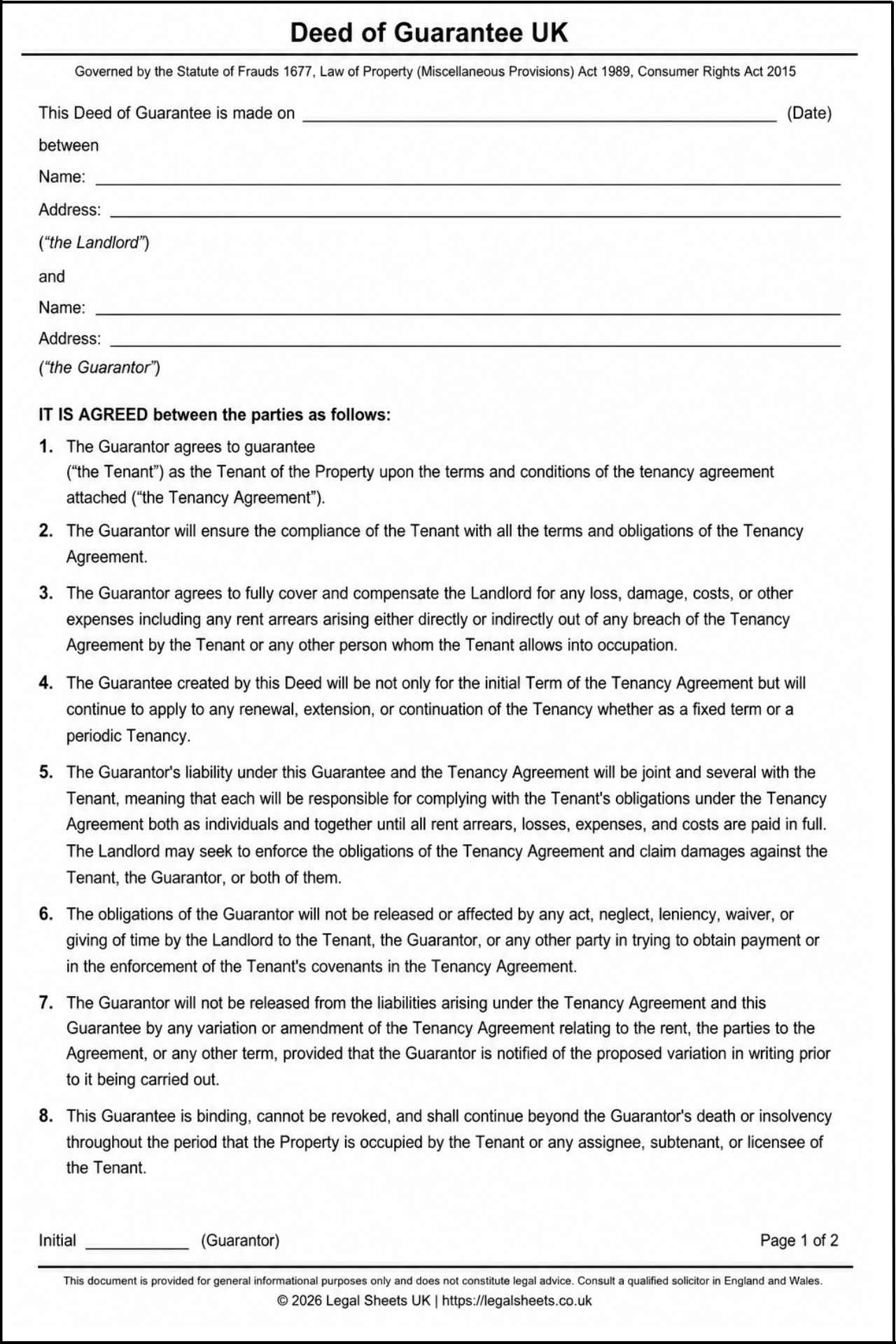
Who should use a Guarantor Deed
Residential landlords
Residential landlords frequently request a Guarantor Deed where the tenant’s financial position creates additional risk. This often applies to applicants with limited income, no previous renting history, or uncertain employment.
The deed gives the landlord an additional route to recover financial losses if the tenant breaches the tenancy agreement. Where rent arrears arise, the landlord may pursue both the tenant and the guarantor through the County Court if the deed has been executed correctly.
Letting agents
Letting agents regularly administer Guarantor Deeds during tenant referencing. However, under the Tenant Fees Act 2019, agents and landlords are strictly prohibited from charging the guarantor or tenant any fee for drafting, referencing, or executing this deed. Attempting to charge a setup fee is an unlawful prohibited payment that triggers severe trading standards penalties.
Poor administration frequently creates enforcement problems. Missing witness details, unsigned execution blocks, or incomplete guarantor information often become significant issues if legal proceedings are required months or years later.
Guarantors
Anyone agreeing to become a guarantor should understand that the obligation may extend well beyond simply paying a missed month’s rent.
Depending on the wording of the deed, liability may include:
- Rent arrears
- Damage beyond fair wear and tear
- Other obligations owed by the tenant
- Interest where permitted
- Recoverable legal costs where provided by the deed
Before signing, the guarantor should receive the tenancy agreement so they understand exactly what obligations they are guaranteeing. Failure to provide this document commonly becomes a point of dispute when enforcement is challenged.
Tenants requiring a guarantor
Many tenants require a guarantor despite having every intention of paying their rent on time.
Common examples include:
- Students
- First-time renters
- Overseas tenants
- Self-employed applicants
- Applicants with limited credit history
Providing a properly executed Guarantor Deed often allows the tenancy to proceed where additional financial reassurance is required by the landlord.
What the template includes
Deed execution wording
A Guarantor Deed must clearly state that it is intended to operate as a deed. If the document does not make this intention clear on its face, it may fail to satisfy the statutory requirements for execution as a deed.
The execution block should contain wording confirming that the guarantor signs the document as a deed in the presence of a witness.
Guarantor obligations
The template identifies the obligations the guarantor agrees to perform if the tenant defaults.
These commonly include payment of unpaid rent, complying with tenancy obligations, and meeting financial liabilities arising from breaches of the tenancy agreement.
Clear drafting reduces later arguments over the extent of the guarantor’s responsibility.
Financial liability clauses
Financial liability provisions define exactly what sums may be recovered.
Depending upon the tenancy, these clauses may cover:
- Outstanding rent
- Damage claims
- Interest where applicable
- Other contractual financial obligations
Unclear wording often results in disputes about whether a particular loss falls within the guarantee.
Continuing guarantee provisions
Many landlords expect liability to continue if the tenancy carries on after the original fixed term.
A continuing guarantee clause can specify whether liability extends into later stages of the tenancy, including any renewal or statutory periodic tenancy where appropriate.
Without sufficiently clear wording, courts may interpret liability as ending when the original fixed term expires.
Demand and notice clauses
The deed normally explains how payment demands should be served if the tenant defaults.
Clear notice procedures reduce uncertainty and establish the process the landlord should follow before pursuing recovery from the guarantor.
Execution block
The execution block records the guarantor’s signature and confirms that execution takes place as a deed.
Incomplete execution wording is a common reason why otherwise well-drafted guarantees become difficult to enforce.
Witness section
The witness section records the independent witness’s signature and details.
Execution problems regularly arise where:
- The witness was not physically present.
- The witness signs later.
- Essential witness information is missing.
Because execution is frequently challenged during County Court proceedings, retaining a properly completed witness section is just as important as retaining the deed itself.
When a template may not be suitable
A standard residential Guarantor Deed is not appropriate for every arrangement.
More specialist drafting is often required where the guarantee extends beyond an ordinary residential tenancy.
Situations commonly requiring bespoke documentation include:
- Corporate guarantors providing security over company assets
- Commercial lease guarantees
- Bespoke guarantee arrangements
- Complex multiple-property transactions
Using a residential template for these arrangements may leave important commercial risks unaddressed or require additional legal formalities that fall outside the scope of a standard tenancy guarantee.
When a Guarantor Deed Is Used Instead of a Standard Guarantee
A standard contractual guarantee is not always sufficient. Once the tenancy agreement has already been signed, creating an enforceable guarantee becomes more difficult unless the document is executed as a deed.
This is why Guarantor Deeds are frequently used in situations such as:
- The tenant has already signed the tenancy agreement.
- Additional financial security is requested before occupation.
- Student accommodation.
- First-time renters.
- Overseas tenants.
- Self-employed applicants.
- Tenancies presenting increased financial risk.
In practice, landlords often discover concerns during referencing or immediately before occupation. Rather than replacing the tenancy agreement, the parties execute a separate Guarantor Deed so the additional security can be created without relying upon fresh contractual consideration.
Even where all parties agree, the execution process must still be completed carefully. Courts generally apply strict scrutiny to guarantees, and procedural defects frequently become the central issue when enforcement is later disputed.
Deciding Exactly What the Deed Covers
Before a Guarantor Deed is signed, the parties should be clear about the obligations the guarantor is accepting. Vague drafting is one of the most common reasons disputes arise later. If the wording leaves uncertainty about what has been guaranteed, the County Court will usually interpret that uncertainty against the party who prepared the document.
Rent arrears
Most Guarantor Deeds are intended to cover unpaid rent. The clause should identify whether liability applies to all rent due under the tenancy or only to arrears arising during a specified period.
Landlords often discover that broadly worded rent clauses become difficult to enforce where the tenancy has been renewed or varied without suitable continuing liability provisions.
Damage beyond fair wear and tear
Many deeds also extend liability to damage caused by the tenant that exceeds normal use of the property.
This usually covers breaches of repair obligations contained in the tenancy agreement rather than ordinary deterioration expected through everyday occupation.
Other tenant obligations
A guarantor may also agree to answer for other contractual obligations owed by the tenant.
Examples include:
- Breach of tenancy covenants
- Failure to comply with repair obligations
- Other financial liabilities arising under the tenancy agreement
The wider these obligations become, the more carefully they should be explained to the guarantor before execution.
Interest and recoverable costs
Some Guarantor Deeds state that liability extends beyond the original debt and includes contractual interest or recoverable enforcement costs.
Where these provisions exist, they should be drafted clearly so that the guarantor understands the potential financial exposure if legal proceedings become necessary.
Whether liability continues after tenancy renewal
Many enforcement disputes do not concern the original tenancy at all. Instead, they arise months or years later after the tenancy has continued beyond its fixed term.
The deed should make clear whether liability continues after renewal or is limited to the original tenancy.
Future statutory periodic tenancies
If the parties intend the guarantee to continue when the tenancy automatically becomes a statutory periodic tenancy, the wording should expressly address that point.
Where the document simply refers to the original fixed-term tenancy without additional wording, courts may conclude that the guarantee ended when the fixed term expired.
Joint and several liability considerations
Extra care is needed where multiple tenants occupy the property.
“For shared houses or HMOs, blanket clauses making a single parent guarantor jointly and severally liable for unrelated tenants’ rent are routinely struck out by County Court judges. Under Part 2 of the Consumer Rights Act 2015, such terms are deemed unfair and disproportionate, effectively limiting the guarantor’s liability strictly to their own child’s share.
Preparing Before the Deed Is Signed
Good preparation usually determines whether a Guarantor Deed withstands scrutiny if enforcement later becomes necessary. Most practical problems arise long before the tenant falls into arrears.
Confirm the tenancy has been agreed
The parties should first confirm the tenancy terms that the guarantor is being asked to support.
If important tenancy terms remain unsettled, later amendments may affect the scope of the guarantee and create arguments about whether the guarantor agreed to those changes.
Verify the guarantor’s identity
Identity checks reduce the likelihood of disputes over who signed the deed.
Landlords and letting agents commonly retain identification records alongside the executed deed so there is supporting evidence if the guarantor later disputes execution.
Give the guarantor the tenancy agreement
A guarantor should receive a copy of the tenancy agreement before signing.
Without seeing the underlying contract, the guarantor may later argue that they did not fully understand the obligations they were guaranteeing. This frequently becomes an issue during defended County Court claims.
Explain the financial exposure
Many guarantors underestimate the extent of their potential liability.
Before execution, they should understand:
- What financial obligations are guaranteed.
- Whether liability continues after renewal.
- Whether interest or enforcement costs may be claimed.
- The circumstances in which payment may be demanded.
Clear communication at this stage often prevents later disputes about informed consent.
Decide whether execution as a deed is required
Where the guarantee is being obtained after the tenancy agreement has already been entered into, execution as a deed is commonly required.
A document that fails to satisfy the statutory requirements for a deed may instead be treated as an ordinary contract, creating significant enforceability problems if no contractual consideration exists.
Arrange an independent witness
Witnessing should never be treated as an administrative formality.
The guarantor signs the deed while the witness is physically present, after which the witness immediately attests the signature.
Attempts to complete witnessing remotely or retrospectively regularly become central issues when the validity of the deed is challenged.
Check all parties’ details before execution
Before signing, every section should be reviewed carefully.
Common errors include:
- Incorrect property address
- Misspelled names
- Missing dates
- Incomplete execution wording
- Missing witness details
These mistakes are usually simple to correct before execution but can become expensive to resolve once enforcement proceedings begin.
Completing the Guarantor Deed
Completing the document accurately is just as important as using the correct legal wording. Even small inconsistencies between the tenancy agreement and the deed can create uncertainty about what has actually been guaranteed.
Property information
The property address should match the tenancy agreement exactly.
Differences between documents can create unnecessary arguments about whether the guarantee relates to the correct tenancy.
Tenant information
The tenant’s full legal name should be entered consistently throughout both documents.
If there are joint tenants, the deed should clearly identify whether the guarantee applies to one tenant or all tenants.
Guarantor information
The guarantor’s full legal details should be completed accurately before execution.
This information assists identification if enforcement becomes necessary and reduces the possibility of later disputes over identity.
Landlord details
The landlord should be identified using the same details that appear in the tenancy agreement.
Where a managing agent signs on behalf of the landlord, the document should accurately reflect the parties involved.
Financial obligations
The deed should identify the financial liabilities being guaranteed.
Broad wording may appear attractive from the landlord’s perspective, but ambiguity often weakens enforcement rather than strengthening it.
Continuing liability clause
If liability is intended to continue beyond the original fixed term, that intention should be stated clearly.
Many guarantees fail because they refer only to the original tenancy without addressing later continuation or renewal.
Variations to the tenancy
Changes to the tenancy agreement deserve careful consideration.
Where rent increases or other significant contractual terms are altered without the guarantor’s written consent, the guarantor may argue that liability has ended if the deed does not contain suitable continuing liability provisions.
Demand procedure
The deed should explain how payment demands are made after tenant default.
Clear procedures reduce procedural arguments and establish when the guarantor becomes liable to respond.
Notice provisions
Notice clauses specify how communications between the parties should be served.
Although they may appear routine, defective notice procedures often delay recovery where payment demands are disputed.
Execution wording
Execution wording should make it unmistakably clear that the document is being signed as a deed.
Failure to include appropriate wording may fundamentally affect enforceability if the guarantee is challenged later.
Witness details
The witness should complete their details immediately after observing the guarantor sign.
Leaving witness information incomplete or attempting to complete it later creates avoidable evidential problems if the deed is scrutinised during County Court proceedings.
Executing the Guarantor Deed Correctly
A well-drafted Guarantor Deed can still fail if it is executed incorrectly. In practice, many County Court disputes focus on how the document was signed rather than what it says. The court will expect strict compliance with the legal formalities for deeds before enforcing the guarantor’s obligations.
Face-value deed declaration
The document must clearly state that it is intended to operate as a deed. If this declaration is missing, the guarantee may be treated as an ordinary contract instead.
If a guarantee is signed after the primary tenancy agreement is executed, it lacks ‘consideration’ (a legal exchange of value). To bypass this fatal contract flaw, it must be validly executed as a deed under the Law of Property (Miscellaneous Provisions) Act 1989, which binds the guarantor regardless of consideration.
Signing as a deed
The execution clause should expressly confirm that the guarantor signs the document as a deed.
This wording distinguishes the document from a standard contractual guarantee and satisfies one of the essential statutory formalities required for a valid deed.
Independent witnessing requirements
The guarantor’s signature must be witnessed by an independent adult who is present when the document is signed.
Although the witness does not become responsible for the tenant’s obligations, their role is critical because they may later be required to confirm that the execution took place correctly.
Physical presence of the witness
The witness must be physically present when the guarantor signs.
Remote observation by video call or adding a witness signature afterwards creates a serious execution defect. If challenged, the court may conclude that the deed was never validly executed, preventing enforcement against the guarantor.
Electronic signatures and practical risks
Electronic signing platforms are sometimes used for tenancy documentation, but particular care is required for deeds.
Under Section 1(3) of the LPMPA 1989, remote witnessing of a deed via video call is strictly invalid. If the guarantor uses an e-signature platform, the witness must physically stand in the same room to observe the signing before adding their own attestation. Failing this physical presence requirement renders the deed totally void and unenforceable.
Retaining the original executed deed
The original signed deed should be kept securely with the tenancy records.
If enforcement becomes necessary several years later, producing the original executed document often becomes one of the first evidential requirements in a County Court claim.
Situations That Can End the Guarantor’s Liability
A Guarantor Deed does not necessarily continue forever. Liability depends on the wording of the deed and what happens during the tenancy.
Fixed-term tenancy expires
Where the deed only refers to the original fixed-term tenancy, liability may end when that term expires.
Many landlords incorrectly assume the guarantee automatically continues, only discovering the problem after attempting to recover later rent arrears.
Renewal without proper wording
If the tenancy is renewed without suitable continuing liability provisions, the guarantor may argue that the new tenancy is a separate agreement that was never guaranteed.
Courts frequently examine whether the deed expressly anticipated renewals before deciding whether liability continues.
Statutory periodic tenancy
If the tenancy becomes a statutory periodic tenancy after the fixed term, the wording of the deed becomes particularly important.
Where continuation into the periodic tenancy has not been addressed clearly, liability may end at the conclusion of the original fixed term.
Material tenancy variations
Landlords sometimes agree changes with the tenant during the tenancy.
Examples include:
- Increasing the rent
- Extending the tenancy term
- Changing important contractual obligations
Under the strict English common law rule established in Holme v Brunskill, any material alteration to the tenancy (such as a rent increase or term extension) made without the guarantor’s explicit consent totally discharges them from the guarantee. The deed becomes permanently void unless it contains a meticulously drafted ‘continuing liability’ clause.
Rent increases
Even a straightforward rent increase can become significant.
Where the increase materially changes the underlying agreement, landlords should consider whether fresh consent from the guarantor is required before relying on the original deed.
Changes to tenant obligations
Adding new obligations or substantially changing existing ones may alter the guarantor’s exposure.
The greater the variation, the greater the likelihood that the guarantor may dispute continuing liability.
Guarantor’s written consent
Obtaining written consent before making significant contractual changes is often the safest approach.
This creates clear evidence that the guarantor agreed to continue guaranteeing the revised tenancy terms.
If the Tenant Defaults
Default does not automatically mean the guarantor must pay immediately. The landlord should follow the procedure contained in the deed before commencing recovery action.
Rent arrears
The most common default involves unpaid rent.
Many landlords contact the guarantor once arrears begin rather than allowing the debt to continue increasing over several months.
Property damage
Where the tenant causes damage beyond fair wear and tear, the guarantor may become liable if the deed extends to those losses.
Supporting evidence such as inventories, photographs, invoices and inspection reports will often be required if the claim is disputed.
Serving a payment demand
The demand should follow the notice provisions contained within the deed.
Failure to comply with the agreed procedure may delay recovery or provide additional grounds for dispute.
County Court debt recovery
If payment is not made voluntarily, the landlord may issue a debt recovery claim in the County Court against the guarantor.
The court will closely examine both the wording of the deed and whether it was executed correctly before considering the financial claim.
Combined possession and arrears claims
Where possession proceedings are also required, landlords sometimes pursue both the tenant and guarantor within the same County Court proceedings.
This approach can simplify recovery where both possession and unpaid rent are being sought.
Documentary evidence to retain
Good record keeping strengthens enforcement.
Useful documents include:
- Original executed Guarantor Deed
- Signed tenancy agreement
- Rent account
- Payment demands
- Correspondence with the guarantor
- Property inspection records
- Evidence of losses claimed
Common Enforcement Problems Seen in Practice
Many unsuccessful claims fail because of avoidable procedural mistakes rather than weaknesses in the guarantee itself.
Common problems include:
- The document is not clearly expressed as a deed.
- The guarantee was signed after the tenancy without valid deed execution.
- The witness was not physically present.
- Witnessing took place remotely.
- The guarantor was not provided with the tenancy agreement before signing.
- HMO liability clauses are drafted too broadly.
- Continuing guarantee provisions are unclear.
- The guarantor was not informed about significant arrears until the debt became substantial.
- The original executed deed cannot be produced.
UK Legal Facts
| Topic / Issue | Precise Legal Rule | Governing Statute / Administrative Regulation |
| Writing Requirement | An agreement to guarantee the debt of another is completely void unless it is documented in writing and signed. | Statute of Frauds 1677, s.4 |
| Face-Value Requirement | A document intended to be a deed must explicitly declare itself to be a deed on its face to be valid. | Law of Property (Miscellaneous Provisions) Act 1989, s.1(2) |
| Physical Witnessing | A deed is only validly executed if the signatory applies their signature in the physical presence of an attesting witness. | Law of Property (Miscellaneous Provisions) Act 1989, s.1(3) |
| Consumer Protection (Fairness) | Clauses binding a private, non-commercial guarantor must be prominent, plain, and proportionate, or they will be struck out as unfair. | Consumer Rights Act 2015, Part 2 (ss.61–68) |
| Prohibited Setup Fees | Landlords and letting agents are legally banned from charging guarantors any administrative or referencing fees to set up the guarantee. | Tenant Fees Act 2019, s.1 & Schedule 1 |
| Discharge by Variation | A material variation to the underlying tenancy without the guarantor’s consent permanently voids the guarantee, unless specific continuing liability clauses exist. | Common Law (The Rule in Holme v Brunskill) |
These legal rules directly affect whether a Guarantor Deed can be enforced. County Courts generally expect landlords to demonstrate that the deed was executed correctly, that the guarantor understood the underlying tenancy, and that any claim falls within the wording of the guarantee. Procedural defects that may have appeared insignificant when the tenancy began often become decisive once enforcement proceedings start.
Practical Legal Impact
Why deed formalities matter
Execution requirements are not technicalities. If the statutory formalities are not satisfied, the guarantor may avoid liability entirely despite intending to provide a guarantee.
Consequences of defective execution
Incorrect witnessing, missing execution wording or failure to execute as a deed can undermine the entire document, leaving the landlord to pursue only the tenant.
How County Courts assess guarantor deeds
County Courts interpret guarantees strictly. Ambiguous wording is commonly interpreted against the party who prepared the document, particularly where consumer guarantors are involved.
Why witness evidence becomes critical
Where the guarantor disputes signing the deed or questions how it was executed, the witness may become an important source of evidence confirming that the statutory execution process was followed correctly.
Effect of unfair consumer clauses
Clauses that impose disproportionate liability on consumer guarantors may receive close judicial scrutiny. Transparent drafting and clear explanations reduce the likelihood of enforcement difficulties.
Importance of retaining the executed original
Without the original executed deed, proving proper execution may become considerably more difficult, particularly where the guarantor disputes liability several years after signing.
Practical Tips Before Signing
- Read the tenancy agreement before signing the deed.
- Confirm exactly what financial obligations are guaranteed.
- Check whether liability continues after renewal or a periodic tenancy.
- Review any continuing liability and variation clauses carefully.
- Ensure the witness is physically present during execution.
- Keep the original signed deed and tenancy documents in a secure location.
Related Documents
- Tenancy Agreement
- Guarantor Agreement
- Guarantor Consent Form
- Rent Arrears Letter
- Section 8 Notice
- Section 21 Notice
- Inventory and Schedule of Condition
- Deed of Variation
Frequently Asked Questions
Can a Guarantor Deed be signed after the tenancy agreement?
Yes. This is one of the main reasons a deed is used instead of a standard contractual guarantee. However, the document must satisfy the statutory requirements for execution as a deed if it is to remain enforceable.
Does a Guarantor Deed always require an independent witness?
Yes. The guarantor’s signature should be witnessed by an independent person who is physically present when the deed is signed.
Can liability continue after the fixed term ends?
It can, but only if the wording of the deed clearly extends liability beyond the original fixed term into any renewal or statutory periodic tenancy.
What happens if the tenancy changes without the guarantor’s consent?
Material changes to the tenancy may release the guarantor from future liability if the deed does not contain appropriate continuing liability provisions or the guarantor has not given written consent.
Can a Guarantor Deed be enforced if the witness was not physically present?
That creates a significant risk that the deed will be found invalidly executed. If challenged, the County Court may refuse to enforce the guarantee because the statutory execution requirements for deeds were not satisfied.
Author
-

Ankur is the founder and editorial reviewer at LegalSheets. He researches, writes, and reviews legal content, ensuring every template and guide is clear, accurate, and based on current UK laws and official government guidance. His focus is on making legal documents easier for individuals and businesses to understand and use.
