
Letter Before Action (commercial debt) Fillable PDF
An unpaid commercial invoice often reaches the point where repeated payment reminders are no longer enough, but issuing a claim immediately can create unnecessary procedural and costs issues. A Letter Before Action (commercial debt) should identify the debt, explain its contractual or legal basis and state precisely what payment is being sought, particularly where statutory interest under the Late Payment of Commercial Debts (Interest) Act 1998 is being claimed.
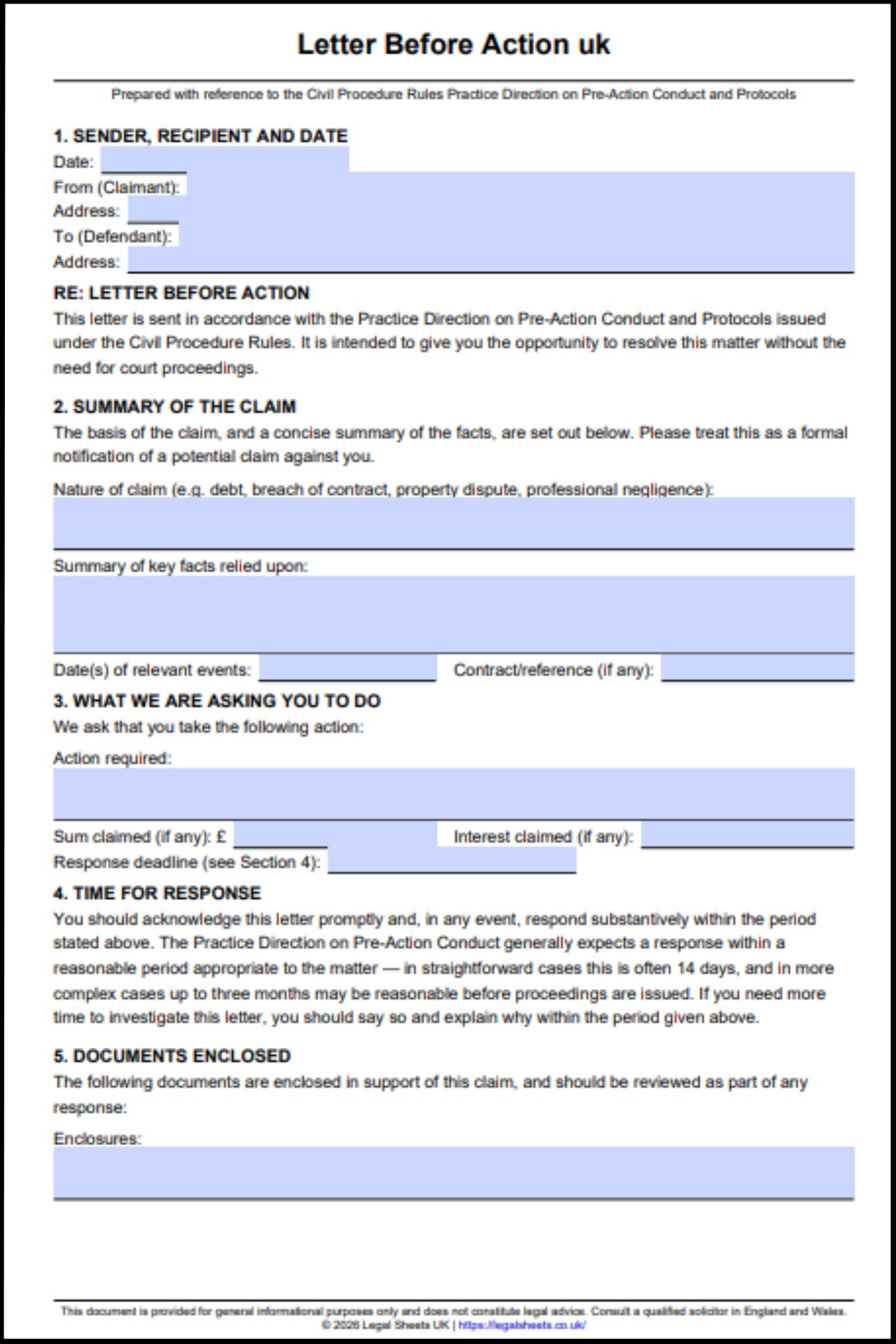
For claims where no specific pre-action protocol applies, the Civil Procedure Rules Practice Direction on Pre-Action Conduct and Protocols expects sufficient information to be exchanged before proceedings, including the basis of the claim, relevant facts, remedy sought and key documents. A realistic response period also matters; paragraph 6 refers to 14 days for a straightforward case, while more complex disputes may require longer. The wording below is designed around that practical England court process, so the debt, interest calculation and proposed next step can be presented clearly before a money claim is considered.
Letter Before Action (Commercial Debt) Template (PDF, Word & Printable Formats)
When an Unpaid Commercial Debt Has Reached the Pre-Action Stage
The letter is normally appropriate after ordinary payment requests have failed and the invoice remains overdue.
The distinction matters. A routine payment reminder can simply ask when an invoice will be paid. Pre-action correspondence should instead set out the basis of the proposed claim and the amount sought. The general Practice Direction states that where no specific protocol applies, the claimant’s letter should include the basis of the claim, a summary of the facts, what is wanted from the defendant and, where money is claimed, how the amount has been calculated.
The purpose is therefore not merely to increase pressure. It gives the business receiving the letter a final opportunity to understand the claim, respond to disputed points and potentially settle the matter before proceedings.
What the Letter Needs to Establish Before Court Proceedings
Identify the Contractual Basis of the Debt
The recipient should be able to see immediately why the money is said to be due.
Identify the relevant agreement, terms of supply, purchase order or other contractual arrangement. Where possible, include the date of the agreement and the payment obligation relied upon.
This becomes particularly important where the commercial relationship involved repeated orders under standard trading terms. A bare statement that money is “overdue” does not explain which contractual obligation has allegedly been breached.
Give an Itemised Account of the Money Owed
An invoice total should not be presented as an unexplained lump sum.
Set out:
- Invoice numbers
- Invoice dates
- Original amounts
- Contractual due dates
- Payments already received
- Remaining balances
Where several invoices are involved, an itemised schedule can prevent an otherwise simple debt claim becoming a dispute about arithmetic.
Deal With Interest and Recovery Costs Separately
Interest should be identified separately from the principal debt.
Under Sections 5 and 6 of the Late Payment of Commercial Debts (Interest) Act 1998, qualifying B2B debts automatically accrue simple statutory interest at 8% above the Bank of England reference rate unless the contract provides a substantial contractual remedy for late payment. Section 5A also entitles creditors to tiered fixed statutory compensation (£40, £70, or £100 per overdue invoice).
The creditor should therefore state:
- whether contractual or statutory interest is being claimed;
- the rate relied upon;
- the period for which interest is claimed;
- the resulting daily rate where appropriate;
- any statutory compensation claimed; and
- any additional recovery costs being sought.
The calculation should be capable of being checked against the underlying invoices.
The 14-Day Response Period and When More Time May Be Appropriate
Under paragraph 6 of the CPR Practice Direction on Pre-Action Conduct and Protocols (PDPAC), the claimant must afford the debtor a reasonable timeframe to respond—typically 14 calendar days for routine B2B commercial debt claims, extending up to three months for complex multi-invoice or cross-border disputes
That does not make every commercial debt letter legally invalid merely because a different number of days appears on it. The practical issue is whether the period is reasonable in the circumstances.
A creditor dealing with one undisputed overdue invoice may have little reason to give an extended period. A dispute involving numerous invoices, contractual documents and competing allegations requires more time for a meaningful response.
A 48-hour ultimatum can create an unnecessary procedural problem if the creditor then issues proceedings immediately. The pre-action process is intended to allow the parties to understand their positions and consider settlement rather than operate as a tactical device.
B2B Company Debt Is Different From a Sole Trader Debt
One of the most important checks is the legal identity of the debtor.
A debt owed by a limited company or LLP should not automatically be treated in the same way as a debt owed by an individual or sole trader.
A strict distinction applies under the Civil Procedure Rules: the Pre-Action Protocol for Debt Claims (PAP-D) governs debts owed by individuals (including sole traders), mandating a 30-day response window and standard Reply Sheets. Conversely, corporate debts owed by limited companies or LLPs fall exclusively under the general Practice Direction on Pre-Action Conduct.
Before sending a standard commercial letter, check whether the named debtor is:
- a limited company;
- an LLP;
- an individual;
- a sole trader; or
- a general partnership.
Using the wrong pre-action procedure can cause problems once proceedings are issued. The letter should reflect the debtor’s actual legal status rather than simply the trading name appearing on an invoice.
What Evidence Should Accompany the Letter?
Documents Commonly Relevant to the Debt
The documents should match the particular claim.
Common supporting material includes:
- Unpaid invoices
- The relevant contract or trading terms
- Purchase orders
- Delivery notes
- Proof of delivery
- Relevant correspondence
- Account statements
- Previous payment demands
The creditor does not necessarily need to attach every document ever exchanged. The better approach is to provide the material needed to understand the debt and identify the contractual and factual basis of the claim.
Keep Evidence of Sending and Receipt
Keep a complete copy of the final letter and every attachment that was actually sent.
Also retain:
- Postal receipts
- Delivery confirmations
- Email records
- Electronic audit trails
- Copies of attachments
- Dates and times of transmission
This evidence can become important if the debtor later says the letter was never received or claims that essential information was missing.
How to Address and Serve a Commercial Letter Before Action
Start by checking the contract for any notice provisions. The agreement may specify where notices should be sent and how they should be delivered.
The creditor should also identify the correct legal entity. For a limited company or LLP, the supplied framework recommends serving or copying the letter to the official registered office in addition to the normal commercial or accounts-payable contact.
Practical methods identified in the supplied framework include:
- First Class Post
- Special Delivery or tracked courier
- Email with an appropriate audit trail
The important practical point is evidence. If the matter later reaches court, being able to demonstrate what was sent, when it was sent and where it was sent can be just as important as producing the original letter.
What Happens If the Business Does Not Pay?
If the Debtor Pays
Once payment arrives, reconcile it against the invoices identified in the letter.
Check whether:
- the principal debt has been paid;
- interest remains outstanding;
- statutory compensation remains outstanding; and
- any recoverable costs remain outstanding.
A short written confirmation of settlement can prevent later disagreement about whether the account has been fully resolved.
If the Debtor Disputes the Debt
A substantive dispute should not simply be ignored.
Review the contractual documents and evidence supporting the original claim. The debtor may dispute delivery, the quality of goods or services, the agreed price, the payment date or the existence of the contractual obligation itself.
Where appropriate, the parties should consider ADR. The Practice Direction specifically expects parties to consider whether negotiation or another form of ADR could resolve the dispute without proceedings.
If the Debtor Ignores the Letter
Ignoring the letter does not automatically establish the debt.
The creditor may consider issuing a County Court claim, but the pre-action correspondence should be retained as part of the evidence. The claimant should also ensure that the underlying contractual documents, invoices and calculation of the amount claimed are ready.
The next procedural step should reflect the nature and value of the claim rather than simply treating silence as proof that every allegation is accepted.
Court Proceedings After a Letter Before Action
Commercial money claims may proceed through the County Court, with the applicable procedure depending on the value and complexity of the claim.
The supplied framework identifies:
- Small Claims Track: debts up to £10,000;
- Fast Track: £10,000 to £25,000;
- Intermediate Track: £25,000 to £100,000;
- Multi-Track: complex claims or claims exceeding £100,000.
High-value or complex commercial matters may fall within the High Court, including the King’s Bench Division or Commercial Court where appropriate.
Obtaining judgment and recovering the money are separate stages. A creditor may succeed on the claim but still face practical enforcement difficulties if the debtor company has insufficient assets.
Common Mistakes That Weaken Commercial Debt Claims
Using the Wrong Pre-Action Procedure
A corporate B2B debt should not automatically be treated as an individual debt. Misidentifying the debtor can lead to the wrong pre-action process being used.
Sending an Unreasonable Deadline
A very short ultimatum may undermine the creditor’s position if the dispute requires proper investigation.
Failing to Identify the Contractual Basis
The letter should identify why payment is legally due rather than merely listing an unpaid balance.
Providing No Invoice Breakdown
Several invoices should be itemised so that the debtor can identify which amounts are disputed and which, if any, are accepted.
Miscalculating Interest
Interest should be calculated against the correct contractual or statutory basis. Government guidance confirms that statutory interest for qualifying commercial debts is 8% above the Bank of England base rate and cannot be claimed where a different contractual interest rate applies.
Claiming Unsupported Charges
Do not add arbitrary administration or legal-notice charges without a contractual or statutory basis. Unsupported additions can create an avoidable dispute about the amount actually owed.
Failing to Preserve Service Evidence
Keep the evidence showing how and when the letter was sent.
Issuing Proceedings Without Addressing a Genuine Dispute
Where the debtor has raised a substantive issue, proceeding without engaging with it can create costs and case-management consequences.
Treating a Statutory Demand as Interchangeable With an Ordinary Debt Claim
A statutory demand is an insolvency-related mechanism, not simply a stronger version of an ordinary pre-action debt letter.
Letter Before Action vs Statutory Demand
These documents have different purposes.
A commercial Letter Before Action is part of the pre-action process for a prospective civil claim. A statutory demand is connected with insolvency proceedings and can carry much more serious consequences for a company.
The supplied framework identifies the use of a statutory demand under section 123(1)(a) of the Insolvency Act 1986 in relation to a liquidated debt over £750, with 21 days identified as the relevant period.
The distinction becomes particularly important where the debt is genuinely disputed. The supplied framework states that presenting a winding-up petition in those circumstances can amount to an abuse of process. A conventional civil debt claim may instead be the appropriate route where the underlying liability requires determination.
UK Legal Facts for Commercial Debt Letters
Although the broader term “UK” is sometimes used commercially, the procedural discussion here is based on the England framework specified for this article.
Legal Requirements Table
The official Practice Direction on Pre-Action Conduct and Protocols sets out the expected pre-action approach where no specific protocol applies. It requires sufficient information to understand the dispute and states that the parties should consider settlement and ADR
Practical Legal Impact
The legal rules affect the letter in several practical ways.
First, the amount claimed needs to be transparent. A debtor should be able to see how the principal, interest, compensation and any recoverable costs have been calculated.
Second, the contractual terms should be checked before interest is added. The creditor should not simply select the highest available figure.
Third, limitation should not be overlooked because correspondence has continued. The supplied framework identifies a six-year limitation period for simple commercial contractual claims.
Finally, pre-action conduct can affect the later litigation even where the underlying debt is valid. The Practice Direction states that non-compliance can lead to consequences including stays, costs orders and adjustments to interest.
Commercial Debt Recovery Problems That Often Arise After the Letter Is Sent
A letter can expose problems that were hidden during the ordinary invoicing process.
The debtor may dispute whether the goods were delivered, challenge the agreed payment terms or claim that the services were defective. A business may accept the principal invoice but dispute the interest calculation.
Multiple invoices can create a further complication: some may be accepted while others are disputed. The creditor should therefore avoid treating the entire account as automatically undisputed.
There is also a practical enforcement problem. Even a successful judgment does not guarantee payment. A company may have dissipated assets or otherwise lack sufficient assets against which enforcement can operate.
The supplied framework therefore distinguishes obtaining a judgment from actually recovering the money.
Frequently Asked Questions
Does a commercial Letter Before Action have to be sent before issuing a County Court claim?
Where no specific pre-action protocol applies, the Practice Direction expects parties to exchange appropriate correspondence and information before proceedings. The court can take pre-action non-compliance into account when managing proceedings and deciding costs.
How long should a business be given to respond to a Letter Before Action?
For a straightforward case where the general Practice Direction applies, 14 days is identified as a reasonable response period. More complex disputes may justify substantially more time.
Can statutory interest and contractual interest both be claimed?
The supplied legal framework states that the creditor must distinguish between contractual and statutory interest and avoid claiming both inconsistently on the same invoices. The contractual terms should therefore be checked before statutory interest is added.
Does the Pre-Action Protocol for Debt Claims apply to limited companies?
The supplied framework states that the specific Pre-Action Protocol for Debt Claims applies to individuals, including sole traders, while pure B2B claims between limited companies, LLPs or other corporate entities fall under the general Practice Direction on Pre-Action Conduct and Protocols.
What can a creditor do if the business ignores the letter?
The creditor may consider court proceedings if the debt remains unpaid and the pre-action requirements have been addressed. The underlying contract, invoices, calculations, correspondence and evidence of sending should be preserved before proceedings are issued.