
Free HMO Tenancy Agreement Template [Printable PDF Formats]
Many landlords start searching for an HMO Tenancy Agreement when a standard tenancy contract no longer reflects the reality of several unrelated occupiers sharing kitchens, bathrooms, and other communal spaces. Problems often emerge much later, particularly where the agreement is silent on rent responsibility, use of shared facilities, guest policies, or occupation arrangements, leaving key issues open to dispute. In England, those risks can become more significant when HMO licensing obligations under the Housing Act 2004 intersect with tenancy enforcement and possession proceedings.
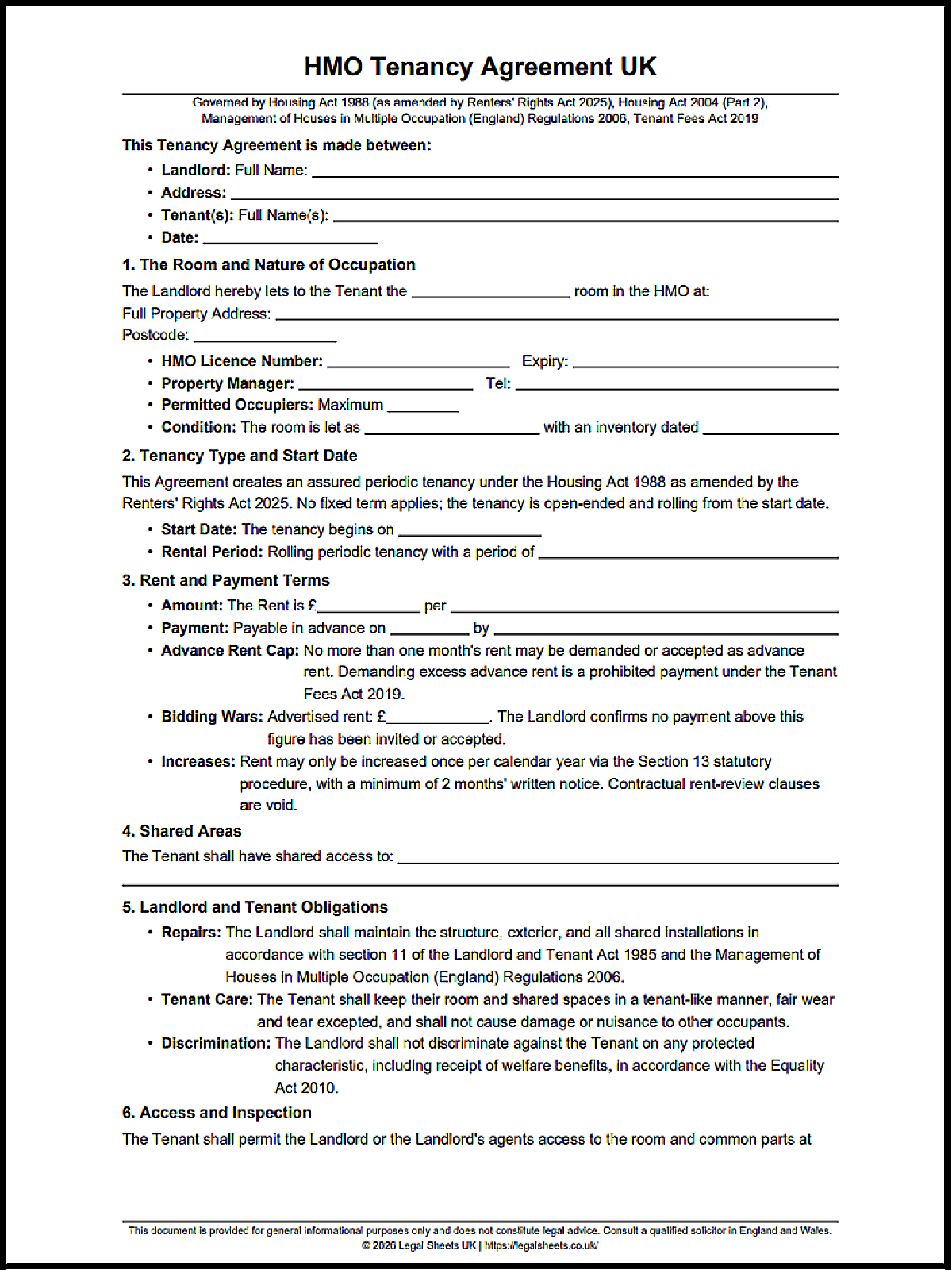
County Courts frequently see disagreements where unclear tenancy wording makes it difficult to establish who was responsible for particular obligations within the property. The template and guidance that follow are designed for shared accommodation arrangements and include the practical wording commonly needed when managing an HMO tenancy in England.
HMO Tenancy Agreement Template (PDF, Word & Printable Formats)
Why HMO Tenancies Require Different Drafting From Ordinary Residential Lets
Many landlords first encounter difficulties when they discover that shared accommodation cannot be managed in the same way as a single-family tenancy.
Shared Living Creates Additional Legal Risks
The practical reality of an HMO is that multiple unrelated households are occupying the same building simultaneously.
This creates additional risks, including:
- Shared kitchens and bathrooms
- Increased wear and tear
- Competing expectations regarding communal spaces
- Greater management involvement
- Increased potential for disputes between occupiers
Where expectations are not documented clearly, landlords often become drawn into disputes that have little to do with rent collection or property maintenance.
The Problems Most Frequently Seen in Poorly Drafted HMO Agreements
Certain disputes appear repeatedly in shared housing.
Common examples include:
- Unclear responsibility for cleaning communal areas
- Disagreements over overnight guests
- Noise complaints between occupiers
- Utility cost disputes
- Refuse and recycling disagreements
- Damage to shared appliances
Property managers frequently discover that informal house rules are difficult to enforce once a disagreement has developed. Written provisions tend to carry considerably more weight when issues escalate.
Avoiding Confusion Between Room Lets and Joint Tenancies
One of the most common drafting mistakes involves confusing individual room tenancies with joint tenancies.
Where a tenant is renting a specific room, the agreement should identify the room being occupied and distinguish between:
- Exclusive occupation rights
- Shared facility rights
- Access arrangements
- Communal area usage
If the tenancy structure is drafted incorrectly, enforcement becomes more complicated. Landlords may find themselves uncertain about responsibility for damage, occupancy limits, or termination procedures involving individual occupiers.
Before Issuing an HMO Agreement: Property Checks That Cannot Be Ignored
Many possession and enforcement problems originate before the tenancy even begins.
A tenancy agreement cannot compensate for underlying compliance failures.
Confirming Whether the Property Requires an HMO Licence
Before granting occupation rights, landlords should establish whether the property falls within a licensable HMO category.
Under the Housing Act 2004, a mandatory licence is generally required where a property is occupied by five or more people forming two or more households.
Some local authorities also operate additional licensing schemes covering smaller HMOs.
Operating a licensable HMO without the correct authorisation is a catastrophic legal misstep. While Section 21 ‘no-fault’ evictions were fully abolished on 1 May 2026 under the Renters’ Rights Act 2025, operating an unlicensed property continues to expose landlords to Rent Repayment Orders (RROs) for up to twelve months of rent, unlimited local authority fines, and severely restricts the ability to successfully serve a valid Section 8 possession notice. Local authority enforcement activity frequently begins after tenant complaints rather than routine inspections.
Fire Safety Measures Expected in Shared Accommodation
Fire safety is often the area receiving the greatest scrutiny from local authorities in shared housing.
Common measures include:
- Working smoke alarms
- Carbon monoxide alarms where required
- Suitable escape routes
- Appropriate fire doors where necessary
- Ongoing fire risk management
Enforcement officers rarely focus solely on paperwork. They typically assess how safely the property operates in practice.
Where fire safety deficiencies are identified, enforcement action can occur regardless of how carefully the tenancy agreement has been drafted.
Safety Documentation Tenants Should Receive Before Occupation
Certain documents should be available before occupation begins.
These commonly include:
- Gas Safety Certificate
- Electrical Installation Condition Report (EICR)
- Energy Performance Certificate (EPC)
- Mandatory tenancy information required for new tenancies
Failures in this area frequently become apparent during possession proceedings. Courts often examine compliance documentation closely where possession claims are contested.
Following the landmark implementation of the Renters’ Rights Act 2025 on 1 May 2026, the housing landscape shifted fundamentally. Fixed-term Assured Shorthold Tenancies (ASTs) have been universally replaced by rolling Assured Periodic Tenancies, and landlords are now strictly required to provide mandatory written statements of terms. Landlords must overhaul their onboarding workflows immediately to reflect these statutory mandates.
Building the Agreement Around How the House Actually Operates
Many HMO agreements fail because they describe the property in broad terms rather than reflecting how occupiers actually live within it.
The agreement should mirror the practical operation of the building.
Defining the Tenant’s Private Space
The room occupied by the tenant should be identified clearly.
This typically includes:
- Room number or description
- Exclusive occupation rights
- Furniture provided
- Inventory references
- Storage arrangements
Where room descriptions are vague, disputes can arise over access rights, room swaps, storage usage, and responsibility for contents.
Inventory records are particularly valuable when assessing damage claims at the end of occupation.
Defining Shared Areas Properly
Shared areas often generate more complaints than private rooms.
The agreement should clearly identify communal facilities such as:
- Kitchens
- Bathrooms
- Lounges
- Gardens
- Hallways
- Storage areas
Ambiguous descriptions frequently lead to disagreements about whether an occupier has rights to use a particular space.
Property managers often discover that assumptions made at move-in differ considerably between occupiers.
Rules for Shared Living Arrangements
House rules are often treated as an afterthought despite being one of the most frequently relied upon parts of the agreement.
Areas commonly covered include:
- Cleaning responsibilities
- Refuse and recycling procedures
- Appliance usage
- Visitor policies
- Noise expectations
- Anti-nuisance obligations
When complaints reach landlords, local authorities, or courts, written behavioural standards provide a clearer basis for enforcement than verbal arrangements.
Utility and Broadband Arrangements
Utility disputes can become surprisingly contentious in shared accommodation.
The agreement should specify whether rent:
- Includes utilities
- Includes broadband
- Contains fair usage limits
- Requires separate utility contributions
- Relies on metered or sub-metered consumption
Where utility responsibilities are unclear, disputes frequently emerge during periods of increased energy costs.
Landlords operating rent-inclusive HMOs often find that fair usage provisions become particularly important where occupiers have significantly different consumption patterns.
Clauses That Frequently Determine Whether Future Disputes Can Be Controlled
Many HMO disputes are not caused by the absence of a tenancy agreement. They arise because the agreement does not deal with the issues that commonly occur in shared accommodation. Certain clauses repeatedly become central when disagreements escalate.
Rent Payment Provisions
Rent clauses should do more than state the amount payable.
They should address:
- Due dates
- Accepted payment methods
- Consequences of late payment
- Arrears procedures
- Record-keeping expectations
In practice, disputes often develop when tenants make partial payments, split payments between occupiers, or pay through informal arrangements that are difficult to evidence later.
Deposit Clauses
Deposit provisions should accurately reflect the amount collected and explain how the deposit will be handled.
The agreement should cover:
- Deposit amount
- Protection requirements
- Circumstances allowing deductions
- End-of-tenancy inspection procedures
Under the Housing Act 2004, deposits must be protected within 30 days of receipt and prescribed information must be provided within the same period. A deposit clause that fails to reflect statutory obligations will not shield a landlord from compliance failures.
Access Rights for Landlords and Managers
Shared accommodation generally requires more frequent management involvement than conventional residential lettings.
Access provisions commonly address:
- Routine inspections
- Maintenance visits
- Repairs
- Safety inspections
- Emergency entry
Many access disputes arise because occupiers misunderstand the distinction between lawful management activity and interference with occupation rights.
Tenant Conduct and House Rules
Behavioural clauses often become the most heavily relied upon provisions in an HMO.
Common topics include:
- Anti-social behaviour
- Smoking restrictions
- Pet arrangements (bearing in mind that under the 2026 legal framework, tenants possess a statutory right to request a pet, which landlords cannot unreasonably refuse—though mandating adequate pet damage insurance is permissible).
- Illegal activities
- Excessive noise
- Respect for communal facilities
Where behaviour standards are vague, management action becomes harder to justify when complaints are received from neighbours or other occupiers.
Damage to Shared Facilities
One recurring difficulty in HMOs is identifying responsibility when damage occurs in communal areas.
The agreement should address:
- Reporting obligations
- Investigation procedures
- Evidence requirements
- Allocation of responsibility where appropriate
Without clear procedures, landlords often struggle to establish who caused damage to appliances, furniture, fixtures, or communal facilities.
Compliance Requirements That Directly Affect Enforceability
Many landlords focus heavily on tenancy drafting while overlooking compliance requirements that ultimately determine whether possession rights can be exercised successfully.
Legal Requirements Table
| Topic / Issue | England Legal Rule | Governing Law |
|---|---|---|
| Deposit Protection | Tenancy deposits must be protected in a government-backed scheme within 30 days of receipt. | Housing Act 2004 |
| Deposit Cap | Maximum 5 weeks’ rent where annual rent is below £50,000; 6 weeks where £50,000 or above. | Tenant Fees Act 2019 |
| Written Information | Landlords must provide a comprehensive written statement of tenancy terms to all occupiers. | Renters’ Rights Act 2025 |
| Gas Safety | Annual gas safety inspections are mandatory, and valid certificates must be provided to the tenants. | Gas Safety (Installation and Use) Regulations 1998 |
| Electrical Safety | EICRs are legally required every 5 years, with copies distributed to current and prospective tenants. | Electrical Safety Standards in the Private Rented Sector (England) Regulations 2020 |
| HMO Licensing | Mandatory or additional selective licences are required for qualifying multiple-occupancy properties. | Housing Act 2004 |
| Repair Obligations | Landlords hold statutory obligations to keep the property structural, safe, and free of hazards. | Landlord and Tenant Act 1985 (and forthcoming Awaab’s Law provisions) |
| Tenancy Creation and Termination | ASTs and Section 21 evictions are abolished; properties now operate under open-ended Assured Periodic Tenancies requiring Section 8 possession grounds. | Housing Act 1988 (as radically amended by the Renters’ Rights Act 2025) |
Further information can be found within the official Housing Act 1988 and Tenant Fees Act 2019.
Practical Legal Impact
Possession claims frequently fail because compliance failures are discovered long after the tenancy began.
Common examples include:
- Deposits protected outside the statutory 30-day period
- Missing prescribed information
- Missing EPCs
- Failure to provide safety certificates
- Licensing deficiencies
- Missing mandatory written information
County Courts generally take a strict approach to statutory compliance. Landlords often discover that procedural mistakes made at the start of a tenancy continue to affect enforcement options years later.
Documents That Should Be Given Alongside the HMO Tenancy Agreement
The tenancy agreement is only one part of the documentation package that should accompany a room letting.
Statutory Documents
Landlords commonly provide:
- How to Rent guide
- Prescribed deposit information
- EPC
- Gas Safety Certificate
- EICR
The latest government guidance relating to the How to Rent guide should be supplied where required.
Failure to provide certain documents can create significant possession difficulties later.
Operational Documents
Good management practice often involves issuing:
- Inventory and condition reports
- House rules handbooks
- Emergency contact information
- Waste collection guidance
- Appliance instructions
These documents frequently become valuable evidence if disputes later arise regarding property condition or occupier conduct.
Landlord Contact Requirements
Section 48 of the Landlord and Tenant Act 1985 requires landlords to provide an address in England or Wales at which notices may be served.
This requirement is frequently overlooked by inexperienced landlords.
The practical consequence is significant. Rent is not legally due until the required address has been provided.
Mistakes That Commonly Prevent Possession Proceedings Later
Many landlords assume possession proceedings fail because tenants challenge the claim aggressively.
In reality, procedural mistakes by landlords are often the deciding factor.
Licensing Problems
Common licensing failures include:
- Operating a licensable HMO without a licence
- Breaching licence conditions
- Exceeding authorised occupancy limits
Under the Housing Act 2004, managing a qualifying HMO without a licence is a direct criminal offence. In our post-Section 21 era, lacking this vital compliance documentation actively paralyses a landlord’s capacity to evict via the new, stricter Section 8 grounds, while opening the floodgates to crippling Rent Repayment Orders.
Deposit Compliance Errors
Frequent problems include:
- Late protection
- Failure to provide prescribed information
- Incomplete documentation
The official government guidance regarding deposit protection rules outlines these obligations.
Deposit disputes frequently reveal compliance failures that remained unnoticed throughout the tenancy.
Safety Certificate Failures
Possession difficulties commonly arise where landlords cannot demonstrate that they provided:
- Gas Safety Certificates
- EICRs
- EPCs
Even where the property itself is physically safe, documentary failures can have serious procedural consequences.
Drafting Errors Within the Agreement
Certain clauses routinely create problems.
Examples include:
- Charging prohibited fees
- Attempting to remove statutory repair rights
- Ambiguous obligations relating to shared facilities
Under the Consumer Rights Act 2015, unfair terms may be unenforceable regardless of whether the tenant signed the agreement.
When Occupiers Change During the Tenancy
Shared houses rarely remain static for long periods. Occupiers frequently leave, arrive, or change rooms through subletting arrangements.
Replacing a Room Occupier
Replacing a departing occupier often requires:
- Proper surrender arrangements
- Deposit reconciliation
- Updated inventories
- Fresh occupation documentation
Many disputes arise because the condition of a room is not recorded when one occupier leaves and another arrives.
Adding New Occupants
Additional occupiers may affect:
- Occupancy limits
- Licensing requirements
- Household composition
- Property management obligations
Landlords should consider whether a proposed change could alter the property’s licensing position before authorising additional occupation.
Managing Vacancy Periods Within Shared Houses
Vacancies often create practical questions concerning:
- Rent allocation
- Utility costs
- Maintenance responsibilities
- Communal area management
Properties operating on an all-inclusive rent model can face particular difficulties when rooms remain empty for extended periods.
How HMO Disputes Usually Escalate in Practice
Most disputes begin with relatively minor disagreements before developing into formal complaints.
Occupier vs Occupier Complaints
Common complaints include:
- Excessive noise
- Failure to clean communal areas
- Shared kitchen disputes
- Bathroom usage conflicts
Landlords frequently become involved as mediators even where the underlying issue relates primarily to occupier behaviour.
Tenant vs Landlord Disputes
Recurring areas of conflict include:
- Repairs
- Deposit deductions
- Access requests
- Property condition
Many disputes that eventually reach formal proceedings begin with communication failures rather than serious misconduct.
Local Authority Enforcement Risks
Local authorities commonly focus on:
- Licensing breaches
- Management regulation failures
- Fire safety concerns
- Occupancy issues
Enforcement action often follows tenant complaints, inspections, or intelligence gathered during investigations into unrelated housing concerns.
Tribunal and Court Involvement
Different forums deal with different types of disputes.
Examples include:
- County Court possession claims
- Rent arrears proceedings
- First-tier Tribunal appeals
- Rent Repayment Order applications
Further information regarding the First-tier Tribunal (Property Chamber) is available through official government resources.
Frequently Asked Questions
Can a landlord use a standard tenancy agreement for an HMO room let?
Sometimes, but standard tenancy agreements often fail to address communal facilities, behavioural rules, shared responsibilities, and room-specific occupation rights. Shared accommodation generally benefits from drafting tailored to the property’s management structure.
What are the consequences of letting a licensable HMO without a licence?
Under the Housing Act 2004, letting an unlicensed HMO is a criminal offence. With Section 21 completely abolished as of 1 May 2026, operating illegally will severely impede your ability to recover possession through the remaining Section 8 eviction courts. Furthermore, you face significant enforcement action, including massive civil penalties and tenant-led applications for Rent Repayment Orders.
Can possession proceedings fail because the deposit was protected late?
Yes. Failure to comply with statutory deposit protection requirements can create significant barriers to possession proceedings and may expose landlords to financial penalties.
Does each tenant in an HMO need separate prescribed deposit information?
Where deposit protection obligations apply, prescribed information must be provided in accordance with statutory requirements. Landlords should ensure documentation is issued accurately for each tenancy arrangement.
What clauses are most likely to be unenforceable in an HMO tenancy agreement?
Clauses attempting to remove statutory repair obligations, impose prohibited fees, or restrict rights protected by legislation are particularly vulnerable to challenge.
Can a tenant challenge charges for cleaning or damage in shared areas?
Yes. Disputes commonly arise where responsibility cannot be established clearly. Detailed inventories, inspection records, photographs, and properly drafted communal area provisions often become important evidence.
How does the Renters’ Rights Act 2026 affect new HMO tenancy agreements?
For new tenancies commencing from 1 May 2026, mandatory written information requirements apply. Landlords should review tenancy onboarding procedures and documentation to ensure compliance with the new requirements.