
Boat Bill Of Sale UK Fillable Template (PDF & Word)

A Boat Bill Of Sale usually becomes important after the deal has already been agreed, when the buyer asks for proof of ownership or the seller needs clear evidence that responsibility for the vessel has passed. In England, private boat sales commonly fall under the Sale of Goods Act 1979, while dealer sales are also subject to the Consumer Rights Act 2015, and a written record can make all the difference if ownership or the condition of the boat is later questioned.

One of the most common problems is relying on a simple receipt that omits details such as the Hull Identification Number (HIN), engine serial number, included equipment or outstanding marine finance, leaving the parties arguing in the County Court over what was actually sold. Whether you’re selling a narrowboat, yacht, motorboat or small pleasure craft, the template below records the transaction clearly and includes the practical wording needed to document the sale properly.

Boat Bill Of Sale TemplateBoat Bill Of Sale
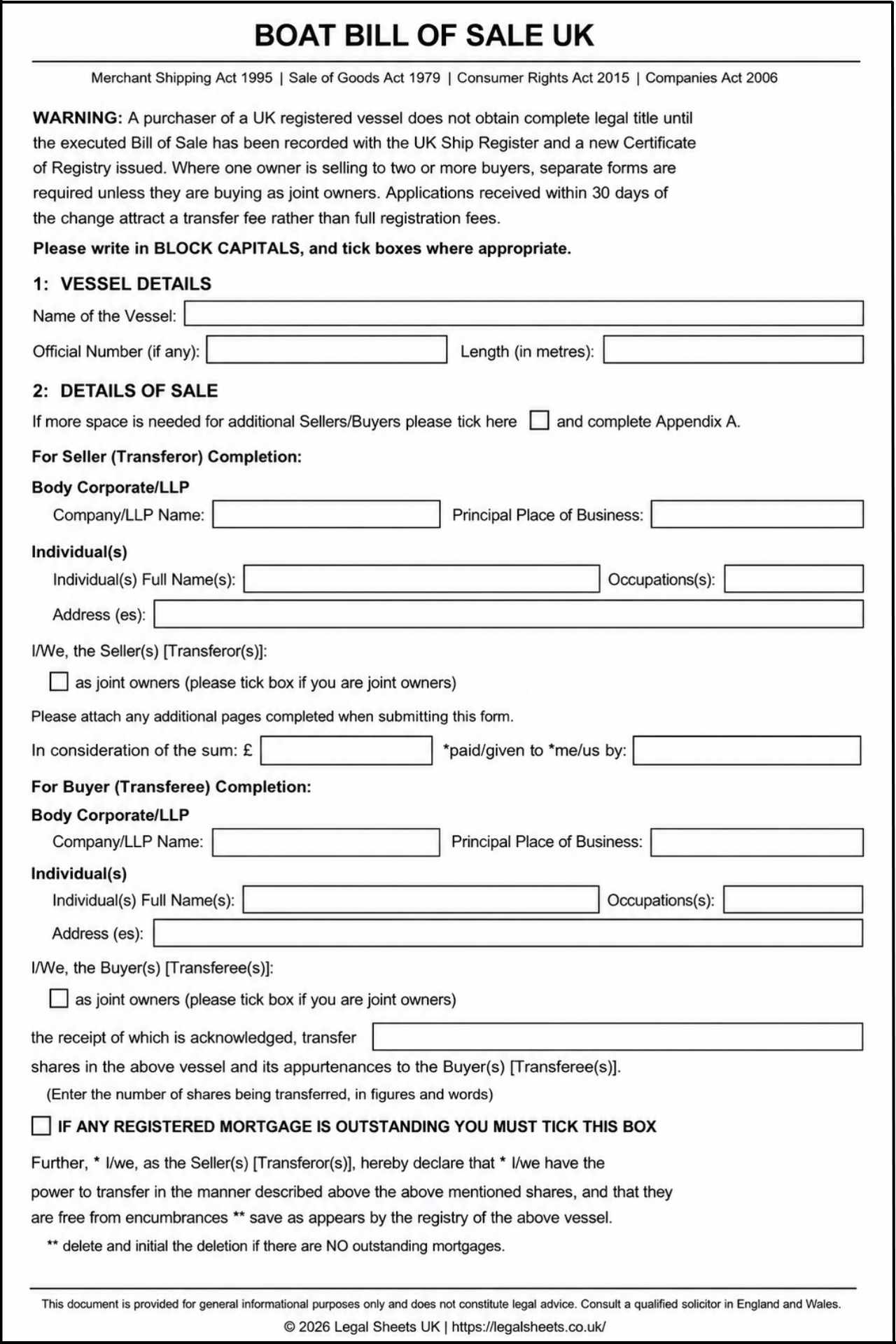
Get PDF | WORD

When a Boat Bill of Sale Is Needed

Private sale of an unregistered boat

Private sales remain one of the most common situations requiring a Boat Bill Of Sale. Although there is no statutory requirement for a particular form when selling an unregistered vessel, a written agreement provides valuable evidence if ownership is later disputed. It identifies the parties, confirms the agreed price, and records precisely which boat was transferred.

If disagreement reaches the County Court, a properly completed document is likely to carry considerably more evidential weight than relying solely on emails or verbal discussions.

Sale of a Part I registered vessel

The position changes for vessels registered on Part I of the UK Ship Register. Under the Merchant Shipping Act 1995, the property in a Part I registered vessel is legally divided into exactly 64 shares. Any transfer of these shares must be executed using the official Maritime and Coastguard Agency (MCA) form—MSF 4705—signed in the physical presence of an independent attesting witness. Relying on an ordinary contract template will cause the Registrar of Shipping to instantly reject the transfer, leaving legal title unperfected

Simply exchanging money and taking possession does not complete the registration process where statutory requirements have not been satisfied.

Boat broker transactions

Broker sales frequently create confusion because the broker may simply introduce buyer and seller rather than becoming the legal seller. Under English agency law, if a yacht broker fails to explicitly disclose in writing on the Bill of Sale that they are executing the document purely as an agent for a private vendor, they become personally liable as the contractual principal. This operational failure strips away the protection of a private sale and binds the brokerage directly to the strict consumer quality standards of the Consumer Rights Act 2015.

Transfer between family members

Family transfers are often completed without money changing hands, yet a written Boat Bill Of Sale remains valuable. It records the change of ownership, identifies the vessel accurately, and provides documentary evidence for insurers, future purchasers, or registration authorities.

Years later, ownership history may become difficult to establish if no written transfer exists.

Sale of narrowboats and inland waterway vessels

Most inland boats are transferred through private agreements rather than formal registration systems. A Boat Bill Of Sale creates a permanent ownership record that can assist when applying for new waterway licences, arranging insurance, or selling the vessel again in the future.

It also helps distinguish which fixtures, equipment, and accessories formed part of the agreed purchase.

Recording ownership for insurance and finance purposes

“Insurers and finance providers frequently request documentary evidence showing how ownership was acquired for commercial leasing. A properly completed Boat Bill Of Sale establishes the purchase date, identifies the vessel, and records the agreed consideration.

Incomplete documents can delay finance approval or insurance arrangements because ownership cannot easily be verified.

Information That Should Appear in a Boat Bill of Sale

Buyer and seller details

Record each party’s full legal name and residential address. Accurate identification reduces uncertainty if either party later needs to enforce the agreement or confirm ownership.

Boat identification details

The vessel should be described with enough detail that it cannot reasonably be mistaken for another boat. A vague description may create difficulties if ownership is later challenged.

Hull Identification Number (HIN)

The Hull Identification Number is one of the most important identifiers. Even a single incorrect character can create registration problems or confusion over the vessel being transferred.

Before signing, both parties should compare the recorded HIN against the physical marking on the hull.

Registration number

Where applicable, include the vessel’s registration number exactly as it appears on the registration documents. Any discrepancy may delay future registration updates.

Make and model

State the manufacturer’s name together with the model designation. This supports accurate identification and assists future buyers when reviewing ownership history.

Year of manufacture

Including the year of manufacture provides additional certainty, particularly where similar models were produced over several years.

Engine details

The agreement should identify the engine supplied with the boat, including any available serial numbers where appropriate. This reduces disputes about whether the original engine formed part of the sale.

Equipment included in the sale

Disagreements frequently arise over removable equipment rather than the vessel itself. List significant items included in the purchase, such as:

  • Navigation equipment
  • Anchors
  • Safety equipment
  • Covers
  • Spare propellers
  • Tender boats
  • Electronics
  • Mooring equipment

A detailed inventory is often easier than attempting to resolve disagreements after completion.

Purchase price and payment details

State the agreed purchase price together with how payment will be made. Recording whether payment has been received in full provides clarity if questions arise later.

Completion date

The completion date identifies when ownership and possession pass between the parties. This date may also become relevant for insurance, registration updates, and future ownership records.

Ownership declaration

Under the Sale of Goods Act 1979, private sellers must have the legal right to sell the vessel at the time ownership passes. Dealer sales are additionally subject to consumer protections under the Consumer Rights Act 2015.

Including an ownership declaration records the seller’s confirmation that they are entitled to transfer ownership.

Existing mortgages or marine finance

One of the most significant risks in boat purchases involves undisclosed marine mortgages. For Part I registered vessels, statutory requirements include declarations concerning registered mortgages or encumbrances.

An undischarged registered marine mortgage creates an absolute in rem claim that permanently attaches to the vessel itself, regardless of whether it is subsequently sold to an innocent buyer. If the underlying debt is defaulted upon, the lender holds the statutory right to secure an arrest warrant from the Admiralty Court, authorizing an Admiralty Marshal to physically seize, chain, and sell the boat to recover the funds.

Signatures and witnessing requirements

Execution requirements depend on the registration status of the vessel.

For Part I registered vessels, the Merchant Shipping Act 1995 requires execution by the transferor in the physical presence of an attesting witness using the prescribed statutory form.

For unregistered boats and Small Ships Register vessels, written signatures remain valuable evidence even where no equivalent statutory witnessing requirement applies.

Different Rules Depending on the Boat’s Registration Status

Part I UK Ship Register vessels

Part I registration carries the most formal transfer requirements. The prescribed statutory Bill of Sale must be completed correctly before the transfer can be recorded by the UK Ship Register. The executed document is submitted together with the required registration documentation to perfect legal title.

Errors in the prescribed form can prevent registration from being completed even if payment has already been made.

Small Ships Register (SSR) vessels

The Small Ships Register does not establish legal ownership. Following a sale, the buyer applies separately for a new SSR certificate, while the seller notifies the Maritime and Coastguard Agency of the transfer. The Boat Bill Of Sale remains a private ownership record rather than a document filed with the register.

Unregistered boats

For unregistered vessels, ownership normally transfers through ordinary contract principles supported by the written Boat Bill Of Sale. Although no statutory filing process exists, retaining signed copies provides valuable evidence if ownership is questioned in the future.

Why registration status changes the legal requirements

Many ownership problems occur because parties assume every vessel follows identical transfer procedures. Registration status determines whether statutory forms, witnessing requirements, or registration filings are necessary.

Using the wrong document for a Part I registered vessel may prevent the buyer from becoming the registered owner, whereas an unregistered boat generally relies on the private agreement itself to establish ownership history.

Completing the Boat Bill of Sale Step by Step

Gather ownership documents

Before completing the Boat Bill Of Sale, the seller should collect every document supporting ownership. This is particularly valuable where the buyer later wants to register the vessel or sell it again. Missing paperwork often causes delays long after the purchase has completed.

Verify the vessel details

Compare the Hull Identification Number (HIN), registration details, make, model, engine information, and year of manufacture against the boat itself and the supporting documents. Small errors in identifying information can create registration problems and unnecessary ownership disputes.

Check outstanding finance or marine mortgages

Where the vessel is registered on Part I of the UK Ship Register, buyers should establish whether any registered marine mortgage remains attached to the boat. Purchasing a vessel subject to an undischarged registered marine mortgage may expose the buyer to enforcement action because the security attaches to the vessel itself.

Describe the boat accurately

Avoid vague descriptions such as “used motorboat.” Include identifying information that clearly distinguishes the vessel from any similar craft. The more accurately the boat is described, the easier it becomes to establish ownership if questions arise later.

Record included equipment

List every significant item included with the sale rather than relying on assumptions. Navigation electronics, safety equipment, anchors, spare parts, tenders, and covers frequently become points of disagreement after completion when they are omitted from the agreement.

Sign the agreement correctly

Execution requirements depend upon the vessel’s registration status. Part I registered vessels require the prescribed statutory Bill of Sale executed in the presence of an attesting witness. Using an ordinary sale agreement instead of the prescribed statutory form may prevent registration of the transfer.

Keep copies for both parties

Each party should retain a signed copy together with supporting ownership documents, payment evidence, and correspondence relating to the sale. These records can become valuable evidence if ownership is challenged years later.

Documents That Should Be Collected Before Completing the Sale

Previous Bills of Sale

A continuous chain of previous Bills of Sale demonstrates how ownership has passed over time. Missing links in ownership history may create difficulties when attempting future Part I registration or obtaining marine finance.

Registration certificates

Where registration exists, the relevant certificate should match the vessel being sold and the ownership details recorded in the Boat Bill Of Sale.

Builder’s certificate

The builder’s certificate can assist in proving the vessel’s origin and early ownership history, particularly where older ownership documents are unavailable.

Marine survey reports

Although not legally required for every transaction, recent survey reports often identify structural or mechanical issues before completion. Buyers in private sales frequently rely upon independent surveys because consumer quality protections applicable to dealer sales do not automatically apply.

VAT evidence (where applicable)

Where VAT documentation exists, retaining it with the ownership records may simplify future sales and ownership verification.

Recreational Craft documentation

Under the Recreational Craft Regulations 2017, placing any applicable post-1998 watercraft on the English market without a valid statutory Declaration of Conformity and appropriate UKCA or CE hull markings is a regulatory offense. The absence of this paperwork gives the buyer an immediate civil right to rescind the transaction for illegality and demand a full refund

Service and maintenance records

Maintenance records help demonstrate how the vessel has been cared for and often support future resale by providing reassurance to prospective buyers.

UK Legal Requirements

Legal Requirements Table

Topic / Issue Precise English Legal Rule Governing Statute / Precedent
Part I Ship Transfers Property in a registered ship must be divided into 64 shares and transferred strictly via the prescribed official form (MCA MSF 4705). Merchant Shipping Act 1995 (Schedule 1), Paragraph 2
Perfecting Legal Title The completed statutory Bill of Sale must be formally filed with the Registrar of Shipping in Cardiff to establish legal title and priority over third-party claims. Merchant Shipping Act 1995 (Schedule 1), Paragraph 3
Private Vessel Sales Governed by the caveat emptor (buyer beware) principle. The seller must possess the legal right to sell, but owes no automatic duty regarding mechanical quality. Sale of Goods Act 1979 (Section 12)
Trade Marine Sales Commercial sellers and undisclosed brokers are strictly barred from using contractual terms to exclude statutory obligations of satisfactory quality. Consumer Rights Act 2015 (Section 31)
Marine Mortgage Claims Registered marine mortgages attach to the vessel’s hull in rem. The Admiralty Court can order the physical arrest and sale of the ship to satisfy outstanding debts. Merchant Shipping Act 1995 / Senior Courts Act 1981
Craft Hull Compliance Post-1998 recreational vessels must carry a valid Declaration of Conformity and UKCA/CE markings to be lawfully sold or placed on the inland market. Recreational Craft Regulations 2017

In practice, these legal requirements affect different transactions in different ways. Private buyers commonly encounter disputes over ownership history, while dealer sales are more likely to involve consumer rights relating to defects. Registration authorities may refuse to record ownership where statutory requirements for Part I vessels have not been satisfied, even if both parties intended the transfer to be effective.

Practical Legal Impact

The legal consequences usually become apparent after the sale rather than during it. Buyers often discover missing ownership documents when arranging finance, updating registration, or attempting to resell the boat. Completing the correct paperwork from the outset avoids many of these practical difficulties.

Merchant Shipping Act 1995

For Part I registered vessels, this legislation controls the statutory Bill of Sale requirements and the registration of ownership transfers.

Sale of Goods Act 1979

Private sales remain subject to the seller’s implied right to sell the vessel. Buyers should not assume the wider consumer protections available in dealer transactions apply automatically.

Consumer Rights Act 2015

Where a business sells to a consumer, statutory rights relating to satisfactory quality, fitness for purpose, and matching the description cannot be excluded through wording such as “Sold as Seen.”

Recreational Craft Regulations 2017

Compliance documentation for applicable recreational craft should accompany the vessel where required. Missing documentation can affect both resale and lawful placement on the market.

Registration requirements

Registration obligations vary according to the vessel’s registration status. Part I registered vessels require statutory registration procedures, whereas SSR and unregistered boats follow different administrative processes.

Witnessing requirements

Witnessing is mandatory for the statutory transfer of Part I registered vessels but does not apply in the same way to ordinary private transfers of unregistered boats.

Consumer protection obligations

Dealer sales carry statutory consumer protections that cannot be contracted away through restrictive wording.

Marine mortgage implications

A registered marine mortgage can remain attached to the vessel despite the sale. Buyers should investigate existing security interests before completing the transaction.

Common Clauses Included in a Boat Bill of Sale

Ownership and title

Confirms that the seller is transferring ownership of the vessel.

Purchase price

Records the agreed consideration and payment arrangements.

Included equipment

Specifies which equipment forms part of the transaction.

Condition of the vessel

Records the condition described by the parties at the time of sale.

“Sold as Seen” wording in private sales

In private consumer-to-consumer sales, ‘sold as seen’ wording successfully invokes the caveat emptor rule under the Sale of Goods Act 1979, meaning the buyer bears all risks for latent defects. However, under Section 31 of the Consumer Rights Act 2015, marine traders or brokers acting as principals are strictly prohibited from using this phrasing to exclude or restrict statutory rights of satisfactory quality and fitness for purpose.

Encumbrance declaration

States whether registered mortgages or other known encumbrances affect the vessel.

Delivery and possession

Records when possession transfers from seller to buyer.

Governing law

Confirms that the agreement is governed by the law applicable to the transaction.

Entire agreement

Clarifies that the written agreement records the complete understanding between the parties regarding the sale.

Mistakes That Frequently Cause Ownership Problems

Incorrect Hull Identification Number

A single incorrect digit may prevent future registration or create uncertainty about the vessel sold.

Missing ownership history

Incomplete chains of previous Bills of Sale often create difficulties during future registration or resale.

Failing to disclose marine finance

Undisclosed registered marine mortgages may expose buyers to enforcement against the vessel.

Omitting onboard equipment

Equipment disputes frequently arise where inventories are incomplete.

Using the wrong Bill of Sale for Part I registered vessels

Using a non-statutory document instead of the prescribed statutory form may prevent registration of ownership.

Broker signing incorrectly

A broker who fails to identify their agency role clearly may unintentionally assume liabilities associated with a dealer sale.

Missing witness where legally required

Failure to satisfy statutory witnessing requirements for Part I registered vessels may prevent successful registration.

Special Considerations for Dealer, Broker and Private Sales

Private seller transactions

Private sales generally operate on the principle of buyer beware. Independent inspections and marine surveys remain particularly valuable before completion.

Dealer sales

Business sellers remain subject to statutory consumer protection obligations relating to the quality and description of the vessel.

Yacht broker sales

The documentation should clearly identify whether the broker acts solely as an agent or as the contracting seller.

Consumer protection differences

The legal protections available to buyers differ substantially depending upon whether the seller is a private individual or a business.

Caveat emptor in private sales

County Court disputes following private sales often depend upon whether the buyer can establish a false representation rather than simply proving the boat later developed faults.

Registering the Change of Ownership

Part I registered vessels

The executed statutory Bill of Sale must be submitted to the UK Ship Register together with the required supporting documentation before the buyer becomes the registered owner.

Small Ships Register boats

The buyer applies separately for a new SSR certificate, while the seller notifies the Maritime and Coastguard Agency that ownership has changed.

Inland and unregistered boats

The Boat Bill Of Sale normally remains a private ownership document. Separate licence applications may still be required for waterways where applicable.

Filing requirements

Only certain registered vessels require formal filing with the register. Many private sales simply retain the signed agreement as evidence of ownership.

Supporting forms

Part I registration may require additional supporting documentation alongside the statutory Bill of Sale.

What Happens After the Sale

  • Transfer possession of the vessel.
  • Update insurance arrangements.
  • Notify marinas where appropriate.
  • Apply for any necessary waterway licence changes.
  • Complete registration updates where required.
  • Retain ownership records for future reference.

Common Disputes After Boat Sales

Misrepresentation claims

Disputes frequently arise where the buyer alleges inaccurate descriptions regarding ownership or condition.

Ownership disputes

Missing documentation or inconsistent ownership history often becomes apparent during resale.

Outstanding marine mortgages

Failure to identify registered security interests before purchase can have serious consequences for the buyer.

Faulty engines and hidden defects

Private buyers often encounter difficulty pursuing claims unless they can establish misrepresentation rather than ordinary wear or undisclosed defects.

Missing documents

Absent ownership records regularly delay registration, resale, and finance applications.

Registration refusals

Incorrect statutory documentation may prevent registration authorities from recording the transfer.

Equipment disagreements

Disputes commonly concern removable equipment omitted from the inventory.

Court and Enforcement Issues

County Court claims

Ownership disputes involving private boat sales, payment disagreements, or alleged misrepresentation are commonly determined in the County Court.

Admiralty Court proceedings

High-value disputes involving registered vessels, marine mortgages, and maritime ownership issues may proceed before the Admiralty Court.

Marine mortgage enforcement

Registered lenders may enforce security against the vessel where outstanding obligations remain unpaid.

In Rem arrest of vessels

Unlike many other assets, certain maritime claims may be enforced directly against the vessel itself, potentially resulting in its arrest and sale despite a later transfer of ownership.

Evidential value of the Boat Bill of Sale

A properly completed Boat Bill Of Sale provides valuable written evidence of ownership, consideration, and the terms agreed by the parties.

When a Boat Bill of Sale May Not Be Enough

Complex commercial transactions

Commercial sales often require additional contractual documentation through distributors.

High-value yachts owned in partnership

Higher-value transactions frequently involve more detailed legal documentation and due diligence.

Shared ownership transfers

Shared ownership arrangements may require additional documents identifying ownership interests.

Boats subject to marine finance

Existing finance arrangements should be addressed before ownership transfers.

International sales

Cross-border transactions often require further documentation beyond a standard Boat Bill Of Sale.

Frequently Asked Questions

Does a Boat Bill of Sale need to be witnessed?

For Part I registered vessels, the statutory Bill of Sale must be executed in the presence of an attesting witness. Other private sales do not automatically carry the same statutory witnessing requirement.

Can I sell a boat that still has a marine mortgage?

A sale may still occur, but buyers should understand that a registered marine mortgage may continue to affect the vessel if it has not been properly discharged.

Is a “Sold as Seen” clause legally effective in every boat sale?

No. While it may reflect buyer-beware principles in genuine private sales, business sellers cannot rely upon such wording to exclude statutory consumer rights under the Consumer Rights Act 2015.

What documents should I receive when buying a used boat?

Common documents include previous Bills of Sale, registration documents where applicable, maintenance records, builder’s certificate if available, Recreational Craft documentation where required, and any supporting ownership records.

Can I register a Part I vessel without the correct statutory Bill of Sale?

No. Part I registered vessels require the prescribed statutory Bill of Sale before the transfer can be recorded by the UK Ship Register.

Author

  • Eva

    Eva Gray is a content writer and editorial reviewer at LegalSheets, where she writes and fact-checks articles on UK law, contracts, and everyday legal matters. She holds both a First-class BA and an MPhil from the University of Cambridge, and has gained hands-on legal experience through internships at Stephenson Harwood, Linklaters, and O'Keefe's Solicitors. A member of the Cambridge Law Society, Eva combines academic rigour with practical legal insight to produce clear, accurate, and trustworthy content that helps readers navigate complex legal topics with confidence.

Similar Posts

Leave a Reply

Your email address will not be published. Required fields are marked *