
Parenting Plan Agreement UK – PDF & Word Template
A Parenting Plan is often prepared when separated parents want to establish clear day-to-day arrangements before disagreements become entrenched. In England, decisions affecting children are guided by the welfare principle under the Children Act 1989, so a written plan that deals with everyday issues such as school routines, holidays and communication is usually far more useful than a collection of informal messages.
Family Court judges frequently expect parents to show what attempts have been made to agree practical arrangements before seeking a Child Arrangements Order, and incomplete or ambiguous plans often become a source of further disagreement rather than a solution. The template and guidance that follow are designed to help you record those arrangements in a structured and practical format that reflects the realities of co-parenting in England.
Parenting Plan Template (PDF, Word & Printable Formats)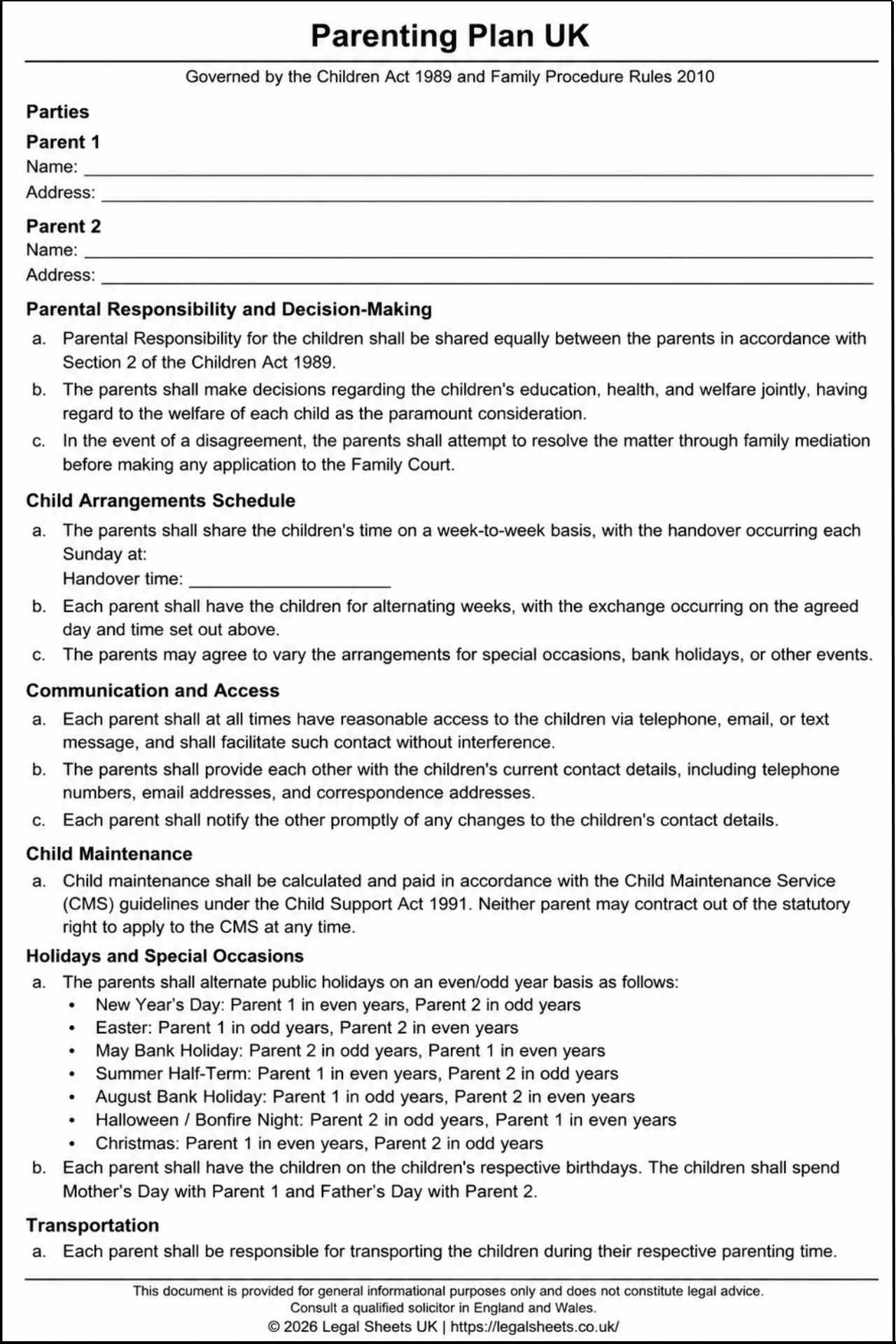
When This Template May Not Be Suitable
Although a Parenting Plan works well in many circumstances, there are situations where a simple private agreement may not provide sufficient protection.
Examples include:
- Serious safeguarding concerns.
- Domestic abuse allegations.
- High-conflict parenting relationships.
- International relocation proposals.
- Ongoing Family Court proceedings.
- Complex parental responsibility disputes.
In these situations, parents may ultimately require a Child Arrangements Order or other directions from the Family Court rather than relying solely on a private agreement.
When a Parenting Plan Is the Right Choice
Many parents wait until disagreements develop before preparing a Parenting Plan. In practice, creating one shortly after separation often prevents misunderstandings from becoming entrenched.
Separation Without Court Proceedings
Not every separation results in litigation. Many parents remain committed to working together despite ending their relationship.
A Parenting Plan allows them to establish practical routines without immediately asking the court to intervene. Because the document is voluntary, it can usually be updated more easily than formal court orders whenever circumstances change.
After Divorce or Dissolution
Even after financial matters have been resolved, parenting arrangements continue for many years.
Preparing a Parenting Plan following divorce allows parents to separate childcare discussions from financial negotiations, making future decisions more child-focused rather than relationship-focused.
Following Family Mediation
Family mediation frequently results in broad agreements that still require practical detail.
A Parenting Plan converts those discussions into a structured record covering everyday responsibilities such as school collections, extracurricular activities, healthcare appointments and holiday arrangements.
If mediation later breaks down, the existing Parenting Plan may assist the Family Court by showing the arrangements parents previously considered appropriate for their child.
Unmarried Parents Raising a Child Together
Unmarried parents increasingly choose shared parenting without marrying.
Where communication remains constructive, a Parenting Plan records practical childcare arrangements. However, unmarried fathers (not named on the birth certificate) or step-parents must recognize that a generic private plan cannot legally grant them Parental Responsibility. Under the Children Act 1989, Parental Responsibility can only be acquired via a formal Parental Responsibility Agreement (using the prescribed form C(PRA)1 strictly witnessed by a court officer) or a specific Family Court order
Parents Sharing Care Across Two Homes
Children often adapt well to living between two households when routines remain consistent.
Parents commonly include:
- Collection locations.
- Collection times.
- School responsibilities.
- Bedtime routines.
- Homework expectations.
- Sports activities.
- Contact during holidays.
Recording these details reduces uncertainty and limits unnecessary disagreements about everyday parenting.
Updating Existing Parenting Arrangements
Children’s needs rarely remain unchanged.
Starting school, changing schools, new employment, moving home or developing extracurricular commitments may all require revisions to existing parenting arrangements.
Instead of relying on outdated agreements, parents should review their Parenting Plan regularly to confirm it still reflects the child’s current routine and best interests.
What a Parenting Plan Can and Cannot Do
A common misconception is that signing a Parenting Plan creates a legally enforceable contract.
It does not.
What It Can Achieve
A well-prepared Parenting Plan can:
- Record agreed parenting arrangements.
- Promote consistent routines.
- Demonstrate cooperative parenting.
- Reduce misunderstandings.
- Support mediation discussions.
- Provide evidence of previous intentions if disputes later arise.
It can also encourage parents to discuss issues that might otherwise be overlooked, including emergency contact arrangements, communication during holidays and responsibilities for extracurricular activities.
Legal Limits You Should Understand
A Parenting Plan remains a voluntary agreement.
Under the Children Act 1989, the Family Court retains jurisdiction over child welfare and is not bound by private agreements between parents.
Similarly, parents cannot use a Parenting Plan to prevent future applications to the Child Maintenance Service or permanently remove the court’s ability to determine arrangements affecting a child’s welfare.
How It Differs from a Child Arrangements Order
One of the most significant differences concerns enforceability.
A Parenting Plan records intentions.
A Child Arrangements Order is made by the Family Court following consideration of the child’s welfare and carries legal authority.
If parents later ask the court to approve agreed arrangements, the proposed Parenting Plan may form the basis of the application, but the judge will independently consider whether making an order is better for the child than making no order at all.
When a Court Order May Be More Appropriate
Private agreements work best where communication remains cooperative.
Where parents repeatedly disagree, refuse to follow arrangements or concerns arise regarding the child’s welfare, applying for a Child Arrangements Order may become necessary. Before certain private law applications, the applicant will generally need to attend a Mediation Information and Assessment Meeting (MIAM), unless an exemption applies.
Before Completing Your Parenting Plan
Preparing a Parenting Plan is often easier when parents first agree on the child’s routine rather than attempting to resolve every disagreement at once. The most effective plans are practical, realistic and capable of adapting as family circumstances change. Rather than relying on assumptions, discuss everyday matters openly before completing the document so each section accurately reflects the child’s current needs.
Gather Essential Information
Before drafting the plan, collect information that will help create a realistic schedule, including:
- School timetables
- Nursery arrangements
- Parents’ working hours
- Medical information
- Extracurricular activities
- Existing holiday commitments
- Emergency contact details
Having this information available reduces the likelihood of overlooking important arrangements.
Focus on the Child’s Daily Routine
Children generally adapt better when familiar routines continue after separation.
Think about:
- Morning routines
- School drop-offs
- Homework time
- Bedtimes
- Meals
- Weekend activities
A Parenting Plan should support consistency wherever possible rather than requiring the child to adapt to completely different expectations in each household.
Discuss Future Changes Rather Than Past Disagreements
Many plans fail because parents spend more time recording previous arguments than future arrangements.
Instead, discuss:
- How future schedules will be reviewed.
- How unexpected events will be managed.
- How decisions affecting education or healthcare will be made.
- How new work commitments may affect parenting time.
Forward-looking discussions usually produce more workable agreements.
Decide How Future Decisions Will Be Made
Not every issue can be predicted.
Parents should agree how significant decisions will be discussed, particularly where they involve:
- School changes.
- Medical treatment.
- Religious upbringing.
- Overseas travel.
- Major extracurricular commitments.
Agreeing a decision-making process often prevents unnecessary conflict later.
Clauses Every Parenting Plan Should Include
A Parenting Plan should address the practical issues that parents are most likely to encounter. Missing details frequently become the source of future disagreements.
Child’s Details
Record:
- Full name
- Date of birth
- Home address
- School or nursery
- Medical conditions
- Emergency contacts
Living Arrangements
Clearly explain:
- Where the child normally lives.
- Overnight arrangements.
- Collection and return responsibilities.
- Handover locations.
- Changes during school holidays.
Specific wording is generally more effective than broad phrases such as “reasonable contact.”
Weekly Parenting Schedule
Include a timetable covering:
- Monday to Friday arrangements.
- Weekend care.
- Overnight stays.
- School collections.
- Alternative arrangements for shift workers if necessary.
A detailed schedule reduces uncertainty for both parents and the child.
School Holiday Arrangements
Holiday arrangements should cover:
- Summer holidays.
- Christmas.
- Easter.
- Half-term breaks.
- Bank holidays.
Many disputes arise because holiday arrangements were never agreed while term-time schedules appeared straightforward.
Christmas, Birthdays and Special Occasions
Parents frequently alternate important occasions each year.
Consider including:
- Christmas Day.
- Boxing Day.
- Birthdays.
- Mother’s Day.
- Father’s Day.
- Religious celebrations.
- Family events.
Nursery and School Decisions
State how parents will deal with:
- School applications.
- Parents’ evenings.
- School reports.
- Homework.
- School trips.
- Additional educational support.
Healthcare and Medical Treatment
Include arrangements for:
- GP appointments.
- Dental treatment.
- Hospital appointments.
- Prescriptions.
- Vaccinations.
- Emergency medical decisions.
Religion, Culture and Family Traditions
Where relevant, parents may wish to record how religious observance, language, cultural celebrations or important family traditions will continue after separation.
Extracurricular Activities
Specify responsibility for:
- Sports clubs.
- Music lessons.
- Swimming.
- School clubs.
- Transport.
- Payment arrangements.
Communication Between Parent and Child
Children often benefit from regular communication with the parent they are not staying with.
Parents may agree:
- Telephone calls.
- Video calls.
- Messaging.
- Appropriate contact during holidays.
Communication Between Parents
Agreeing suitable methods of communication can prevent unnecessary disagreements.
Examples include:
- Email.
- Text messages.
- Parenting apps.
- Telephone calls for emergencies.
Travel Within the UK and Overseas
Record expectations regarding:
- Domestic holidays.
- Foreign travel.
- Notice periods.
- Passport arrangements.
- Sharing travel details.
Taking a child out of the United Kingdom for any length of time without the explicit, real-time consent of every person holding Parental Responsibility—or a specific Family Court order—is a strict criminal offence under the Child Abduction Act 1984. A private Parenting Plan cannot legally override this statutory prohibition, even for short holidays.
Introducing New Partners
Although circumstances differ, some parents agree to discuss when new partners will be introduced to the child to avoid unnecessary conflict.
Financial Responsibilities
Parents may record practical agreements concerning:
- School uniforms.
- School trips.
- Sports equipment.
- Activity fees.
- Everyday expenses.
However, under the Child Support Act 1991, a Parenting Plan cannot prevent either parent from applying to the Child Maintenance Service.
Unexpected Events and Emergencies
Consider including procedures for:
- Illness.
- School closures.
- Severe weather.
- Family emergencies.
- Last-minute work commitments.
Planning ahead often avoids confusion during stressful situations.
Reviewing and Updating the Parenting Plan
Children’s needs naturally change.
Parents commonly review the document:
- Every six or twelve months.
- Before each school year.
- After moving home.
- Following significant employment changes.
Regular reviews help keep arrangements realistic.
Parent Signatures and Date
Although there is no statutory requirement for witnessing or executing the document as a deed, both parents should sign and date the Parenting Plan and retain identical copies as evidence of their agreed intentions.
How to Complete a Parenting Plan Step by Step
Step 1 – Record the Child’s Information
Complete all personal information accurately before discussing schedules.
Step 2 – Agree Weekly Care Arrangements
Create a practical timetable that reflects work patterns, school commitments and the child’s normal routine.
Step 3 – Plan School Holidays and Special Days
Record holiday arrangements clearly to minimise future disagreements.
Step 4 – Decide How Major Decisions Will Be Made
Agree how education, healthcare and significant life decisions will be discussed.
Step 5 – Review the Draft Together
Read every section carefully and confirm both parents understand the arrangements.
Step 6 – Sign and Keep Copies
Each parent should retain a signed copy and update the document whenever significant changes occur.
Common Parenting Plan Mistakes That Cause Future Disputes
Many disagreements begin because parents assume common sense will fill gaps in the document.
Common mistakes include:
- Using vague contact arrangements.
- Ignoring school holidays.
- Leaving collection times unclear.
- Forgetting emergency procedures.
- Attempting to prevent Child Maintenance Service claims.
- Attempting to unlawfully grant Parental Responsibility to a step-parent or partner, or drafting clauses that attempt to irrevocably ban future statutory claims through the Child Maintenance Service.
- Assuming the document is automatically enforceable.
- Never reviewing arrangements as the child grows.
These issues often become apparent only after routines begin to change.
What Happens If One Parent Stops Following the Parenting Plan?
Can the Police Enforce It?
Absolutely not. The police have zero legal authority to enforce a private Parenting Plan, and it cannot be enforced as a commercial contract in civil courts. If one parent breaches the agreed routine or refuses to return the child, law enforcement will deem it strictly a civil matter, requiring you to formally apply to the Family Court for a legally binding Child Arrangements Order.
Using the Plan as Evidence in the Family Court
If proceedings become necessary, the Parenting Plan may demonstrate the arrangements parents previously considered appropriate and provide useful evidence of the child’s established routine.
Attending a MIAM Before Court
Before applying for a Child Arrangements Order, applicants must attend a Mediation Information and Assessment Meeting (MIAM). Following stringent updates to the Family Procedure Rules, exemptions are now aggressively policed. Judges possess the explicit power to halt court proceedings and sanction parties financially (via adverse costs orders) if they refuse to engage in Non-Court Dispute Resolution (NCDR) without an airtight, evidence-backed statutory exemption.
Applying for a Child Arrangements Order
Where agreement cannot be restored, either parent may apply to the Family Court. The court will consider the child’s welfare using the statutory Welfare Checklist rather than simply enforcing the Parenting Plan.
Can a Parenting Plan Be Made Legally Enforceable?
Converting the Agreement into a Child Arrangements Order
Parents who wish their agreed arrangements to have legal effect may submit them to the Family Court as part of an application for a Child Arrangements Order.
Form C100 and the Family Court Process
To ask the court to approve agreed arrangements, parents must submit a draft Consent Order together with Form C100. Judicial approval is required before the arrangements become enforceable.
The Role of CAFCASS
Where appropriate, CAFCASS safeguarding checks and recommendations assist the court when determining whether proposed arrangements are in the child’s best interests.
The Welfare Checklist Applied by the Court
The Family Court does not simply approve every private agreement. Instead, it applies the Welfare Checklist contained within the Children Act 1989 before deciding whether a Child Arrangements Order should be made.
UK Legal Facts
Legal Requirements Table
| Topic / Issue | Precise English Legal Rule | Governing Statute / Administrative Rule |
| Legal Status & Enforceability | A private Parenting Plan is a voluntary statement of intent. It is not a legally binding contract and cannot be enforced by the police or civil courts. | Children Act 1989 (Section 1) / Common Law |
| The Welfare Principle | The Family Court will not simply “rubber stamp” a private plan into an order; it applies the statutory Welfare Checklist to ensure the terms meet the child’s best interests. | Children Act 1989 (Section 1(3)) |
| Parental Responsibility (PR) | Unmarried fathers (off the birth certificate) or step-parents cannot gain PR via a Parenting Plan; they must execute a statutory C(PRA)1 PR Agreement or obtain a court order. | Children Act 1989 (Sections 4 & 4A) |
| Mandatory MIAM & NCDR | Parents must attend a MIAM before initiating court proceedings. Judges can pause hearings and issue costs orders against parents who unreasonably refuse Non-Court Dispute Resolution. | Family Procedure Rules 2010 (Part 3) / Children and Families Act 2014 |
| International Travel (Abduction) | Taking a child abroad without the explicit consent of all PR holders or a specific court order is a criminal offence. A private plan cannot circumvent this. | Child Abduction Act 1984 (Section 1) |
| Child Maintenance Limitations | Parents cannot lawfully contract out of the statutory child support regime. Any clause attempting to permanently block CMS assessments is legally void. | Child Support Act 1991 (Section 9) |
Practical Legal Impact
A Parenting Plan is best viewed as evidence of cooperation rather than a document that overrides the court’s powers. If parents later disagree, the Family Court will consider the previous Parenting Plan alongside the child’s current circumstances before deciding whether a Child Arrangements Order is appropriate. Because the court’s focus remains the child’s welfare, arrangements that once worked well may still be altered if they no longer meet the child’s best interests.
Frequently Asked Questions
Is a Parenting Plan legally binding in England?
No. A private Parenting Plan records agreed intentions but is not automatically enforceable by the Family Court.
Can a Parenting Plan be turned into a Child Arrangements Order?
Yes. Parents may submit agreed arrangements to the Family Court for approval, although the court will only make an order if it considers this better for the child’s welfare than making no order.
Does a Parenting Plan replace child maintenance arrangements?
No. Parents cannot exclude the jurisdiction of the Child Maintenance Service through a private Parenting Plan.
Is mediation required before going to court?
In many cases, yes. Before applying for a Child Arrangements Order, an applicant is generally expected to attend a Mediation Information and Assessment Meeting unless a recognised exemption applies.
Can we change our Parenting Plan after signing it?
Yes. As the document is voluntary, parents may agree to update it whenever their child’s circumstances or family arrangements change.
What happens if one parent refuses to follow the Parenting Plan?
The Parenting Plan itself cannot usually be enforced directly. If discussions and mediation fail, either parent may apply to the Family Court for a Child Arrangements Order, where the existing Parenting Plan may be considered as evidence of previous arrangements.