
Separation Agreement UK [Free Fillable, Printable PDF]
A Separation Agreement is often prepared when a couple has decided to live apart but isn’t yet ready to finalise a divorce or dissolve every financial connection straight away. Difficulties usually arise months later, not because an agreement was signed, but because property, pensions or savings were recorded without full financial disclosure or one spouse had little opportunity to obtain independent legal advice before signing.
While the Divorce, Dissolution and Separation Act 2020 has simplified the process of obtaining a divorce, the Family Court will still look closely at the circumstances in which any earlier financial agreement was reached if financial remedy proceedings follow. If you’re separating and want to record practical arrangements for finances, property and day-to-day responsibilities, the template and completion guidance that follow are designed for that stage of the process.
Separation Agreement Template (PDF, Word & Printable Formats)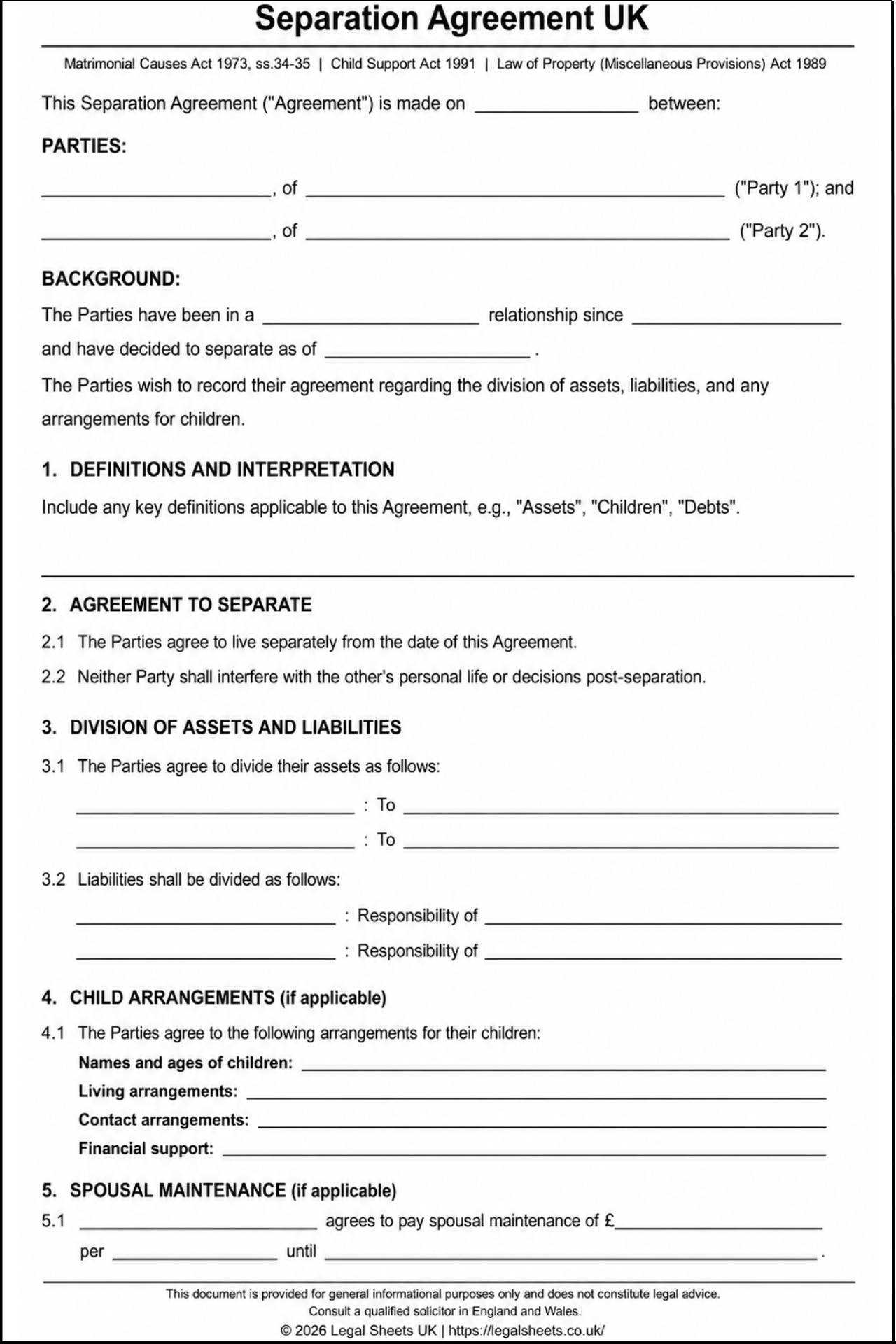
When a Separation Agreement Becomes the Right Choice
Living Apart Before Divorce Proceedings
Many couples separate long before beginning formal divorce proceedings. During this period, practical decisions cannot simply be left unresolved. Questions quickly arise regarding who remains in the family home, who pays the mortgage, how savings should be managed, and how ongoing household expenses will be divided.
A Separation Agreement allows these issues to be recorded while leaving both parties free to decide later whether divorce is appropriate.
Agreeing Financial Arrangements Without Immediate Court Action
Not every separating couple wishes to involve the court immediately.
Some prefer to negotiate privately while considering reconciliation or organising their financial affairs. A legal separation agreement enables both parties to record voluntary financial arrangements without commencing Family Court proceedings. If negotiations are conducted fairly, the agreement may later assist the court in understanding what both parties originally considered reasonable.
Managing the Family Home During Separation
Occupation of the family home frequently becomes the most difficult issue following separation.
The agreement should clearly record:
- Who remains living in the property.
- Responsibility for mortgage or rent payments.
- Utility bills and household expenses.
- Property maintenance.
- Whether the home will later be sold.
- How sale proceeds are expected to be divided.
Where ownership of the property is intended to change, additional legal formalities apply because land transfer provisions must satisfy statutory requirements.
Recording Temporary Spousal Maintenance
One spouse may agree to provide financial support while the parties remain separated.
Rather than relying upon informal conversations, the agreement should specify:
- Payment amount.
- Payment dates.
- Payment method.
- Review arrangements.
- Circumstances allowing future changes.
Clear drafting significantly reduces disagreement if payments stop before divorce proceedings begin.
Dividing Household Bills and Joint Debts
Financial responsibilities rarely end simply because the relationship has ended.
The agreement should identify responsibility for:
- Mortgage payments.
- Rent.
- Council tax.
- Utilities.
- Broadband.
- Insurance.
- Credit cards.
- Personal loans.
- Other household expenses.
Although lenders remain entitled to pursue any borrower who is legally liable for the debt, recording financial responsibilities between the parties often prevents later disputes regarding reimbursement.
Preparing for Future Divorce Proceedings
Many experienced family solicitors recommend recording financial arrangements as early as possible after separation.
A carefully drafted marital separation agreement provides useful evidence of the parties’ intentions at the time of separation. Agreements negotiated voluntarily, supported by complete financial disclosure and independent legal advice, are generally given greater weight if financial issues later reach the Family Court.
What Should a Separation Agreement Cover?
Personal Details of Each Spouse
The agreement should accurately identify each party using their full legal names, current addresses, and relevant marriage or civil partnership details.
Accurate identification reduces uncertainty if questions later arise regarding enforcement or interpretation.
Family Home and Property Arrangements
Property clauses require careful drafting because they frequently become the source of later disputes.
The agreement should explain:
- Who occupies the property.
- Mortgage responsibilities.
- Insurance obligations.
- Maintenance responsibilities.
- Future sale arrangements.
- Proposed division of sale proceeds.
If ownership itself is intended to change, those provisions must satisfy the legal requirements governing land transactions.
Savings, Investments and Bank Accounts
Every significant financial asset should be listed individually rather than grouped together.
This commonly includes:
- Current accounts.
- Savings accounts.
- ISAs.
- Investment portfolios.
- Premium Bonds.
- Shares.
- Other investments.
Detailed financial schedules attached to the agreement make later allegations of hidden assets much less likely.
Mortgage, Rent and Household Expenses
Regular household expenditure should be allocated clearly.
Typical expenses include:
- Mortgage.
- Rent.
- Council tax.
- Gas.
- Electricity.
- Water.
- Broadband.
- Insurance.
- Service charges.
Failure to define responsibility for these payments often creates avoidable disagreements within weeks of separation.
Spousal Maintenance Arrangements
Where maintenance payments are agreed, the document should record:
- Amount payable.
- Payment frequency.
- Payment method.
- Review provisions.
- Circumstances allowing future amendment.
Clear wording reduces uncertainty if either party later believes the arrangements should change.
Pensions and Future Pension Sharing Expectations
Pensions are frequently misunderstood during separation.
A separation contract may record both parties’ expectations regarding future pension sharing, but it cannot itself require a pension provider to divide pension benefits. Pension sharing can only take effect following an appropriate Family Court order during divorce proceedings.
Debts and Financial Liabilities
Liabilities deserve the same attention as assets.
The agreement should identify:
- Personal loans.
- Credit cards.
- Overdrafts.
- Vehicle finance.
- Tax liabilities.
- Joint borrowing.
Ignoring debts often causes greater problems than overlooking assets because creditors remain entitled to pursue repayment.
Personal Possessions and Vehicles
Valuable personal belongings should be identified individually wherever ownership could later become disputed.
Examples include:
- Motor vehicles.
- Jewellery.
- Furniture.
- Family heirlooms.
- Antiques.
- Electronic equipment.
- Collectables.
Specific descriptions provide much greater certainty than general references to personal belongings.
Child Arrangements and Financial Responsibilities
Parents may include practical arrangements regarding children’s daily care, education, holidays, and living arrangements.
However, child maintenance occupies a separate legal position. Parents cannot permanently remove the statutory right to apply for child maintenance through private contractual wording. Any clause attempting to prevent future child maintenance claims will not be legally enforceable.
Reviewing or Replacing the Agreement
Financial circumstances often change during a lengthy separation.
Employment, income, property ownership, pensions, and family needs may all develop before divorce proceedings begin. Reviewing the agreement whenever significant financial changes occur produces a more accurate document than relying on arrangements that no longer reflect reality.
Drafting Requirements That Matter Most
Why Full Financial Disclosure Is Essential
Complete financial disclosure is one of the strongest indicators that a Separation Agreement was negotiated fairly.
Both parties should exchange accurate information regarding:
- Income.
- Property.
- Savings.
- Investments.
- Pensions.
- Debts.
- Other valuable assets.
Attaching detailed financial schedules demonstrates exactly what information was available when the agreement was signed. Where valuable assets have been deliberately concealed, the agreement becomes significantly more vulnerable to later challenge.
Independent Legal Advice Before Signing
Although independent legal advice is not a statutory requirement, it remains one of the strongest safeguards available to separating couples.
Separate legal advice provides evidence that both parties understood the legal consequences of the agreement before signing. Without that protection, allegations of misunderstanding, undue influence, or unfair pressure become considerably easier to raise if the agreement is later challenged.
When the Agreement Should Be Executed as a Deed
Some Separation Agreements operate effectively as ordinary contracts.
However, where property rights are transferred or contractual consideration is absent, execution as a deed is generally appropriate. This requires compliance with the statutory formalities governing deeds, including independent witnessing of each signature.
Property Transfer Clauses Must Be Properly Drafted
Where the agreement includes provisions transferring ownership of land, those clauses require particular care.
Incomplete drafting, missing signatures, or failure to include all agreed terms within one written document may leave the property provisions legally unenforceable, creating significant complications if one party later refuses to complete the transfer.
Why the Agreement Cannot Create a Permanent Clean Break
One of the most common misunderstandings is that signing a Separation Agreement permanently prevents future financial claims.
That is not the legal position in England.
Under Sections 23, 24 and 25A of the Matrimonial Causes Act 1973, a private Separation Agreement cannot legally oust the Family Court’s jurisdiction.